St. Peter the Professor gives us a master’s mini-class on biblical interpretation and preaching in Acts 3.
Among the strings of names and titles for Jesus, such as Holy and Righteous One and the Author of life, he also twice calls him God's “servant” (vv. 13, 26). Why this one?
Peter hasn't just picked a random title from a nearby messianic thesaurus. He chose “servant” because he's preaching Jesus through the lens of Isaiah’s Servant Songs, especially Isaiah 52–53.
Here’s how this works.
Peter begins, “The God of Abraham, the God of Isaac, and the God of Jacob…has glorified [δοξάζω] his servant Jesus” (Acts 3:13). That language echoes Isaiah 52:13: “Behold, my servant shall act wisely; he shall be high and lifted up, and shall be exalted.” In the Greek translation of the OT, the verb for "glorified," δοξάζω (doxazo), is the exact word used by Peter in Acts 3.
He goes on to say that Jesus was “delivered over [παραδίδωμι]” (Acts 3:13). Again, this echoes Isaiah 53, where the suffering servant is handed over to suffering and death: “The LORD has laid on him the iniquity of us all” (Isa. 53:6). And “He poured out his soul to death” (Isa. 53:12). Again, in the Greek translation of the OT, the same verb that Peter uses for "handed over," παραδίδωμι, is used twice in Isaiah 53:12.
Peter also calls Jesus “the Holy and Righteous One” (Acts 3:14), language that resonates with Isaiah 53:11, where the servant is called “the righteous one.”
Notice, too, how Peter frames the entire sermon in the covenant promises that God made to the patriarchs in Genesis (Acts 3:13, 25).
In other words, Peter is proclaiming that the entire symphony of the Old Testament reaches its crescendo in Jesus.
He is the promised seed of Abraham, the holy and righteous one, the suffering servant, the one handed over unto death, and the one through whom blessing comes to the nations.
In short, Peter shows us how to read, interpret, and preach Christ from the OT.
Go and do likewise.
______
We read Acts 3 today in Bible in One Year. https://t.co/XxNvEtNH7e
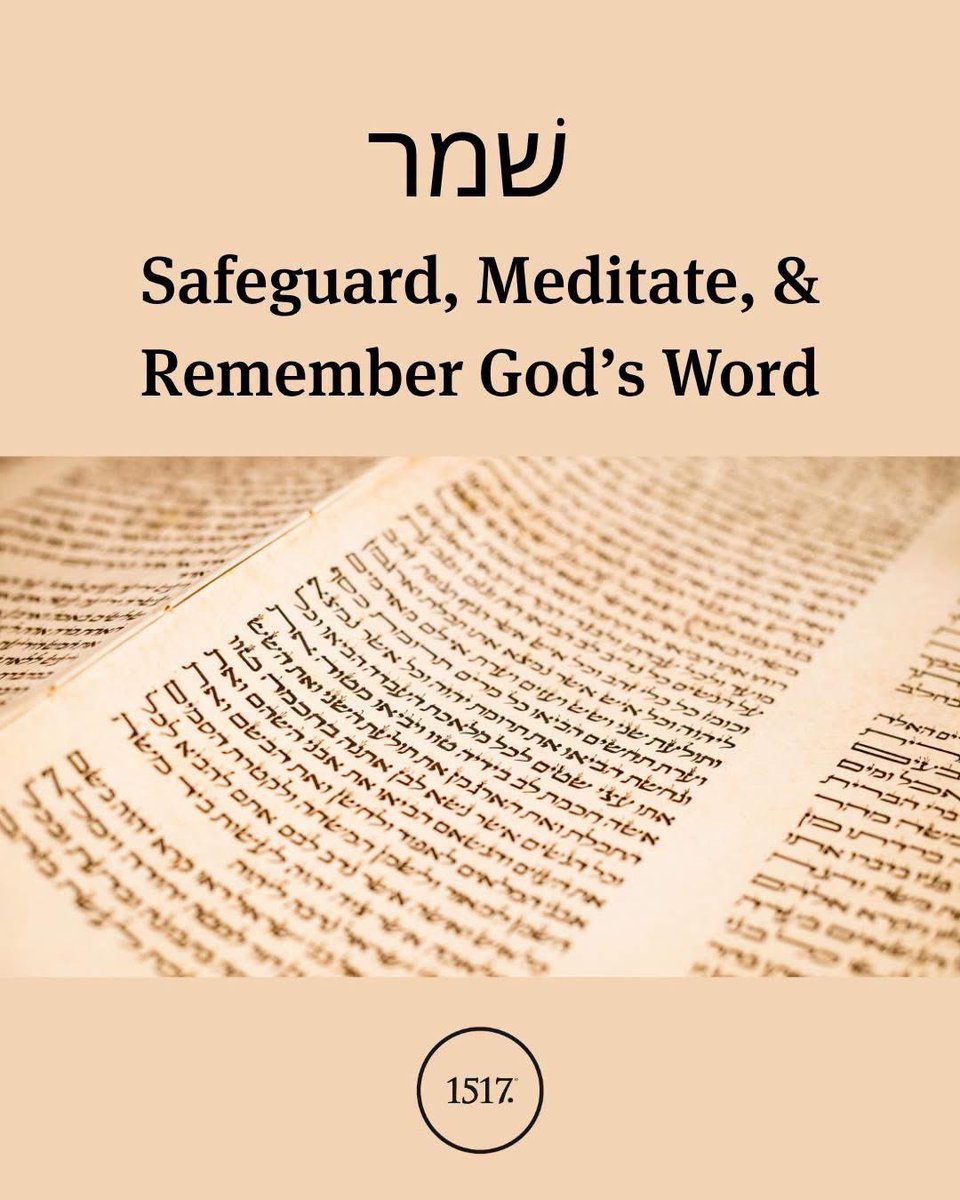
When Hebrew words dress in English clothing, they do not always wear the same outfit.
A single Hebrew verb can "wear" a wide range of meanings depending on the context, so translators cannot always use the same English word every time it appears. They need a large lexical closet.
Today in Bible in One Year, we read Deuteronomy 4–6. Most English readers would never guess that one particular Hebrew verb occurs eighteen times in those three chapters because translators render it in various ways: “keep,” “take care,” “watch,” “be careful,” and “observe.”
The verb is שׁמר (shamar).
I do not want to play fast and loose with the language, but as a teaching tool, let me align the three consonants of shamar (S-M-R) with three English words to help us unpack the heart of what this verb means, especially in relation to God’s word: Safeguard, Meditate, and Remember.
First, safeguard. Shamar does not merely mean “obey.” It means guard, protect, treasure, and watch over. Treat God’s words like a precious inheritance placed into your care.
Second, meditate. Let those words sink deep into your soul. Speak them. Rehearse them. Teach them to your children. Ponder them day and night. Deuteronomy 6 is saturated with this idea.
Third, remember. You can't shamar something that you have forgotten, so Deuteronomy is obsessed with memory. Again and again, Moses warns Israel: “Do not forget.” Do not forget the Lord, his salvation, his commandments, or who you are as his covenant people.
I've shared this prayer before, but it is a fitting way of explaining what it means to shamar the Word of God by devouring and digesting it, and letting that Word become part of what you are and what you do.
“Blessed Lord, who hast caused all holy Scriptures to be written for our learning: Grant that we may in such wise hear them, read, mark, learn, and inwardly digest them, that by patience and comfort of thy holy Word, we may embrace and ever hold fast the blessed hope of everlasting life, which thou hast given us in our Saviour Jesus Christ; who liveth and reigneth with thee and the Holy Spirit, one God, for ever and ever. Amen.”
"Kissing the bride through the veil." That's how one of my professors at Hebrew Union College vividly described reading the Bible in translation. A kiss is a kiss, to be sure, but skin on skin is always preferable.
That's why anytime we can "kiss" the Hebrew, Aramaic, or Greek of the original text, well, pucker up. Often, the original has connotations that are difficult, if not impossible, to get across fully in translation.
One of the verses we read today in Bible in One Year is like that: “Only let your manner of life be worthy of the gospel of Christ…” (Philippians 1:27).
That translation is accurate, but it can come across in English as if Paul were merely saying, “Behave yourselves,” or “Try to live a decent life.”
But the Greek word Paul uses carries far more cultural and political weight than “conduct yourselves” or “let your manner of life.”
The verb is πολιτεύομαι (politeuomai). If you have a hunch, based on the "polit-" beginning, that it has something to do with politics or political life, you're not wrong.
πολιτεύομαι is the language of citizenship, public identity, civic loyalty, and belonging to a kingdom. A more literal rendering would sound something like this: “Live as citizens worthy of the gospel of Christ.”
That matters enormously because Paul is writing to the church in Philippi, a city nicknamed “little Rome.” Roman citizenship was treasured. It was a badge of pride and allegiance. Your citizenship shaped how you understood your place in the world.
The townspeople would πολιτεύομαι in this way: “living as citizens worthy of Rome.”
Paul takes that familiar civic language and turns it upside down.
In essence, he says, “Yes, you live in a Roman colony. But Rome is not your true homeland.” As he says later in the letter, “Our citizenship is in heaven” (Phil. 3:20).
That does not mean Christians abandon earthly responsibilities. It means that beneath every earthly identity is a more fundamental one. We belong first to the kingdom of God, to Christ our King.
Paul’s point in Philippians 1:27 is not simply behavioral: “Be good people.”
It is: “Live like the citizens of heaven that you already are by virtue of Christ your King.”
Christians, we can't expect to grow in holiness if we spend hours on social media and several seconds in prayer every day.
What you do will actively shape your heart and mind.
“The very worst sin that’s ever been committed was the murder of the Son of God. The very best thing that’s ever happened on this planet was the death of the Son of God. And if God can make the worst thing the best thing, He can make your disappointment, even your sin, even your foolishness, work together for good.”
– Stuart Olyott
Why is spending time in God’s Word so essential?
The Reformers often spoke of a triangle consisting of Scripture, meditation, and prayer.
In Scripture, God speaks to us. As the church, and personally.
Through meditation, we ponder, apply, and press God’s truth into our hearts.
In prayer, we respond to God with worship, confession, thanksgiving, and dependence.
Remove any side of the triangle and spiritual growth suffers. Reading without meditation can remain superficial. Meditation without prayer becomes self-focused. Prayer without Scripture can become detached from God’s voice.
The goal of daily time with God is not merely acquiring information. It is communion and intimacy with Christ.
--
Join me and 150+ others as we pray and journal through the Psalms this summer. We start tommorrow in Psalm 1.
https://t.co/ykSxgyX5zF
𝗣𝗿𝗼𝗽𝗵𝗲𝘁: “Behold, something greater than Jonah is here” (Matt 12:41).
𝗣𝗿𝗶𝗲𝘀𝘁: “But I say to you that something greater than the temple is here” (Matt 12:6).
𝗞𝗶𝗻𝗴: “Behold, something greater than Solomon is here” (Matt 12:42).
When people complain to God, he does not always put his arm around them and comfort them. Sometimes he gives them a swift kick in the pants.
To Job, he says, “Dress for action like a man” (Job 38:3). After the prophet Jeremiah has been whining about the prosperity of the wicked, the Lord says, “If you have raced with men on foot, and they have wearied you, how will you compete with horses?” (Jer. 12:5).
In other words, Jeremiah, if you are already worn out by this level of opposition, what are you going to do when things really heat up? If you are moaning and groaning about the burden you have to carry now, how will you handle it when the road gets steeper, and the cross gets heavier?
Do you want to run with horses or shuffle with sloths?
The same question confronts us. If we are constantly grumbling over small inconveniences, small sufferings, small acts of obedience, how will we endure when true trials come? How will we follow Jesus down the hard road of costly discipleship?
Yes, there are many times when we need the Lord to put his arm around us, bind up our wounds, and speak tenderly to us. And he does. But there are also times when we need him to shake us awake, get in our face, and rebuke our spiritual laziness and self-pity. And he does that, too.
Do we want easy, spiritually apathetic lives? Or do we want the long, difficult, but deeply blessed life of running with horses on the path Christ has set before us?
So let us hear the exhortation: “Let us also lay aside every weight, and sin which clings so closely, and let us run with endurance [run with horses!] the race that is set before us” (Heb. 12:1).
____
We read Jeremiah 12 today in Bible in One Year. Join us at https://t.co/XxNvEtNH7e
Man, this is beautiful. A life adorning the gospel.
Listen to what @StevenBartlett—host of one of the world’s most popular podcasts—says to Christian apologist John Lennox.
Blink and you will miss some masterful biblical interpretation and preaching in 1 Corinthians 1. Paul the Apostle is also Professor Paul the Bible Teacher.
Paul exemplifies how Jewish interpretation often worked. At the end of 1 Corinthians 1, he quotes a little section of Jeremiah 9:24, “Let the one who boasts, boast in the Lord.” It can seem like almost a throwaway line, a kind of proverbial truth.
But, no. That little quote is an outstretched hand, fingers beckoning us, inviting us to walk backward to Jeremiah 9 and the surrounding verses.
See how Paul echoes and expands what Jeremiah says:
Jeremiah: Let not the wise man boast in his wisdom (9:23).
Paul: God chose what is foolish in the world to shame the wise (1:27).
Jeremiah: Let not the mighty man boast in his might (9:23).
Paul: God chose what is weak in the world to shame the strong (1:27).
Jeremiah: Let not the rich man boast in his riches (9:23).
Paul: God chose what is low and despised in the world (1:28).
Jeremiah: I am the LORD who practices steadfast love, justice, and righteousness (9:24).
Paul: Christ Jesus became to us wisdom from God, righteousness, sanctification, and redemption (1:30).
Finally, having mirrored Jeremiah point by point (without ever telling us), Paul concludes by finally explicitly quoting the prophet, “As it is written, ‘Let the one who boasts, boast in the Lord'” (1 Cor. 1:31).
It’s easy to miss what Paul has done, but not if you know Jeremiah 9. And even if you didn’t know Jeremiah 9, Paul’s quote from that chapter should send us running back to the broader context.
When we do, we see that the apostle has been interpreting and preaching on the Old Testament, using Jeremiah as the basis for preaching the cross of our Lord Jesus.
____
We read Jeremiah 9 today in Bible in One Year. Join us at https://t.co/XxNvEtNH7e
God does not forgive you BECAUSE you repent, confess, and believe.
Must you repent? Yes. Must you confess? Yes. Must you believe? Of course. But none of those are the reason you are forgiven.
Think of it this way. If you are sick, should you go to the doctor, tell him your symptoms, and fill the prescription? Of course, but none of those will bring you healing. The healing comes *because* of the medicine.
Jesus is the divine medicine. He and he alone is “the because” of our forgiveness. He is The Reason God justifies us.
There is a widespread confusion about this in the church. It’s partly based on a misunderstanding of 1 John 1:9, “If we confess our sins, he is faithful and just to forgive us our sins and to cleanse us from all unrighteousness.”
This is true, of course, just as we might say, “If we go to the doctor and tell him our issues, he is responsible and qualified to heal us of our ailments.” How does he “heal” us? By giving us medicine. How does God forgive us? John tells us three verses later, “Jesus is the propitiation for our sins, and not for ours only but also for the sins of the whole world’ (2:2).
But people often believe and speak as if a mannequin full of their repentance, confession, and faith is on the cross. Don't put your faith in your faith, your faith in your confession, or your faith in your repentance.
Your repentance was not crucified for you.
Your confession did not die for you.
Your faith did not rise from the grave.
Jesus, and Jesus alone, lived, died, and rose again for you.
When God the Father forgives us, he forgives us as people who repent, confess, and believe. But it is not our repentance, our confession, or our faith, that is our salvation.
Christ, and Christ alone, is our salvation. Forgiveness is based 100% upon the atoning work of Jesus Christ. His atonement is enough. His sacrifice was perfectly sincere.
His blood covers not only the sin of which you repent but also your imperfect repentance for that sin, your less-than-100%-honest confession, and your lackluster faith.
Our hope is built on nothing less—and nothing more—than Jesus’ blood and righteousness alone.
Hosea and Hebrew Repentance, Hosea 14. Dive into the Bible in One year series at https://t.co/Yrg5F0EFv5 for the reading guide and to catch up on previous posts. #BibleInOneYear#BibleStudy
“Philippians 2 therefore gives no basis for positing a change in the Son's exercise of certain divine perfections or in his divine lordship.
After all, divine omniscience, divine omnipotence, divine providence, and so forth do not have an on-off switch.”
- Steven Duby
ProTip: Read @pj_schreiner’s helpful works on Matthew, including how Matthew uses “righteousness,” before preaching it:
“Jesus fulfilling all righteousness means Jesus brings righteousness (eschatologically) by performing righteousness (ethically) in order to pardon all unrighteousness and credit righteousness (imputationally).
… As the common trope goes, Matthew and Paul employ ‘righteousness’ in very different ways. In Matthew it is an ethical demand, in Paul it is a gift of God.
Yet I think we have exaggerated the differences; their views are complementary. Matthew and Paul sing in the same choir, even though they sometimes sing in different registers.”





![birdchadlouis's tweet photo. St. Peter the Professor gives us a master’s mini-class on biblical interpretation and preaching in Acts 3.
Among the strings of names and titles for Jesus, such as Holy and Righteous One and the Author of life, he also twice calls him God's “servant” (vv. 13, 26). Why this one?
Peter hasn't just picked a random title from a nearby messianic thesaurus. He chose “servant” because he's preaching Jesus through the lens of Isaiah’s Servant Songs, especially Isaiah 52–53.
Here’s how this works.
Peter begins, “The God of Abraham, the God of Isaac, and the God of Jacob…has glorified [δοξάζω] his servant Jesus” (Acts 3:13). That language echoes Isaiah 52:13: “Behold, my servant shall act wisely; he shall be high and lifted up, and shall be exalted.” In the Greek translation of the OT, the verb for "glorified," δοξάζω (doxazo), is the exact word used by Peter in Acts 3.
He goes on to say that Jesus was “delivered over [παραδίδωμι]” (Acts 3:13). Again, this echoes Isaiah 53, where the suffering servant is handed over to suffering and death: “The LORD has laid on him the iniquity of us all” (Isa. 53:6). And “He poured out his soul to death” (Isa. 53:12). Again, in the Greek translation of the OT, the same verb that Peter uses for "handed over," παραδίδωμι, is used twice in Isaiah 53:12.
Peter also calls Jesus “the Holy and Righteous One” (Acts 3:14), language that resonates with Isaiah 53:11, where the servant is called “the righteous one.”
Notice, too, how Peter frames the entire sermon in the covenant promises that God made to the patriarchs in Genesis (Acts 3:13, 25).
In other words, Peter is proclaiming that the entire symphony of the Old Testament reaches its crescendo in Jesus.
He is the promised seed of Abraham, the holy and righteous one, the suffering servant, the one handed over unto death, and the one through whom blessing comes to the nations.
In short, Peter shows us how to read, interpret, and preach Christ from the OT.
Go and do likewise.
______
We read Acts 3 today in Bible in One Year. https://t.co/XxNvEtNH7e](https://pbs.twimg.com/media/HMDnLfUXIAAfomP.jpg)


![birdchadlouis's tweet photo. When people complain to God, he does not always put his arm around them and comfort them. Sometimes he gives them a swift kick in the pants.
To Job, he says, “Dress for action like a man” (Job 38:3). After the prophet Jeremiah has been whining about the prosperity of the wicked, the Lord says, “If you have raced with men on foot, and they have wearied you, how will you compete with horses?” (Jer. 12:5).
In other words, Jeremiah, if you are already worn out by this level of opposition, what are you going to do when things really heat up? If you are moaning and groaning about the burden you have to carry now, how will you handle it when the road gets steeper, and the cross gets heavier?
Do you want to run with horses or shuffle with sloths?
The same question confronts us. If we are constantly grumbling over small inconveniences, small sufferings, small acts of obedience, how will we endure when true trials come? How will we follow Jesus down the hard road of costly discipleship?
Yes, there are many times when we need the Lord to put his arm around us, bind up our wounds, and speak tenderly to us. And he does. But there are also times when we need him to shake us awake, get in our face, and rebuke our spiritual laziness and self-pity. And he does that, too.
Do we want easy, spiritually apathetic lives? Or do we want the long, difficult, but deeply blessed life of running with horses on the path Christ has set before us?
So let us hear the exhortation: “Let us also lay aside every weight, and sin which clings so closely, and let us run with endurance [run with horses!] the race that is set before us” (Heb. 12:1).
____
We read Jeremiah 12 today in Bible in One Year. Join us at https://t.co/XxNvEtNH7e](https://pbs.twimg.com/media/HKXbzteX0AAY3Dw.jpg)


