''I'm an extreme moderate, Mr. Routledge. I believe anybody not in favor of moderation and compromise ought to be castrated...'' - Ben Franklin (John Adams, HBO)
A new standard is emerging in public life: civil society organisations must now answer for the policy frameworks their white papers and advocacy have influenced. Immigration policy is the first arena where this principle is being tested. It is a curious state of affairs that those who most vigorously champion accountability for others so often prove resistant to it themselves.
For decades, civil society has positioned itself as the moral conscience of the state; producing white papers, drafting model legislation, mobilising public opinion, and exerting enormous influence over the legislative and executive branches of government. In the realm of immigration, this influence has been particularly profound. Advocacy groups have shaped everything from visa regimes and asylum procedures to border enforcement and integration policies, often with little scrutiny of their own methodologies, funding sources, or ideological commitments. Their recommendations have been adopted as policy, their language has been codified into law, and their worldview has come to define the parameters of public debate.
Yet this influence has rarely been matched by accountability. Civil society organisations routinely demand transparency from government, insist on data-driven decision-making, call for impact assessments, and subject public officials to rigorous oversight. But when asked to apply the same standards to themselves, to disclose their donors, to evaluate the real-world consequences of their proposals, to acknowledge unintended harms, or to accept that their advocacy may have contributed to policy failures, they retreat behind claims of moral authority or dismiss criticism as politically motivated. In doing so, they have created a privileged class of unelected actors who shape policy without being shaped by it.
That era is now ending. Governments, legislatures, and the public are beginning to ask uncomfortable questions: Who funds these organisations? What evidence underpins their proposals? What were the outcomes of their previous advocacy? In the case of immigration, the stakes are particularly high, because policy failures have real human consequences; backlogs, deportations, labour exploitation, social tensions, and the erosion of public trust in institutions. When civil society's prescriptions prove inadequate or counterproductive, it cannot simply disclaim responsibility and move on to the next campaign.
The emerging accountability standard is not about silencing civil society or curtailing its legitimate role in democratic deliberation. It is about recognising that influence entails responsibility, that advocacy is not a free pass from scrutiny, and that those who shape policy must also be prepared to answer for its outcomes. Immigration is merely the first domain where this principle is being enforced. The same logic will inevitably extend to other areas, such as health, education, climate, and economic policy, where civil society has similarly inserted itself into the policymaking process.
This is not a partisan issue, nor is it an attack on civil society as such. It is a matter of democratic hygiene: no actor in a democratic system should wield power without accountability. Civil society has long demanded that governments be transparent, responsive, and evidence-based. It is only fitting that the same standards now be applied to civil society itself. The era of unilateral moral authority is over; the era of mutual accountability has begun.
A new standard is emerging in public life: civil society organisations must now answer for the policy frameworks their white papers and advocacy have influenced. Immigration policy is the first arena where this principle is being tested. It is a curious state of affairs that those who most vigorously champion accountability for others so often prove resistant to it themselves.
For decades, civil society has positioned itself as the moral conscience of the state; producing white papers, drafting model legislation, mobilising public opinion, and exerting enormous influence over the legislative and executive branches of government. In the realm of immigration, this influence has been particularly profound. Advocacy groups have shaped everything from visa regimes and asylum procedures to border enforcement and integration policies, often with little scrutiny of their own methodologies, funding sources, or ideological commitments. Their recommendations have been adopted as policy, their language has been codified into law, and their worldview has come to define the parameters of public debate.
Yet this influence has rarely been matched by accountability. Civil society organisations routinely demand transparency from government, insist on data-driven decision-making, call for impact assessments, and subject public officials to rigorous oversight. But when asked to apply the same standards to themselves, to disclose their donors, to evaluate the real-world consequences of their proposals, to acknowledge unintended harms, or to accept that their advocacy may have contributed to policy failures, they retreat behind claims of moral authority or dismiss criticism as politically motivated. In doing so, they have created a privileged class of unelected actors who shape policy without being shaped by it.
That era is now ending. Governments, legislatures, and the public are beginning to ask uncomfortable questions: Who funds these organisations? What evidence underpins their proposals? What were the outcomes of their previous advocacy? In the case of immigration, the stakes are particularly high, because policy failures have real human consequences; backlogs, deportations, labour exploitation, social tensions, and the erosion of public trust in institutions. When civil society's prescriptions prove inadequate or counterproductive, it cannot simply disclaim responsibility and move on to the next campaign.
The emerging accountability standard is not about silencing civil society or curtailing its legitimate role in democratic deliberation. It is about recognising that influence entails responsibility, that advocacy is not a free pass from scrutiny, and that those who shape policy must also be prepared to answer for its outcomes. Immigration is merely the first domain where this principle is being enforced. The same logic will inevitably extend to other areas, such as health, education, climate, and economic policy, where civil society has similarly inserted itself into the policymaking process.
This is not a partisan issue, nor is it an attack on civil society as such. It is a matter of democratic hygiene: no actor in a democratic system should wield power without accountability. Civil society has long demanded that governments be transparent, responsive, and evidence-based. It is only fitting that the same standards now be applied to civil society itself. The era of unilateral moral authority is over; the era of mutual accountability has begun.
The problem with liberals is that they treat compromise not as a meeting point, but as a concession to be extracted. To them, every ground you give is not a settlement; it is a starting point for the next demand.
You concede on gay marriage. It is not enough. You concede on abortion. It is not enough. You concede on immigration, on gender, on language, on history itself; and still, it is not enough. There is no final destination. There is only an endless horizon of further demands, each one framed as a moral imperative, each one requiring just one more sacrifice.
They do not want consensus. They want capitulation. And they will never admit it; because to admit it would be to reveal that compromise was never their goal.
They have no respect for cultures, traditions, or where societies are in their evolution. They do not see difference as something to be understood; only something to be overwritten. They do not ask why a people hold certain beliefs. They simply declare those beliefs obsolete and demand their surrender. There is no humility. There is no patience. There is only the relentless, self-righteous march of their own moral certainty; indifferent to the societies they claim to save.
South Africa is better than every other African country on these issues. On gay rights, on gender equality, on legal protections, on institutional progress; we lead. But it is still not enough. They do not acknowledge how far we have come. They do not respect our pace, our context, or our choices. They only measure us against their own ideal and find us perpetually wanting. No matter how much we concede, they always want more. And they always will.
The danger of this approach is that once there is pushback against one issue, there is a chance of a review against the others that have already been won. The victories are fragile. They are not settled; they are only tolerated. And the moment society pushes back on the latest demand, the entire edifice becomes vulnerable. The gains that were supposedly permanent are suddenly subject to reconsideration. The liberal approach does not secure progress; it risks its wholesale collapse by demanding too much, too fast, with no regard for the society it is reshaping.
The problem with liberals is that they treat compromise not as a meeting point, but as a concession to be extracted. To them, every ground you give is not a settlement; it is a starting point for the next demand.
You concede on gay marriage. It is not enough. You concede on abortion. It is not enough. You concede on immigration, on gender, on language, on history itself; and still, it is not enough. There is no final destination. There is only an endless horizon of further demands, each one framed as a moral imperative, each one requiring just one more sacrifice.
They do not want consensus. They want capitulation. And they will never admit it; because to admit it would be to reveal that compromise was never their goal.
They have no respect for cultures, traditions, or where societies are in their evolution. They do not see difference as something to be understood; only something to be overwritten. They do not ask why a people hold certain beliefs. They simply declare those beliefs obsolete and demand their surrender. There is no humility. There is no patience. There is only the relentless, self-righteous march of their own moral certainty; indifferent to the societies they claim to save.
South Africa is better than every other African country on these issues. On gay rights, on gender equality, on legal protections, on institutional progress; we lead. But it is still not enough. They do not acknowledge how far we have come. They do not respect our pace, our context, or our choices. They only measure us against their own ideal and find us perpetually wanting. No matter how much we concede, they always want more. And they always will.
The danger of this approach is that once there is pushback against one issue, there is a chance of a review against the others that have already been won. The victories are fragile. They are not settled; they are only tolerated. And the moment society pushes back on the latest demand, the entire edifice becomes vulnerable. The gains that were supposedly permanent are suddenly subject to reconsideration. The liberal approach does not secure progress; it risks its wholesale collapse by demanding too much, too fast, with no regard for the society it is reshaping.
South Africa stands at a crossroads defined by a fundamental misallocation; not just of capital, but of sovereign attention, institutional energy, and national purpose. For too long, the country has operated under an unspoken assumption inherited from mid-20th-century developmental thinking: that true sovereignty is demonstrated through direct state ownership and hands-on operation of strategic economic assets. This belief has led to a state that formally controls an immense portfolio, electricity generation and transmission, freight rail and ports, pipelines, airlines, telecommunications infrastructure, and more, yet finds itself unable to make much of it work reliably or efficiently. The result is not enhanced national power but a profound vulnerability masquerading as ambition.
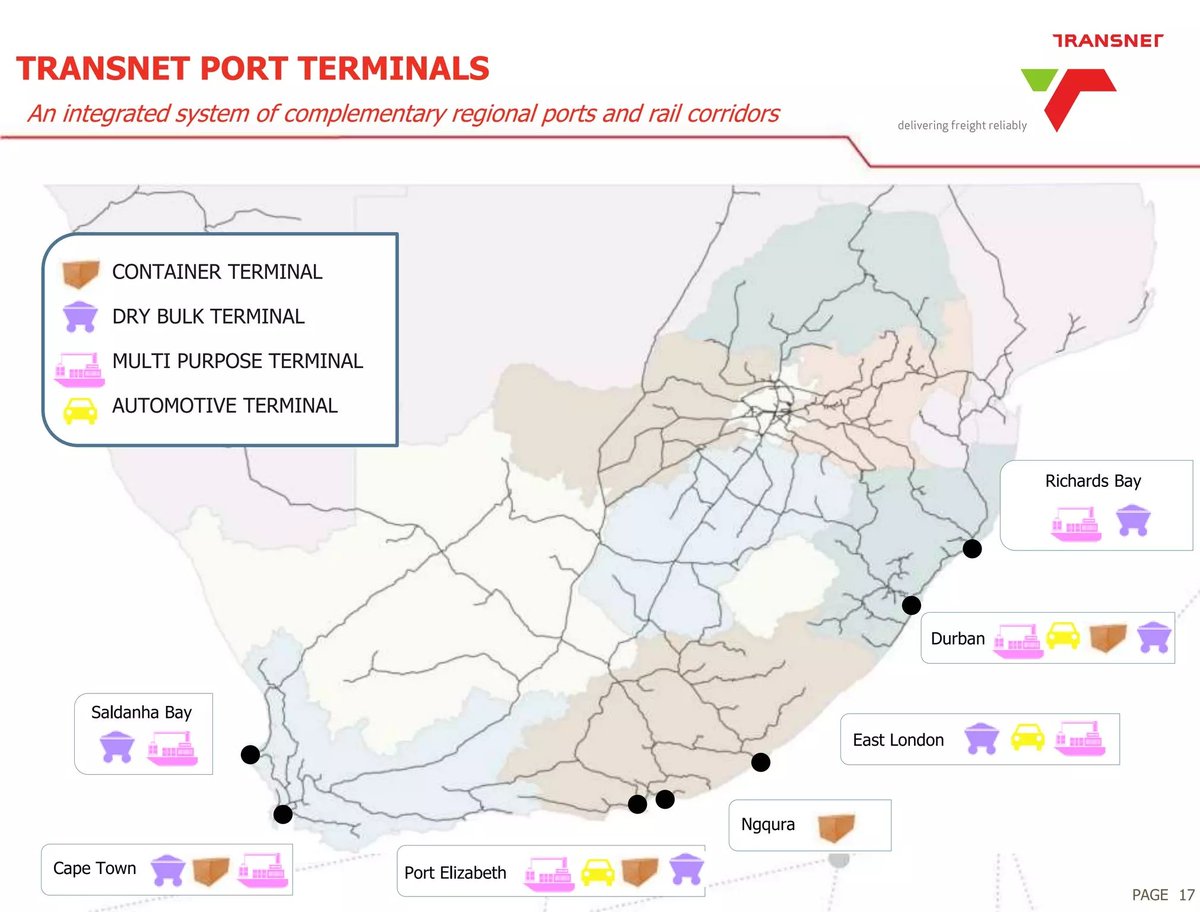
The scale of failure is no longer debatable. Eskom, despite repeated debt relief packages exceeding R400 billion since 2008 and ongoing guarantees, continues to struggle with municipal arrears surpassing R100 billion as of late 2025. Transnet’s rail freight volumes have declined from a peak of over 226 million tonnes to approximately 150 million tonnes, effectively transporting less general freight today than in the late apartheid era. South African ports, particularly Durban, consistently rank among the world’s least efficient in the World Bank’s Container Port Performance Index, with vessel berth times and truck turnaround measured in days rather than hours. Scheduled load-shedding, once portrayed as a temporary crisis measure, became a structural feature of economic life for over a decade, imposing cumulative costs estimated in the trillions of rand.
These are not isolated managerial lapses. They are systemic consequences of a state that has taken on operational responsibilities far beyond its sustainable capacity. Running world-class power systems, heavy-haul railways, and high-throughput ports demands relentless focus, specialised technical depth, rapid capital allocation, and freedom from short-term political pressures. Large public monopolies, constrained by procurement regulations, labour frameworks designed for stability rather than agility, and exposure to policy volatility, rarely excel at these tasks over extended periods. South Africa’s state has become a vast, unwieldy conglomerate attempting to execute thousands of complex functions simultaneously, from dispatching trains to maintaining turbines to negotiating global shipping contracts. In spreading itself across so many operational domains, it has diluted its effectiveness in all of them.
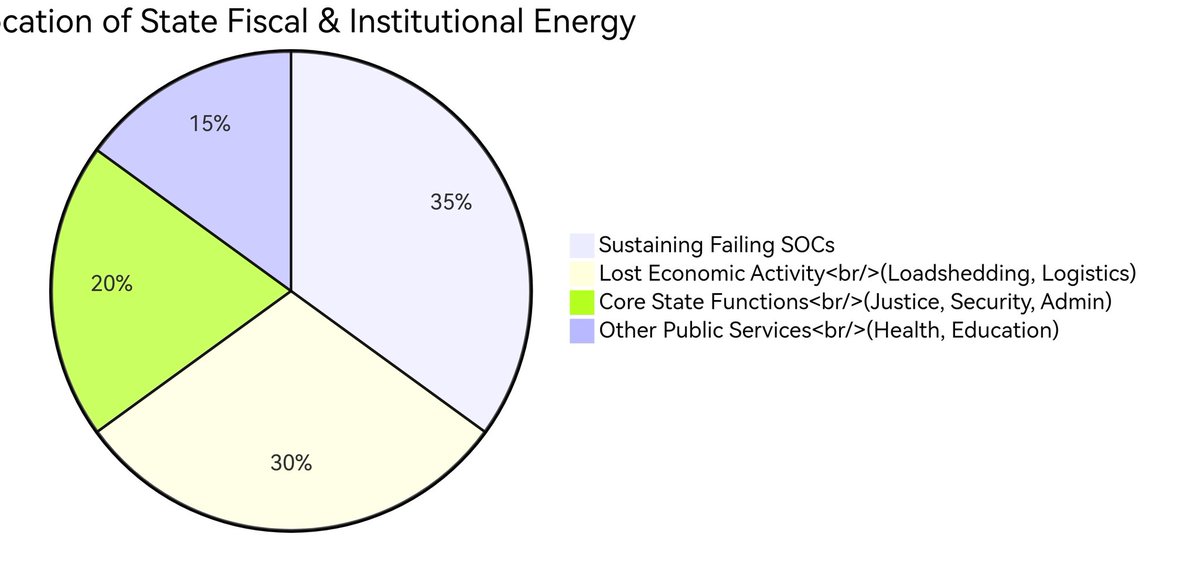
The human and institutional cost extends far beyond balance sheets. While hundreds of billions are diverted annually to sustain loss-making enterprises, through direct bailouts, debt transfers, or foregone dividends, the irreducible core functions of the state erode. Policing lacks sufficient personnel and equipment, contributing to elevated crime rates. The criminal justice system grapples with case backlogs and prison overcrowding. Border management remains porous. Many municipalities cannot deliver consistent water, sanitation, or electricity distribution. The state is compelled to rob its essential sovereign obligations to feed commercial activities that were never constitutionally mandated and that it has proven unable to perform at competitive standards. This inversion of priorities, sacrificing the non-negotiable for the optional, represents a profound betrayal of the social contract.
South Africa stands at a crossroads defined by a fundamental misallocation; not just of capital, but of sovereign attention, institutional energy, and national purpose. For too long, the country has operated under an unspoken assumption inherited from mid-20th-century developmental thinking: that true sovereignty is demonstrated through direct state ownership and hands-on operation of strategic economic assets. This belief has led to a state that formally controls an immense portfolio, electricity generation and transmission, freight rail and ports, pipelines, airlines, telecommunications infrastructure, and more, yet finds itself unable to make much of it work reliably or efficiently. The result is not enhanced national power but a profound vulnerability masquerading as ambition.
The scale of failure is no longer debatable. Eskom, despite repeated debt relief packages exceeding R400 billion since 2008 and ongoing guarantees, continues to struggle with municipal arrears surpassing R100 billion as of late 2025. Transnet’s rail freight volumes have declined from a peak of over 226 million tonnes to approximately 150 million tonnes, effectively transporting less general freight today than in the late apartheid era. South African ports, particularly Durban, consistently rank among the world’s least efficient in the World Bank’s Container Port Performance Index, with vessel berth times and truck turnaround measured in days rather than hours. Scheduled load-shedding, once portrayed as a temporary crisis measure, became a structural feature of economic life for over a decade, imposing cumulative costs estimated in the trillions of rand.
These are not isolated managerial lapses. They are systemic consequences of a state that has taken on operational responsibilities far beyond its sustainable capacity. Running world-class power systems, heavy-haul railways, and high-throughput ports demands relentless focus, specialised technical depth, rapid capital allocation, and freedom from short-term political pressures. Large public monopolies, constrained by procurement regulations, labour frameworks designed for stability rather than agility, and exposure to policy volatility, rarely excel at these tasks over extended periods. South Africa’s state has become a vast, unwieldy conglomerate attempting to execute thousands of complex functions simultaneously, from dispatching trains to maintaining turbines to negotiating global shipping contracts. In spreading itself across so many operational domains, it has diluted its effectiveness in all of them.
The human and institutional cost extends far beyond balance sheets. While hundreds of billions are diverted annually to sustain loss-making enterprises, through direct bailouts, debt transfers, or foregone dividends, the irreducible core functions of the state erode. Policing lacks sufficient personnel and equipment, contributing to elevated crime rates. The criminal justice system grapples with case backlogs and prison overcrowding. Border management remains porous. Many municipalities cannot deliver consistent water, sanitation, or electricity distribution. The state is compelled to rob its essential sovereign obligations to feed commercial activities that were never constitutionally mandated and that it has proven unable to perform at competitive standards. This inversion of priorities, sacrificing the non-negotiable for the optional, represents a profound betrayal of the social contract.
The False Choice: Why Starlink’s "Investment" is Just a Digital Royalty Payment
There is a troubling, almost nostalgic, naivety in the way we talk about the digital economy. We seem to believe that because the technology is new, satellites, lasers, low latency, the old rules of power and exploitation no longer apply. This is a dangerous illusion. The debate around Starlink's entry into South Africa is not a debate about faster internet for farmers. It is a debate about whether the 21st-century economy will look exactly like the 19th-century one: extraction dressed up as disruption.
Let me be clear about what Broad-Based Black Economic Empowerment (BEE) means in this context. It is not, as some would have you believe, a shakedown. BEE means local equity, local content, and local technology and skills transfer; the whole package. No one is asking Elon Musk for a piece of his global Starlink constellation or a seat on the board in the US. That is a deliberate, bad-faith misdirection used to inflame an American culture war that has no place in our regulatory discussions. We are talking about Starlink South Africa (Pty) Ltd; a local subsidiary, domiciled here, operating on our soil, utilizing our national spectrum, and bound by our laws. We are simply demanding that they play by the same rulebook we hand to MTN, Vodacom, and the smallest township ISP.
What Musk and company want is to treat us as a raw material pitstop in the sky. They want to use our spectrum and orbital slots, those finite, sovereign national assets that are the digital "land" of the 21st century, and they want to use the purchasing power of our 60-million-strong consumer base to amortize their satellite constellation costs. And what do they offer in return? What are we left with once the dust settles and the terminals are bolted to the roofs?
We are left with little more than installation jobs, literally tightening brackets, and Corporate Social Investment (CSI) photo-ops at a few rural schools. This is not a bonus or a gift; it is a legal requirement they are already obligated to meet under the ICT Sector Code. You do not get a trophy for showing up to the mandatory compliance meeting. We are left with a permanent trade deficit in the digital economy, exporting hard currency via subscription fees and importing bandwidth dependency. That is not partnership. That is extraction.
I want to fill in the blanks on what "strategic position" actually means here. They want access to three specific things they cannot manufacture in a Texas clean room:
1. Our Market: The gateway to the SADC region and a population of over 60 million potential subscribers.
2. Our Commons: The Radio Frequency Spectrum. This is the lifeblood of their business. Without South African spectrum rights, Starlink is just expensive space junk passing silently overhead.
3. Our Strategic Sovereignty: A stable regulatory win in South Africa unlocks the entire continent's regulatory future for them.
And yet, in the face of all this, they refuse to build real capacity here. They refuse to open the books on local shareholding beyond a nominal 4% administrative trust. They refuse to discuss the transfer of ground station infrastructure skills that would give us control over our own data flows. They refuse to develop a local supply chain for the terminals, locking us into a permanent state of dependency on a single, erratic billionaire's supply line and political whims.
If we capitulate to this model, we are not just failing a BEE scorecard. We are deliberately engineering a future of tech unemployment. We are telling our own brilliant engineers, our own fiber network entrepreneurs, and our own software developers: "You will be the waiters, the cleaners, and the bolt-tighteners for an American monopoly. You will never be the owners".
We’re not asking for a piece of "global Starlink". We're demanding a piece of South Africa's digital future. A real partnership would look like this: local assembly of user terminals; if we can build BMWs, we can build plastic dishes and circuit boards; ground station autonomy so our national connectivity is not beholden to a foreign kill switch; and credible local equity that builds generational wealth here, not in Silicon Valley.
The law is the law. And the law was written for exactly this moment: to ensure that those who profit from our soil, and our spectrum, help build the capacity of those who live on it. We should not bend the rules for a billionaire who refuses to bend the knee to South African sovereignty. The answer is simple: Build capacity here, or beam your signal elsewhere.
The False Choice: Why Starlink’s "Investment" is Just a Digital Royalty Payment
There is a troubling, almost nostalgic, naivety in the way we talk about the digital economy. We seem to believe that because the technology is new, satellites, lasers, low latency, the old rules of power and exploitation no longer apply. This is a dangerous illusion. The debate around Starlink's entry into South Africa is not a debate about faster internet for farmers. It is a debate about whether the 21st-century economy will look exactly like the 19th-century one: extraction dressed up as disruption.
Let me be clear about what Broad-Based Black Economic Empowerment (BEE) means in this context. It is not, as some would have you believe, a shakedown. BEE means local equity, local content, and local technology and skills transfer; the whole package. No one is asking Elon Musk for a piece of his global Starlink constellation or a seat on the board in the US. That is a deliberate, bad-faith misdirection used to inflame an American culture war that has no place in our regulatory discussions. We are talking about Starlink South Africa (Pty) Ltd; a local subsidiary, domiciled here, operating on our soil, utilizing our national spectrum, and bound by our laws. We are simply demanding that they play by the same rulebook we hand to MTN, Vodacom, and the smallest township ISP.
What Musk and company want is to treat us as a raw material pitstop in the sky. They want to use our spectrum and orbital slots, those finite, sovereign national assets that are the digital "land" of the 21st century, and they want to use the purchasing power of our 60-million-strong consumer base to amortize their satellite constellation costs. And what do they offer in return? What are we left with once the dust settles and the terminals are bolted to the roofs?
We are left with little more than installation jobs, literally tightening brackets, and Corporate Social Investment (CSI) photo-ops at a few rural schools. This is not a bonus or a gift; it is a legal requirement they are already obligated to meet under the ICT Sector Code. You do not get a trophy for showing up to the mandatory compliance meeting. We are left with a permanent trade deficit in the digital economy, exporting hard currency via subscription fees and importing bandwidth dependency. That is not partnership. That is extraction.
I want to fill in the blanks on what "strategic position" actually means here. They want access to three specific things they cannot manufacture in a Texas clean room:
1. Our Market: The gateway to the SADC region and a population of over 60 million potential subscribers.
2. Our Commons: The Radio Frequency Spectrum. This is the lifeblood of their business. Without South African spectrum rights, Starlink is just expensive space junk passing silently overhead.
3. Our Strategic Sovereignty: A stable regulatory win in South Africa unlocks the entire continent's regulatory future for them.
And yet, in the face of all this, they refuse to build real capacity here. They refuse to open the books on local shareholding beyond a nominal 4% administrative trust. They refuse to discuss the transfer of ground station infrastructure skills that would give us control over our own data flows. They refuse to develop a local supply chain for the terminals, locking us into a permanent state of dependency on a single, erratic billionaire's supply line and political whims.
If we capitulate to this model, we are not just failing a BEE scorecard. We are deliberately engineering a future of tech unemployment. We are telling our own brilliant engineers, our own fiber network entrepreneurs, and our own software developers: "You will be the waiters, the cleaners, and the bolt-tighteners for an American monopoly. You will never be the owners".
The tragic death of the senior clerk in Emfuleni's finance department has, understandably, given rise to speculation and deep concern. Let me state clearly at the outset where I stand: I believe her murder had something to do with corruption. However, I do not believe it is connected to the R16 million fleet corruption case. To conflate the two is to look in the wrong direction. And if we are looking in the wrong direction, we are forced to confront an even more unsettling possibility: that the rot within the municipality runs far deeper than any single, already-exposed case.
It is entirely plausible that she may have been murdered for attempting to expose wrongdoing, and that possibility should be taken with the utmost gravity. But we do not know the precise motive for certain. The determination of that motive and the pursuit of justice are now exclusively in the hands of the South African Police Service, and we must allow that investigation to run its course without undue interference or presumption.
That said, to categorically and publicly link her death to the R16 million fleet corruption case at this stage is not merely premature; it is a form of dangerous misinformation. The logic of investigation and justice does not benefit from a misdiagnosis of events. When we, as the public or as commentators, force a narrative onto a tragedy without verified evidence, we create a fog of confusion that makes it significantly harder for investigators to uncover the real truth; a truth that may involve a different scheme entirely. We risk obscuring other potential motives, overlooking alternative suspects, or creating a public environment where the actual facts become indistinguishable from rumor. If we fixate on a single, unverified theory, we may never arrive at the true and complete story of what happened to her.
Furthermore, the specific narrative that she was silenced specifically for exposing the fleet corruption flies in the face of established, documented fact. The details of the R16 million fleet corruption case are not a secret she was on the verge of unearthing alone. The process in that matter has already run its full institutional course. A comprehensive forensic investigation was instituted and completed by a reputable, independent external company. Those findings were not hidden away or suppressed; they were formally tabled, served before the council, debated, and ultimately adopted. The council went even further than the forensic report's baseline recommendations, adding extra stipulations that included the formal opening of criminal cases with law enforcement and the summary dismissal of all officials found to be implicated.
In short, the facts of the fleet corruption case have already been established and are a matter of public record and council resolution. Given that the investigation has concluded and the internal consequences have been meted out, the claim that the senior clerk was murdered in order to prevent the exposure of those same facts is, at best, a logical inconsistency. It is difficult to reconcile the idea that someone would be killed to stop information from coming to light when that information has already been fully exposed, investigated, and acted upon by the very institution she served.
If she was killed for what she knew, it was likely for something else. And her position as a senior clerk in finance places her precisely at the intersection of numerous other potential corruption streams. The finance department is not a silo concerned only with fleet management; it is the central nervous system of the municipality's entire fiscal operation. A senior clerk in that environment would have had intimate access to, and knowledge of, several high-risk areas where malfeasance is notoriously prevalent.
I have said that I believe the senior finance clerk's murder had something to do with corruption, but not the fleet corruption case. The rot, I suspect, runs deeper. But there is another layer to this tragedy that we are not talking about with nearly enough precision, and it sits far above the municipal offices of Emfuleni. It sits in the Union Buildings.
Let me state clearly what I mean. In late 2025, the Executive Mayor of Emfuleni, Sipho Radebe, did what the law required of him. He wrote a formal letter to President Cyril Ramaphosa requesting a presidential proclamation to empower the Special Investigating Unit (SIU) to probe corruption of all kinds within the municipality. The letter, dated October 28, specifically identified systemic corruption, bribery, extortion, and fraudulent billing across service delivery departments. The mayor explained, in the restrained language of official correspondence, that "the SIU's legal mandate and forensic expertise are indispensable to ensuring a credible, thorough, and conclusive investigation that restores public trust".
That was nearly six months ago. The President has not signed the proclamation. No SIU investigators have been deployed. And in the interval between that request and today, a senior finance clerk who had reportedly identified corruption and opened a case with the Hawks was murdered in broad daylight.
Now, I am not suggesting that the President is responsible for her death. That would be a reckless overreach. But I am saying that his inaction has left a vacuum, and vacuums in places like Emfuleni do not remain empty for long. They are filled by the very forces the SIU is designed to dismantle. By failing to act, the President has denied the municipality access to the one institution in this country with the legal mandate, the forensic expertise, and the statutory teeth to conduct a credible, thorough, and conclusive investigation. That is not a matter of opinion. It is a matter of fact.
What more could the mayor have done? This is not a rhetorical question, and I have yet to hear a satisfactory answer. The mayor cannot compel the President to sign a piece of paper. He cannot deploy the SIU on his own authority. The request has been made, formally and publicly, through the correct constitutional channel. The ball is not in the mayor's court. It has not been in his court since October. The President holds it, and he is choosing not to move.
This is not a new pattern for Emfuleni. In October 2018, an auditor from the Office of the Auditor-General was shot and wounded while staying at a guesthouse in Vanderbijlpark during an audit of the municipality. The late Kimi Makwetu had to withdraw his entire audit team. That was nearly eight years ago, long before the current mayor's letter. The message sent then was clear: financial oversight in Emfuleni is a high-risk occupation. The message sent now, with the murder of a finance clerk, is the same message, only louder and more final. And still, from the highest office in the land, there is silence.
What I find particularly frustrating, and this is where I will insert my own view plainly, is the behavior of the political parties. They have descended on Emfuleni in the wake of this killing. There have been press briefings and site visits and expressions of grave concern. They are doing what political parties do when a tragedy captures the national imagination: they are being seen to do something. But what they are not doing, at least not with anything approaching the necessary volume, is asking the President why he has not signed the proclamation. They are directing their fire at the municipality, at the mayor, at the council, all legitimate targets, to be sure, but they are ignoring the one actor whose inaction is most consequential. That is not oversight. That is busywork. It is the appearance of engagement without the substance of accountability.
But let me be clear about something else. To say that the President bears the primary responsibility for the stalled SIU investigation is not to absolve the local executive and council of all agency. The mayor cannot sign his own proclamation, but he is not powerless. And in the absence of presidential action, he has a duty to exhaust every alternative available to him. I can think of at least two, and neither requires a signature from Pretoria.
First, the mayor should table an item before Council to establish Section 79 Oversight Committees for every problematic portfolio area he identified in his letter to the President. Section 79 of the Municipal Structures Act allows a council to establish committees of councillors to exercise oversight over the administration. These committees can call for documents, summon officials, and conduct inquiries. They are not a substitute for a forensic investigation, but they are a start. They are a mechanism for gathering information, preserving evidence, and creating a public record. The mayor knows where the problems are; he listed them in his letter. Supply chain, revenue, billing, human resources. He should establish a committee for each, give them a mandate, and let them get to work.
Second, once those committees have completed their initial inquiries, the municipality should commission independent forensic investigations into the specific areas of concern they identify. These investigations would be narrower in scope than a full SIU probe, but they would be targeted, actionable, and immediate. And the funding should come from the Gauteng Department of Cooperative Governance and Traditional Affairs. CoGTA has both the legal authority and, in my view, the moral obligation to fund forensic investigations in a municipality that has demonstrated a clear need but lacks the fiscal capacity to act. Section 154 of the Constitution obliges provincial government to support municipalities. There is no more urgent support required in Emfuleni right now than the resources to investigate itself.
The strategic logic here is straightforward. By the time the President eventually signs that Proclamation, if he ever does, two separate levels of investigation will have already been completed. The Section 79 committees will have gathered evidence and produced reports. The independent forensic investigators will have drilled down into specific schemes and compiled findings. The SIU will not be starting from a blank slate. They will be walking into a municipality where the groundwork has been laid. The delay caused by the President's inaction, while inexcusable, will not have been entirely wasted.
I return to the question that should be dominating our public discourse. Why has the President not signed the proclamation? Is there a legal impediment that has not been communicated? Is there a competing priority so urgent that it justifies leaving Emfuleni's residents exposed to a corrupt network that has now demonstrated its willingness to kill? Or is this simply bureaucratic inertia at the highest level; an indifference to the fate of a municipality deemed too distant, too troublesome, or too politically inconvenient to warrant the full application of presidential authority?
I do not know the answer. But I know that the question must be asked, and asked relentlessly, by every political party, every journalist, and every civil society organization that claims to care about good governance. The senior finance clerk who was murdered deserved a state that would protect her. She deserved a President who would act. She got neither. The least we owe her now is a demand for an answer, and a refusal to accept silence as a response.
I have said that I believe the senior finance clerk's murder had something to do with corruption, but not the fleet corruption case. The rot, I suspect, runs deeper. But there is another layer to this tragedy that we are not talking about with nearly enough precision, and it sits far above the municipal offices of Emfuleni. It sits in the Union Buildings.
Let me state clearly what I mean. In late 2025, the Executive Mayor of Emfuleni, Sipho Radebe, did what the law required of him. He wrote a formal letter to President Cyril Ramaphosa requesting a presidential proclamation to empower the Special Investigating Unit (SIU) to probe corruption of all kinds within the municipality. The letter, dated October 28, specifically identified systemic corruption, bribery, extortion, and fraudulent billing across service delivery departments. The mayor explained, in the restrained language of official correspondence, that "the SIU's legal mandate and forensic expertise are indispensable to ensuring a credible, thorough, and conclusive investigation that restores public trust".
That was nearly six months ago. The President has not signed the proclamation. No SIU investigators have been deployed. And in the interval between that request and today, a senior finance clerk who had reportedly identified corruption and opened a case with the Hawks was murdered in broad daylight.
Now, I am not suggesting that the President is responsible for her death. That would be a reckless overreach. But I am saying that his inaction has left a vacuum, and vacuums in places like Emfuleni do not remain empty for long. They are filled by the very forces the SIU is designed to dismantle. By failing to act, the President has denied the municipality access to the one institution in this country with the legal mandate, the forensic expertise, and the statutory teeth to conduct a credible, thorough, and conclusive investigation. That is not a matter of opinion. It is a matter of fact.
What more could the mayor have done? This is not a rhetorical question, and I have yet to hear a satisfactory answer. The mayor cannot compel the President to sign a piece of paper. He cannot deploy the SIU on his own authority. The request has been made, formally and publicly, through the correct constitutional channel. The ball is not in the mayor's court. It has not been in his court since October. The President holds it, and he is choosing not to move.
This is not a new pattern for Emfuleni. In October 2018, an auditor from the Office of the Auditor-General was shot and wounded while staying at a guesthouse in Vanderbijlpark during an audit of the municipality. The late Kimi Makwetu had to withdraw his entire audit team. That was nearly eight years ago, long before the current mayor's letter. The message sent then was clear: financial oversight in Emfuleni is a high-risk occupation. The message sent now, with the murder of a finance clerk, is the same message, only louder and more final. And still, from the highest office in the land, there is silence.
What I find particularly frustrating, and this is where I will insert my own view plainly, is the behavior of the political parties. They have descended on Emfuleni in the wake of this killing. There have been press briefings and site visits and expressions of grave concern. They are doing what political parties do when a tragedy captures the national imagination: they are being seen to do something. But what they are not doing, at least not with anything approaching the necessary volume, is asking the President why he has not signed the proclamation. They are directing their fire at the municipality, at the mayor, at the council, all legitimate targets, to be sure, but they are ignoring the one actor whose inaction is most consequential. That is not oversight. That is busywork. It is the appearance of engagement without the substance of accountability.
Compounding this confusion is the municipality's own failure of transparency. At a moment when this story has captured the national imagination and when public trust is hanging by a thread, the municipality is actively making matters worse by refusing to release the forensic report to the public. While the council has debated it and adopted its recommendations, the document itself remains hidden behind closed doors. This is not merely a bureaucratic oversight; it is an act of self-sabotage. By withholding the report, especially now, amid a maelstrom of suspicion surrounding a violent death, the municipality is inadvertently fueling the very conspiracy theories it wishes to dispel. The public is left to fill the void of official silence with speculation and fear. If the report truly contains the established facts and exonerates the process, then there is no defensible reason to keep it secret. Conversely, if there are sensitivities within the document, the municipality owes it to the nation to explain those redactions openly rather than resorting to a blanket embargo. At this critical juncture, silence is not prudence; it is an accelerant on the fire of misinformation.
We owe it to the memory of the senior clerk to seek the truth, not a convenient headline. Let the police do their work, and let us refrain from tying her tragic end to a case that has already seen the light of day, lest we inadvertently bury the real motive for her death forever. And we must demand that the municipality stop acting as an obstacle to clarity. Releasing that report would not hinder the murder investigation; it would help separate the known facts of the past from the deeper, more dangerous rot that festers in the financial arteries of Emfuleni, a rot that this senior clerk in finance may well have paid the ultimate price for trying to stop.
The tragic death of the senior clerk in Emfuleni's finance department has, understandably, given rise to speculation and deep concern. Let me state clearly at the outset where I stand: I believe her murder had something to do with corruption. However, I do not believe it is connected to the R16 million fleet corruption case. To conflate the two is to look in the wrong direction. And if we are looking in the wrong direction, we are forced to confront an even more unsettling possibility: that the rot within the municipality runs far deeper than any single, already-exposed case.
It is entirely plausible that she may have been murdered for attempting to expose wrongdoing, and that possibility should be taken with the utmost gravity. But we do not know the precise motive for certain. The determination of that motive and the pursuit of justice are now exclusively in the hands of the South African Police Service, and we must allow that investigation to run its course without undue interference or presumption.
That said, to categorically and publicly link her death to the R16 million fleet corruption case at this stage is not merely premature; it is a form of dangerous misinformation. The logic of investigation and justice does not benefit from a misdiagnosis of events. When we, as the public or as commentators, force a narrative onto a tragedy without verified evidence, we create a fog of confusion that makes it significantly harder for investigators to uncover the real truth; a truth that may involve a different scheme entirely. We risk obscuring other potential motives, overlooking alternative suspects, or creating a public environment where the actual facts become indistinguishable from rumor. If we fixate on a single, unverified theory, we may never arrive at the true and complete story of what happened to her.
Furthermore, the specific narrative that she was silenced specifically for exposing the fleet corruption flies in the face of established, documented fact. The details of the R16 million fleet corruption case are not a secret she was on the verge of unearthing alone. The process in that matter has already run its full institutional course. A comprehensive forensic investigation was instituted and completed by a reputable, independent external company. Those findings were not hidden away or suppressed; they were formally tabled, served before the council, debated, and ultimately adopted. The council went even further than the forensic report's baseline recommendations, adding extra stipulations that included the formal opening of criminal cases with law enforcement and the summary dismissal of all officials found to be implicated.
In short, the facts of the fleet corruption case have already been established and are a matter of public record and council resolution. Given that the investigation has concluded and the internal consequences have been meted out, the claim that the senior clerk was murdered in order to prevent the exposure of those same facts is, at best, a logical inconsistency. It is difficult to reconcile the idea that someone would be killed to stop information from coming to light when that information has already been fully exposed, investigated, and acted upon by the very institution she served.
If she was killed for what she knew, it was likely for something else. And her position as a senior clerk in finance places her precisely at the intersection of numerous other potential corruption streams. The finance department is not a silo concerned only with fleet management; it is the central nervous system of the municipality's entire fiscal operation. A senior clerk in that environment would have had intimate access to, and knowledge of, several high-risk areas where malfeasance is notoriously prevalent.
· Supply Chain Management: This is often the soft underbelly of local government corruption. A finance clerk would have been involved in processing purchase orders, verifying invoices against delivery notes, and reconciling payments to suppliers. She would have been able to identify ghost vendors, inflated pricing, or the splitting of orders to circumvent tender thresholds. If she noticed discrepancies, for example, a payment approved for goods never received or a contract awarded to a politically connected entity without proper procedure, she would have been in a position to flag it. That knowledge is far more dangerous than the details of a case already in the public domain.
· Tender Irregularities: Even if she was not on a bid evaluation committee, the finance department is the ultimate gatekeeper for the release of funds. A senior clerk would see the financial flows that follow a tainted tender award. She would notice if a contractor was paid upfront in violation of the Municipal Finance Management Act, or if variation orders were being used to bleed additional, unapproved funds out of a project. Exposing how the money actually moves is often more incriminating than exposing the award itself.
· Revenue Management and Rates Collection: This is a less discussed but equally fertile ground for fraud. A senior clerk in finance might have oversight of the rates and services billing system, cash receipting, or the reconciliation of the municipality's bank accounts. She could have uncovered a scheme where ratepayers' payments were being diverted into private accounts, or where indigent subsidies were being fraudulently claimed for non-existent or ineligible beneficiaries. Fraud in revenue collection often involves internal collusion to manipulate the debtors' book, and someone on the inside who notices that the figures don't add up becomes an immediate threat.
· Payroll and Ghost Employees: The finance department processes the municipality's payroll. A senior clerk might have been responsible for verifying the employee register against the actual salary run. She could have stumbled upon the existence of "ghost employees"; individuals on the payroll who do not exist or do not work for the municipality but whose salaries are being siphoned off by a syndicate. Discovering and threatening to expose such a scheme is a well-documented motive for violence against finance officials in South African municipalities.
By forcing a connection solely to the fleet case, we inadvertently provide cover for any or all of these other forms of corruption she may have been trying to bring to the surface. If the rot is indeed deeper, and the finance department of a struggling municipality is precisely where one would expect to find it, then fixating on the fleet case is a convenient distraction for those who might still be operating in the shadows of these other, still-hidden schemes.
@JohannBiermann1 No; we can take advantage of the restructuring in other ways. We're sitting on the world's greatest treasure chest. All we need is leadership that will legislate and implement.
https://t.co/Jl6TbhFYr7
@Zuko_Godlimpi Please go through the 10-post series. That's all I'm asking; no need to reply, just read and reflect on the content.
https://t.co/Jl6TbhFYr7