Blockchain upgrades usually require new software and a coordinated restart across all nodes.
Tau Net introduces technology that allows a blockchain to amend itself without a hard fork, client updates, or downtime.
This demo shows how Tau Net users can upgrade the network's consensus mechanism simply by stating their requirements and agreeing to them.
You can change the law of the Tau Net blockchain right inside a block, ushering in a new era of blockchain and software governance capabilities.
Showcasing Pointwise Revision:
Pointwise Revision is a built-in mechanism that jointly takes new software requirements and the current specification as input. Then outputs a program that consistently satisfies both the new requirement and the maximum of the previous specification.
This allows software to update correctly according to given rules, and it is all handled by providing only the required changes to the software.
Explore testnet alpha here: https://t.co/HHRC2GV0pb
Should we rename the Agoras token to just "Tau"?
The ticker would still stay as ethereum:0x738865301a9b7dd80dc3666dd48cf034ec42bdda until we swap to mainnet, as changing the ticker requires a swap.
4/4 Reaching the end of an input file should be uneventful. David fixed Tau's file-fed runs so that normal stop no longer produces a read error. Missing files and bad reads still report failure. Less noise for builders, in development.
https://t.co/o0gKRyR7gI
1/4 Tau Lead Dev David Castro keeps tightening up Tau Language.
Three developer fixes worth a look: clearer inconclusive solver results, explicit failure for invalid fractions, and a quiet end to file-fed runs. All in development.
3/4 An invalid fraction could become zero through Tau's qint C++ API without any notification. David made that path return an explicit failure, letting developers catch a zero denominator or a value outside the supported range. In development.
https://t.co/1uI7PXUDdS
What’s important for self custody and programmable money is who can write, accept and change the rules.
Tau empowers users to program their own money on-chain with rules that can be amended only under conditions they set.
You decide how your money behaves and what it takes to change those instructions.
@XRPSEOUL@chandler_agi@t54ai User-set limits are the way but how are dispute handled.
Which transactions can be challenged, who decides, how long settlement stays open, and can the agent or operator change those terms after approval?
3/3 A missing file should stay missing. Tomáš fixed a Windows read path that could create an empty file, and kept the file-opening error in the parser's report. Good catch for anyone debugging an input problem. In development.
https://t.co/Gdl4Zuv1Vi
2/3 Tomáš added a JSON interface to Tau's grammar tool. Developer tools can send parsing requests and read results and errors as structured data, without scraping terminal output. A useful building block, in development.
https://t.co/a1SYKb346D
1/3 More useful groundwork from Tau's Tomáš.
His recent parser work gives tool builders structured results and clearer file errors. Two practical improvements for people building with Tau, both in development.
Excited to see what Tau community member @tau_l0g1x has been cooking 👀
Tau Chess vs Claude, live this Sunday at 12:00 UTC.
The Tau Community is the best!
Most AI today predicts. It's brilliant – and it can't tell you why. Sunday we put a different kind of AI on a chessboard, live against a Claude model.
https://t.co/fkmuZ3jo7P
Money is important.
Programmable money is even more important.
With ethereum:0x738865301a9b7dd80dc3666dd48cf034ec42bdda you'll be able to:
Send money for a need: "Send 10,000 to Jack for university. Cap the spend at 900 per week". And;
Send money with a mission: "Send Mara 1,300. It can only be spent on groceries, rent and fuel".
AGRS will let you put meaning in your money for the things that matter.
Hi, Super Intelligence.
Tau is building the wallet and financial system that follows your rules.
Agents will have their own accounts with programmable money. People can set what to buy, lend, who to pay, and how much to spend.
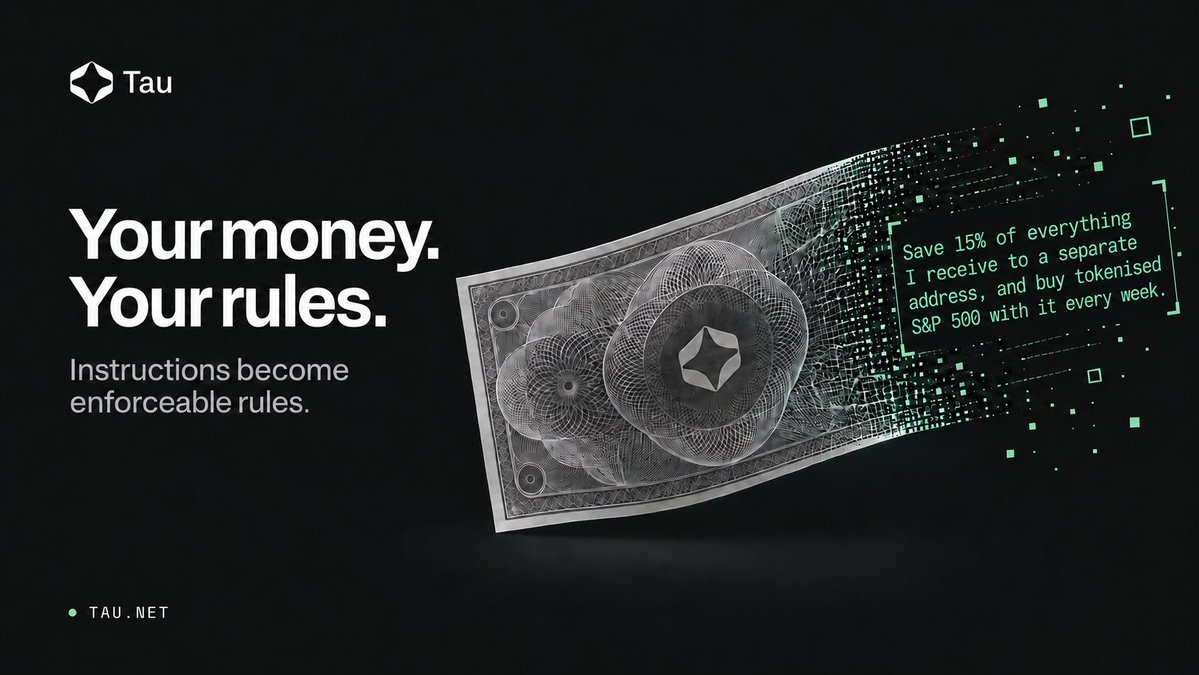
Instructions become enforceable on-chain rules.
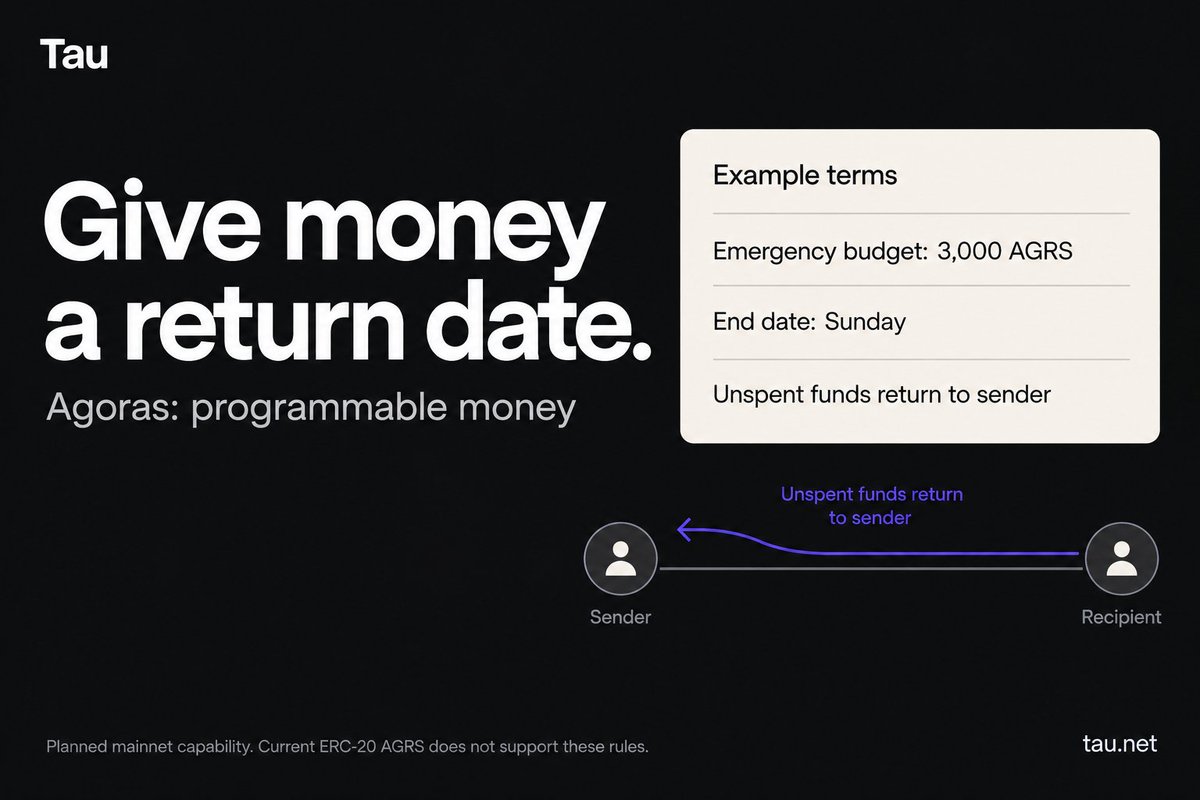
Set up an emergency budget for friends and family that returns unused funds after a set period.
Truly programmable money with $AGRS.
Ask your wallet agent to build agreed-upon payment conditions using Tau Wallet.
ethereum:0x738865301a9b7dd80dc3666dd48cf034ec42bdda will be programmable money in the truest sense.
"Send 3,000 to Mara for emergencies this weekend, return anything unspent at the end back to me"
Soon we'll have the power to put our meaning in our money.
Code has controlled money, data and physical systems for decades.
Using formal methods to prove it follows your rules is starting to sound like common sense.
For Tau Net's development that's always been the case.
Your wallet, your rules. Including who can change them!
The cryptographic world computer:
https://t.co/LF2JGU38Rx
My attempt to express in somewhat concise terms the true meaning of basically everything planned to happen to Ethereum starting from the fork after Hegota. It's really not just a blockchain anymore. It's a hybrid architecture that combines together blockchains and modern cryptography, to enable much more powerful properties.
FOCIL, EIP-8288, Lean consensus, state management, formal verification, advanced mempool improvements (including privacy), and the longer-term specter of obfuscation all mentioned.