Tax policy is all about trade-offs.
Our new guide analyzes 86 potential changes to the federal tax code, considering their impact on federal revenue, the long-term debt trajectory, the distribution of after-tax income, and the US economy.
Launch our interactive tool: https://t.co/aDPUgmsUcq
With Democrats retaking control of the US House of Representatives and US Senate, several new federal tax issues are on the table for 2027.
Read more: https://t.co/u9St03tQ8l
As Portland City Council considers the proposed tax increase, they should understand the city’s starting point—as arguably the highest-tax jurisdiction in the entire country—not one of the lowest.
Read more: https://t.co/xmvK2RYnzu
Unfortunately, not all bipartisan efforts will make for sound tax reform. Both parties have leaned into the “no tax on” trend in recent years, complicating the tax code and narrowing the US income tax base.
Read more: https://t.co/UVkILpwlFy
How do taxes in your state compare regionally and nationally? Facts and Figures, a resource we’ve provided to US taxpayers and legislators since 1941, serves as a one-stop state tax data resource that compares all 50 states on over 40 measures of tax rates, collections, burdens, and more.
Explore the latest data: https://t.co/YcuSS9E6ud
A recent report by the Government Accountability Office found the federal government loses $116 billion to $304 billion to tax fraud each year, more than many government agencies’ annual budgets.
Read more: https://t.co/MKtWjJkUsi
Expensing for capital investment is not a special tax break. Expensing aligns the timing of tax deductions with the timing of actual capital expenditures so that the tax code does not discourage marginal investment projects.
Read more: https://t.co/dx2sBan7Sh
Imposing sales taxes on rental car companies’ fleet purchases, in addition to the sales and rental car excise taxes levied when those cars are rented, yields double taxation and causes harmful tax pyramiding.
Read more: https://t.co/y8PlyaGkH4
Publicly held debt is projected to rise to a new record high of 106 percent of GDP within the next four years and continue to rise to 120 percent by 2036 and 175 percent by 2056.
Read more: https://t.co/DNhmh13D7B
If the U.S. taxed personal income in the same way that Denmark does, all income over $82,000 would be taxed at over 55 percent.
https://t.co/mhYyiYtqth
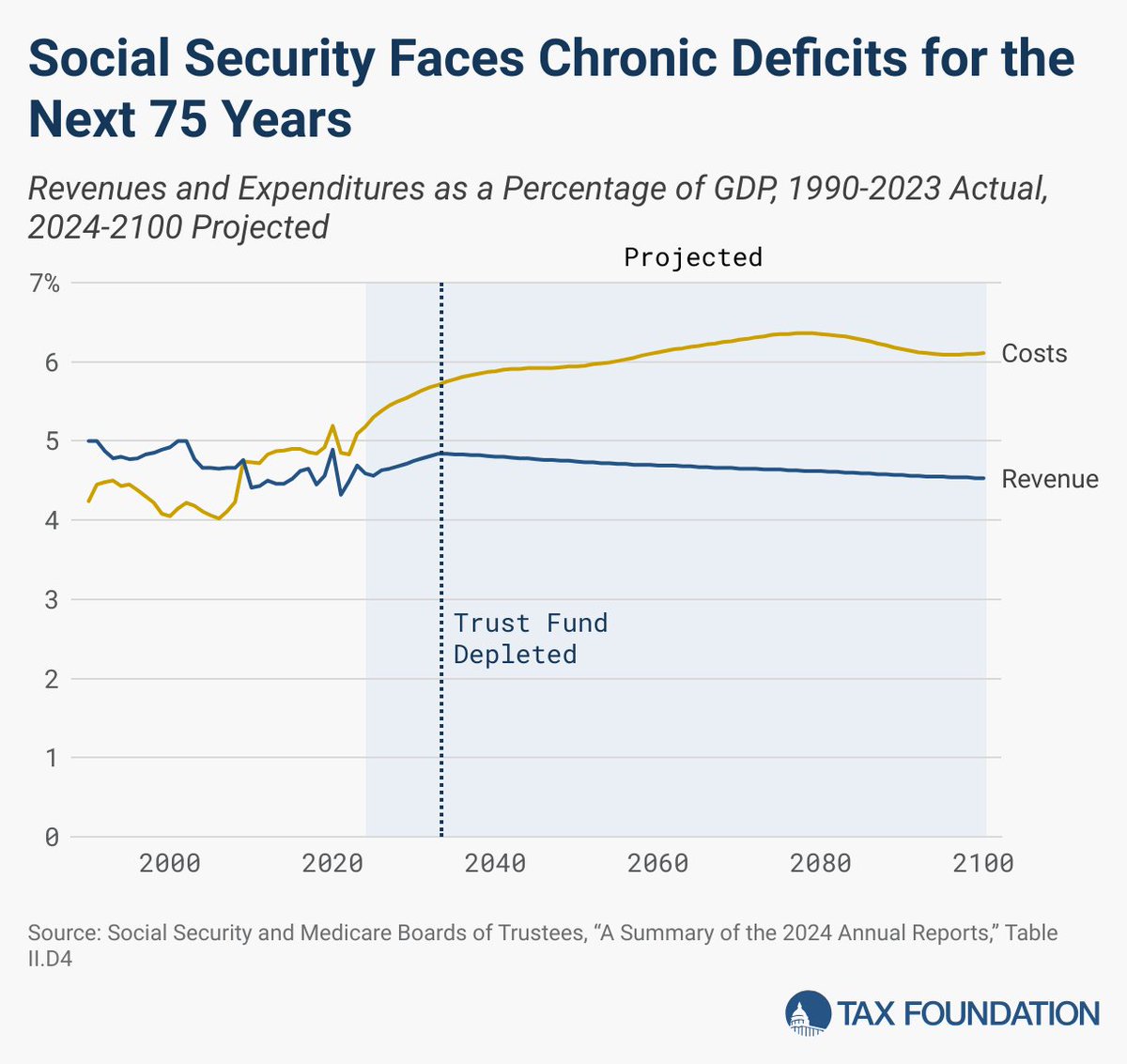
By 2035, the Old-Age, Survivors, and Disability Insurance Trust Fund, or the Social Security Trust Fund, will be depleted, and current payroll taxes will only be able to fund 83 percent of the scheduled benefits.
Read more: https://t.co/gV4lujqywZ
In red and blue states alike, voters showed wariness toward novel changes to the tax code, with two notable exceptions.
How Tax Policy Fared on the Ballot in 2026: https://t.co/3XPSvV0jed @JaredWalczak
Some form of improved cost recovery for structures—whether full expensing, expensing with a per-unit cap, neutral cost recovery, or simply shortening the asset life of residential structures—is one of the most powerful pro-housing supply options available to federal policymakers.
Read more: https://t.co/OIHk01IncG
Some taxes have more powerful economic effects than others, and that’s a lesson policymakers should absorb as they work to craft a tax code that encourages growth and raises sustainable revenue.
Read more: https://t.co/yxg1xVE29O
.@GS_Watson and I keep getting asked: what could Congress do on a bipartisan basis in tax in 2027?
The answer is: a lot! Housing tax, tariff rollbacks, gas tax, EV fees, IRS reform, and crypto tax among them.
But some bad ideas lurk too...read below for the full list!