San Diego fell from 5th to 12th most expensive rental market by building more multifamily housing per capita than any other California city.
This is what happens when you actually build. The lesson isn't complicated.
New 2025 Census Bureau population estimates for cities and towns show population growth farther from city centers, but not for every city. https://t.co/dMpUPy0CHT
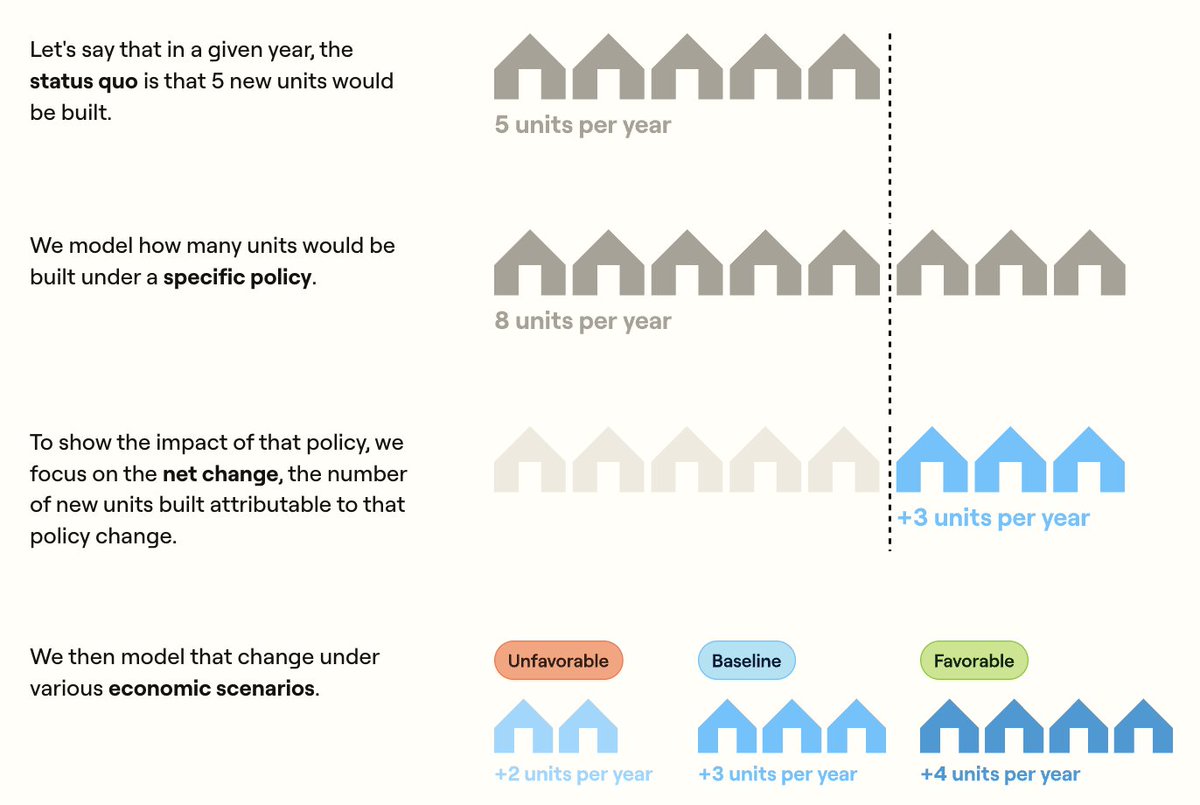
Excited to share this new tool from Terner Labs: the Housing Policy Simulator Visualization translates complex "development math" into accessible maps, allowing users to test how policy changes actually affect the financial feasibility of new housing. In a recent study, the University of Denver used the Simulator's models to show that eliminating parking minimums in Denver could increase the city's expected housing production by 13% annually.
Now you can explore the tool for yourself with an interactive which features data for Denver, San Diego, and Tucson: https://t.co/4JymMThm72
A new geospatial foundation model can now estimate how poor your neighbourhood is, track how fast that's changing, and do it without anyone filling out a single survey form.
A team of Stanford researchers just published Tempov, a foundation model trained on three million pairs of Landsat images spanning two decades. It takes raw satellite imagery and predicts asset wealth at the village level, across entire continents, updated in near real-time.
The benchmark numbers are worth sitting with. In Malawi and Mozambique, the model explains 87% and 74% of the variation in household wealth from satellite imagery alone. That's from six spectral bands. No census forms. No field enumerators. No mobile phone metadata.
The harder problem is tracking change, not just level. Most existing models are trained to predict a static snapshot. When you ask them to predict how wealth shifted between 2008 and 2018 in the same locations, performance collapses to near-random. Tempov holds at R² = 0.69 for Malawi and 0.46 for Mozambique on that same change-tracking task.
What makes the difference is how the model was pretrained. The researchers constructed bitemporal image pairs that maximise seasonal variance, then forced the model to learn representations that are stable across seasons but sensitive to genuine long-run economic shifts. The learned embeddings spontaneously delineate road networks, urban structure, and agricultural patterns from natural background, without ever being told to.
The scarcity problem is where it gets interesting for development economics. The standard tools for measuring poverty rely on the Demographic and Health Surveys. DHS data is spatially sparse and resurveyed infrequently. The correlation between asset wealth in Malawi's earlier and later censuses is only 0.42. In Mozambique it's actually negative: -0.71.
Tempov gets around this with a two-stage adaptation. Train on historical census data, then fine-tune to the target year using only 5% of contemporary survey points. With that 5% adjustment, it outperforms geospatial foundation models that were given 100% of available survey data. Combining a strong historical prior with minimal contemporary calibration can substitute for the full survey investment.
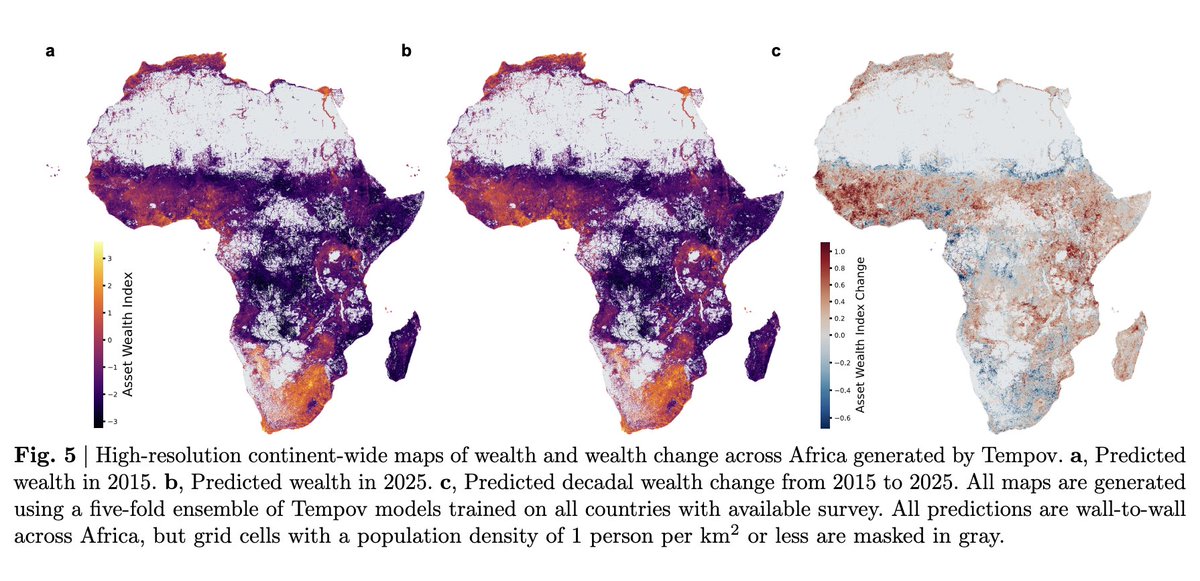
The researchers then deployed it continent-wide. Five models trained under cross-validation on all 34 African countries with recent DHS surveys, averaged into a single ensemble, producing 6 km × 6 km wealth maps for the entire African continent in 2015 and 2025. Roughly 80% of measured wealth inequality across the continent is within countries, not between them.
The decadal change map shows wealth gains concentrated in West and East Africa and substantial declines across parts of Southern and Central Africa. Country-level factors explain only about a third of the variation in wealth change. Local temperature trends and nearby conflict events predict the changes better than institutional-quality proxies do.
For the applied economics side: the model achieves competitive performance with 10% of available survey samples where baseline foundation models need 100%. That's not a modest efficiency gain. That's a different cost structure for poverty measurement entirely.
DHS survey rounds are already under funding pressure. The World Bank's Living Standards Measurement Surveys have become increasingly irregular. The status quo is a slow degradation in the quality and frequency of ground-truth data on living standards in the places that most need monitoring.
What Tempov suggests is that the role of household surveys may be shifting from the primary measurement instrument to the calibration anchor. You don't stop running surveys. You run fewer, target them better, and use them to tune a model that fills in the rest from orbit.
The code and weights are open-source. The continent-wide wealth maps are public. The methodology is reproducible by a national statistics office with a laptop and a moderate AWS bill.
The hard part was always getting data out of places that couldn't afford to collect it. That constraint just got significantly looser.
Link to paper: https://t.co/lNbIJp3mn6
New Freemark paper on big upzonings!
YIMBYs everywhere got mad when anti-transit NIMBYs abused Freemark's past work--he found that small upzonings have small effects--to fight housing near trains
Today Yonah asks: What do big upzonings in strong markets do? The answer is a lot
Last year, the typical U.S. host on Airbnb made $16,000 for opening up their home for a few days a year. At a time of rising costs, that money is a lifeline. That is the case for many homeowners in New York - especially those in the Outer Boroughs. Airbnb isn’t fighting housing bills - we are fighting to give these New Yorkers a chance to stay in their homes.
Foreclosures in NYC are on the rise, with 1,588 first-time filings in 2025 — up 8% year over year — with the Bronx seeing the sharpest increase at a 35% increase from 2024. Nearly 1 in 4 NYC homeowners with a mortgage -- 138,000 people -- are severely cost-burdened, paying more than 50% of their income on housing.
The idea that Airbnb causes the housing crisis is wrong. In the more than two years since NYC all but banned Airbnb, rent has gone up 8.1% - above the national average - while vacancies have gone down. Across Airbnb's 50 biggest cities around the world, “dedicated” listings made up only 0.4 percent of the housing stock overall.
The Redfin Data Center just got a makeover. If you are looking for free, downloadable data on national and local markets, this is for you! All we ask is that you cite Redfin. Enjoy!
Let's upzone NYC!
Now live:
https://t.co/CvGmSOxD2G
See the zoning potential (air rights=blue) for every residential lot in NYC. And then ... change it.
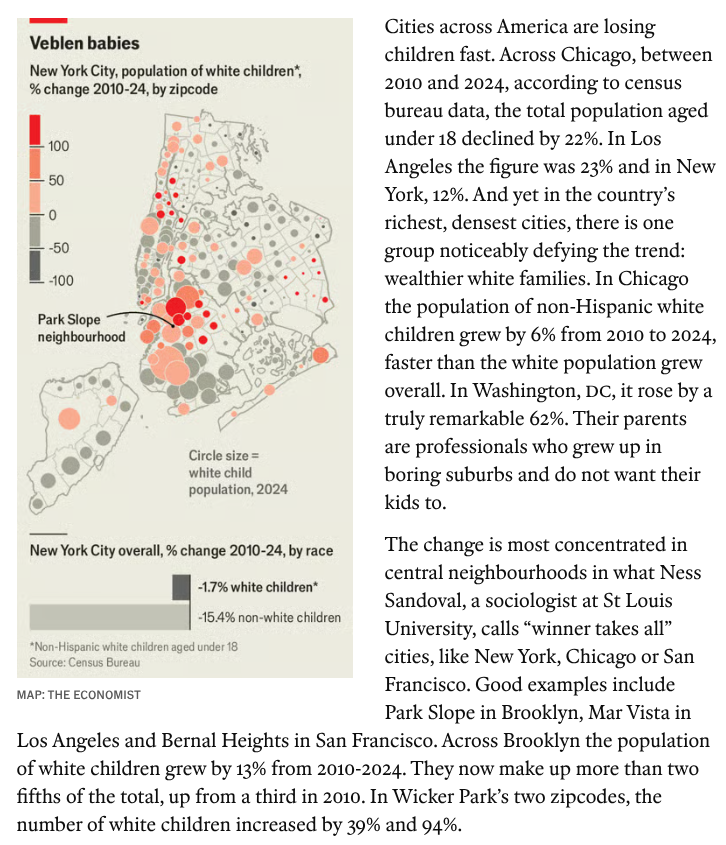
Veblen babies: "In Chicago the population of non-Hispanic white children grew by 6% from 2010 to 2024, faster than the white population grew overall. In Washington, DC, it rose by a truly remarkable 62%" https://t.co/iHYgtVN8Ll
A Terner Center study modeled duplexes, fourplexes, and tenplexes across four California markets.
Cutting fees from $40,000 to $10,000 and switching to residential building codes brought several more project types close to being built. But more reforms are also needed.
Link ⬇️
A 2020 Terner Center study found new owner-occupied homes are 50% larger than in the 1980s — despite shrinking household sizes.
The result: fewer entry-level homes, and first-time buyers who are increasingly older, wealthier, and whiter.
https://t.co/8xArVSNS9V