Curious for those who have worked on research languages for PhD studies, specifically theological German, were there any resources/tools that were particularly helpful along the way?
The aim of preaching: “To John the Baptist there was accorded the highest tribute that could ever come to a minister of the Gospel: When they had heard John, ‘they followed Jesus’ (John 1:37).” -Charles W. Koller
These are simply thoughts coming forward as I write a paper for a PhD seminar, “Becoming the Implied Preacher: An Analysis of Expository Preaching and the Implied Reader.”
I think because of the nature of the Gospels, the original audience is often misunderstood, if not neglected. Why? Because we forget that this is a text written for a reader and not live reporting. Simple, but true.
But then step out. Ask what Luke is up to. How does Luke desire his audience to respond? Why this story, and why here, within Luke’s Gospel. Remember, we interpret the text. God, in His sovereignty (and inspiration) trusted Luke with this beautiful story. Interpret accordingly.
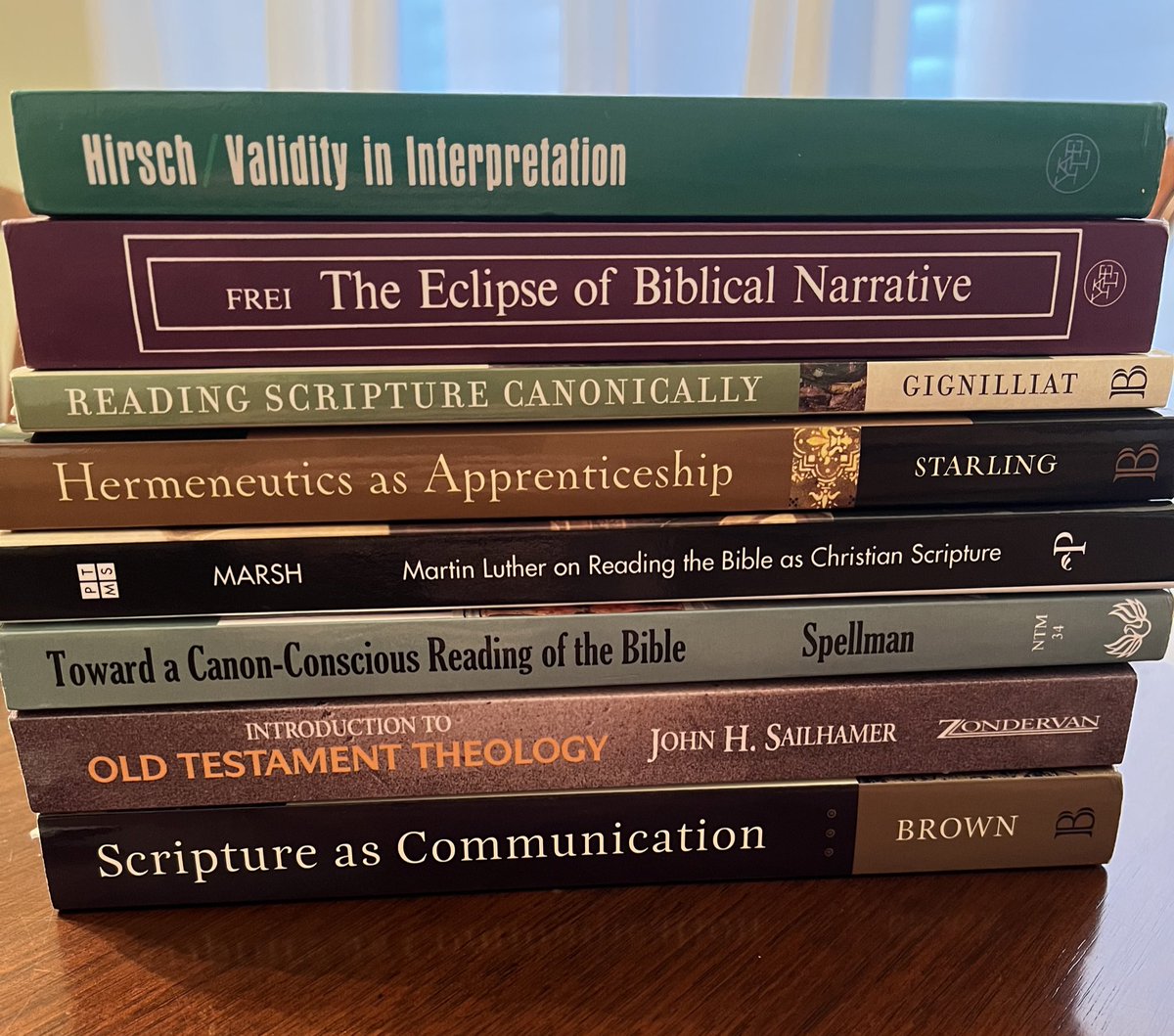
“There is no true knowledge of Christ that is not ‘according to the Scriptures,’ just as there is no true knowledge of the Scriptures that does not accord with Christ.” David I. Starling, Hermeneutics as Apprenticeship.
The New Testament canon won’t even let you have a single verse before making the OT critical for its understanding. Enjoyed that reminder from Ched Spellman in his book on Canon-Conscious reading.
Excited to begin the advanced biblical hermeneutics seminar this week and also feel like I will blow the room away when I flawlessly pronounce Gignilliat. A day one leg up.
Adam and Eve were in a bright, sunny garden, and God said, “Obey me about the tree, and you will live.” And they didn’t. Jesus Christ was in a dark garden, and God said, “Obey me about a tree, and you will be crushed.” And he did. For us. -Tim Keller, Paradise in Crisis, 1/11/09
@kristenpadilla This is so true. I think consistency in preaching voice and “normal” voice is so important. They may not have to be identical, but surely shouldn’t be night and day different. Keller had it. Robert Smith has it (which makes conversations with him so awesome).
This is exactly why I’m thankful to be a PhD student at @MBTS. I remember emailing @jasonkeithallen a simple hello on my first day of the program and hearing back the same morning. The same has been true for all of my professors. A large program felt very small quick.
This is an important discussion as the world of theological education continues to evolve. As a professor and administrator @MBTS, I'd like to share a few things on behalf of our school (and other larger doctoral programs).
-MBTS/SC has experienced significant growth over the past decade. The campus is bigger, the faculty and staff is bigger, the budget is bigger, and yes, our enrollment is bigger. We now have over 5,000 degree-seeking students with another 10,000+ taking free courses through @institute_ftc.
-Our PhD program has experienced similar growth. We're not bashful about that. We’re really proud of how God is using these students around the world.
-Doctoral programs are indeed “high touch.” Our teams have worked hard to develop systems, technology, and efficient curricular and supervisory structures to support these scholars.
-As many have noted, it's important to remember that only a small minority of students are in the dissertation phase. The vast majority of students are quietly and diligently working through seminars.
-We have 60+ professors with faculty status and many others serving as adjuncts and supervisors.
-Most faculty supervise 4-8 doctoral students at any moment. I currently have six . I emailed one this morning, have a call with one later today, and have lunch with another next week. Of course, like me when I was a PhD student @SEBTS, every student wants more access to their chair. But our students have the access they need to research and write a world-class dissertation.
-The Association For Theological Schools recently conducted their extensive 10-year review of every program @MBTS. Not only were they reaffirmed, they received the highest possible marks and required no changes (exceptionally rare). ATS even sent their leadership team to meet with ours, looking for ideas they could share with sister schools.
-Though the standards are the same, it is true that our students range in gifts and calling. Some desire the academy and are publishing books and presenting at various conferences. Others want to maximize their God-given gifts and practical ministry opportunities. Both are held to the same high standards. This diversity doesn’t dilute our program, it enriches it. Both students benefit.
-Southern Baptists have given us a job. Our job is not to maintain an elite ivy league seminary for a few luminaries. To the very best of our abilities, it's to equip every qualified student your churches send. To that end, every incoming doctoral student is recommended by their pastor, church, and a former professor, has already earned a rigorous masters degree, and averages a GPA well above 3.5.
-Ultimately, there’s no getting around the fact that the world of theological education is changing. Given the importance of the task, we’re doing our best to innovate and continue serving the Church. We'll undoubtedly do things some disagree with along the way. That's why hope you keep sharing your feedback and sending your prayers.
We need both!
With the greatest respect,
CWS
The references came from as early as Genesis 12 as as late as Revelation 22. He is preaching a specific text but showing it’s perfect place within unified Scripture. This was in no way unique for a Smith sermon but very much the norm.
In a 2018 sermon, “Adversity Theology,” from FBC Decatur, @DrRobertSmithJr inserted 32 specific Scripture references on top of his preaching passage. Thats right around a reference every minute and a half during the 46-minute sermon.
The biggest danger of moralistic preaching is that it could possibly “work.” You possibly could become nicer through your efforts. You possibly could use five steps and reduce stress. And now, the unbeliever believes they are living the spiritual life, and living it rightly.
Doctrinal preaching does not motivate the hearer to be like the biblical character; they are already. The challenge of doctrinal preaching is for the believer to be transformed into the image of Christ. -Robert Smith, Jr., Doctrine that Dances
@blake_fenn Not often the 27 time world champions feel like an underdog to a team that hadn’t won a championship in franchise history. But I’ll go Yankees in 6.