Si vous êtes favorable à un débat sur le service public entre @gabriel_zucman et @sc_cath sur la fiscalité et l’investissement, merci de relayer ce tweet…
Les enjeux économiques et démocratiques méritent cette mobilisation des média publics !
#débatéco2025
In 2024, our teamwork led to astonishing results.
Thanks to a strong improvement in our execution quality, and calculated risks taken in new product segments, we delivered €623m in revenues, +20% vs last year, €135m EBITDA, +35% vs last year, and came just 50m short of hitting the 1 billion download milestone.
But more important than the numbers is what we accomplished:
After 3 years of iterations, failures, and successive reorganizations, we successfully diversified into the €20b+ Hybrid-Casual segment, that we pioneered and now lead. Hybrid-Casual games are resilient IPs growing years after years, with a loyal and engaged user base.
You should try Mob Control, our flagship Hybrid-Casual title; Blitz, our real-money gaming platform; and Lord of the Board, the top Backgammon game on the store by our Israeli studio Beach Bum, which just celebrated its 8th consecutive year of user growth.
We managed to grow again of our Hyper-Casual business following the massive decrease post iOS 14 and ATT (App Tracking Transparency, 2021), thanks to major improvements in product quality and content. https://t.co/E77rTJIv5f 2 is a great example of this transition.
Wizz was also born internally—it was our first attempt at social networking, and is now the leading social app for teens in the US.
Looking ahead:
Our games are good, but we don’t have yet produced a worldwide massive leading blockbuster, that will significantly leave its mark on the gaming industry.
This is where we’re heading to: investing even more to build larger teams, hiring the best talents in the world, and allowing them more time to create games that will shake up the mobile gaming industry, and inspire players around the globe.
And of course, taking care of BeReal, which we were honored to acquire. We’re in the middle of the journey: two months ago, we managed to stop user churn, and we’ve been financially breakeven since early this year. Now, our focus is to innovate within the product—building features that amplify what makes BeReal magical: authenticity, no infinite scroll, algorithmic transparency, and real social connections.
I want to deeply thank:
Our employees, who are dedicated, hard-working, and ambitious—all while spreading an incredibly joyful atmosphere throughout the company.
Our investors and lenders, who believed in us and stood by us through the highs—and more importantly—the lows.
And of course, our users, for whom we dedicate our long hours and hard work to entertain.
These dudes have been calling each other the worst President in history for 80 straight minutes — and neither one of them got really offended until their golf skills were questioned. Hahaha.
Les universitaires qui soutiennent le programme du « Nouveau Front Populaire » n’ont aucune expérience de l’économie concrète et de la conduite d’une entreprise. C’est la raison pour laquelle ils ne voient pas que leurs propositions fiscales détruiraient notre système productif.
Ma tribune pour Le Figaro ⬇️
Madame la députée @Ayledain, je viens d’avoir au téléphone le propriétaire de ce brave toutou (il a 8 ans et s’appelle Moogly). Ce monsieur, parfaitement identifiable sur votre photo, me dit que vous n’êtes pas venu lui parler et que vous avez pris la photo en douce, sans son accord.
Il me précise aussi qu’il voyage toujours avec une muselière, et qu’il la met dès qu’un passager, ayant peur des chiens, se sent mal à l’aise.
Édouard, le propriétaire de Moogly, espère que les contrôleurs (très sympas et compréhensifs) ne se feront pas taper sur les doigts à cause de votre dénonciation sur X. On l’espère aussi @SNCFVoyageurs !
La prochaine fois, n’hésitez pas à entamer un dialogue avant de tweeter.
Voodoo just turned 10 this year.
It's been an adventurous journey full of hard work, fun, mistakes, ups & downs, breakthroughs, failures, fears of going bankrupt, and barely manageable growth.
Those moments truly shaped our culture, our strategy and the way we operate as a team.
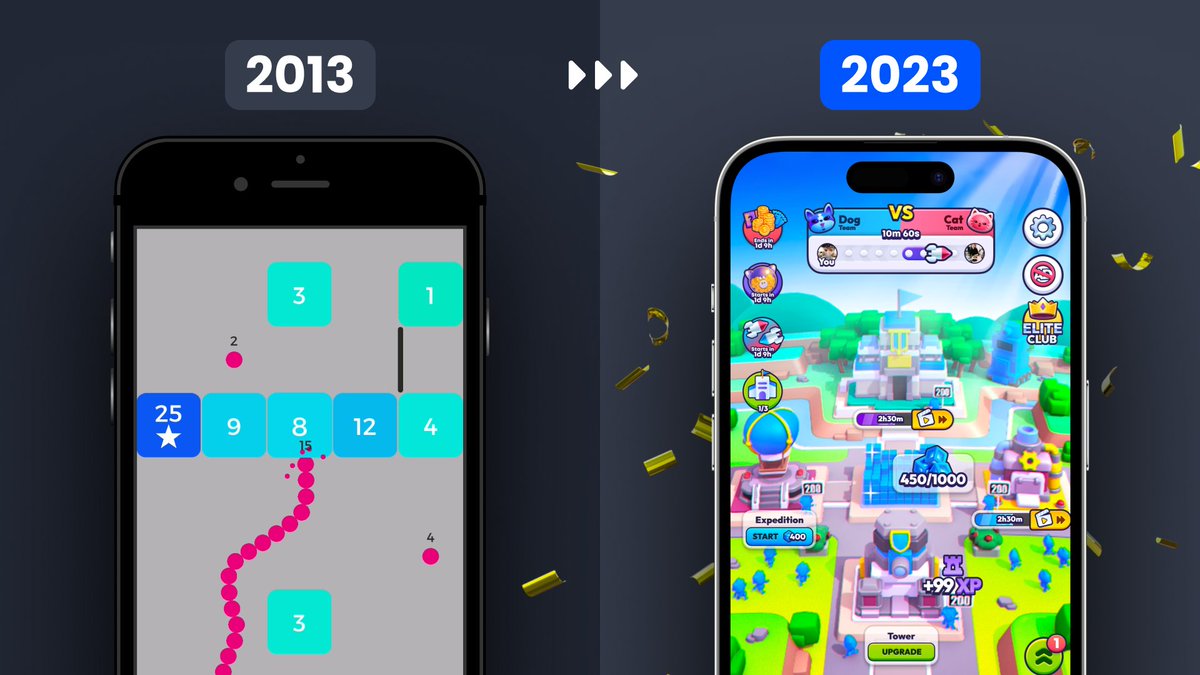
For this milestone, I am very excited to share how we transitioned from a startup mass-producing minimalistic hyper-casual games, into a more structured organization that now delivers innovative mobile products with high production value, on a global scale:
2013-2016: Doing stupid stuff
My co-founder Laurent and I started the company in 2013, mainly driven by the will to create consumer mobile products that would inspire millions of people. Even if we had absolutely no experience in either apps or gaming, we decided to take the leap anyway and launch a mobile game.
At first, we took the most stupid approach by creating a quiz (which is not a big segment in gaming) in French for the French market (which is a tiny market).
We spent endless hours debating about the shape and colors of the buttons, the style of the logo, and after 10 very long months we finally launched the game, and it was a flop. Instead of simply trashing this product and starting again from scratch, we spent another year or so iterating, and trying to build something on shaky foundations.
2016-2017: Doing less stupid stuff
We started to understand that there was no proxy between the time spent on a game and its success, and that human beings (or at least us) were not the best at predicting the success of a new idea. So we launched quite a radical experiment: we asked each of our teams to create one game per week, and release it on the app store. We would then spend a little marketing budget to get real users, and test the quality of any game concept with real data. Even if, at first, this fast prototyping strategy was not very well received by our teams, they agreed to give it a try, and it had the most beneficial effect of all time: we could kill any low-potential concept after just 5 days of coding, the teams would find shortcuts to go fast while maintaining a sleek user experience, and we would explore large numbers of ideas rapidly.
Fortunately, after a few weeks, we launched a massive hit game: Paper .io. It would reach #1 in app stores in nearly every country, and more than 35m downloads its first year. It was also thanks to the marketing expertise we had developed over the previous 4 years on weak products.
This success attracted a large number of independent studios that saw how we were working and wanted in. We decided to seize the opportunity and helped all of them, for free, and split the profit their games would generate.
2017-2018: Hyper Growth
We went from working with 20 studios to 800, and from $1m to $400m in revenues in just 2 years, with a solid $120m profit.
It was a thrilling period, but also a very stressful one. We could barely keep up with the new studios inbound, the massive growth of our games, the launch of an increasingly high number of new games, and also the onboarding of many new employees. At the same time, we had to learn to structure our organization and keep our culture, and made plenty of mistakes on those fronts.
2019-2020: Calm before the storm
Our explosive growth and massive success attracted competition. Dozens of new hyper-casual studios popped up, trying to mimic our model. Thankfully, it was complex to replicate in full, as there were numerous aspects to be mastered: studio onboarding and scaling, product coaching, growth technologies & operations, monetization, and product optimization. Even so, our market share decreased, and our growth slowed down, but we were still very profitable.
Foreseeing that the future would not be as bright in the coming years, we decided to massively invest in new ventures: higher production value games (casual & midcore), non-gaming apps, and growth technologies.
2021-2022: Hangover
Then everything fell apart.
New regulations around ads and tracking policies accelerated the decline of our hyper-casual core business: its revenues were divided by 2 in just one year, as user acquisition costs went through the roof. The vast majority of our competitors didn’t survive this massive change, and we had to implement hard, radical, but life-saving measures.
2022-2023: Reborn
Hyper-growth and large funding capabilities had created bad habits, overconfidence, complacency and a myriad of inefficiencies. Hard times helped us to get rid of them. We first had to protect the company from cash burn, as there were no scenarios in which we could raise equity or debt, given the situation we were in. We managed to go from massive cash flow loss, to comfortable cash flow generation, ensuring our long-term runway, just by cutting projects with no potential, cutting unproductive costs, and parting ways with people who did not bring true value to the company in their current positions. We chose to keep only the few strategic projects that we truly believed in for our long-term growth. We called it the “financial fast”: getting rid of the fat, but keeping the muscle, ending up lighter, but stronger.
Then some of our new venture games and apps started to ramp up, after 3 years of strategic iterations: Mob Control, Collect Em All, Block Jam, Wizz, Blitz, WeMoms are the new generation of casual/midcore games and apps that are shaping Voodoo’s future.
To achieve this, we went through a complete redesign of our organization: we kept our fast-paced core gameplay teams, but directed them towards games with more depth, and had to hire hyper-skilled teams who took those prototypes to the next level by optimizing all aspects of the games (user experience, monetization, art, economy, balancing).
We also acquired a remarkable game studio, Beach Bum, leader in mobile board games, with astonishing product execution and optimization skills, accelerating our diversification even more.
Voodoo is now a new company, stronger than ever, that has nothing to envy its young hyper-growing version. We have a variety of games and apps, with diversified business models and audiences, and highly resilient revenues, that are forecasted to reach $600m this year, hyper-casual accounting for only 25% of that.
We have the best growth teams & technologies in the world, the largest number of prototypes tested every day, and product teams that are fast, innovative, and passionate about our mission to entertain the world.
2024 and beyond: Raising the bar
Those foundations give us the confidence to push our dreams further. We want to raise the bar and build the next generation of major iconic mobile games and apps that will inspire everyone around the world.
To make that happen, we aspire to be the destination company for the people with the highest ambitions, who are seeking a platform that will let them act with strong ownership and minimal processes, while providing them with the growth and tech infrastructure to give their products the best possible life and scale.
If those words resonate with you and you want to write Voodoo next chapters with us, you can apply online or DM me directly here on X.
Entertainment is among the most advanced forms of life, and games among the most advanced forms of entertainment. Working at Voodoo to achieve this mission, surrounded by so many exciting people, is incredibly thrilling.
Thanks to all our employees, investors, partners, friends and users all around the world who have shared a part of this 10-year journey.
New to hyper-casual?
Our brand new Voodoo Academy is designed to support all newcomers to the industry by providing the knowledge, tools, and financial support you need to transform into fully established hit-making studios. 🎓
Check out more in the thread 👇