🔥 MiniMax-M3.1-Flash running on 4x NVIDIA DGX Spark
⚡ TP4 vLLM + native DSpark spec decoding
🧠 300K context, 1.42M-token KV pool
✅ 84/84 requests passed, up to six 100K prompts at once
🛠️ Full recipe, scripts + every gotcha 👇
https://t.co/VvDzhvjKrQ
🔥 MiniMax-M3.1-Flash running on 4x NVIDIA DGX Spark
⚡ TP4 vLLM + native DSpark spec decoding
🧠 300K context, 1.42M-token KV pool
✅ 84/84 requests passed, up to six 100K prompts at once
🛠️ Full recipe, scripts + every gotcha 👇
https://t.co/VvDzhvjKrQ
🔥 Kimi K3.1 Pro is #4 on the @ArtificialAnlys Intelligence Index (55)
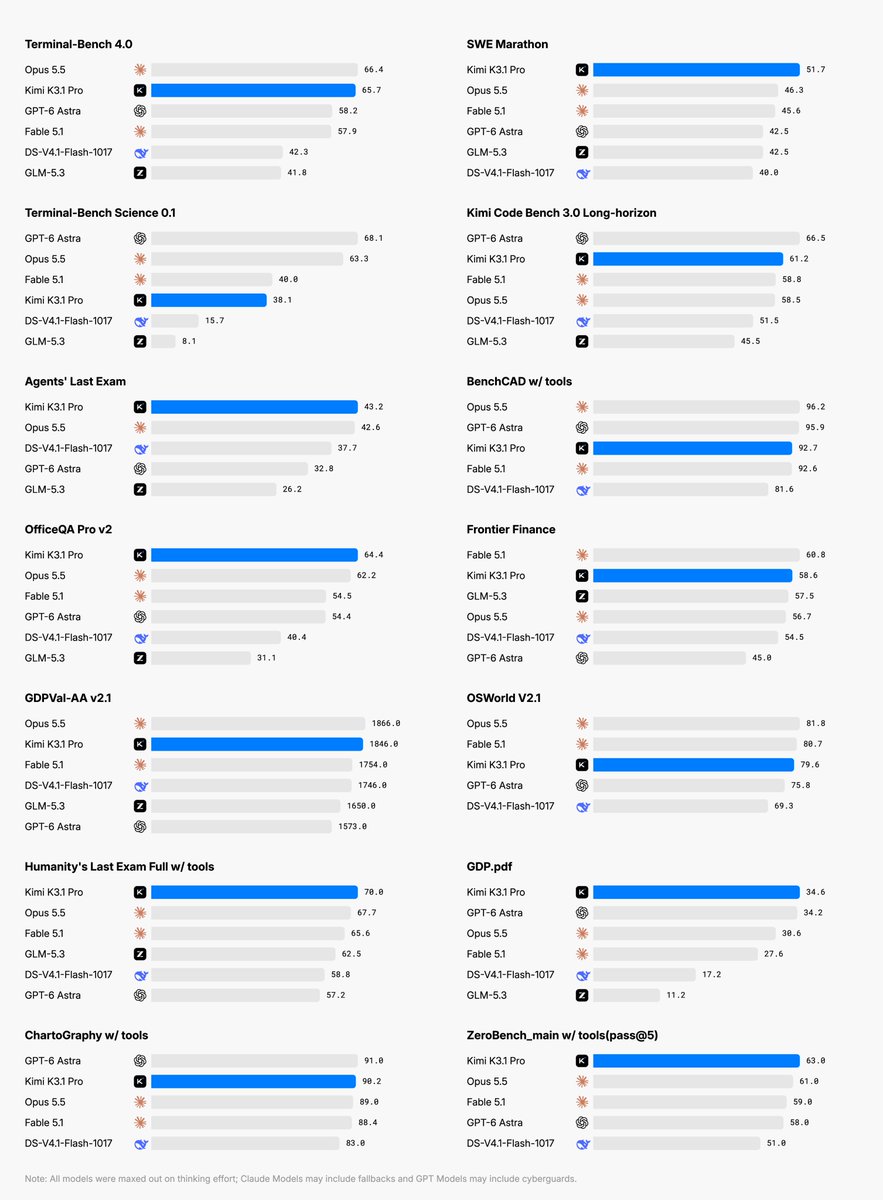
🥇 #1 on Terminal-Bench 4.0: 67% (K3: 13%)
📈 GDPval-AA: 1,846 Elo, #3
🧠 2.8T / 104B active, 1M ctx
💸 $2/$10 per 1M, 33% cheaper
When weights drop, open vs closed gap: 12 pts ➡️ 3
Kimi K3.1 Pro launches at 4th on the Artificial Analysis Intelligence Index scoring 55, making large gains in agentic performance; it will be the leading open-weights model once its weights are published
@Kimi_Moonshot's new reasoning model gains 11 points over Kimi K3 (max, 44). It trails only Claude Opus 5.5 (max with fallback, 58), Claude Sonnet 5.5 (max with fallback, 56), and Muse Wonder Full (max, 56) on the Intelligence Index.
Once the weights for K3.1 Pro are released it will be the highest-scoring open weights model and the gap between the leading open weights and proprietary models on the Intelligence Index will narrow from 12 points to 3.
Key results:
➤ Large gains in agentic performance: Kimi K3.1 Pro scores 3rd on GDPval-AA with 1,846 Elo, up 312 Elo from Kimi K3, behind only Claude Opus 5.5 (1,866 Elo) and Muse Wonder Full (1,857 Elo). Kimi K3.1 Pro also achieves the highest score of any model on Terminal-Bench 4.0. K3.1 Pro scores 67%, up from 13% for Kimi K3 and ahead of Claude Sonnet 5.5 (64%). AutomationBench-AA, which tests agentic SaaS workflows, rises from 58% to 73%.
➤ Gains in other evals are more moderate: Humanity's Last Exam rises from 47% to 52%, CritPt from 23% to 25%, and SciCode from 59% to 61%. AA-Omniscience Index rises from 20 to 30, as the hallucination rate falls from 53% to 44% and accuracy rises from 48% to 51%.
➤ Cost per Task roughly equal to Kimi K3 at $1.98 per Task: K3.1 Pro uses 55K output tokens per Intelligence Index task, 14% more than Kimi K3 at 48K, while its first-party token prices are 33% lower.
Additional model details:
➤ Context window: 1M tokens.
➤ Size: 2.8T total, 104B active parameters
➤ Input modalities: Text and image
➤ Weights and license: Weights currently not published, Moonshot is expected to release the weights soon after launch
➤ Pricing: $2/$10/$0.20 per 1M input/output/cache hit tokens, 33% lower than Kimi K3 on all three rates.
Congratulations to the team at @Kimi_Moonshot on the release!
Kimi K3.1 Pro tweet for @Tech2Wild (272/280 on X):
🚨 Kimi K3.1 Pro just dropped 🔥
🧠 3T-class open-weight model, 1M context
🏆 #1 on SWE Marathon (51.7), Agents' Last Exam (43.2), HLE w/ tools (70.0)
⚡️ Terminal-Bench 4.0: 65.7 vs Opus 5.5's 66.4
📦 Weights drop by Nov 4
Open source is CLOSE 👀
https://t.co/O1zyUNfvVW
Introducing Kimi K3.1 Pro: our most capable 3T-class open-weight model.
🔹 1M-token context, 2.8T total / 104B active params (MoE), Multimodal.
🔹 Full-project coding: games in Unreal, Unity & Godot.
🔹 Excels at parametric 3D modeling in Blender & CAD.
🔹 More reliable at finance work: Accurate modeling with hallucination down by 65%.
🔹 Matching the strongest proprietary models across coding, agentic and knowledge benchmarks.
Kimi K3.1 Pro and K3.1 Pro Highspeed (2–3× faster) are now live on https://t.co/85jA71X9gw, Kimi Work, Kimi Code, and the Kimi API.
Open weights by Nov 4, 2026.
🔗 API: https://t.co/XCrgjXAqMw
🔗 Tech blog: https://t.co/5iPP0MBej6
When I first came into the space the FIRST model my OPENCLAW Agents ran on were Kimi K2.5. I would love to be able to run Kimi locally one day... The only way though would happen is if they made a FLASH model.
🔥 MiniMax-M3.1-Flash running on 4x NVIDIA DGX Spark
⚡ TP4 vLLM + native DSpark spec decoding
🧠 300K context, 1.42M-token KV pool
✅ 84/84 requests passed, up to six 100K prompts at once
🛠️ Full recipe, scripts + every gotcha 👇
https://t.co/VvDzhvjKrQ
🔥 MiniMax-M3.1-Flash running on 4x NVIDIA DGX Spark
⚡ TP4 vLLM + native DSpark spec decoding
🧠 300K context, 1.42M-token KV pool
✅ 84/84 requests passed, up to six 100K prompts at once
🛠️ Full recipe, scripts + every gotcha 👇
https://t.co/VvDzhvjKrQ
About to Drop Minimax M3.1 Checkpoint. NATIVELY it runs on 3-4 Sparks. Comes with DSPARK already, speeds are MEH. In my opinion GLM 5.3 Flash is still probably the BEST model right now on 2 x Spark Systems. For 4 Sparks, Deepseek V4.1 Flash.
Here Me Out... Minimmax M3.1 FLASH, is basically Minimax M3 but upgraded. M3 was ALSO 428B A23B. So what they did was turn M3 into a FLASH mode. Because more than likely a PRO model is on the horizon.
MiniMax M3.1 Flash weights are now public. 428B parameters total, 23B activated per token.
Agentic performance: A generational leap in agentic tasks, coding, and cybersecurity — 76.2 on BankerToolBench, 73.7% on DeepSWE v1.1, 61.7 on OSWorld V2, 29.6 on Agents' Last Exam, and 82.2 on CyberGym.
Efficient by design: MiniMax Sparse Attention and DSpark speculative decoding improve inference efficiency.
Hugging Face:
https://t.co/JDYA1zZh54
ModelScope:
https://t.co/DQcmOjTwhO
API: https://t.co/fHRdSV7BwZ
M Plan: https://t.co/LYnYZcsesu
MCode for desktop: https://t.co/SGmLTI3fFU
About to Drop Minimax M3.1 Checkpoint. NATIVELY it runs on 3-4 Sparks. Comes with DSPARK already, speeds are MEH. In my opinion GLM 5.3 Flash is still probably the BEST model right now on 2 x Spark Systems. For 4 Sparks, Deepseek V4.1 Flash.
I Was Outside Touching Grass And Missed The Open weights ! 428B Paramets with 23B put this RIGHT in the middle of GLM 5.3 Flash and Deepseek V4.1 Flash... How we feeling about this ?
MiniMax M3.1 Flash weights are now public. 428B parameters total, 23B activated per token.
Agentic performance: A generational leap in agentic tasks, coding, and cybersecurity — 76.2 on BankerToolBench, 73.7% on DeepSWE v1.1, 61.7 on OSWorld V2, 29.6 on Agents' Last Exam, and 82.2 on CyberGym.
Efficient by design: MiniMax Sparse Attention and DSpark speculative decoding improve inference efficiency.
Hugging Face:
https://t.co/JDYA1zZh54
ModelScope:
https://t.co/DQcmOjTwhO
API: https://t.co/fHRdSV7BwZ
M Plan: https://t.co/LYnYZcsesu
MCode for desktop: https://t.co/SGmLTI3fFU