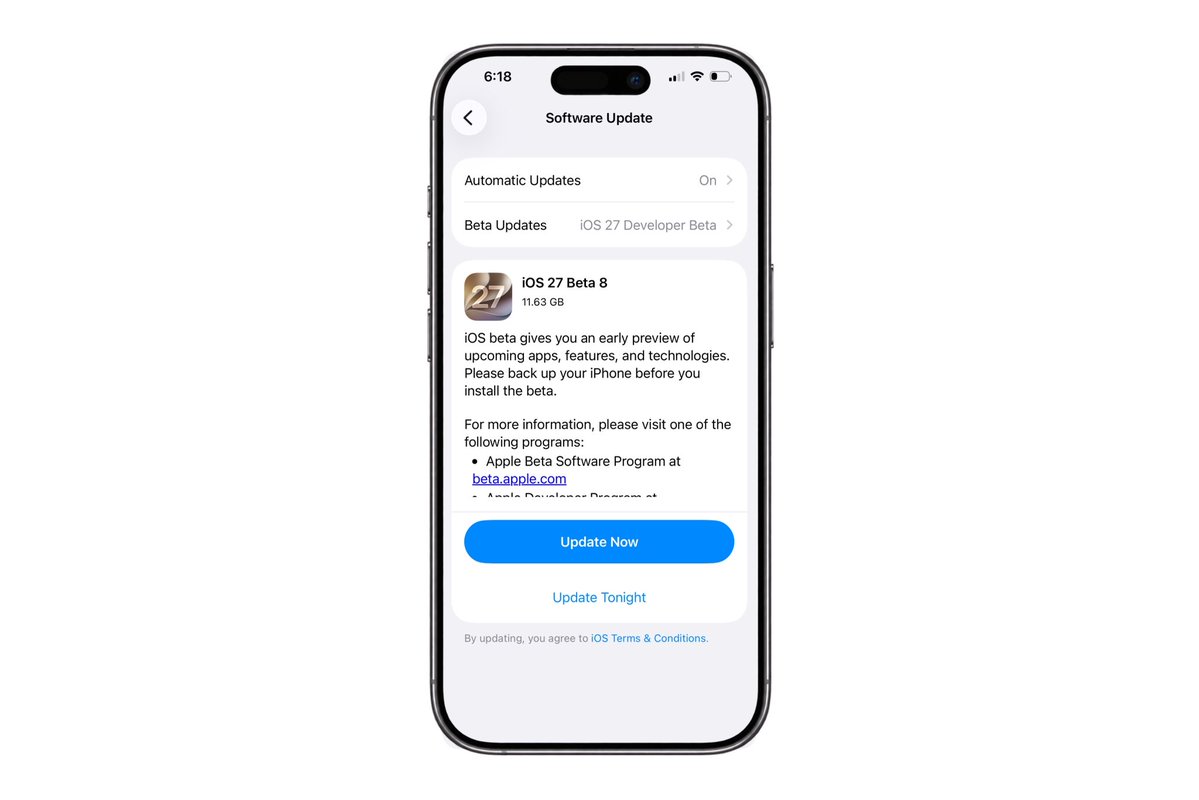
I’ve been using iOS 27 Beta 8 for the last 20+ hours and this afternoon I will be posting a detailed thread regarding all the changes, performance, battery, Siri and all so stay tuned.
#iOS27Beta8#apple
Just noticed the new little detail on Instagram 👀
Check out the new micro-interaction when hitting follow that subtle click sound and smooth morphing animation. Simple update but I kind of love it.
Is this showing up on your app too?
@TechnovityTech So that means If I talk about India, It would cost around 💀
iPhone Ultra repair cost: ₹1,09,204
Samsung charges around: ₹55,000-₹55,000
Okay Apple, I admit that I am not your target customer…
iOS 27 Beta 8 Released (31 Aug, 2026)
Update size: 1.51 GB
This update is primarily a maintenance and polish update focusing heavily on bug fixes, performance optimisation and backend stability.
#iOS27
@derekyt_@VerdeSelvans Hey, I was already on iOS 26.6.1 yesterday and last night I updated to iOS 27 Beta 8. It showed 11.63 GB for me, but the actual size was only 1.5 GB.
iOS 27 Beta 8 Released (31 Aug, 2026)
Update size: 1.51 GB
This update is primarily a maintenance and polish update focusing heavily on bug fixes, performance optimisation and backend stability.
#iOS27
iOS 27 is coming later this year and here’s the complete compatibility list ⬇️
- iPhone 17
- iPhone 16
- iPhone 15
- iPhone 14
- iPhone 13
- iPhone 12
- iPhone 11
- iPhone SE (2nd Generation and later)
Includes all supported Pro, Pro Max, Plus, mini, e & Air models.
I’ve grown up watching Apple evolve under your leadership.
From Apple watch and AirPods to Apple silicon and Vision Pro, you’ve helped shape the tech we use today.
Whatever comes next, your impact on technology will be remembered.
Thank you @tim_cook ❤️
Because hardware creates initial customers, but ecosystems capture them permanently.
True, Apple’s ecosystem is so seamless that leaving it doesn’t feel like an option.
I grew my company's market valuation from $350 billion to over $4 trillion while the world spent 15 years complaining that I was no longer capable of inventing anything new.
How does a technology enterprise multiply its value by more than 11 times without introducing a single hardware category as culturally explosive as the smartphone it inherited?
Because hardware creates initial customers, but ecosystems capture them permanently. I did not need to reinvent the wheel every autumn. I only needed to ensure every digital transaction on earth paid me a toll for turning.
Is that all? Was my transformation merely a matter of collecting tolls at the gate?
No. That misses the underlying mechanism. Toll collection requires a highway that users can't leave. I built that highway out of custom microchips, logistics perfection, and relentless capital allocation.
What was the original mistake Wall Street made when Steve Jobs stepped down in August 2011?
They assumed charisma was the primary engine of capital creation. They believed that without a product visionary at the helm, my innovation would stall and my profit margins would collapse. They confused the magic of product design with the mechanics of enterprise value.
So what did I actually do?
I replaced high variance artistic inspiration with low variance operational mastery. Steve Jobs taught me how to make people desire an object. I taught the world how to deliver two billion of those objects with zero excess inventory, maximum gross margins, and absolute supply chain control.
How did that operational control turn into US$4 trillion of equity value?
Through a dual engine of ecosystem monetisation and share repurchases that most analysts failed to model. First, I turned my hardware user base into a recurring revenue subscription engine. Services like iCloud, Apple Pay, Apple Music, and App Store commissions generated high margin cash flows that grew independently of smartphone upgrade cycles.
And the second engine?
Capital retirement. I took those vast cash reserves and spent hundreds of billions of dollars buying back my own stock. I did not waste capital on massive speculative corporate acquisitions. I systematically reduced my share count. By shrinking the denominator while expanding high margin service earnings, earnings per share compounded exponentially. I turned a hardware maker into the most effective cash compounding machine in corporate history.
What was the greatest vulnerability hidden beneath this financial machine?
Hyper concentration. My entire physical supply chain was anchored in Asia, particularly China, paired with advanced semiconductor manufacturing in Taiwan. I operated with such extreme supply chain efficiency that I held fewer days of stock than a local supermarket. If a single link in that global chain snapped, the entire assembly line halted.
How did I survive those disruptions?
By decoupling from third party chip vendors and designing my own silicon architecture. The introduction of my custom A series and M series chips gave my devices unmatched performance per watt while insulating my margins. Simultaneously, I began shifting assembly lines into India and Vietnam, quietly diversifying my geography without destroying my cost structure.
What does my success reveal about the people who buy my products?
They value zero friction over freedom. They stay in my ecosystem not because every software update delights them, but because leaving is too painful. Their photos, passwords, payment methods, and messaging habits are deeply woven into my software. The blue message bubble is not an aesthetic detail; it is a behavioural wall.
On 31 August 2026, as I step down as chief executive and hand the role to John Ternus on 1 September 2026, what am I actually leaving behind?
I am leaving behind an enterprise at its absolute peak of financial power, but standing at a structural precipice. Regulatory authorities across America, Europe, and Asia are breaking open my walled garden. My App Store fees face legal dismantling. At the same time, artificial intelligence is shifting the computing paradigm away from screen based hardware toward cloud based intelligence, where my traditional hardware lock in faces new challenges.
Did I succeed because I was a visionary, or because I understood human behaviour?
I succeeded because I understood that romance builds an enterprise, but routine scales it. Steve Jobs gave Apple its identity, but I built the machine that monetised it at global scale. I proved that a company does not need to invent the future every year if it owns the infrastructure through which the present must flow.
#Apple