🚀 AI Engineering Roadmap for 2027
What Should You Learn?
Knowing how to call an LLM API won't be enough.
The next generation of AI engineers must know how to build reliable, scalable, production-ready AI systems.
🔥 8 areas worth mastering:
1Agentic AI & Multi-Agent Systems
2RAG & Knowledge Engineering
3LLMOps & Model Evaluation
4AI Data Engineering
5Multimodal AI
6Small Language Models & Edge AI
7AI Security & Governance
8AI System Architecture
💡 My prediction: The most valuable AI engineers won't be those who know the most models.
They'll be the ones who can turn AI prototypes into secure, reliable products that deliver measurable business value.
Which AI engineering skill will matter most in 2027?
#AIEngineering #ArtificialIntelligence #AgenticAI #LLMOps
💻 System Design Interview Question:
Your production database has 500 million records.
You need to add a NOT NULL column without taking the application offline.
How would you deploy this change safely?
Expand-and-contract? Backfills? Feature flags? Rolling deployments?
What's your migration strategy?
#SystemDesign #SoftwareEngineering
🔥 Data Engineering Interview Question:
Your data pipeline processes 200 million events daily.
Suddenly, storage costs increase by 300%, but data volume grows by only 15%.
How would you investigate?
Small files? Duplicate data? Poor compression? Retention policies?
What would you check FIRST?
#DataEngineering #BigData
🚀 AI Engineering Interview Question:
Your AI agent is authorised to issue refunds up to $100.
A customer tricks it into processing a $5,000 refund.
How would you design the system to prevent this?
Prompt guardrails? Policy engines? Tool-level authorisation?
Where should enforcement happen?
#AgenticAI #AIEngineering
💻 System Design Interview Question:
Your application uses Redis for caching.
Redis goes down during peak traffic.
Suddenly, every request hits the database, overwhelming it within seconds.
How would you prevent this cascading failure?
Circuit breakers? Request coalescing? Stale cache?
What's your recovery strategy?
#SystemDesign #SoftwareEngineering
🔥 Data Engineering Interview Question:
Your Kafka consumer processes 1 million events per hour.
Suddenly, consumer lag grows to 10 million messages.
Adding more consumers doesn't help.
How would you diagnose the bottleneck?
Partition limits? Slow processing? Database writes?
What would you check FIRST?
#DataEngineering #Kafka
🚀 AI Engineering Interview Question:
Your AI model scores 98% accuracy in testing.
Three months after deployment, accuracy drops to 76%.
No code changes. No model updates.
How would you identify and fix the problem?
Data drift? Concept drift? Evaluation gaps?
What would you investigate FIRST?
#AIEngineering #MLOps
🚀 AI Engineering Interview Question:
Your AI agent executes a 5-step workflow.
Step 4 fails after the first 3 steps have modified production data.
How would you recover safely without repeating successful operations?
Rollback? Compensating actions? Checkpointing?
#AgenticAI #AIEngineering
If the failure is local to Step 4, make the step idempotent (or check for prior partial effects) and retry only that step, with checkpoints after Steps 1–3 so you don’t re-execute them.
If the issue is orchestration (missing state, race, or incomplete saga), the safer pattern is:
• Persist a durable checkpoint after each successful step
• Use compensating actions for any non-reversible side effects from Steps 1–3
• Treat the workflow as a saga: either complete remaining steps or run compensations in reverse order
Rollback only if the system natively supports it and the data changes are truly reversible. In most production agent setups, checkpoints + compensations beat full rollback.
🚀 AI Engineering Interview Question:
Your AI agent executes a 5-step workflow.
Step 4 fails after the first 3 steps have modified production data.
How would you recover safely without repeating successful operations?
Rollback? Compensating actions? Checkpointing?
#AgenticAI #AIEngineering
Once side effects have hit production, full rollback is usually the wrong tool. A solid approach is:
1. Checkpoint after every successful step, persist the completed step ID + a hash of its inputs/outputs. This lets the orchestrator resume exactly at step 4 without touching the first three.
2. Prefer compensating actions (Saga pattern) over rollback, design each step with a corresponding “undo” action for irreversible changes (e.g., reverse a charge, cancel a booking, revert a status). Only compensate what’s necessary.
3. Make steps idempotent where possible so retries are safe even if a step partially succeeded before failing.
The orchestration layer (not the agent itself) should own recovery. This keeps the system consistent, avoids duplicating work, and is far more reliable in real agentic workflows than hoping for a clean rollback.
A classic lakehouse design problem.
Approach without full rebuild:
1. Store the lake in a table format that supports row-level deletes (Apache Iceberg, Delta Lake, or Hudi).
2. Run a targeted DELETE FROM table WHERE customer_id = 'xyz' — the engine writes small delete files / deletion vectors instead of rewriting the whole dataset.
3. For historical snapshots: expire old snapshots (or set a short retention) and run vacuum/compact so the physical data is eventually purged.
4. Maintain an audit log of the deletion request + proof of execution for GDPR compliance.
Bonus: partition or cluster by customer_id (or a hash of it) so the engine only touches relevant files. Privacy-by-design (tokenising PII early, separate PII tables) makes this even cheaper next time.
Would love to hear other approaches people have used at scale.
🔥 Data Engineering Interview Question:
Your data lake contains 2 billion records.
A GDPR deletion request requires removing one customer's data from every dataset, including historical snapshots.
How would you ensure complete deletion without rebuilding the entire lake?
#DataEngineering #DataGovernance
This is a classic “success before durability” problem. The API is returning 200 before the write is fully committed (or the commit is happening asynchronously after the response is sent).
Practical redesigns that fix it:
1. Synchronous commit – only return 200 after the DB transaction has successfully committed. Simple and correct for most cases.
2. Transactional Outbox – write the business data and an outbox record in the same transaction. A separate process (or CDC) then reliably publishes/handles the side effects. The API succeeds only if the atomic write succeeds.
3. Combine with idempotency keys so clients can safely retry on failure without creating duplicates, and monitor actual business outcomes (not just HTTP status).
The goal is simple: never tell the client “it worked” until the durable state is guaranteed.
💻 Software Engineering Interview Question:
Your API returns HTTP 200, but the database transaction fails immediately afterward.
Monitoring shows 100% API success, yet users report missing data.
How would you redesign the API to guarantee accurate success responses?
#SystemDesign #BackendEngineering
🚀 AI Engineering 2027-Part 7:
AI Security & Governance
Everyone wants AI agents that can access databases, call APIs, and execute business operations.
But here's a question we're not asking enough:
What happens when your AI agent does exactly what it was told: by the wrong person?
An AI system can have excellent reasoning, accurate responses, and impressive automation.
And still be a serious security risk.
In enterprise SaaS, security cannot be something we add after the AI starts working.
AI must operate within the same security boundaries as the systems it interacts with.
🔥 6 skills AI engineers must master for 2027:
1️⃣ Prompt Injection Defence: Treat retrieved documents, websites, and external tool responses as untrusted input. Never allow them to override system policies.
2️⃣ Identity & Access Control: Enforce RBAC, row-level security, tenant isolation, and least-privilege permissions at the API and data layers.
3️⃣ Secure Tool & Agent Execution: Validate tool arguments, restrict dangerous operations, and require human approval for high-impact actions.
4️⃣ Data Privacy & Protection: Understand encryption, PII handling, data retention, residency, and how sensitive information moves through AI pipelines.
5️⃣ AI Governance & Compliance: Design audit trails, risk assessments, accountability, and policies aligned with relevant regulatory obligations.
6️⃣ AI Observability & Red Teaming: Test adversarial scenarios, monitor abnormal behaviour, and evaluate security controls continuously.
💡 Here's what I've learned from building multi-tenant SaaS platforms:
A prompt telling AI to "only access authorised customer data" is NOT a security control.
Neither is telling an agent to "never reveal sensitive information."
Authorisation must be enforced in deterministic code, independent of the model.
My preferred architecture:
✅ Authenticate and authorise every tool request
✅ Enforce tenant boundaries at the data layer
✅ Treat model output as untrusted until validated
✅ Require approvals for irreversible actions
✅ Maintain traceable, tamper-resistant audit records
✅ Test malicious inputs before production releases
And one more thing:
Human-in-the-loop isn't a substitute for security. It's an additional control.
The next generation of AI engineers won't just build systems that can act autonomously.
They'll build systems that know exactly what they're permitted to do and cannot bypass those limits.
The real breakthrough isn't autonomous AI. It's trustworthy autonomy.
💬 Would you give an AI agent direct write access to your production database?
#AIEngineering #AISecurity #AIGovernance #AgenticAI #AI2027
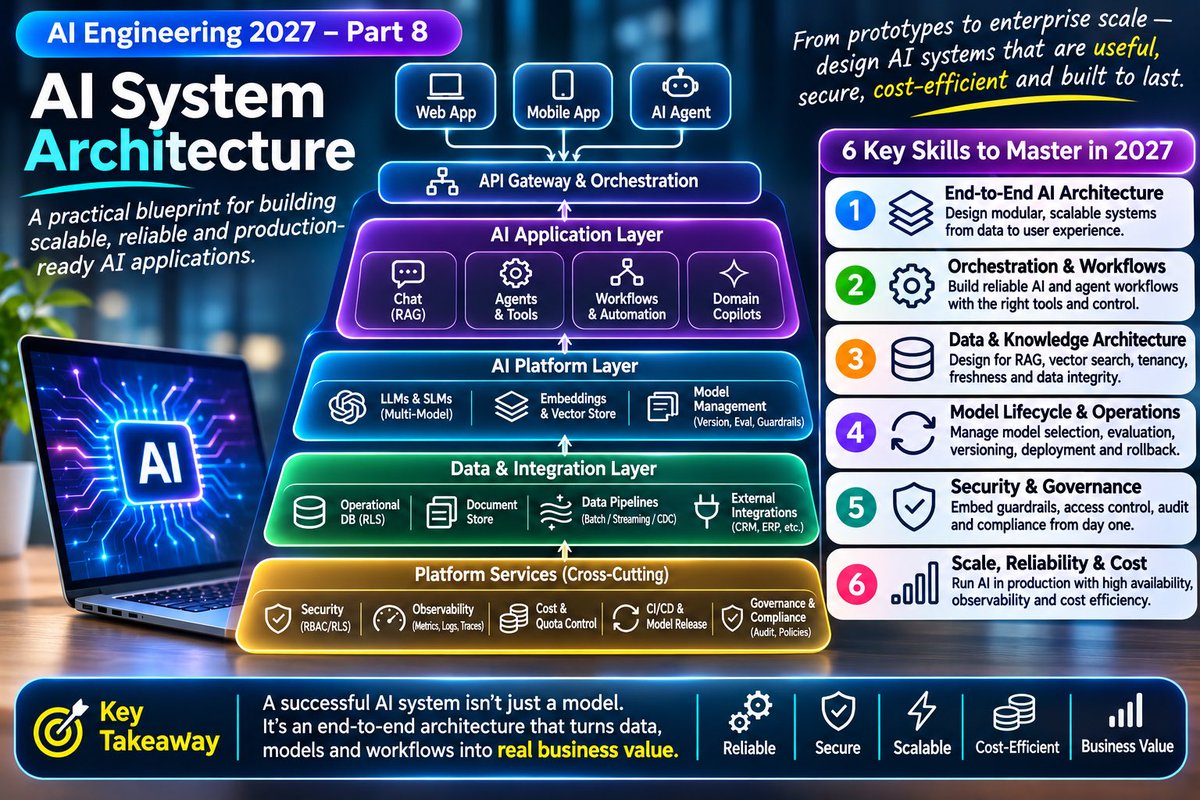
🚀 AI Engineering 2027-Part 8:
AI System Architecture
Everyone is learning how to build AI agents, RAG pipelines, and LLM-powered applications.
But here's the bigger question:
Can you architect an AI system that reliably serves 100,000 users without compromising security, performance, or cost?
That's where AI System Architecture becomes critical.
A working AI demo is not the same as a production-ready AI platform.
In enterprise SaaS, the challenge isn't simply connecting an LLM to an API.
It's making AI work reliably with existing systems, databases, users, permissions, and business processes.
🔥 7 architecture skills AI engineers should master for 2027:
1️⃣ AI-Native System Design: Architect modular systems combining LLMs, agents, RAG, deterministic services, and business workflows.
2️⃣ Scalability & Resilience: Design asynchronous processing, queues, retries, circuit breakers, rate limiting, and graceful degradation.
3️⃣ Model Routing & Orchestration: Select the right models for different workloads and avoid unnecessary AI complexity.
4️⃣ Data Architecture & Multi-Tenancy: Design reliable data flows, tenant isolation, secure retrieval, and knowledge synchronisation.
5️⃣ Security by Design: Enforce authentication, RBAC, row-level security, encryption, and tool-level authorisation.
6️⃣ Observability & Evaluation: Monitor accuracy, latency, reliability, token usage, costs, and business outcomes.
7️⃣ Cost & Lifecycle Engineering: Manage caching, infrastructure efficiency, model upgrades, deployments, rollbacks, and disaster recovery.
💡 Here's what I've learned from building and scaling enterprise SaaS platforms:
The best architecture isn't the one with the most AI components.
It's the one that uses AI only where AI genuinely adds value.
Not every workflow needs an agent.
Not every search needs a vector database.
Not every business operation needs an LLM.
And not every problem needs the largest model.
My approach to production AI architecture:
✅ Deterministic code for predictable operations
✅ AI reasoning for genuinely complex decisions
✅ Event-driven workflows for long-running tasks
✅ Strong tenant isolation and security boundaries
✅ Human approval for high-impact actions
✅ Continuous evaluation and observability
✅ Cost, performance, and reliability designed from day one
The future belongs to engineers who can turn AI capabilities into dependable business platforms.
Because the real measure of AI engineering isn't how intelligent your demo looks.
It's how reliably your system delivers value when real customers depend on it.
💬 What's the most overlooked challenge in AI system architecture scalability, security, reliability, or cost?
#AIEngineering #SoftwareArchitecture #SystemDesign #AgenticAI #AI2027
🚀 AI Engineering 2027-Part 8:
AI System Architecture
Everyone is learning how to build AI agents, RAG pipelines, and LLM-powered applications.
But here's the bigger question:
Can you architect an AI system that reliably serves 100,000 users without compromising security, performance, or cost?
That's where AI System Architecture becomes critical.
A working AI demo is not the same as a production-ready AI platform.
In enterprise SaaS, the challenge isn't simply connecting an LLM to an API.
It's making AI work reliably with existing systems, databases, users, permissions, and business processes.
🔥 7 architecture skills AI engineers should master for 2027:
1️⃣ AI-Native System Design: Architect modular systems combining LLMs, agents, RAG, deterministic services, and business workflows.
2️⃣ Scalability & Resilience: Design asynchronous processing, queues, retries, circuit breakers, rate limiting, and graceful degradation.
3️⃣ Model Routing & Orchestration: Select the right models for different workloads and avoid unnecessary AI complexity.
4️⃣ Data Architecture & Multi-Tenancy: Design reliable data flows, tenant isolation, secure retrieval, and knowledge synchronisation.
5️⃣ Security by Design: Enforce authentication, RBAC, row-level security, encryption, and tool-level authorisation.
6️⃣ Observability & Evaluation: Monitor accuracy, latency, reliability, token usage, costs, and business outcomes.
7️⃣ Cost & Lifecycle Engineering: Manage caching, infrastructure efficiency, model upgrades, deployments, rollbacks, and disaster recovery.
💡 Here's what I've learned from building and scaling enterprise SaaS platforms:
The best architecture isn't the one with the most AI components.
It's the one that uses AI only where AI genuinely adds value.
Not every workflow needs an agent.
Not every search needs a vector database.
Not every business operation needs an LLM.
And not every problem needs the largest model.
My approach to production AI architecture:
✅ Deterministic code for predictable operations
✅ AI reasoning for genuinely complex decisions
✅ Event-driven workflows for long-running tasks
✅ Strong tenant isolation and security boundaries
✅ Human approval for high-impact actions
✅ Continuous evaluation and observability
✅ Cost, performance, and reliability designed from day one
The future belongs to engineers who can turn AI capabilities into dependable business platforms.
Because the real measure of AI engineering isn't how intelligent your demo looks.
It's how reliably your system delivers value when real customers depend on it.
💬 What's the most overlooked challenge in AI system architecture scalability, security, reliability, or cost?
#AIEngineering #SoftwareArchitecture #SystemDesign #AgenticAI #AI2027
🚀 AI Engineering Roadmap for 2027
What Should You Learn?
Knowing how to call an LLM API won't be enough.
The next generation of AI engineers must know how to build reliable, scalable, production-ready AI systems.
🔥 8 areas worth mastering:
1Agentic AI & Multi-Agent Systems
2RAG & Knowledge Engineering
3LLMOps & Model Evaluation
4AI Data Engineering
5Multimodal AI
6Small Language Models & Edge AI
7AI Security & Governance
8AI System Architecture
💡 My prediction: The most valuable AI engineers won't be those who know the most models.
They'll be the ones who can turn AI prototypes into secure, reliable products that deliver measurable business value.
Which AI engineering skill will matter most in 2027?
#AIEngineering #ArtificialIntelligence #AgenticAI #LLMOps