Amazing news!
Supreme Court has asked "If both parents are IAS officers, why you still need Reservation?"
#OneFamilyOneReservation is set to become a reality!
>Dhruv Rathee lives in Germany,
>Abhijeet Dipke lives in the US,
>Takla Aprit Sharma lives in Australia.
But they want Indian students to leave their studies, join riots and protests, and put their future at risk😅
Booked a Tatkal Sleeper ticket today from kanpur central to New Delhi.
Filled every detail in seconds, but IRCTC kept showing- "We are experiencing high load."
Tried repeatedly, Then my ID got locked out. Minutes later, every seat was gone.
So the question is - who actually gets these Tatkal tickets?
Genuine passengers or a system designed to fail common people every morning?
If lakhs of users face the same "high load" issue daily, why has it still not fixed it?
Or is the chaos itself benefiting someone?
@IRCTCofficial@RailMinIndia@AshwiniVaishnaw
> Brought UGC Regulations
> Turned campuses into battlegrounds
> Minus 40 marks cutoff for NEET PG
> Caste conferences in IITs
> NEET Paper leaks
> Lakhs of students are suffering today
Still, he is never held Accountable !
I bow down to the people of TN for your verdict. Happy to see in my land, people have risen in one voice and spoken
1. No to buying of votes
2. No to dynastic Politics
& yes to a generational shift in politics.
Whoever gets it done has actually done a favour to all!
Congrats and best wishes to TVK & Thiru @TVKVijayHQ avl for a spectacular debut in TN politics. Let Almighty be with you to do what you intend to do.
And to all NDA candidates, it was a hard-fought battle on the ground. Congrats to all those who won, and for those who couldn’t register a victory this time, let’s keep fighting.
Commiserations to Thiru @mkstalin avl & Thiru @Seeman4TN avl for your loss in this election!
Finally & most importantly, I thank my dear @BJP4TamilNadu cadres and leaders for toiling hard on the ground. Better times will come soon!
His name is Arunachalam Muruganantham.
He was born in 1961 in Coimbatore, Tamil Nadu. His father died in a road accident when he was a child. His mother worked as a farm labourer to keep him in school. At 14, he dropped out to support her.
In 1998, he married Shanthi. One day, he saw her hiding a dirty rag she had been washing and reusing during her menstrual cycle because sanitary pads were too expensive.
He decided to make her affordable ones.
He made a pad from cotton and handed it to her. The feedback was devastating. He went back to experimenting. He needed volunteers to test each prototype. Medical students were too embarrassed. He tested the pads himself.
He built a uterus from a football bladder filled with animal blood and wore it under his clothes. He walked, ran and cycled to test the absorption. His clothes began to smell. The village concluded he was mad.
His wife filed for divorce. His mother left. His neighbours ostracised him.
He kept experimenting alone.
For years, he could not figure out what commercial pads were made of. Then one day, a courier arrived while he was out. His dog tore it open. Inside were samples from an American supplier. He examined the material closely.
Pine bark wood pulp. That was the secret.
He spent four years building a machine to process it. Commercial pad making machines cost Rs 35 million. He built one for Rs 65000.
He took it to IIT Madras in 2006. Out of 943 entries in the National Innovation Foundation competition, his machine came first. The President of India presented him the award.
Multinational corporations offered to buy the patent. He turned every one of them down. He sold the machines exclusively to women’s self help groups. Today, over 1300 units operate across 23 states employing thousands of women.
Five years after she filed for divorce, Shanthi saw him on television receiving the award. She called. She came back.
He held no grudge.
TIME magazine named him one of the 100 most influential people in the world in 2014. Padma Shri in 2016. A documentary inspired by his work won the Academy Award for Best Documentary Short in 2019.
He still lives in a modest apartment. He said if you get rich you have an apartment with an extra bedroom. And then you die.
Follow for stories India deserves to remember.
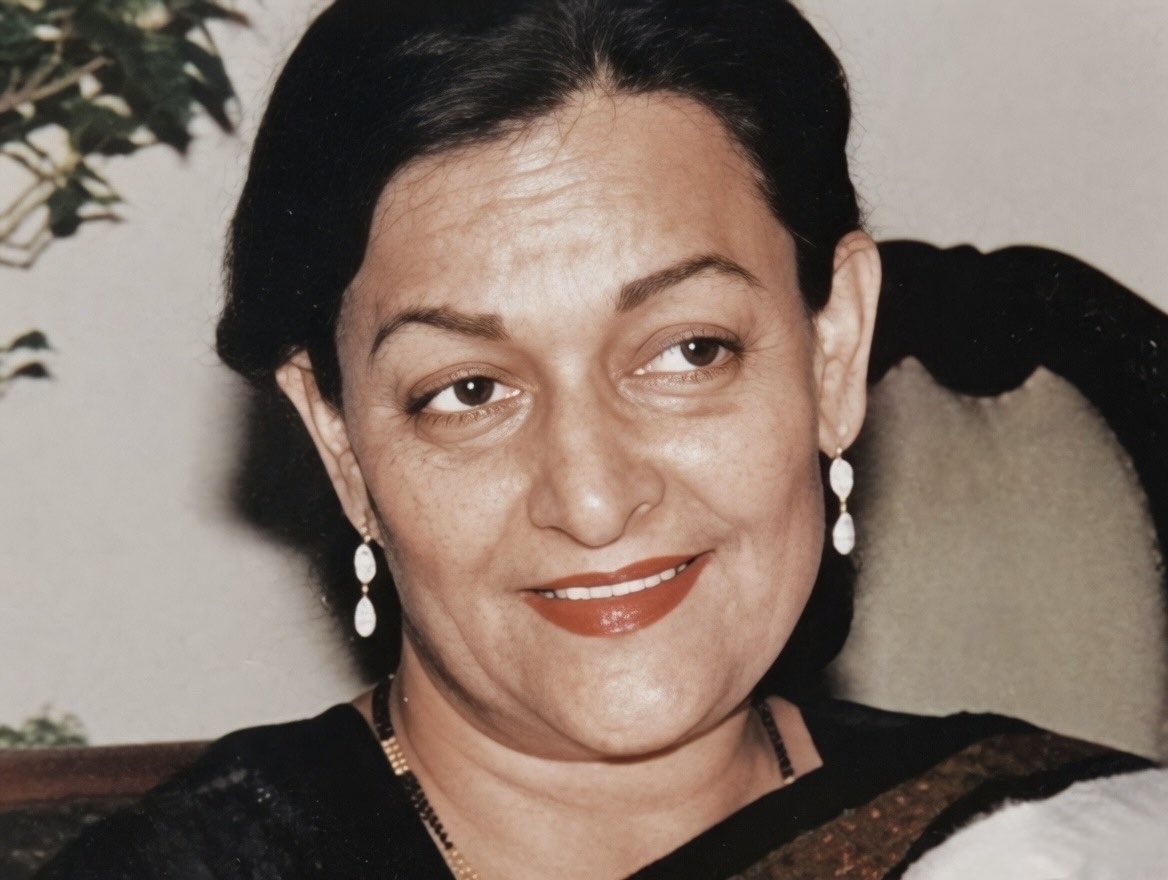
Her name is Rupan Deol Bajaj.
She was an IAS officer of the Punjab cadre serving as Special Secretary Finance. One of the most senior women in the Punjab government in 1988.
On the night of July 18, 1988, she attended a dinner party at the Chandigarh residence of Punjab’s Financial Commissioner SL Kapoor.
Also at that party was KPS Gill. The Director General of Police, Punjab. The most powerful police officer in the state.
Around 10 pm, he walked up to her and ordered her to get up and come with him. She turned to leave.
He slapped her on her posterior in front of the other guests.
She filed a complaint the very next day.
What followed was 17 years.
The police submitted a report favouring Gill. The High Court quashed her FIR. The same officer who reviewed her complaint had already given an opinion in Gill’s favour before acting as a judicial officer in the same case.
She went to the Supreme Court.
Her own mother told her to cry over it privately and move on. She received death threats. She was given punishment postings.
She fought anyway.
In 1995, the Supreme Court restored her complaint and directed prosecution. In 2005, the final verdict came. Gill was convicted under Section 354 and Section 509 of the IPC for outraging her modesty. His three month jail sentence was converted to probation. He was fined Rs 2 lakh.
She declined to accept the compensation. The court ordered it be donated to women’s organisations.
In 2010, she wrote to the government demanding they take back the Padma Shri given to KPS Gill.
The man who slapped her was never jailed for a single day.
The woman who fought him spent 17 years doing it.
Follow for real stories India never makes headlines about.
His name is Armstrong Pame.
He was born in Impa village in Tamenglong district, Manipur. No roads. No electricity. Patients carried to hospitals on bamboo stretchers.
He watched all of it growing up and decided he would become an IAS officer and come back.
He cracked UPSC in 2009 and asked for the hardest posting available.
He got Tousem. So remote that people crossed a river and walked five hours just to reach the nearest town 50 kilometres away.
He walked all 31 villages on foot. He wrote to the government asking for funds to build a 100 kilometre road connecting Tousem to the rest of Manipur.
The government refused.
He went on Facebook instead. Put in Rs 5 lakh from his own salary. His brother donated Rs 1 lakh. His mother sent his late father’s one month pension of Rs 5000.
Donations came from across India and from Indians abroad.
One morning, he arrived at the construction site and found 250 people already working. Over 100 of them were women holding spades. He asked what they were doing.
They said it is our road sir, we are doing it with you.
He raised over Rs 50 lakh in total. The road was built. It connected Manipur with Nagaland and Assam. The government of India later declared it National Highway 137.
He was awarded the Padma Shri in 2022.
He came from the village with no road.
He went back and built one.
Follow for real stories India never makes headlines about.
Her name is Ranya Rao.
She is a Kannada actress. Her stepfather K Ramachandra Rao served as Director General of Police in Karnataka.
On March 3, 2025, customs officers stopped her at Kempegowda International Airport in Bengaluru. She was carrying 14.2 kilograms of gold worth over Rs 12 crore. Smuggled from Dubai.
Investigators say she used the privileges extended to families of senior police officers to bypass standard security checks.
That was just the surface.
The total smuggling racket linked to her was valued at Rs 102 crore. She allegedly helped dispose of 49.6 kilograms of gold and route Rs 38 crore in hawala money to Dubai. Her home search recovered Rs 2.67 crore in cash and jewellery worth Rs 2 crore. Properties worth Rs 34 crore were attached.
Her stepfather was placed on compulsory leave. He was reinstated eight months later.
She was granted bail. The government then invoked the COFEPOSA Act and sent her back to Bengaluru Central Prison without trial.
She spent exactly one full year inside. She was released this week.
Investigation continues. No final verdict yet.
The system that was supposed to catch smugglers was the same system that gave her access.
Her name is Poonam Malakondaiah.
Her grandfather was a police officer in Bundelkhand known for his fearlessness. Her father was the first person in their family to become literate. He became a scientist.
She became a gold medallist in Microbiology from the Indian Agricultural Research Institute. Research was her first priority. Then someone suggested UPSC. She had no coaching money and no time. She prepared alone. She cleared it in 1988.
She had to choose between a research career she had spent years building and IAS. She chose IAS.
As Agriculture Commissioner, she dragged Monsanto to the MRTP Commission. The multinational was charging prices that were strangling Indian farmers for BT cotton seeds. She forced them to reduce the price.
She fought corruption in transport, education and civil supplies. Every department she was assigned to. Every time she acted. Every time she was transferred.
Seven transfers in six years.
Politicians. Lobbyists. Businessmen.
None of them could make her bend.
India Today named her India’s third most honest IAS officer.
She retired in June 2024 as Special Chief Secretary to the Chief Minister of Andhra Pradesh. Thirty six years of service.
Her father was the first in the family to read. She spent 36 years making sure the people of this country were not cheated.
Follow for real stories India never makes headlines about.
His name was Lalit Mehta.
He was 36 years old. A civil engineer from Jharkhand who could have worked anywhere. He stayed in Palamu, one of the most corruption ridden districts in the country.
In 1990, he built software. Not for a company. He wrote a programme that made it nearly impossible for government contractors to inflate costs and siphon off public money. He gave it away free.
He built 125 small irrigation dams with local communities at nearly half the government estimated cost. He trained villagers to file RTIs and audit government work themselves.
In May 2008, he began a social audit of NREGA projects in Chatarpur. Out of 108 names on the payment register, only 8 had actually worked. Signatures were forged. Job cards were in the names of people who had migrated. One was in the name of a dead man. An entire 5 lakh rupees pond project was fake.
He compiled everything onto a CD.
He was travelling to meet Jean Dreze the next morning to continue the audit.
He never arrived.
On May 14, 2008, his body was found in the Kandra jungle. A belt around his neck. His face smashed beyond recognition. He was buried as an unidentified body before anyone could reach him. Villagers later identified him from his clothes and exhumed the body themselves.
He is survived by his wife Ashrita Tirkey, whom he married defying caste pressure, and two sons.
His father Jagdish Mehta still holds the CD containing the evidence Lalit died to protect.
No one has been convicted for his murder.
Follow for real stories about people India must never forget.
His name was Amit Jethwa.
He was 35 years old. From Khambha village in Amreli, Gujarat.
He grew up near the Gir forest. The only place on earth where Asiatic lions still survive in the wild. He gave his life protecting it.
Most people do not know this. He was one of the key activists whose eight-year pursuit led to Salman Khan's conviction for poaching a Chinkara deer inside Gir.
From 2008, he filed six RTI applications exposing an illegal mining lobby operating inside protected areas around Gir. He named a sitting Member of Parliament, Dinu Solanki, in his filings. He filed a Public Interest Litigation in the Gujarat High Court.
On July 20 2010, he came to the High Court to file one final affidavit. It stated his life was in danger from Dinu Solanki.
He filed it. He walked out of the Satyamev Complex at 8:30 PM.
Two men on a motorcycle shot him at close range. Even after being hit, he grabbed the kurta of one attacker. The kurta had a laundry tag. The tag led to Junagadh.
A police vehicle was parked outside. Two officers heard the shot. They did not pursue the killers.
He was killed outside the gates of the very court he had come to seek protection from.
Gujarat Police gave the MP a clean chit. The Gujarat High Court called the investigation far from fair and transferred the case to the CBI in 2012.
In 2019, the CBI court convicted Dinu Solanki and six others. Life imprisonment.
In May 2024, the Gujarat High Court acquitted all seven.
The court said the investigation was a clear eyewash from the beginning. All efforts were made to ensure the truth is buried forever. It quoted Satyamev Jayate. Truth must triumph. Then it let everyone go free.
Amit Jethwa's father, Bhikhabhai, is 80 years old. He is still fighting.
No one has been punished for his son's murder.
His name was Satish Shetty.
He was 39 years old. A social activist from Pune with no political connections and no institutional backing. Just an RTI form and the will to use it.
Between 2005 and 2010 he exposed one of the largest land grab scams in Maharashtra. A real estate company had acquired land near the Pune-Mumbai highway using forged sale deeds.
After his complaints forced an investigation, 90 sale deeds were cancelled, the sub-registrar who processed the fraudulent documents was suspended and a major real estate project was scrapped.
The threat calls started. He did not stop.
On the morning of January 13 2010 he went for his regular walk in Talegaon.
He was stabbed to death on the road.
He was 39 years old.
His brother Sandeep refused to let it end there. Local police closed the case. He went to CBI. CBI went quiet. He went to Bombay High Court. He went to the Supreme Court.
In 2023 the Supreme Court ordered the case reopened.
Fifteen years. Four courts. One brother. Still no conviction.
Since the RTI Act came into force in 2005 more than 65 RTI activists have been killed in India and over 400 have been harassed or intimidated.
The Whistleblower Protection Act passed in 2014 has never been fully implemented.
In India filing an RTI costs ten rupees.
For some people it has cost everything.
Follow for real stories about people India must never forget.