The Do's and Don'ts of replacing your SaaS stack
❌ Don't replace one vendor with five disconnected tools.
✅ Do choose a platform that gives you ownership, continuity, and control over your workflows.
When reducing SaaS dependency, success isn't about swapping Slack, Drive, Notion, and dozens of other tools one by one.
It's about reducing fragmentation and regaining control over the system where your team actually works.
For long-term resilience, look for a solution that offers:
- Unified collaboration instead of stitched-together workflows
- Data ownership and portability by design
- Transparent governance and permission control
- Infrastructure flexibility that can grow with your needs
The benefits?
➡️ Less vendor lock-in and pricing risk
➡️ Better operational continuity when tools change, fail, or increase costs
➡️ Greater control over where data lives, who accesses it, and how it's governed
➡️ A stronger foundation for AI, automation, and future workflows
The goal is to ensure your business can keep operating on its own terms under a unified sovereign data platform.
How much of your team's workflow would still function if a critical SaaS vendor disappeared tomorrow?
Leave your share below 👇
#datasovereignty
Most people think AI spam is just more annoying emails. They’re missing the real shift.
We’re entering the collapse of trust infrastructure on the Internet. More 🧵
#datasovereignty
Another textbook supply-chain failure.
700+ Laravel-Lang package versions compromised through Composer malicious code that auto-runs and drops a cross-platform PHP stealer targeting cloud keys, CI/CD tokens, browser data, crypto wallets, SSH keys, and .env files.Laravel/PHP teams: your composer.lock just became an entry point.
This is not an isolated incident. It’s the predictable result of living deep inside someone else’s dependency graph. Every external package you pull in silently expands your attack surface and hands part of your operational sovereignty to a third party you don’t control.
Forward-thinking builders are done treating dependencies as “set and forget.” They’re shrinking the surface: ruthless auditing, isolated build environments, and moving critical workflows toward self-hosted, auditable infrastructure.Your stack is only as sovereign as the packages you actually trust.
What dependency hygiene practices are you enforcing in 2026? Drop them below to shar👇
#DataSovereignty
Modern teams using SaaS servers don’t have a productivity problem.
They have a context fragmentation problem.
Files in Drive, discussions in Slack, tasks in Notion, permissions somewhere else, and AI context are scattered across all of them.
Modern work is becoming operationally expensive because the system itself is fragmented.
Here’s the shift smarter teams are starting to make:
Step 1 - Stop optimizing individual tools
Most teams keep adding apps instead of fixing workflow architecture. More SaaS doesn't mean better operations.
Step 2 - Centralize operational context
Files, communication, workflows, permissions, and activity history should live together.
Context switching is invisible operational debt.
Step 3 - Make collaboration contextual
Discussions should happen inside the workspace where work actually happens. Not in disconnected chat threads.
Step 4 - Reduce dependency surface
Every external platform becomes a security layer, a governance layer, and a workflow dependency. Operational resilience starts with dependency reduction.
Step 5 - Own the permission layer
Access control is infrastructure. If another platform controls: authentication, visibility, routing, retention, you don’t fully control the system.
Step 6 - Build operational memory
Most organizations lose knowledge through fragmented tooling. A sovereign workspace preserves decisions, workflows, discussions, and execution context inside one operational layer.
Step 7 - Self-host what matters
Not everything needs to leave the cloud. But critical operational systems increasingly need deployment flexibility, infrastructure portability, governance control, and AI-safe environments
Step 8 - Think beyond SaaS
The future is not about more collaboration apps. It’s the operational infrastructure teams actually control.
Most teams ignore steps 2,4, and 5. Then wonder why their outputs don't reflect their efforts.
Build the self-hosted system first. The outputs follow.
Curious how other teams are thinking about this.
What’s currently creating the most fragmentation inside your operational stack? Share your thoughts below 👇
#datasovereignty
GitHub breach update: TeamPCP claims 4,000 private repos for sale at $50k+.
After the April RCE (millions of repos exposed) + repeated supply-chain hits, this proves the point as centralized private code is only private until the next credential slip or vuln.
Hardcoded keys and centralized targets make it inevitable. Sovereign data infrastructure and self-hosted control are now table stakes. #DataSovereignty
@somanossar This shift is real. Vendor pricing hikes and sudden policy changes are forcing boards to treat infrastructure as strategic assets, not utilities. Self-hosted open stacks are quickly becoming the resilient choice.
One of the most important infrastructure shifts happening right now is not AI. It’s ownership.
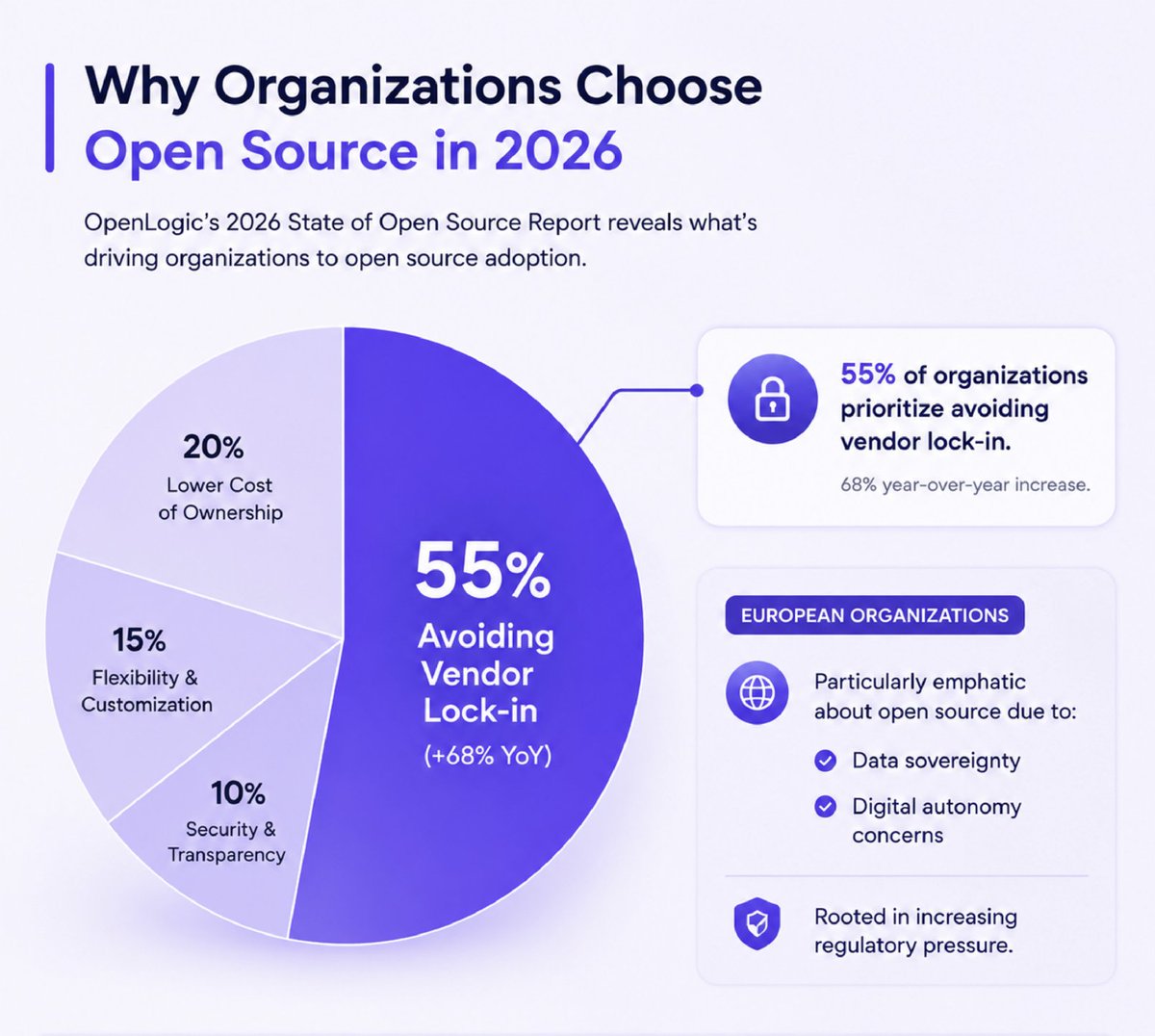
OpenLogic’s 2026 report found that 55% of organizations are now adopting open source specifically to avoid vendor lock-in, with that number growing 68% YoY. That signal matters because it reflects a much bigger change in how companies think about software infrastructure.
For the last decade, most teams optimized for convenience, including:
- Faster onboarding
- Cloud-managed everything
- Fewer infrastructure decisions
- Lower operational friction
But the tradeoff is becoming harder to ignore. Once your workflows, files, permissions, and internal knowledge all live inside someone else’s platform, your company becomes operationally dependent on vendor decisions you cannot control. Pricing changes, API restrictions, AI policy shifts, and infrastructure lock-in stop being product issues and start becoming business risks.
What I find especially interesting is that Europe is pushing this conversation much harder than other regions. Regulatory pressure is part of it, but the bigger shift is philosophical: organizations are starting to treat digital infrastructure as something strategically important to own, not just rent.
I think the future is infrastructure where teams keep the usability of modern collaboration software without surrendering control of their operational layer. That’s why I believe sovereign, self-hosted, open systems will become one of the most important software categories of the next decade.
#Datasovereignty is, and will become the default. Sooner or later.
Agree or Disagree? Share your thoughts below 👇
AI hackers are about to flip cybersecurity on its head, and it perfectly proves why #DataSovereignty is not optional anymore.
The Economist just broke down how advanced AI models (like Anthropic's unreleased Mythos) could supercharge attacks, finding exploits faster than humans ever could. Defenders might win long-term, but expect chaos first: more zero-days, automated breaches, and cloud stacks crumbling under AI-driven pressure.
Read full at: https://t.co/hhUweShGlH
This is exactly why we need to build a unified sovereign data infrastructure you actually own. No more renting your workflows on someone else's hardware where one misconfig or privileged AI agent exposes everything. Your data, your permissions, your context, fully under your control with zero-trust baked in.
In the age of AI hackers, self-hosting is not paranoid. It's the only sane path. Who else is moving their stack on-prem or self-hosted before the next wave hits?
Share your thought below & let's discuss👇 #OwnYourData #AntiSaaS
This post hits hard because I’ve lived it.
I used to juggle Slack threads, Notion pages, Google Drive folders, and random AI chats, feeling “productive” while constantly losing context. Every time I switched apps, part of the team’s knowledge disappeared.
A unified sovereign data platform is what we need to fix that.
One single workspace where files, conversations, decisions, and history live together natively without tab hell or “where did we decide that?” moments. Your team’s entire context stays connected and searchable.
This is the kind of tech innovation I actually get excited about not another SaaS layer, but a real unification of what Big Tech split apart to keep us paying and dependent.
Sovereign infrastructure with local AI? That’s the future I want to build in as self-host the chaos away feels way better than renting 12 different brains.
If you’re tired of fragmented tools killing your team’s momentum, check @DrumeeOS out & start your self-hosted pathway.
#DataSovereignty #SovereignWorkspace
SAAS PRICE INCREASE— aka a tax on dependency.
Slack +20%, Adobe +50%, Microsoft +5%.
SaaS inflation running ~11-12% YoY while general inflation sits at ~2.7%.
Math check: At 11% annual hikes, your SaaS bill doubles in ~6.5 years.
This is exactly why we built @DrumeeOS
— one data sovereign infrastructure you actually own. Your data, your server, your rules. No more renting your own operations.
#AntiSaaS #DataSovereignty
Every year, SaaS vendors call it a pricing update. But let’s call it what it really is - "A tax on dependency"
- Slack up 20%.
- Microsoft up 5%.
- Adobe up 50%.
Meanwhile, SaaS inflation is now 3.2x, growing faster than actual market inflation.
More details here 👉 https://t.co/MPVAHgWH6p
And companies still wonder why their software costs keep spiraling while their teams feel more fragmented than ever.
The problem is in the architecture. Most teams today don’t own their workflows anymore, as their files live with one vendor, their conversations with another, and their permissions with another. Institutional knowledge is scattered across 5–10 SaaS platforms, which can raise prices, change policies, throttle APIs, or lock your data whenever they want.
Convenience became dependency, and dependency became an infrastructure risk.
What’s ironic is that teams are now paying thousands per employee every year just to rent access to their own operations. That model made sense in 2015, but it has become dangerous in 2026.
We’re entering an era where sovereignty matters more than convenience, including owning your data, controlling your infrastructure, reducing SaaS surface area, and building workflows that survive vendor decisions
This is exactly why I've been working on #datasovereignty for a long time. Building @DrumeeOS as a sovereign workspace that teams can actually own. Follow & connect if you're the one chasing after this system
One context. One system. Your server. Your rules.
“Sam Altman out here preaching “responsible AI” while OpenAI quietly funnels your private ChatGPT chats straight to Meta and Google via tracking pixels?
Such a betrayal. They sold your thoughts, your secrets, your data for ad money.
Trust is dead. Time to move to AI that actually respects privacy to #datasovereignty. What a clown show!
You can still instantly tell when a workspace lacks true data sovereignty.
I can’t commit my private notes, chats, health records, and workflows to something if I see the creator isn’t willing to let me own it completely, no cloud, no telemetry, no “trust us” backdoors.
That’s why every line of @DrumeeOS is built the way I want my own data is mine.
#DataSovereignty #SelfHosted #AntiSaaS
This is what Data Sovereignty looks like in the real world.
Regional accounting firm just dropped $48,000 on a fully private AI system.
- Self-hosted Llama 4 reasoning stack
- No OpenAI, no Anthropic, no third-party APIs whatsoever
- Runs on their own H100/L40S GPUs
- RAG pipeline with Qdrant + LlamaIndex
- n8n gluing everything together
- Next.js dashboard with SSO, RBAC, document-level controls, IP restrictions & full audit logs
It’s now their internal “GPT-5-tier” tax & document analyst that processes client returns, K-1s, 1099s, IRS notices, everything, without a single byte leaving their walls.
They didn’t want cheap. They wanted full control, compliance, and zero leakage.
This is the shift as enterprises aren’t just saying “we care about privacy”. They’re wiring real money to own the stack.
Self-host or eventually get owned. More 👇
#DataSovereignty
Microsoft locking accounts over browser choice highlights a deeper systemic issue: closed ecosystems that prioritize vendor lock-in over user freedom and security.
Forcing Edge as the gatekeeper is a friction disguised as protection. In 2026, this should push more builders toward open platforms and true ownership of their tools.
Time to build elsewhere or get your self-hosted server! #datasovereignty
AI just did what years of human audits couldn’t: found macOS flaws that bypass Apple’s “secure” enclave protections.
Closed ecosystems sell you the illusion of safety until one model chains exploits they missed. This is why #DataSovereignty must be a default.
Stop renting your security and data from empires that can be bypassed overnight. Self-host or stay vulnerable!