Improvement is not what happens once it is what continues without interruption
@dgrid_ai is built on the idea that intelligence should move forward consistently not occasionally
Many systems experience moments of progress
But those moments often reset instead of building on each other
True advancement requires continuity
Reasoning keeps direction stable
Evaluation keeps standards intact
Feedback ensures each step strengthens the next
This creates progress that does not break between cycles
DGrid focuses on momentum not moments
It ensures every improvement carries forward
Over time progress stops being visible spikes
It becomes a steady upward path
In a space where most systems restart after each success continuity becomes the real advantage
Strong systems are not defined by how fast they improve
They are defined by how well they keep improving.
@dgrid_ai
From Creation to Continuity: What Happens After the Work Begins
In any meaningful system, the real test doesn’t start at creation, it begins after. It’s easy to build something that works in the moment, something that executes and delivers results under ideal conditions. But the harder question is what happens when that system is pushed and when usage grows, when data accumulates, and when time begins to expose its weaknesses.
This is where many systems fail quietly. Not because they didn’t work, but because they weren’t designed to last. Execution without continuity fades. Storage without structure breaks. Identity without consistency becomes fragmented.
A more complete approach treats these elements as connected, not separate. Systems must not only compute, but also move data efficiently and preserve what is created in a way that remains verifiable over time.
That’s where DGrid AI, Permacastapp, and Dango come into perspective—not as isolated tools, but as layers that address different points in the lifecycle of a system.
DGrid AI — Execution That Scales
DGrid AI focuses on distributing AI workloads across decentralized compute providers.
It enables:
Distributed execution of AI inference tasks
Participation from independent compute nodes
Coordinated task scheduling
Verification systems for output consistency
This ensures that computation remains scalable and not restricted by centralized limits.
Primary role: decentralized AI computation.
Permacastapp — Preserving What Is Created
Once something is produced, its value depends on whether it can be preserved and accessed reliably.
Permacastapp provides:
Permanent storage of podcast content on decentralized networks
Decentralized distribution through RSS
Blockchain-linked timestamps for verifiable publishing
Wallet-based authorship for ownership clarity
This ensures that content remains accessible and verifiable over time.
Primary role: decentralized media permanence.
Dango — Connecting Identity to the System
Systems become more complete when users have a consistent identity across them.
Dango introduces:
Wallet-based identity across decentralized platforms
User interaction within Web3 ecosystems
Activity tracking and participation
Integration with decentralized applications
This creates a consistent link between users and the systems they engage with.
Primary role: decentralized identity and interaction.
The Bigger Picture
DGrid AI handles execution.
Permacastapp ensures preservation.
Dango connects identity.
Together, they represent a system where creation, storage, and user presence are all accounted for—forming a more complete and connected structure.
TL;DR
DGrid AI enables decentralized execution, Permacastapp ensures permanent storage, and Dango provides identity—creating a system that connects creation, preservation, and interaction.
The web once lost data; Permacast secures it permanently on Arweave. Dango removes DeFi friction through a unified, user-friendly interface. Meanwhile, 0G Labs delivers ultra-fast infrastructure for decentralized AI, enabling scalable computation and storage.
The internet forgets.
@Permacastapp remembers forever on Arweave.
Your words become immutable assets.
Verifiable. Owned. Enduring.
This is how knowledge truly compounds.
DeAI needs permanence now.
Forge legacy today.
Most platforms control distribution.
What gets seen. What gets buried.
But @Permaweb_DAO is building something deeper:
It’s removing the gatekeepers of visibility.
Think about it…
On traditional platforms, algorithms decide reach.
Your work can be limited without warning.
Control sits elsewhere.
On the permaweb?
Content exists independent of algorithms.
Accessible. Searchable. Open.
That changes how creators operate:
You’re not just hoping to be seen.
You’re building something that can always be found.
Saying yes to every market impulse usually hides a missing principle. @dango becomes valuable when restraint has structure.
DNG gains weight when participation is selective, because not every opportunity deserves borrowed conviction.
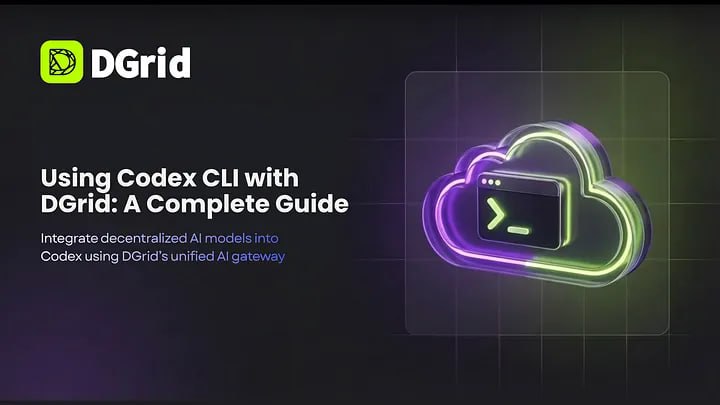
Modern coding agents like Codex CLI are changing how developers work, code is no longer just written, it’s discussed.
With DGrid AI Gateway, every request routes through a single, unified layer, flexible, model-agnostic, and built for control.
One endpoint. Multiple models.
Permanence over virality, aggregation over fragmentation, and infrastructure that assumes AI isn’t a feature, but the default user.
@permacastapp reframes content as an asset with memory, not a post with expiry. By anchoring media to permaweb, it removes the decay layer from information. The real unlock isn’t storage, it’s continuity, where ideas don’t reset every cycle but stack, reference, and evolve.
@dango compresses DeFi’s scattered surface area into a single operational layer. Not just convenience, but coherence. When execution, liquidity, and strategy live in one place, users stop navigating protocols and start thinking in outcomes. That shift is what turns tools into system.
@0G_labs is building where AI and base layers intersect, not as an add-on but as the core assumption. A chain designed for machine-native interaction changes throughput priorities, data structures, even value flow. It’s less about scaling users, more about scaling intelligence.
Intelligence becomes more valuable when it can circulate in open markets. Agents compete, creators earn, and innovation accelerates. @dgrid_ai drives this economic layer while Perma anchors the knowledge infrastructure that supports it.
Permacastapp protocolizes the spoken word as an eternal artifact, bypassing the ephemeral custody of centralized hosts. Dgrid_ai enforces inference as a verifiable public utility. If records never decay, can we truly trust an unauditable mind?
With Zero Gravity (0G)'s Decentralized Storage and Data Availability (DA), massive IoT data stays verifiable yet private. Decentralized AI Operating System (DeAIOS) supports secure stadium networks at concerts. @0G_labs
0G Labs has been explicit about something that most AI projects won't say out loud. Only one percent of global data is currently usable for AI training because of provenance problems.
The data exists. The compute to use it increasingly exists. But the infrastructure to verify where that data came from, whether it's been tampered with, and who has rights to use it, that's been missing. 0G's storage layer with cryptographic provenance trails is built precisely to fix this.
Permacast addresses the exact same gap for audio and video content. When you upload to Arweave through Permacast, the timestamp and the transaction ID are your permanent, unforgeable proof of origin.
The world is creating more data than ever. Both these projects are building the infrastructure that makes that data trustworthy.
@permacastapp@0G_labs
This is not about infrastructure becoming stronger. It is about it becoming less negotiable.
0G Labs, DGrid, and Permacast don’t just improve systems. They remove the parts that could be influenced.
0G Labs removes negotiation at the base.
Imagine building an AI-powered on-chain insurance model that recalculates risk in real time. Normally, infrastructure dictates what’s possible, slow data, expensive compute, rigid throughput. With 0G, data availability and compute are modular, so the system isn’t shaped by those limits. It defines its own capacity.
DGrid removes negotiation during execution.
That model depends on continuous AI inference. Centralized providers introduce subtle control, rate limits, outages, degraded outputs. With DGrid, inference is distributed and verified, so decisions are formed without a single point influencing them.
It doesn’t adjust to pressure. It remains consistent.
Permacast removes negotiation after creation.
Now the model publishes insights, updates, or audio briefings. On Web2 platforms, that content is conditional, it can be removed or suppressed. With Permacast, once it’s published, it persists. The output becomes fixed, not subject to revision.
Three layers. One certainty.
No limits shaping the base.
No influence shaping execution.
No authority shaping the outcome.
Subtle, but this is how Web3 moves from systems that operate within rules to systems that define their own.
A shift is happening that most people are still underestimating in Web3 AI.
It is not about building better systems.
It is about who defines the rules those systems operate on.
Control the outcomes.
OG Labs x DGrid AI x Permacast by PermawebDAO x Galxe are shaping those rules.