One of my traders sent me this today from Peter Brandt's book. (Shoutout Raymond hit me if you're on twitter)
I just scrolled my timeline and see nothing but traders talking about dealing with extreme emotional pain after today's session.
Timely.
A simple reminder nobody is forcing you to click the buttons when the action is most difficult after a prolonged period of "easy" momentum action.
Every day, try to develop greater clarity about setups. process, entries, exits, stops, sizing, timeframes, and catalysts.
The more you reorganize the knowledge and spend time understanding the setup, the easier it will be to implement.
This requires real dedication to repeatedly revisit a setup, reclarify, and reset your mind.
When you immerse yourself in this, one day it clicks, and then suddenly everything starts working.
Through more reflection and revisiting the same idea, the idea becomes part of you.
And whenever we engage in such purposeful mind-clarity efforts in any field, it always results in significant money.
Depth creates wealth.
NOTES: PTJ on trading, investing, macro
Core trading philosophy
-You make the biggest money by riding a major trend for a very long time.
-Trading is like boxing: most of the time you are jabbing, feeling out the market, waiting for a clean opening.
-The real money comes from a few “knockout” opportunities.
Examples:
Bitcoin in 2020.
Short two-year notes in 2022.
Precious metals moves.
Potential yen rally setup.
Trader vs investor
-Investors can win by believing in a long-term compounding story.
-Buffett represents the ideal investor mindset: believe in America, tolerate 50% drawdowns, let compounding work.
-PTJ says he envies that belief system but does not naturally have it.
-His own approach is more trench warfare: daily, active, defensive, alpha-driven trading.
-His fund reportedly had a negative correlation to the S&P 500, so he sees his returns as alpha, not beta.
Compound interest
-He now deeply respects Buffett as “the OG of compound interest.”
-Buffett understood compounding at age nine.
-PTJ says he underappreciated compounding for much of his own career.
Charlie Munger’s key contribution: moving Buffett from cheap “50-cent dollars” toward great companies that compound.
Risk management
-Every great trader or investor is first and foremost a risk manager.
-Liquidity is central: “You’re only worth what you can write a check for tomorrow.”
-Seeing Brother Hunt go from one of the richest men in the world to nearly bankrupt after silver collapsed (within weeks) permanently shaped PTJ’s view.
->He learned never to trust any asset blindly.
-Avoid being trapped in illiquid positions when volatility explodes.
-AI worries him because the world is deploying it with little risk management despite huge tail risks.
Market opportunities
-Big opportunities usually come from:
-Markets getting too carried away.
-An imbalance lasting too long.
-A central bank doing something wrong.
-A government doing something wrong.
-Crowded complacency.
-An undervalued, underowned asset finally getting a catalyst.
Catalyst framework
His ideal macro trade seems to need:
1. Something underowned.
2. Something undervalued.
3. Something “way out of whack.”
4. Market complacency.
5. A catalytic moment.
Example: yen.
Yen is grossly undervalued.
Japan has a huge positive net international investment position.
Much of its foreign exposure is in the US and unhedged.
->A new dynamic, “Japan first” political leader could be the catalyst. (which just got elected. See Buffett major buys into this year)
He compares potential currency appreciation to what happened under Reagan, Thatcher, or Trump-style leadership shifts.
Example:2022 two-year note trade
-He believed there was too much fiscal stimulus.
Powell stayed too easy for too long.
-Once Biden reappointed Powell, PTJ saw it as “go time” to short two-year notes.
-The logic: the Fed would have to normalize policy.
Bubbles and valuation
Valuation matters.
-Buying the S&P 500 at very high valuations historically leads to poor or negative 10-year returns.
-He mentions an S&P P/E around 22 as historically dangerous for forward returns.
-The S&P is excellent over 100 years, but that includes periods when valuations were extremely low.
-Starting valuation drives long-term returns.
-Today’s market is harder because valuations are high.
-He sees public equities, private equity, real estate, and infrastructure as much more heavily owned than in 2007 to 2008.
-Private equity exposure in institutional portfolios has risen materially, creating more illiquidity risk.
Execution
-Execution is about buying when there is fear and selling when there is euphoria.
-“Am I buying when there’s blood on the ground?”
-“Am I selling when there’s complete elation?”
-Great execution requires intense focus on intraday highs/lows and pain points.
-You need a plan before the market opens.
-The plan should be self-executing when volatility hits.
-Being two or three hours late can be materially costly.
-Information overload damages execution quality.
Information overload
-Modern trading is harder because there is too much incoming information.
-Emails, news, and signals distract from observing price, fear, greed, and positioning.
-In the pit-trading era, he could focus more purely on market behavior.
-Today, macro traders must fight distraction to maintain execution quality.
Traits of great traders
-He thinks great traders are about 70% born, 30% made.
-Key traits:Type A personality.
-Intense curiosity.
-Love of competition.
-Love of games.
-Natural probability thinking.
-Emotional resilience.
-Ability to act under maximum fear or greed.
->Trading is another form of probability theory.
Lessons from Eli Tullis
-Eli was excellent at sensing maximum fear and maximum greed.
-He waited patiently for emotional extremes.
-After a huge loss in cotton, Eli remained composed and confident.
-Lesson: when things get brutal, you cannot emotionally collapse.
-You must wear confidence and believe you can come back.
Daily process
-He plans around the US open and close.
-He reserves time before and after the close to map out the next day.
-He thinks ahead to Tokyo, Hong Kong, and London.
-He wakes during the night to watch London open and do analytical work.
-The rhythm is constant because macro is global.
-Communication as trading skill
-Journalism-style writing helped him as a macro trader.
Put the conclusion first.
-Identify who, what, where, when, why, and how.
Rank information by importance.
-Trading requires principal component analysis of many variables.
-The most important variable changes over time.
-The trader’s job is to know what matters most right now for a given instrument.
Macro framework
-Markets are interconnected capital flows.
-Trading means understanding global flows and positioning across asset classes.
-Central banks and governments often create the biggest dislocations.
-The best trades often arise when policy error meets positioning imbalance.
-You must constantly ask: what is actionable now?
AI and markets
-AI is an exogenous risk variable.
-He sees AI as a major tail risk because it is being built with a “build, break, iterate” model.
-That model works for ordinary technology, but not when the “break” could cause catastrophic social damage.
-He believes AI should be regulated.
-He specifically argues all AI-generated content should be watermarked.
-AI could cause major workforce disruption within a few years.
-From a risk-manager’s lens, AI is currently under-managed.
Passion and longevity
-Trading keeps his mind sharp.
-He sees trading as mental therapy.
-He wants to keep working because “you retire, you die.”
-He still trades because he loves markets, competition, and the ability to make money to give away.
Best distilled PTJ trading rules
-Ride big trends as long as possible.
-Protect liquidity above everything.
-Never trust an asset blindly.
-Be a risk manager first.
-Wait for extreme fear or extreme greed.
-Look for underowned, undervalued, complacent setups with catalysts.
-Policy errors create big trades.
-Valuation matters, especially for long-term equity returns.
-Have a plan before volatility arrives.
-Execute when others freeze.
-Focus on what matters most right now.
-Avoid information overload.
-Trading is probability, not certainty.
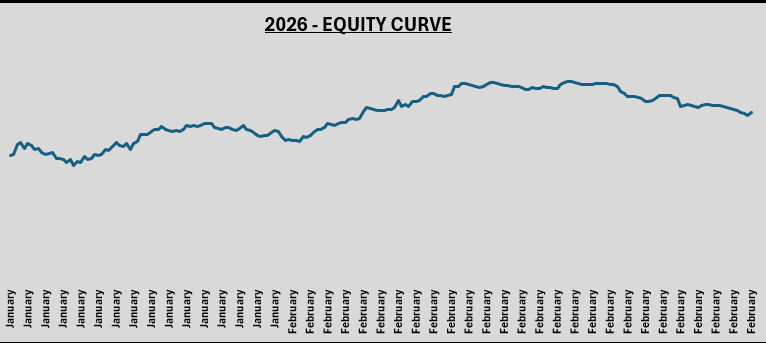
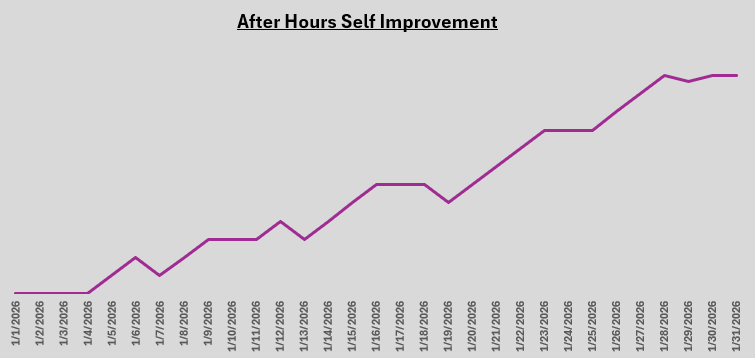
Feb - Little late posting but review was done early. First 3 weeks were going great, and last week of the month got chopped into giving back 50% of profits. Self improvement continues upward, just not with the same momentum as January - aiming for consistency
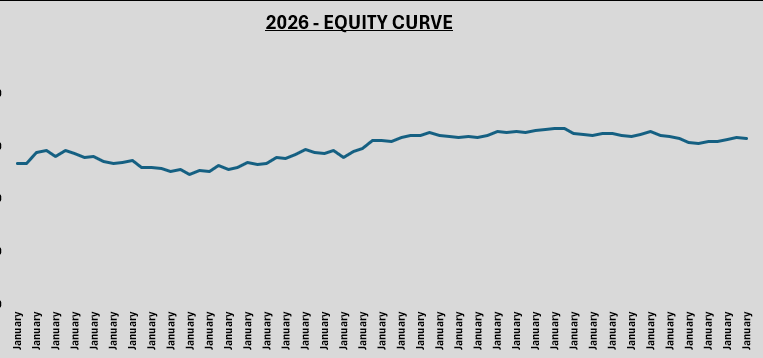
January - Pretty much flat
Incredible month of opportunity though, just did not have the experience to capitalize on it.
I'm starting to track the work I do AH to help keep myself accountable and focus on improving. The hope is that the Equity curve will be a lagging indicator to the continuous improvements & journaling done at night/weekends.
It always takes longer, costs more, and isn’t as easy as you thought it would be.
And the expectation that it shouldn’t, just makes it take longer, cost more, and be even harder should be.
FY25 -$2.3K
Finally finding the time to face the prior year performance.
Overall, its been a fantastic year of growth, if there was a chart for this, it would be exponential. For that I can look back at 2025 and be content.
Still not profitable and that is obviously a bummer as it felt at many times during the year that it was going to be the year I finally found my stride.
From Jan to May things were going OK with my initial strategy, however an accident in SBET made me go on tilt.
I went to work HARD back to the drawing board and back testing. My new strategy was promising and I Monte Carlo'd that that thing - everything looked good so I committed. Things worked out initially, I almost made back my entire SBET fiasco. Then, end of October hit, and I've been on a DD since and it seems many others too in the Small Cap space.
So, going into year 6 of trading, the biggest take away from last year I'm carrying over is that the nights of hard work paid off the most. Not the hours listening to trading podcasts, youtube videos, or X posts. It was the nights of journaling , charting, and excel work that gave me the best strides forward - Its what will get me out of this Drawdown.
Pivot, pivot, but never quitting.