Let us reject the logic of violence and war, and embrace peace founded on love and justice—an unarmed peace, not based on fear, threats or weapons. This peace is disarming, because it is capable of resolving conflicts, opening hearts, and generating trust, empathy, and hope. I strongly reiterate: The world thirsts for #Peace! Enough of war and all the pain it causes through death, destruction, and exile! #ApostolicJourney #Cameroon
God does not bless any conflict. Anyone who is a disciple of Christ, the Prince of Peace, is never on the side of those who once wielded the sword and today drop bombs. Military action will not create space for freedom or times of #Peace, which comes only from the patient promotion of coexistence and dialogue among peoples.
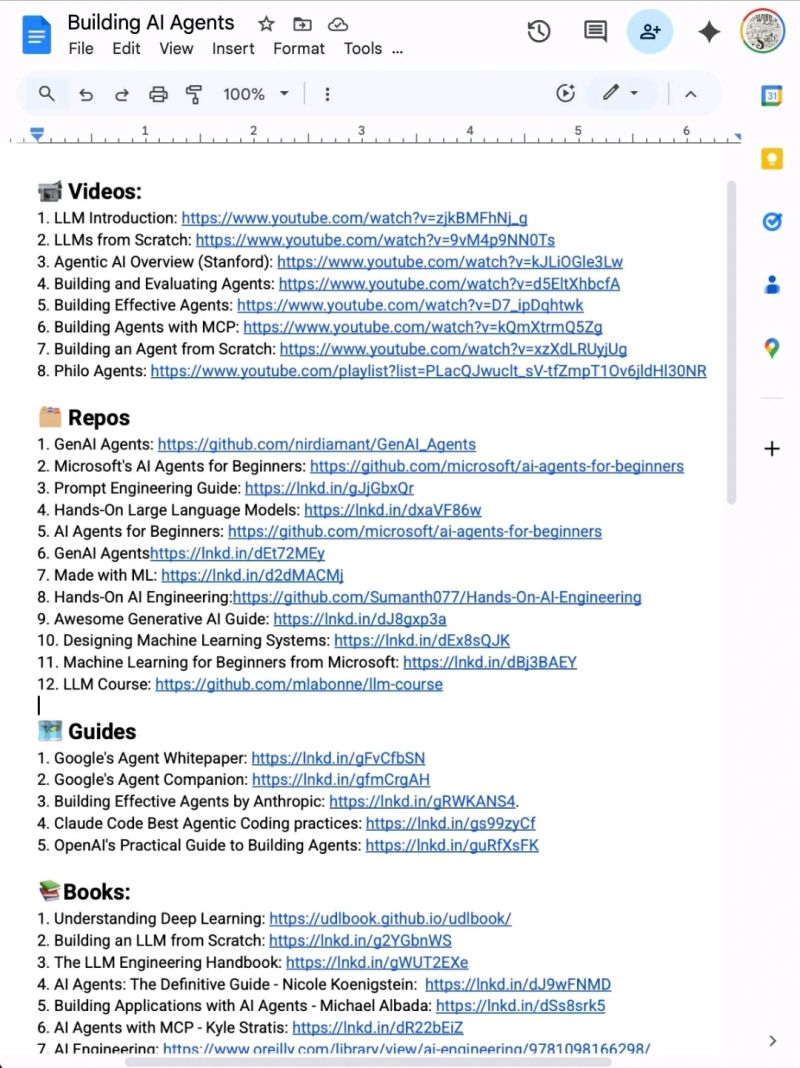
Stop wasting hours trying to learn AI. 📘📚
I have already done it for you.
With one list. Zero confusion. And no fluff
📹 Videos:
1. LLM Introduction: https://t.co/MfZHtEFSZC
2. LLMs from Scratch: https://t.co/kfPUVOpIxp
3. Agentic AI Overview (Stanford): https://t.co/YwfdVehhsO
4. Building and Evaluating Agents: https://t.co/6S8FGJRYbE
5. Building Effective Agents: https://t.co/pDTKM04SbE
6. Building Agents with MCP: https://t.co/5tXUZo9Xri
7. Building an Agent from Scratch: https://t.co/BtDWY0u0Du
8. Philo Agents: https://t.co/A4bj3gDOAg
🗂️ Repos
1. GenAI Agents: https://t.co/XbindjiOGu
2. Microsoft's AI Agents for Beginners: https://t.co/6Yaapil6AA
3. Prompt Engineering Guide: https://t.co/9JyzmoITLO
4. Hands-On Large Language Models: https://t.co/cuFS03HiXZ
5. AI Agents for Beginners: https://t.co/6Yaapil6AA
6. GenAI Agentshttps://lnkd.in/dEt72MEy
7. Made with ML: https://t.co/vDNcCdZ8Ni
8. Hands-On AI Engineering:https://t.co/GZs4q8rSYc
9. Awesome Generative AI Guide: https://t.co/EdJ1eGDF0m
10. Designing Machine Learning Systems: https://t.co/Nf1szfXGWK
11. Machine Learning for Beginners from Microsoft: https://t.co/gEdhvs78o3
12. LLM Course: https://t.co/4ISw9XBGWe
🗺️ Guides
1. Google's Agent Whitepaper: https://t.co/fQ64JT8Hru
2. Google's Agent Companion: https://t.co/NHt05sw0Sx
3. Building Effective Agents by Anthropic: https://t.co/VjaqhSl1jz.
4. Claude Code Best Agentic Coding practices: https://t.co/yBGMtyeWTg
5. OpenAI's Practical Guide to Building Agents: https://t.co/kmqQgcvvwL
📚Books:
1. Understanding Deep Learning: https://t.co/cgSSJ1U1d6
2. Building an LLM from Scratch: https://t.co/IUVA1tpJJ2
3. The LLM Engineering Handbook: https://t.co/G5HGLfTTq9
4. AI Agents: The Definitive Guide - Nicole Koenigstein: https://t.co/kehojr3v2p
5. Building Applications with AI Agents - Michael Albada: https://t.co/QHaJEitMMN
6. AI Agents with MCP - Kyle Stratis: https://t.co/POn6waJ2w7
7. AI Engineering: https://t.co/rU9HES8VEU
📜 Papers
1. ReAct: https://t.co/q4zflGWTVT
2. Generative Agents: https://t.co/GK5QswcPQ2.
3. Toolformer: https://t.co/mhDey5PGJL
4. Chain-of-Thought Prompting: https://t.co/3kwFbejFqA.
🧑🏫 Courses:
1. HuggingFace's Agent Course: https://t.co/jIyZzuScoQ
2. MCP with Anthropic: https://t.co/ph5cM4zgx1
3. Building Vector Databases with Pinecone: https://t.co/VtA6lSCaQd
4. Vector Databases from Embeddings to Apps: https://t.co/mr9rePzbc3
5. Agent Memory: https://t.co/hjWM88dY2h
Repost for your network ♻️
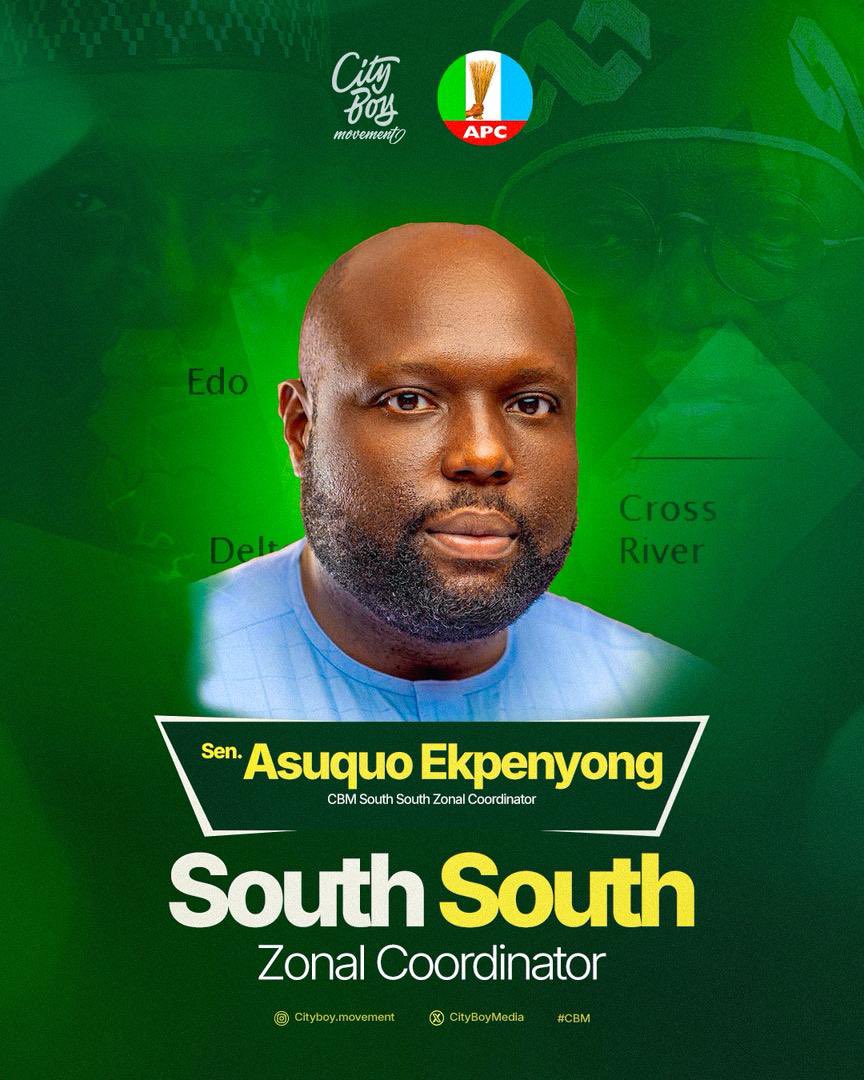
We are proud to introduce Senator Asuquo Ekpenyong as the Cityboy Movement South-South Zonal Coordinator! 🙌🏽 @A_Ekpenyong
A distinguished leader and transformational public servant, Sen. Ekpenyong represents Cross River South Senatorial District in the 10th Nigerian Senate one of the youngest and most influential voices in Nigeria’s democracy today 🇳🇬. 
A brilliant economist and financial expert, he served as Cross River State Commissioner for Finance, starting at just 29 making him one of Nigeria’s youngest commissioners. 
In the Senate, he has championed development, youth empowerment, education, infrastructure and legislative reform across the Southern region. 
His leadership is marked by grassroots impact, real progress for communities, and unwavering dedication to inclusive governance. 
As Zonal Coordinator for the South-South, Sen. Ekpenyong brings vision, energy and strategic direction to our movement’s mission of empowering youth, strengthening communities, and driving positive change. 🚀
Join us in welcoming him as we continue to build a better future together! 💚
#CityboyMovement #SouthSouthCoordinator
cc: @STinubu
Most people use LLMs.
Very few actually understand how they work under the hood.
If you want to go from prompt user → real AI engineer, study these 9 concepts in order:
1️⃣ Transformers — attention, tokens, self-attention basics
https://t.co/5YmBhXQrpu
2️⃣ Transformer tricks — what makes them stable & scalable
https://t.co/QFvPbLVuMt
3️⃣ From Transformers → LLMs — how scale changes behavior
https://t.co/1mbXcogTGF
4️⃣ LLM training — where “intelligence” actually emerges
https://t.co/4PnlOTPjbT
5️⃣ Instruction tuning & alignment — why fine-tuning matters
https://t.co/r5XbxsJvpu
6️⃣ LLM reasoning — why models fail + what improves them
https://t.co/0wzxbMtIIk
7️⃣ Agentic LLMs — models that plan, call tools, and act
https://t.co/oG0VaEWqp0
8️⃣ LLM evaluation — measure beyond demos & vibes
https://t.co/nLtvJW4n6W
9️⃣ What’s next — trends that actually matter
Bookmark this. Study step-by-step. Your prompts will level up — and so will your builds.
Every week at the UN, I spend hours researching the latest developments in AI, tech policy, and emerging technologies.
I’ve created a list detailing dozens of tools that I find most helpful for my work and independent research: https://t.co/AsN8O6Cit8
Too many Africans still believe the myth that their countries are SO rich in natural resources, if they were just honestly managed, there'd be prosperity for all.
Yet, no African country is in the top ten in terms of natural resource wealth👇
But look at likes of China, Canada and US on the list. Despite having more resource wealth than any African country, they've never RELIED on that for their prosperity.
They've all, at some point in their economic histories, focussed on actually producing stuff, innovating, creating wealth and value. Creating the right environments for people and businesses to thrive.
Yes, some African countries like Nigeria, DRC and South Africa, have sizeable natural resources. But not at a Russia, Saudi Arabia or Venezuela level. What they have can, at best, provide a basic foundation to build a more developed economy on.
Yet, many Africans still have this mindset of "we are rich, we just need good leaders who will share the national wealth with us."
This belief fosters an extractive mindset and expectant mindset, not a creative and productive mindset. It fuels passivity, with people waiting for "good leaders" to come and share the wealth.
There is absolutely no doubt African countries need much better leaders who won't loot the little wealth available.
But it is key that Africans shed this belief that their nations are fantastically rich in resources. It is almost never true and quite counterproductive.
I have a theory: Nigerian leaders struggle to handle complexity and anything with moving parts. We can pour concrete. It’s pretty straightforward. I guess that is why people see roads being built and say that Governance is not rocket science. If roads are what they mean by governance, they would be right: it’s not rocket science.
When it comes to complexity, multiple components, or moving parts, our leaders tend to struggle. For instance, electricity involves generation, transmission, distribution, metering, billing and tariff management. Complexity. We don’t handle it well.
That is why, when a new governor succeeds one who has already poured concrete, they seem clueless about what to do next. Facilitating the economic activity that will make use of the roads and buildings is harder than pouring the concrete to build them. It requires brain power. Complexity hurts the brain. We don’t like it.
In countries like France, most politicians would be expected to have attended one of the governance schools if they want to seek high public office. In the UK, you would probably have studied Politics, Philosophy and Economics at Oxford or Cambridge. In the USA, it would be usual for you to have attended an Ivy League university. Same as Japan and Singapore. In all these places, you would be exposed to complexity, innovation and problem-solving.
In Nigeria, all you need is to have completed a course of secondary education. Did you know that you actually don’t have to have a WAEC certificate? You just need to have finished secondary education, you don’t need to have passed WAEC or even NECO. Is it surprising the quality of leaders that we have?
It is not about having a PhD. Most Nigerian governors with PhDs have been thoroughly disappointing. It is more about being equipped with the skills and intellectual rigour to handle the complexity of governing others and making the best decisions on their behalf.
I would suggest that we upgrade the Public Service Institute of Nigeria and the Administrative Staff College of Nigeria into proper governance schools. We should then make
it mandatory that all politicians who want to occupy elective executive positions (like LGA Chairman, Speaker, Senate President, Deputy Governor, Governor, Vice President or President) must attend and graduate from those institutions before they can even seek any elective public office at all.
Do you agree with my theory? If not, do you have a counter theory? If you agree, do you think that this would make any difference? If you think that it won’t make any difference, what do you think would? #NaijaKnowledgeX
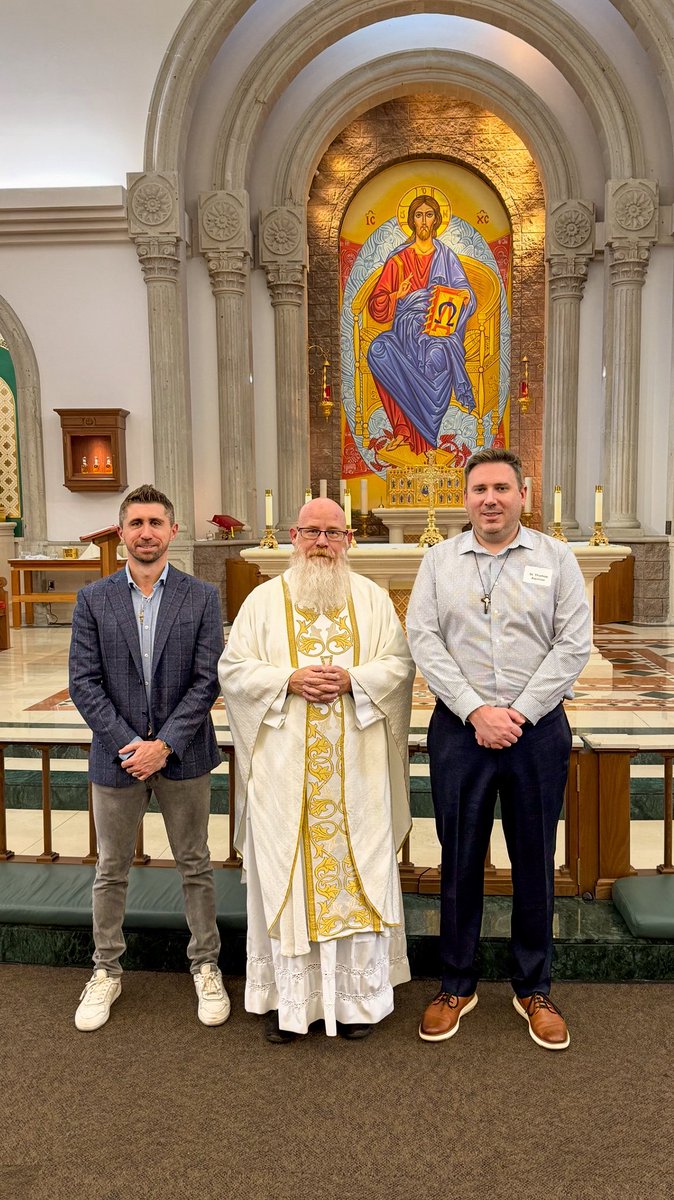
Today, I was confirmed into the Holy Catholic and Apostolic Church.
It wasn’t easy. Honestly, it was one of the hardest things I’ve ever done. When people like Keith Nester, John Bergsma, or Scott Hahn say many converts “come into the Church kicking and screaming,” they aren’t joking.
I grew up in an evangelical/Reformed world where some sermons were solid, and others felt like they were stitched together by proof-texting verses to support a particular message. At the time, I accepted a lot of the anti-Catholic ideas like, the whore of Babylon, the church of Antichrist, and all the usual claims. But even when I believed those things, something in me always felt… unsatisfied.
It was like an itch I couldn’t scratch, a thirst I couldn’t quench, a hunger I couldn’t satisfy.
And because of that, I wandered, spiritually, like Israel in the desert, searching for a home.
Every new church required reading the mission statement to make sure it aligned morally with Scripture, especially on issues where the wider Protestant world was deeply divided. Despite hearing, “We’re all unified in Christ,” it was painfully clear that the teachings were anything but unified. I must have visited nearly every church in the Phoenix area, and yet that spiritual thirst remained.
And when the soul is starving, it begins to look elsewhere.
Sin becomes tempting, like an apple hanging from a tree, bright and perfect on the outside, but turning to ash and vinegar the moment you bite into it. And sadly I found myself there ALOT.
As I dug deeper into my faith, I asked myself:
Would a loving, all-knowing God really leave us wandering spiritually homeless, trying to piece together truth on our own?
The idea of an “invisible church of visible members” never made sense. And in every debate I watched, the Catholic side didn’t just argue well, they argued coherently, biblically, and historically.
Everything changed the night I attended a Midnight Mass on Christmas.
The liturgy, the incense, the music, the Scripture readings, the reverence, it was the most beautiful thing I had ever seen. It washed over me with a sense of peace and belonging, a feeling I had never experienced in worship before. It felt exactly like coming home.
It was like the Father in the parable of the prodigal son. Running toward me, arms open, patiently waiting for me to return. In that moment, something deep in my soul whispered: This is it. This is the Church.
As I read the Church Fathers and studied history, I realized the Church Christ founded was not a tiny mustard seed lost to time, but a towering mustard tree, ancient, rooted, full of saints and sinners, good popes and bad popes, and yet unchanged in the faith it has carried for 2,000 years.
Today, before entering the confessional for the first time, I understood why many leave the Church or fear entering it: because holiness is hard.
Walking into that confessional was humbling. It exposed how far I had fallen from grace, but also how deeply God longs to draw us close. And when I walked out, went through the Mass, and received the Eucharist for the first time, the priest’s words pierced me:
“Peace I leave you, my peace I give you… look not on our sins, but on the faith of Your Church.”
At that moment, I felt the peace, unity, and love Christ gives through His Church. I saw how the Holy Spirit had been working through so many people, apologists, friends, Bible study discussions, debates, all planting seeds like patient gardeners for the Lord.
If you’re reading this, I want to extend the same welcome, kindness, and embrace that the Church extended to me.
Please, come to Mass. Experience the liturgy.
It is truly heaven on earth.
And I pray that one day, you, too, will find your way home.
God bless.
In various parts of the world, Christians suffer discrimination and persecution. I think especially of Bangladesh, Nigeria, Mozambique, Sudan, and other countries from which we frequently hear of attacks on communities and places of worship. God is a merciful Father who desires peace among all His children! I accompany in prayer the families of Kivu, in the Democratic Republic of the Congo, where in recent days there has been a massacre of civilians. Let us pray that all violence may cease and that believers may work together for the common good.
If you’re self learning and can’t afford to pay for cohorts check these YouTube Channels to Learn Data Analysis
DAX - LearnwithWittig
SQL - AlexTheAnalyst
PowerBI - Guy in the Cube
Statistics - StatQuest
Tableau - Tableau Tim
Ms Excel - Excellsfun
Python - Bro Code
Stop writing aimless research papers.
This framework shows exactly what each section should accomplish:
Abstract: Question → Method → Findings → Impact
Intro: Broad problem → Field gap → Your specific contribution
Results: Logical progression from raw data to final analysis
Discussion: What you found → Limitations → Real-world implications
Every paragraph has a purpose. Follow the structure.
The Anatomy of a Strong GPT-5 Prompt.
6-step structure to unlock AI's full potential.
[🔖 bookmark this to upgrade your prompts]
1. Role
→ Assign GPT-5 a defined role to shape its perspective.
→ Framing expertise improves clarity and focus in answers.
2. Task
→ Clearly state the action you want GPT-5 to perform.
→ Make the outcome or deliverable specific and measurable.
3. Context
→ Provide details that help GPT-5 deliver accurate results.
→ Include background, limits, and examples where relevant.
4. Reasoning
→ Instruct the model to think through the problem.
→ Ask for a brief logic or a stepwise approach before the answer.
5. Output
→ State clearly how the response should be delivered.
→ Indicate format (bullets, steps, tables, or narrative).
6. Conditions
→ Set boundaries for scope, length, or stopping points.
→ Tell it when to stop or move to the next step.
Use this framework to get expert-level answers from ChatGPT.
📌 Get Advanced ChatGPT Guide (free): https://t.co/kOBWfKrBaX
👉 Follow me @AndrewBolis for more and 🔄 Repost this to help others use AI
I would like that today we may together begin to build a culture of reconciliation. We must meet one another, heal our wounds, and forgive the wrongs we did and did not do, but whose effects we still carry. There are no enemies — only brothers and sisters. What we need are gestures and policies of reconciliation.
We face moments when holding things inside can slowly consume us. Jesus teaches us not to be afraid to cry out, as long as our cry is sincere, humble, and directed to the Father. A cry is never pointless, if it is born of love. And it is never ignored, if it is entrusted to God. It is one way to continue to believe that another world is possible. #GeneralAudience
24 Academic CV Guides (and Downloadable Templates) from Universities in the USA, Canada, UK, and Australia
USA 🇺🇸:
1. Harvard University: https://t.co/VFf9dQFxSW
2. Stanford University: https://t.co/C3NMbUDF2y
3. MIT: https://t.co/NCO89LJYsK
4. Yale University (7 templates): https://t.co/67OFhZW6Pp
5. Princeton University: https://t.co/oixBkDQ1aD
6. University of Illinois Urbana‑Champaign: https://t.co/UmhGfEHZiO
7. University of Tampa: https://t.co/U7byq2OQZ0
8. Cornell University (5 templates): https://t.co/41XeuMxMKk
9. University of Arizona: https://t.co/iLZgXBVFvH
Canada 🇨🇦:
1. University of Toronto: https://t.co/HZBug9Xjlz
2. University of Manitoba: https://t.co/Na5xZZxy6q
3. McGill University: https://t.co/Nfs8tMvMVW
4. York University: https://t.co/VHcjBbkHW1
5. The University of British Columbia: https://t.co/5nF4npJFfE
UK 🇬🇧:
1. Oxford University: https://t.co/KtXkSxqhSb
2. University of Cambridge: https://t.co/TMvitSi9wy
3. University College London: https://t.co/bJLsCVN6UN
4. The University of Manchester: https://t.co/aZAWMu18Gi
5. University of St Andrews (10 templates): https://t.co/aZAWMu18Gi
Australia 🇦🇺:
1. Griffith University: https://t.co/a9XjK3z6Vu
2. UNSW Sydney: https://t.co/nM5gyenLvJ
3. The University of Queensland: https://t.co/gmYNKSzFlf
4. Monash University: https://t.co/CDhBNZXtn2
5. The University of Melbourne: https://t.co/nT4PVI8m3X
Speaking off-the-cuff in English to his Augustinian Brothers before delivering his prepared sermon in Italian, for the opening of the General Chapter, Pope Leo XIV jokes: “for those of you who understand English but don’t understand Italian pray for a gift of the Holy Spirit.”







![AndrewBolis's tweet photo. The Anatomy of a Strong GPT-5 Prompt.
6-step structure to unlock AI's full potential.
[🔖 bookmark this to upgrade your prompts]
1. Role
→ Assign GPT-5 a defined role to shape its perspective.
→ Framing expertise improves clarity and focus in answers.
2. Task
→ Clearly state the action you want GPT-5 to perform.
→ Make the outcome or deliverable specific and measurable.
3. Context
→ Provide details that help GPT-5 deliver accurate results.
→ Include background, limits, and examples where relevant.
4. Reasoning
→ Instruct the model to think through the problem.
→ Ask for a brief logic or a stepwise approach before the answer.
5. Output
→ State clearly how the response should be delivered.
→ Indicate format (bullets, steps, tables, or narrative).
6. Conditions
→ Set boundaries for scope, length, or stopping points.
→ Tell it when to stop or move to the next step.
Use this framework to get expert-level answers from ChatGPT.
📌 Get Advanced ChatGPT Guide (free): https://t.co/kOBWfKrBaX
👉 Follow me @AndrewBolis for more and 🔄 Repost this to help others use AI](https://pbs.twimg.com/media/G1nGQp8aYAAii3u.jpg)