What is Espresso? And Why Should You Care?
Espresso is building a shared sequencer layer for rollups.
Think: one confirmation layer to rule them all.
Right now, rollups are siloed.
Slow, clunky cross-chain stuff.
Each with its own sequencer = central points of failure.
Espresso fixes that.
How?
Fast finality
Cross-rollup composability
Decentralized sequencing
Restaked security
Espresso =
One unified layer for confirming rollup transactions
Powered by “HotShot” BFT consensus
Built to scale Ethereum & beyond, without compromising on trust
Rollups plug in.
Users get speed + security.
Builders get clean UX.
Everyone wins.
Espresso makes rollups act like one big happy chain.
*Proof, Not Promises: How Mira Restores Truth in the Digital Age*
We’re drowning in digital noise.
AI says one thing.
Blogs say another.
Deepfakes shout louder.
Everyone’s confident.
No one shows receipts.
That’s the problem: trust without proof.
The Mira Fix
Forget “trust me.” Mira delivers proof.
✅ AI responses
✅ Price feeds
✅ Legal docs
✅ Voting results
✅ Any digital claim
How?
Decentralized validators fact-check
Consensus ensures agreement
Cryptographic receipts lock it in
Public audit trails show every step
No guesswork. Just truth you can verify.
Before vs After Mira
Before:
“This report says the market dipped.”
“Cool. But... source?”
After:
“Mira-verified. 12 validators confirmed the dip at 2:17 PM UTC.”
The argument ends. Facts win.
In the Mira Era
No more:
“Trust the algorithm.”
“It feels true.”
Only:
“Mira verified it.”
“Here’s the proof.”
Bottom Line:
In a world of noise, Mira is the signal.
Not promises.
Proof.
When Your AI Hallucinates…But Mira’s in the Room
AI hallucinations aren’t always harmless.
Sometimes, they’re confidently wrong, and costly.
AI: “Based on the 2023 Ethereum crash, your token is projected to hit $0.12 by next week.”
You: “Wait… what crash?”
The fact is AI doesn’t lie. It just doesn’t know better.
Enter Mira.
Your AI’s built-in fact-checker.
✅ Verifies AI’s claims
✅ Flags made-up events
✅ Backs results with cryptographic proof
Before that AI output causes panic, harm, or legal drama, Mira steps in.
The New Rule:
If your AI can hallucinate,
Mira better be in the room.
AI: “Say less, I know the answer.”
Mira: “Say facts or say nothing.”
How Mira Adds a Trust Layer to LLMs (Without Slowing Them Down)
Large Language Models (LLMs) are the golden children of AI.
They generate articles, write code, give advice, summarize contracts, you name it.
But here’s the problem:
They can also hallucinate. Confidently, repeatedly and very convincingly.
And while you’re busy being wowed by their speed, they could be feeding you:
Fake facts
Outdated information
Biased summaries
Made-up sources
However, Mira is the protocol that keeps your LLM honest without killing the vibe.
LLMs Need a Chaperone
LLMs are trained on massive datasets. But once deployed:
They don’t always know what’s real vs. outdated
They have no built-in verification process
They’ll generate a response whether it’s accurate or not
And in high-stakes industries like:
Health
Law
Finance
Education
You can’t afford to “just trust the bot.”
Mira has come to the rescue
Mira integrates directly into the LLM workflow and becomes a real-time fact-checker and output verifier, without slowing things down.
Here’s how it works:
1. User prompts the LLM
2. LLM generates its output
3. Output is instantly passed through Mira’s validator network
4. Validators:
Cross-check claims
Compare with real-time data
Flag hallucinations
Attach a cryptographic proof
5. Final output = Verified, trustworthy, Mira-approved
Just like that, your LLM goes from:
“Here’s a guess...”
To:
“Here’s a validated, consensus-backed answer.”
No Lag, No Drama
You might think all this verification would slow things down. But Mira is built with efficiency in mind.
Validators work in parallel
APIs and SDKs are optimized
You can select what needs verification (full output or just critical claims)
Results are delivered in milliseconds
So your LLM stays quick on its feet, just way more reliable.
*Here is how it works in real time*
Chatbots in healthcare: Mira checks dosage info before it’s shown
Legal assistants: Mira confirms citations are real and case law accurate
News summarizers: Mira validates facts before headlines go viral
Academic AIs: Mira blocks false sources from entering research summaries
With Mira, you’re not just getting speed. You’re getting speed with proof.
LLMs are powerful, but unchecked power leads to AI-generated nonsense, and that’s the last thing the future needs.
Mira doesn’t slow them down. It elevates them. It makes them honest, helpful, and safe without clipping their wings.
Because in a world that moves fast,
the smartest answer isn’t the fastest, it’s the one you can trust.
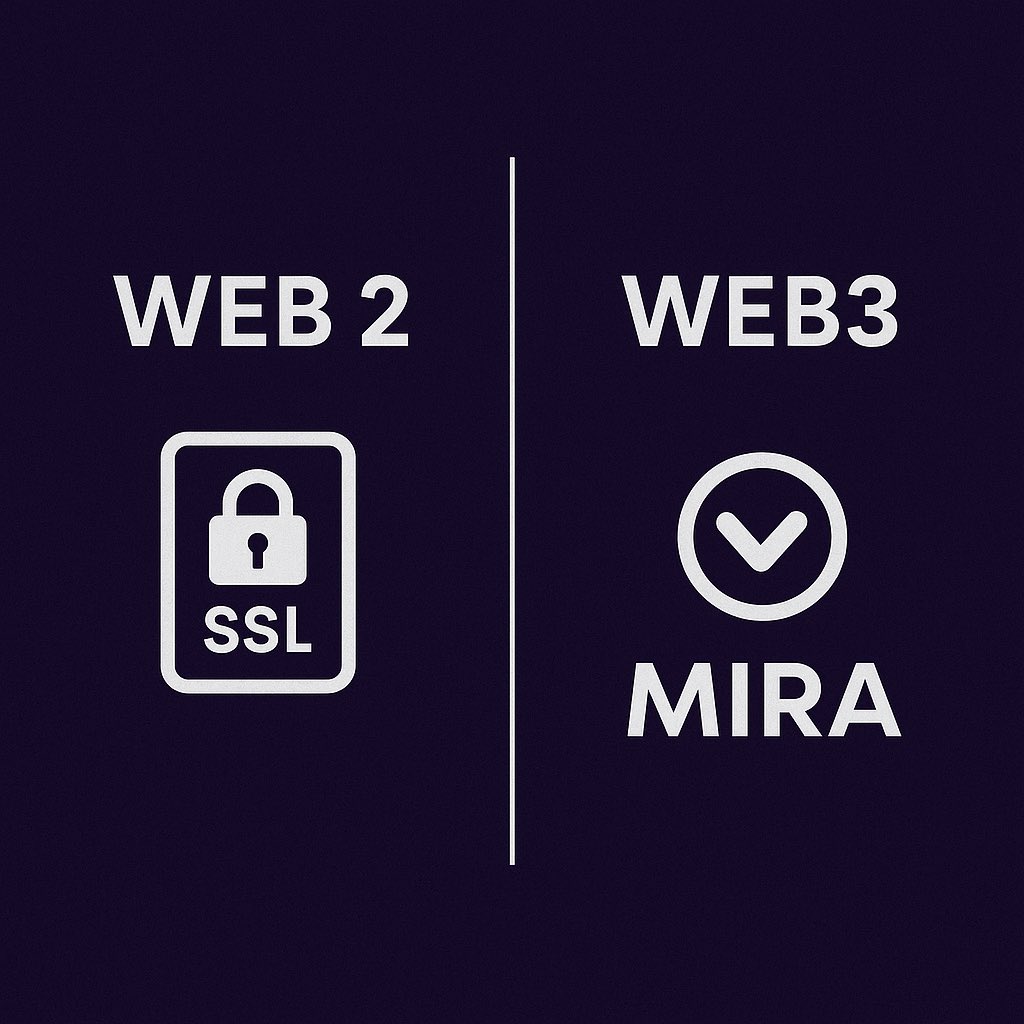
Web2 Had SSL. Web3 Has Mira.
Remember this lock? 🔒
Every time you saw it in your browser, you felt safe.
It meant your data was encrypted. It meant the website was legit.
That was SSL, the gold standard of trust in Web2.
Now, Web3 has its own version: MIRA
Web3 is full of amazing things:
→ Smart contracts
→ AI agents
→ DAOs
→ Decentralized apps
→ Oracles
→ DePINs
But there’s one thing still missing from most of them, and that is Verified truth.
Here’s the brutal truth:
→ A smart contract can still run on bad data
→ An oracle can be manipulated
→ An AI agent can hallucinate
→ A DAO vote can be botted
Web3 without a trust layer?
That’s like browsing the internet in 2001. Barefoot. In lava.
That’s where Mira comes in.
It’s Web3’s trust protocol.
Mira validates:
✅ AI outputs
✅ Oracle data
✅ Smart contract triggers
✅ Voting claims
✅ Identity proofs
✅ Anything digital you’d normally just “trust”
How does it work?
You make a claim →
Mira sends it to validators →
Validators cross-check sources →
If it fails consensus = ❌ blocked
If it passes = ✅ Mira-verified
Web2 said: “This site is secure. You’re safe here.” 🔒
Web3 says: “This data is Mira-verified. You can trust this output.”
Whether you’re using DeFi, AI, a game, or a DAO, Mira is the layer that makes it safe to act.
Just like SSL became mandatory, Mira is fast becoming the same for decentralized platforms.
Soon you’ll see:
“Mira Verified” on AI tools
“Backed by Mira” in DAO dashboards
“Mira-approved” next to contracts.
So, if Web2 gave us SSL,
Web3 is getting something even bigger:
Mira = The Trust Badge for Everything.
Mira is way more than “just” trust.
"Trust" is only the gateway. Once you're in, you realize Mira is a powerhouse, a full fledged decentralized infrastructure engine.
Here is everything it does beyond trust:
1. Infrastructure for Decentralized Everything
Mira isn't just a trust layer; it’s building a decentralized backbone for:
AI applications
Data storage
Smart contract logic
API verification
Real-world data feeds
Think Mira, think AWS + Chainlink + zk-proofs, but decentralized, transparent, and consensus-driven.
2. Storacha (Mira’s Decentralized Storage Layer)
Yeah, Mira has a whole storage stack.
Storacha is like decentralized Dropbox, but made for AI, APIs, and cross-chain data.
Store AI audit trails
Save consensus-validated results
Pin proof forever on-chain
3. Agent Frameworks
Mira doesn’t just check AI, it helps you build better AI agents.
It offers SDKs and modular tools so developers can:
Build smart agents with verifiable reasoning
Run logic that gets consensus
Reduce hallucination and bias
It’s like ChatGPT meets Solidity meets Proof of Reasoning.
4. Cross-Industry Integration
Mira’s tech works beyond AI:
In finance: verifies transaction logic & data feeds
In legal: validates contracts and document history
In supply chain: confirms provenance and logistics truth
In gaming: checks rules, asset ownership, and outcomes
If your system needs proof, Mira slots in.
5. Consensus-as-a-Service
Why rely on centralized moderators or platform rules?
With Mira, any output, API call, or action can go through a network of validators.
You get:
Decentralized governance
Auditable records
Neutral decision-making
No bias. No backdoors. Just math.
TL;DR: Mira is a full ecosystem.
Not just a trust layer.
It’s storage, consensus, agent-building, and decentralized infrastructure are built for a world that’s shifting away from black boxes and fake metrics.
Trust is how it starts.
Infrastructure is what it builds.
Mira has been cooking nonstop, and here’s the latest development on Mira.
Mira launches Phase 2 of its AI verification infrastructure:
What Phase 2 Covers
Progressive Decentralization: Mira shifts from centrally managed node operators to a more trustless system. Multiple instances of the same verifier model called designed duplication, now process each user query. These parallel runs are compared to detect and eliminate malicious or faulty nodes.
Random Sharding Implementation: As the system matures, validation tasks will be randomly distributed (sharded) across nodes. This technique increases security and makes collusion economically unviable.
Here is why phase 2 matters
Stronger Byzantine Resilience: Multiple verifiers and sharding mean that no single bad actor can falsify consensus; the network can identify and penalize misbehaviour.
Economic Accountability: Nodes in Phase 2 must stake assets. Dishonesty or inactivity leads to slashable penalties, ensuring only credible verifiers participate.
Scalability Foundation: This modular decentralization sets the stage for Phase 3, where Mira will offer synthetic verified generations via API, requiring fully autonomous, secure infrastructure.
Technical Highlights
1. Designed Duplication: Verifier redundancy means each query is evaluated by multiple independent node instances. Outputs are matched to detect anomalies.
2. Sharding: Verification tasks are split and scattered randomly, preventing central oversight or task clustering.
3. Hybrid PoW/PoS Consensus: Verifiers stake tokens and complete real AI work—no pointless hashing. Misbehaviour results in stake losses.
4. Binarization Process: Phase 2 expands use of “binarization” breaking outputs into discrete verifiable claims assessed independently by nodes.
What It Means For You
For Developers: More reliable, trustworthy AI outputs wrapping a cryptographic certificate around each result.
For Node Delegators: Easier and safer to join. Stake your compute resources, earn rewards, and benefit from distributed trust.
For End Users: Outputs with far lower risk of hallucination or bias as consensus is validated across multiple independent nodes.
Phase 2 is a major leap toward a decentralized AI verification network. By incorporating duplicate processing, sharding, and economic staking, Mira significantly strengthens integrity, scalability, and trust, laying the groundwork for fully autonomous, verified AI outputs via their upcoming API suite in Phase 3.
Building with Mira: The Dev-Friendly Approach to Verifiable AI
Let’s be honest, developers are tired.
Tired of patching bugs caused by unreliable data.
Tired of babysitting AIs that make things up.
Tired of building trust systems from scratch when all they really want to do is ship.
That’s why Mira is winning hearts in the dev community. Because, while others talk about trust, Mira gives you plug-and-play proof, with tools built for builders.
With Mira, trust Isn’t just a feature, it’s a framework. You can build a rocket-fast AI app, but if no one trusts it, you’ve got nothing.
Mira steps in with a developer-first infrastructure that makes AI outputs provable, trustworthy, and compliant without turning you into a cryptography wizard.
Instead of building your own validator engine, consensus mechanism, or truth oracle. All you have to do is just plug into Mira.
What Makes Mira So Dev-Friendly?
1. Simple Integration
Mira offers clean APIs, SDKs, and dev docs that actually make sense. You don’t need a PhD in blockchain to use it, just your regular tools and a willingness to build smarter.
2. Modular Architecture
Use Mira for just one part of your stack (like verifying AI answers), or go full-on with it as the backbone of your app’s decision-making layer. It’s flexible by design.
3. Verifiable-by-Default
Mira lets you label outputs as “Mira-verified” with built-in cryptographic receipts. That means every response, prediction, or claim your app makes comes with proof.
4. Decentralized Trust Without the Headache
Validators? Consensus logic? Mira handles it under the hood. You just build and watch trust scale along with your product.
Devs Are Already Doing Big Things with Mira
An AI health app uses Mira to verify each diagnosis with live clinical data
A smart trading platform integrates Mira to vet every signal before users act
A Web3 governance tool uses Mira to validate DAO votes in real time
And the best part is that they didn’t need to reinvent the wheel. Mira handled the hard parts, so they could ship faster and smarter.
With Mira:
Your app doesn’t hallucinate
Your data doesn’t lie
Your users don’t ask, “Can I trust this?” They just know because Mira verified it.
So, devs, this is your green light to stop hardcoding trust and start building with it.