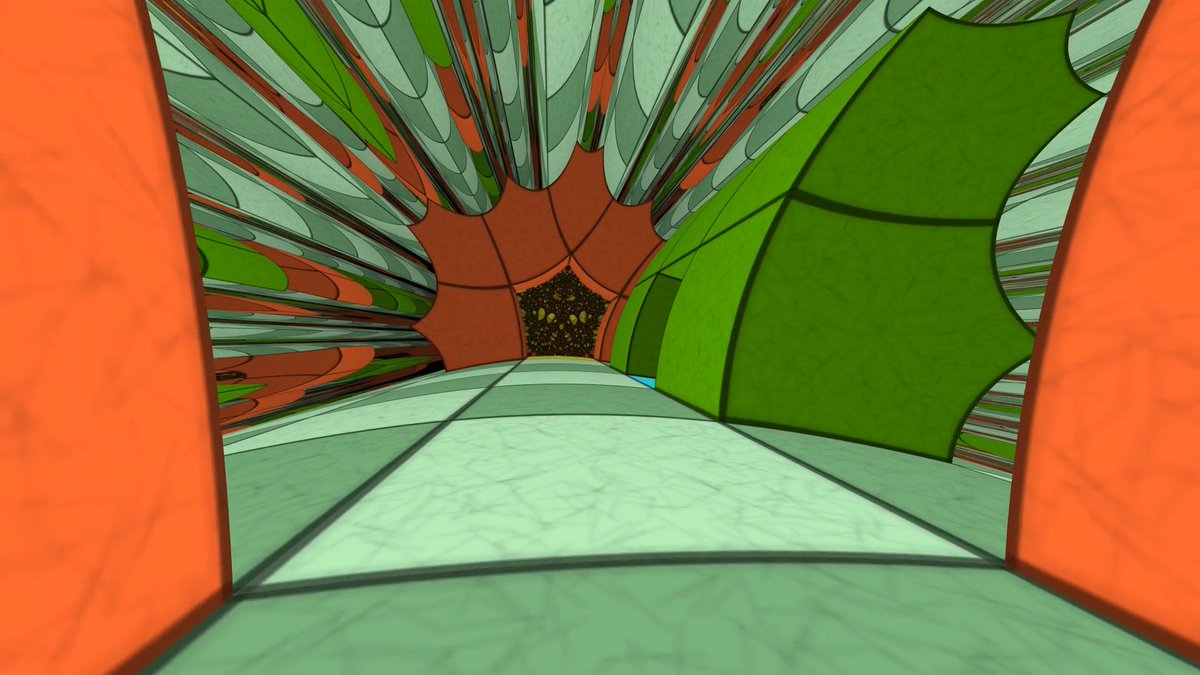
@ZenoRogue I suppose it was also the first video I have decided to put my voice-over. It was a big step for us, to get rid of the shame and "add something personal". We still haven't got the guts to show ourselves, though! :D
Our video "Portals to Non-Euclidean Geometries" has passed 1M views! I know only 5-6 videos using "non-Euclidean" incorrectly with more views. This is not Minecraft!*
(link in the comment)
* 3 of these videos are about Minecraft
Some #mathart from 2001.
Typical visualizations of surfaces I would see back then were boring, angular, and sameish (they used default Mathematica settings, polygons visible).
This uses a rendering method where triangles would be subdivided until they contained 1 pixel.
There are now 151243 tessellations in the Tessellation Catalog!
https://t.co/mbm8uU6jAY
Marek has found (hopefully) all k-uniform Euclidean tessellations up to k=12 (https://t.co/hXDpb2p8jq currently only lists up to k=5), ...
@msmathcomputer2 @fake_journals@JournalsFake There is also Krzysztof Skiba, a Polish musician (https://t.co/LxpOwYwVPr). Coincidence? I don't think so...
Our animation for @cs_kaplan's #SwirledSeries art project. We start by a making the chessboard hyperbolic and then map conformally the #hyperbolicplane into a... cat!
(The first part may remind you of @TilingBot's animation -- we independently had a very similar idea!)
@Sprite_Guard I've got the opposite problem. I tried to start sharing stuff I made&found cool; instead I quickly developed impostor syndrome after reading some mean comments on reddit. BTW I still enjoy watching your videos or streams!
I am quite sure students will meet lecturers' pets during online streams of the lectures from homes... :D I also imagine videos in youtube with "The cat at 4:45!" comments.
In each iteration, temperature of every cell is the average of temperatures of itself and neighbors in the previous iteration. Even though circles (=shapes reachable in N steps) are polygonal here, heat spreads in perfect Euclidean circles (on a sufficiently symmetric tiling).
A rubbery object in non-isotropic geometry (e.g.Nil) should have its preferred orientation which minimizes its potential energy -- intuitively, if we try to rotate it, it should get back to its preferred orientation. This does not happen in our simulation, but still cool IMO :)
The effects of negative curvature: at one point, we can see bundles of almost parallel and very close straight lines; but if we follow them, they shortly turn out to be quite far away from each other.
@henryseg My updates were also significantly frozen till the shipment of PhD thesis (:. It seems to have the researcher as the owner is at least the computational hell for the computer... (eventually, my computer has broken severely recently.... I wanted too much, probably).
@PeterKerkhof I suppose you took my response too serious. My point was that depending on the area (?) there are different feelings on what is an alternative to what (;. To be honest I had learnt how to scrape data before finding out APIs.