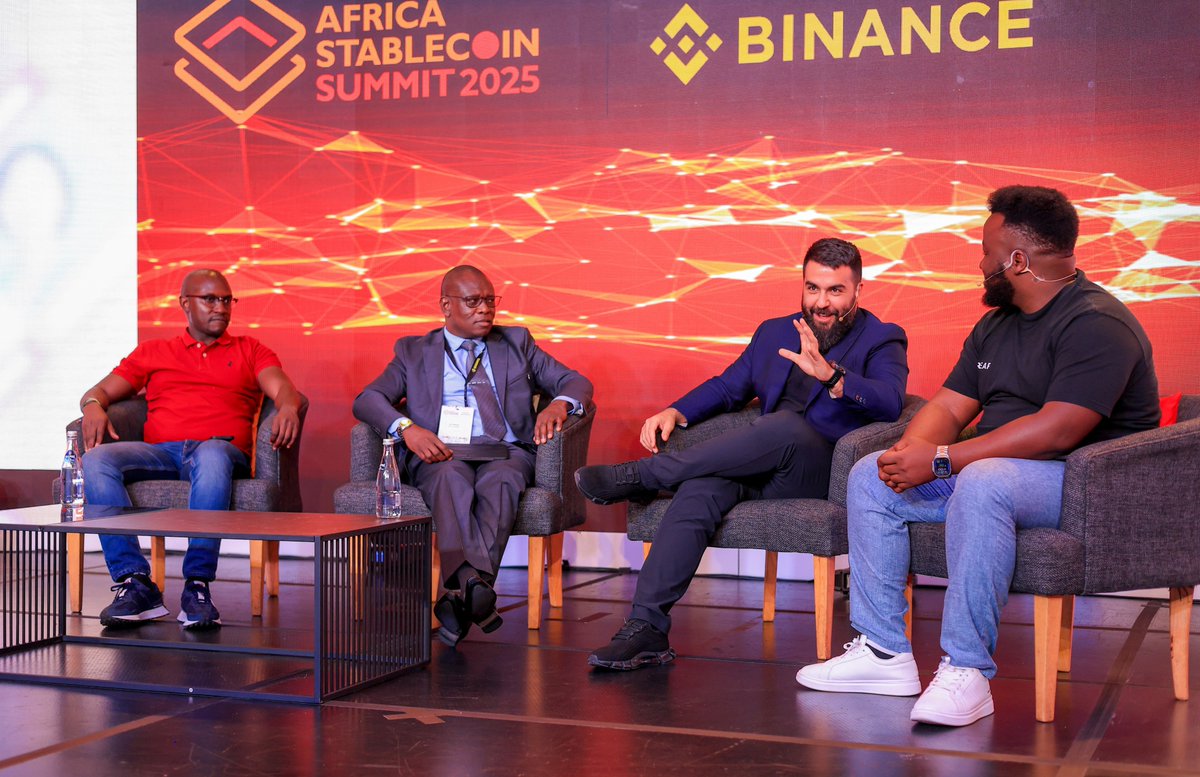
At Africa Stablecoin Summit in Johannesburg, Julien Ghossoub discussed how telecoms can run the Digital Cash settlement layer on Telcoin Network.
By extending distributed ledger infrastructure to MNOs serving billions of users, we’re expanding financial inclusion across Africa.
This aged well... How the rest of the tweet that took me 2hrs to write is beyond me.. $TEL + 100% since this post and is going way higher..
10x from CURRENT levels and it's back to ATH #tel@telcoin
People are now saying that I am getting paid to talk about $TEL
How comical. I have never been paid to talk about a project including Telcoin.
If Telcoin was paying KOLs trust me the token would be much bigger. The project is still extremely under the radar for a reason.
🚀 Crypto 24H Top Gainers Today:
$TEL @telcoin 👉 +99.87%
#Telcoin is integrating #blockchain technology with telecommunications to revolutionize global financial services, offering a secure wallet for digital assets, fast and affordable remittances, and different stablecoins.
👀 Should #FameEX list this token? Comment below⬇️
$TEL Why You Should Think Twice Before Selling Your “Nebraska Bank-Charter-Backed” Telcoin — And Why Borrowing Against It Is the More Intelligent Move
1. You’re Not Holding a Typical Crypto — You’re Holding Regulatory Infrastructure
Most tokens live in a sandbox.
Telcoin operates under a state-chartered bank in Nebraska with statutory authority.
That means:
•It is not operating on “maybe” compliance.
•It is operating under actual U.S. banking law, not just crypto law.
•It can legally connect telecom, remittances, and mobile money to the U.S. banking system.
That’s a regulatory moat, not a meme.
Selling an asset with regulatory protections and banking authority is like selling a piece of land before the city approves a highway through it.
A short-sighted move.
⸻
2. A Banking Asset Should Be Treated Like Equity — Not Cash
You don’t sell equity in a bank.
You leverage it.
Banks don’t sell their vault — they borrow against the assets inside it.
If you believe Telcoin becomes part of U.S. financial plumbing, even in a small way, then:
Your TEL holdings operate closer to “equity in a financial network” than a trading token.
Equity is borrowed against.
⸻
3. Liquidity Events Are Rare — Don’t Kill Your Future Collateral
When TEL reaches the maturity stage where real liquidity exists:
•Listings
•Collateral markets
•Lending protocols
•Telecom partnerships
•Banking rails
•Remittance corridors
•On-chain credit scoring
…you will want SIZE.
Not scraps.
Selling now reduces your future borrowing power.
If TEL becomes accepted collateral in a lending ecosystem, you’ll be wishing you held more — not less.
⸻
4. Selling Turns Growth Into Taxable Income — Borrowing Preserves It
This is the quiet trick wealthy people use:
They borrow against their appreciating assets to avoid taxable events.
Selling TEL → taxable
Borrowing against TEL → no tax triggered
Meanwhile:
•Your TEL stays in your wallet
•Your purchasing power increases
•Your long-term upside stays intact
This is the difference between rich people and people who stay rich.
⸻
5. TEL’s Entire Mission Is Built Around Credit & Mobile Liquidity
You’re holding an asset that is literally designed to become collateral.
Telcoin’s roadmap already references:
•on-chain credit
•decentralized collateral
•mobile money borrowing
•telecom-linked liquidity flows
•credit rails for billions of people without banks
Why would you sell the asset designed to be the raw material of that credit system?
That’s like selling the oil that powers an oil refinery — and then complaining that you have no petroleum to refine.
⸻
6. When Retail Sells, Institutions Buy
When you sell early, you aren’t “taking profits.”
You’re transferring your future position to a larger holder:
•Telcoin
•Telcoin partners
•telecom operators
•liquidity providers
•funds that understand regulatory arbitrage
•state-chartered entities
You’re giving THEM the collateral they will eventually borrow against.
You’re the exit liquidity.
⸻
7. If Telcoin Executes, the Price Behavior Will Be Non-Linear
Regulated financial networks don’t move like meme coins.
They move like:
•Visa
•M-Pesa
•Ripple in 2017
•Square/Cash App’s early days
•PayPal during early adoption
They move slow… slow… slow… exponential.
Selling during the “slow” phase is how people miss the exponential phase.
Borrowing lets you:
•access capital now
•without killing your position later
•and you maintain exposure to the parabolic tail risk
⸻
8. Leverage Wins When You Have a Real Asset
Not meme leverage — productive leverage.
Borrowing against an appreciating asset = expansion.
Sell the asset and you lose:
•future borrowing power
•future appreciation
•future staking/collateral revenue
•your seat in the network
You go from owner → outsider.
🚨 @Telcoin just broke out of the @CoinMarketCap Top 200 prison and stormed into the Top 100 for the first time ever — and that single move quietly changes everything for $TEL!
A token breaking into the CMC Top 100 doesn’t just “go up in rank.” It changes its surface area of discovery, paths of capital, and narrative gravity. Crossing that line flips a bunch of invisible switches:
1️⃣ Visibility Explodes
CMC’s default screens, filters, and “Top 100” modules are where most casual users start. New capital scrolls that list long before it learns any fundamentals. #TEL is now in the lane that gets skimmed by thousands of fresh eyeballs every hour.
2️⃣ Legitimacy Jumps
Right or wrong, the Top 100 badge acts like a coarse risk filter. Analysts, funds, influencers, and journalists lean on it as a crude “not total fringe” screen. Outside the Top 100, projects are easy to ignore. Inside it, TEL becomes something people feel obligated to understand.
3️⃣ Liquidity Deepens
Higher rank trips filters on MM desks, quant dashboards, and portfolio bots. It also reduces perceived tail-risk for traders. That combination usually means more volume, tighter spreads, and cleaner execution — making it far easier for new participants to enter and size positions.
4️⃣ Exchange Attention Intensifies
Listings teams absolutely watch CMC rank. A spot in the Top 100 is often treated as a soft whitelist. Breaking in raises the odds of new spot markets, derivatives, and fiat pairs over time. More listings → more access → more liquidity → stronger price discovery.
5️⃣ Media Coverage Spikes
Crypto newsrooms, dashboards, and data newsletters routinely highlight movers inside the Top 100. Suddenly, routine #Telcoin updates qualify as “newsworthy” because editors know their audiences recognize the ticker.
6️⃣ Retail Psychology Flips
For retail, the #Cryptocurrency Top 100 is the main stage. Once a token crosses that threshold, it stops being filed under “weird microcap” and starts living in the mental bucket of “established names you should at least be aware of.” That psychological shift alone can accelerate inflows.
7️⃣ Institutional Filters Open
A surprising number of small funds, family offices, and structured-product desks simply won’t touch assets outside the Top 100. Moving in doesn’t guarantee they buy — but it does mean TEL finally appears on the models, screens, and pitch decks where it was invisible before.
The line itself is arbitrary — just another number on a website — but the behavioral economics around it are not.
After grinding in obscurity beyond the Top 100 #Crypto rankings, Telcoin has crossed into the region of the map where real capital actually lives. From here on out, the question isn’t “Can people discover $TEL?”
The question is: Who notices it next, and how fast are they forced to adjust?
The Telcoin Wallet will undergo maintenance on Tuesday, November 18th at 19:00 UTC. Downtime should be brief but could last up to 2 hours.
Check the real-time status of the Telcoin Wallet, website, and customer support anytime at: https://t.co/o0uceYeXiR
📣 TELCOIN SECURES APPROVAL IN NEBRASKA - @telcoin is one big step closer to achieving its industry-changing banking goals... Here's why https://t.co/3CyAfRmszU