Wastewater testing is one of the best early indicators for pathogens like bird flu, but only 29% of sites are testing for it. @pandemiccenter experts, including Professor @JenniferNuzzo, tell @statnews wastewater testing should be expanded, not shuttered. https://t.co/ApS2svlhwB
The economic toll of #birdflu is rising for consumers and the ag industry. A low cost “smoke alarm” exists: wastewater monitoring.
An op-ed from our Pandemic Center team highlights how we could lose a helpful tool if @CDCgov doesn’t require #H5 testing.
More via @statnews ⤵️
📣 Attention Brown University Community
Monday the Presidential Faculty Award and lecture featuring Professor @JenniferNuzzo, “Pandemic-Proofing the Future” takes place at 4:30.
Please RSVP if you plan to attend:
https://t.co/6Yuc4KYpwi
"When a new pathogen is announced, you can very quickly look at that previous waste-water data and say: ‘Is this present in our sample?’”
@Brown_Epi visiting fellow @TemiIbitoye on a new @Northeastern airport wastewater model @newscientist
https://t.co/zzISrfPZjl
The USDA has taken down most website pages that have references to climate change.
The Trump admin had ordered USDA workers to identify, archive, or unpublish materials mentioning climate change by "no later than close of business this Friday," according to leaked emails.
Our @pandemiccenter team, led by visiting fellow Temi, has been engaged in important work on wastewater surveillance for pandemic prevention. Our new brief explains how the current system works, its limitations and the impending funding shortfall.
https://t.co/NH1Up55lxK
For anyone learning or teaching bioinformatics, or if you’re interested in getting started, you may like to check out some of many (>404!) detailed tutorials for the Galaxy bioinformatics platform, from microbiome analysis to chloroplast assembly, at https://t.co/633iyCPH2U 👇
The Galaxy platform is a free, easy-to-join, easy-to-use bioinformatics workflow management system that enables scientists to share, analyse and visualise their own data, without needing powerful computers and programming expertise.
Galaxy was first started in 2005, and it has grown year-on-year into an amazingly useful resource for scientists worldwide, with a global community of developers and end-users. You can read about it here:
The Galaxy Community. (2022). The Galaxy platform for accessible, reproducible and collaborative biomedical analyses: 2022 update. Nucleic acids research, 50(W1).
https://t.co/mf3sUPa9LF
To get started, you could first go through a few tutorials to find out how the platform works at the following link:
https://t.co/3EimERhdk2
And you could take a look at some very cool tutorials, for example using Oxford @nanopore MinION data for:
⭐Analysing data to detect microbial pathogens such as Salmonella in food
https://t.co/gLuMqdhCWp
⭐Characterising the microbiome of beer
https://t.co/LKrxn5jJvB
⭐Diving into the bacterial biodiversity of soil
https://t.co/LPkNAuy7Ii
⭐Or assembling the chloroplast genomes of sweet potato and snow gum (Eucalyptus pauciflora) by combining Nanopore long read and Illumina short read data
https://t.co/HBGrmg8Mja
It also has tutorials for learning core skills in data science, such as using Python, bash, R, and SQL:
https://t.co/PHkZvcxTtp
Galaxy has a well-developed community, which you can find out more about here:
https://t.co/PgJvgdCQv6
And, if you have a particular application in mind, you might find a Galaxy pipeline that’s already been created as part of a published study. For example, if you’d like to find antimicrobial resistance genes in Salmonella, this article and workflow may be for you:
Lamas et al. (2023). Whole genome sequencing in the palm of your hand: how to implement a MinION Galaxy-based workflow in a food safety laboratory for rapid Salmonella spp. serotyping, virulence, and antimicrobial resistance gene identification. Frontiers in Microbiology, 14.
https://t.co/bs8LMrPNjY
Or if you’d like to find out how to produce a reference genome for a vertebrate as part of the Earth Genome project, this article explains how it can be:
Larivière et al. (2024). Scalable, accessible and reproducible reference genome assembly and evaluation in Galaxy. Nature Biotechnology, 1-4.
https://t.co/bfHvOuWATn
All amazing resources for people already in the bioinformatics field, but possibly even more useful for teaching the bioinformaticians of the future!
This of course only covers a few aspects of the Galaxy “ecosystem”, so if it seems like it could be useful, be sure to have a look around and see what else there is out there for you.
And, if you are using Galaxy for teaching, we’d love to hear about how you’re using it, especially if you have any tips or online/published resources to share!
Disclaimer: Bento Lab has no affiliation with Galaxy - we just love cool tools and platforms that enable science!
Elegant new work from @LenoraKepler. Lot's of phylodynamic studies have quantified the fitness effects of AMR but this might be the first to holistically quantify the relative contribution of dozens of AMR elements, VFs and plasmids to bacterial fitness! https://t.co/1ZZGTOzapR
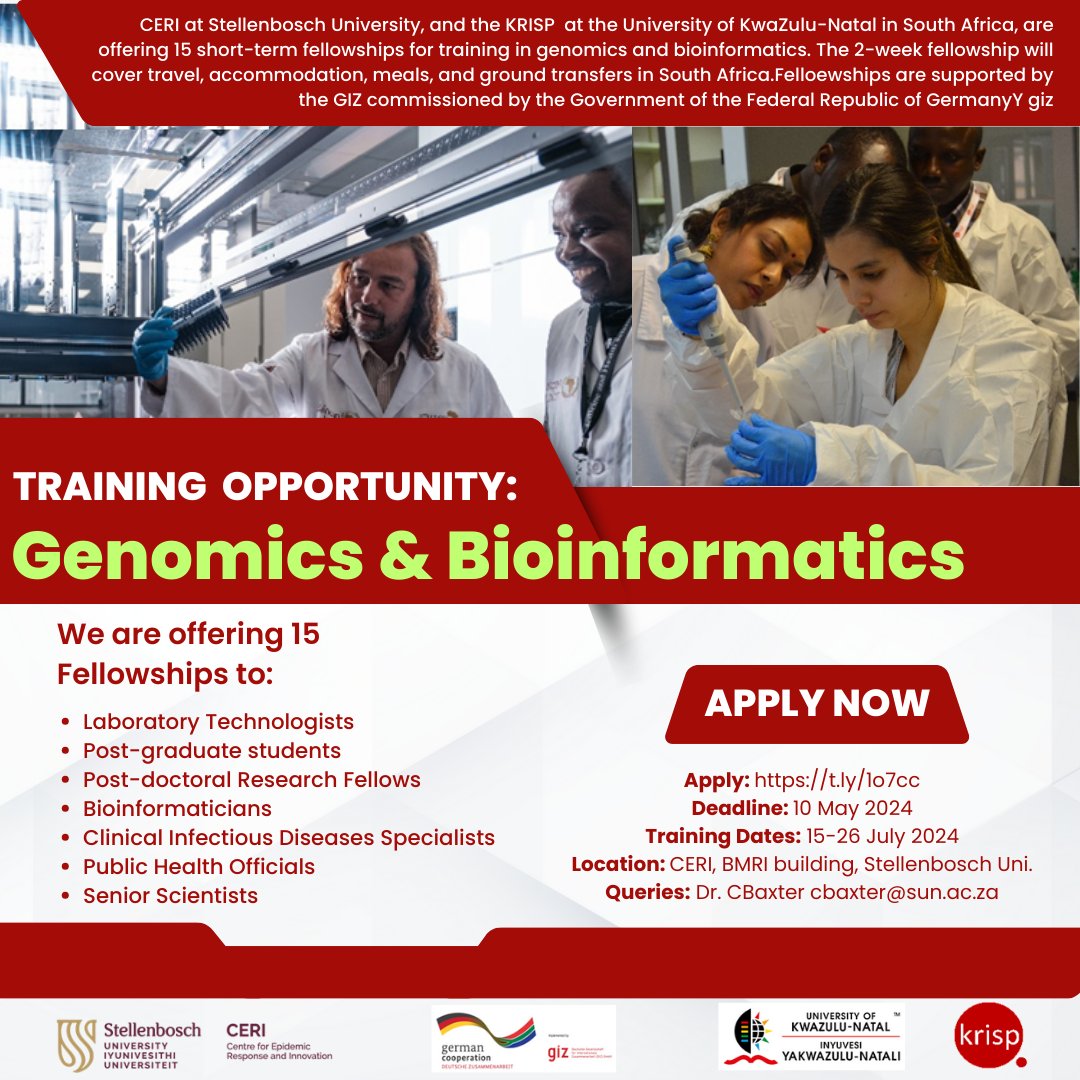
Ready to boost your skills in genomics & bioinformatics? Apply for our 2-week fellowship program covering travel, accommodation, meals, and more. Deadline: May 10, 2024.
In collaboration with @krisp_news at @UKZN & supported by @GizSouth
Apply here: https://t.co/XA5yTJKtqW