It's not like that at all. The states job is to do things that individuals cannot do like national defence and maintaining law and order. Taking money from working people to pay to older wealthy people is clearly not what the state is for. It fails at the level of principle, never mind policy.
The plan of Marxist leaders:
1. Ensure that schools do not properly teach economics.
2. Create envy in the minds of economically illiterate citizens by asserting that there is a limited pie of national wealth and some people have too much of that pie.
3. Appoint themselves as the arbiters of wealth distribution and rely on the envy of the economically illiterate masses to achieve power.
4. Use that power to ensure that everyone is equally poor, except them of course because they deserve disproportionate wealth because of all the "responsibility" they shoulder.
5. Build that party dacha on the Volga River and eat caviar.
6. Profit.
_________________________
With respect to @elonmusk they are somewhere between steps #2 and #3.
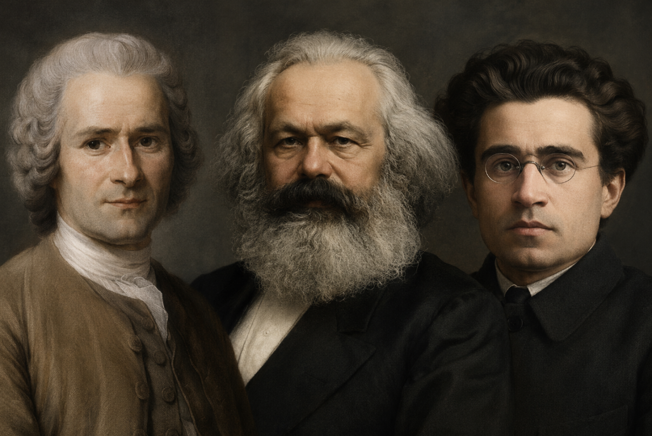
If you want to understand the modern left, you need to understand three men.
One redefined freedom. One redefined history. One redefined power. Together, they created the intellectual foundations of much of modern progressive politics.
Jean-Jacques Rousseau laid the foundation in the 18th century. He argued that man is born good and free but is corrupted by society – especially by private property. This idea that civilization itself is the source of inequality and oppression became the emotional core of leftist thought. Rousseau replaced the individual with the “general will” and portrayed traditional institutions as chains that must be broken.
Karl Marx took Rousseau’s romantic critique and turned it into a supposedly scientific system. He argued that private property and class relations were not just morally wrong but historically doomed. Marx shifted the focus from abstract human nature to the economic base, claiming that history moved through class struggle toward a final, inevitable revolution. His ideas justified the seizure of power and the total reconstruction of society in the name of progress.
By the 20th century, however, it was clear that the Western working class was not going to revolt. Antonio Gramsci provided the next crucial development. He argued that capitalism maintained power not primarily through economics, but through cultural hegemony – the dominance of “bourgeois ideas” in education, media, religion and civil society. Gramsci concluded that revolutionaries must first capture the institutions of culture before they could seize political and economic power. This strategic shift moved the left’s focus from factory workers to universities, schools, media and the family.
Together, these three thinkers created the intellectual architecture of modern leftism: Rousseau supplied the moral grievance against civilization, Marx supplied the revolutionary method and historical justification, and Gramsci supplied the long-term cultural strategy. The result is a movement that no longer primarily fights over wages and factories, but over language, education, identity, and the moral legitimacy of Western society itself.
@Danjsalt I disagree. Starmer is doing what a shit labour leader does. Predictable and unsurprising. My visceral hatred is reserved for Cameron and Osbourne. They were the snakes that put us in this total mess.
@nntaleb No amount of intellectual masturbation can protect the vulnerable mind from disgust that someone who they think is an inferior has made a fuck ton of money more than them.
Il y a un truc qui me fascine.
C'est qu'Elon soit aussi seul.
Des milliers de milliardaires sur cette planète. Des gens qui ont assez d'argent pour ne plus jamais rien craindre de personne. Et un seul ouvre sa gueule.
Il existe une expérience fascinante en éthologie : la boîte des rats de Didier Desor.
On met six rats dans une cage. Pour manger, il faut plonger dans un tunnel immergé et rapporter les croquettes. Très vite, une structure émerge toute seule : deux exploiteurs qui ne plongent jamais et volent la nourriture des autres, deux exploités qui plongent et se font racketter, un souffre-douleur qui ramasse les miettes.
Et un seul autonome. Le rat qui plonge lui-même, rapporte sa propre nourriture, la défend, et ne se soumet à personne.
Le plus troublant : peu importe la composition du groupe. Tu remets six exploiteurs ensemble, la même structure se reforme. Tu remets six autonomes ensemble, pareil. Comme s'il existait une loi naturelle qui fixe la proportion de courage disponible dans une population. Une loi de la paire de couilles, distribuée par la nature avec une avarice remarquable.
Dans la boîte des rats à milliardaires, Elon est le seul autonome.
Les autres ont les mêmes moyens que lui. Souvent les mêmes opinions que lui. C'est ça le plus fascinant : en privé, la grande majorité des milliardaires sont d'accord avec Elon. Sur la liberté d'expression, sur la dérive idéologique des médias, sur le wokisme, sur tout. Ils le disent à voix basse dans les dîners, ils l'écrivent dans des messages privés, ils hochent la tête.
Et puis ils retournent financer les ONG qui les protègent, sponsoriser les médias qui les épargnent, signer les tribunes qui les dédouanent. Ils plongent, rapportent les croquettes, et se laissent racketter par la meute. Avec des centaines de milliards sur le compte.
L'argent ne donne pas le courage. Il révèle juste combien tu en avais au départ.
Un seul rat a refusé le jeu. Il a dit "go fuck yourself" aux exploiteurs devant le monde entier, il a accepté de perdre des milliards, et trois ans plus tard il est le premier trillionnaire de l'histoire.
La nature est bien faite : c'est toujours le rat autonome qui finit par posséder la boîte.
The BBC Has Ruled. Brexit Damaged The Economy. No Further Debate Required.
The BBC's editorial complaints unit has decided that the negative economic impact of Brexit is now a settled fact. Not a contested judgement. Not one side of a live debate. A fact, in the same category as man-made climate change, requiring no balancing view.
The ruling followed a Radio 4 Today programme segment featuring Andrew Bailey, the Governor of the Bank of England, alongside Liam Byrne and Sir John Gieve, both long-standing advocates of closer EU alignment. All three agreed Brexit had damaged growth. The presenter, Katya Adler, did not challenge the premise or introduce a dissenting voice. A complaint followed.
The ECU's response is the revealing part. It acknowledged the segment failed to "acknowledge the alternative case" for pursuing opportunities outside the EU rather than realignment with it. That part of the complaint was upheld. But the central complaint, that three pro-EU voices agreeing with each other on air is not balance, was dismissed. The reasoning given was that this reflected "the consensus among economists" and there was no "significant body of economic opinion" on the other side.
This is worth pausing on. The BBC is not claiming it found balance. It is claiming balance was unnecessary because one side of the argument does not meaningfully exist. The institution that is legally required to be impartial has ruled itself the arbiter of which questions are still open and which are closed, and Brexit has just been moved into the closed file.
The economics itself does not support the certainty on display. The headline figure driving much of this narrative, an 8 per cent hit to GDP since 2016, comes from an NBER paper built on a "synthetic control" model that constructs a hypothetical non-Brexit Britain from a basket of comparator countries. The largest weighting in that basket, over 60 per cent, is the United States, a country currently riding an AI investment boom and a separate fiscal stimulus. The model also weights Estonia and Greece more heavily than France or Germany. On a straightforward per capita basis against France and Germany, the actual comparators, Britain's performance since 2016 sits roughly in line with both. An 8 per cent gap simply isn't visible. This is a model producing a number that then gets reported as "the consensus," which the BBC then cites as the reason no alternative view is required.
That loop, model produces number, number becomes consensus, consensus becomes fact, fact requires no balance, is the mechanism. It does not require a conspiracy. It requires an institution that has decided which conclusions are respectable and which are not, and which then treats its own prior decision as evidence.
The same posture has been on display all week. A government department can decide its diversity targets are lawful without seeking legal advice to check. A police force can decide a book about dismantling "inner white supremacy" is leadership training. A broadcaster can decide an economic question is closed and that deciding so does not breach its own impartiality rules. In each case, the institution marks its own homework, and the mark is always a pass.
None of this requires Brexit to have been a triumph. Britain's economy has genuine problems, most of them unrelated to single market membership. But a state broadcaster, funded by compulsory licence fee under threat of prosecution, has now formally placed one of the most consequential political decisions in modern British history beyond the reach of its own impartiality obligations. Reform's Lee Anderson called it being "blinkered by groupthink." The more precise description is an institution that has stopped being able to tell the difference between its own assumptions and the facts.
"The BBC is not claiming it found balance. It is claiming balance was unnecessary because one side of the argument does not meaningfully exist."
@AndrewHWestern I bought my child a bike so that she could get to school faster. I see now that I must apologise for buying her that advantage. I'm so sorry.