Meet Tenkai.
It turns a server you own into a deployment platform: a cloud VPS, a bare-metal box, or the Raspberry Pi on your shelf.
Push your code, get HTTPS, databases, and rollbacks. The machine stays yours.
Here is how it works 🧵
Shared hosting, PaaS or your own servers?
Shared: cheap, but no root. The plan picks your stack.
PaaS: no servers, but more capacity, higher bill.
Your VPS: root access, but HTTPS, deploys, databases and backups are on you.
Tenkai does that last part.
https://t.co/cjvzMf9Hh6
Tenkai now scales your web apps with their traffic, adds worker nodes when replicas need room, and shows how close each replica runs to its CPU and memory limits. 📈
https://t.co/12Yyjehmgb
Tenkai now runs RabbitMQ, ClickHouse or any service from its image.
Give it an image, its ports and a data directory. Tenkai adds:
→ an address that survives every deploy
→ data that outlives each deployment
→ daily backups
https://t.co/5fmGoEaTdr
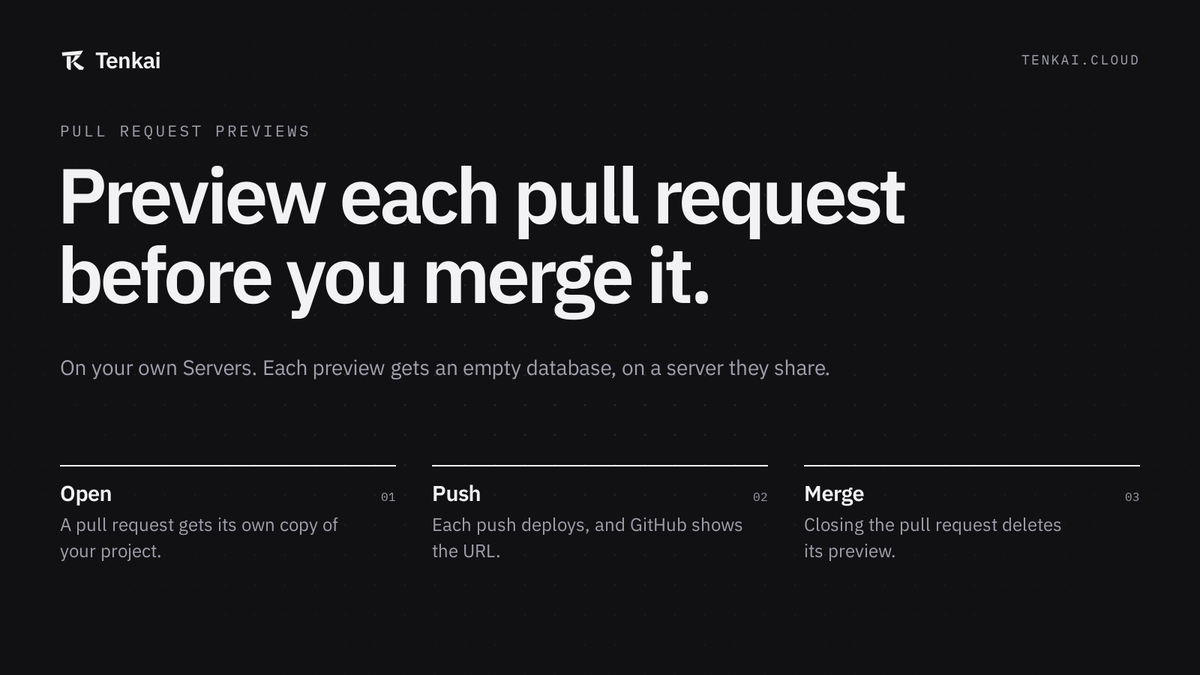
Tenkai now gives each pull request its own preview, on your own Servers.
Open a PR and Tenkai deploys it, then comments the URL on GitHub. Each push updates it, and merging deletes it.
Experimental for now, turn it on in your Team settings.
https://t.co/9WQ1Jk6OW0
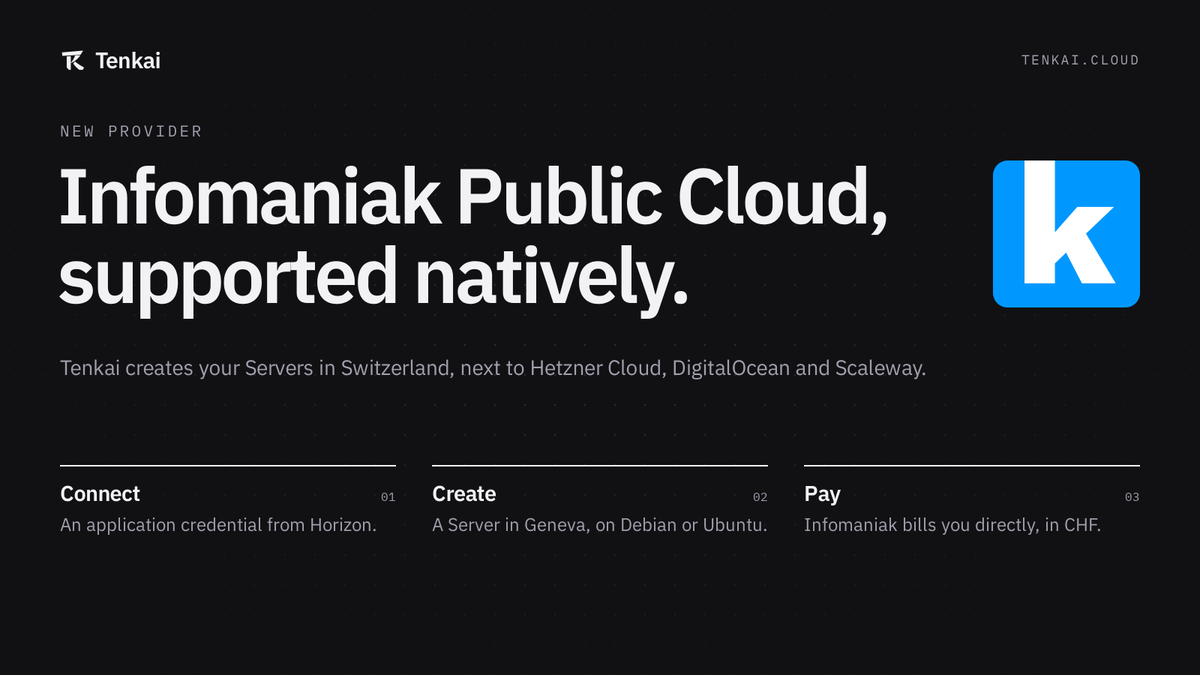
Tenkai now supports @infomaniak Public Cloud as a first-class citizen to create and manage your Servers, in Geneva.
Connect an application credential, pick a region, Debian or Ubuntu, and Tenkai sets the Server up. Infomaniak bills you directly, in CHF.
https://t.co/CYoXeM5OoS
Tenkai is out of private beta 🎉
Turn a server you own (a VPS, a bare-metal box, a Raspberry Pi) into your own platform: push your code, get HTTPS, databases and rollbacks.
Free for one server, no credit card.
https://t.co/RnI1FdM5F8
@twMatthieuH That's a fair concern, and thanks for the kind words! Tenkai will remain closed source. If open source is a requirement for you, there are alternatives that may be a better fit.
We know SSH access requires trust, and it's on us to earn it.
Meet Tenkai.
It turns a server you own into a deployment platform: a cloud VPS, a bare-metal box, or the Raspberry Pi on your shelf.
Push your code, get HTTPS, databases, and rollbacks. The machine stays yours.
Here is how it works 🧵
@twMatthieuH Tenkai isn't open source. Everything runs on your own servers, using standard components, and you retain full root access.
It connects over SSH using a dedicated tenkai user. You can inspect what it installs and changes, and revoke its access at any time.
Meet Hako 📦
The AI assistant built into Tenkai. Ask about your Projects, debug a failed Deployment, and approve every fix it proposes.
Available on all plans.
https://t.co/RnI1FdM5F8
Un testeur de la beta @TenkaiCloud a migré un projet de Railway la semaine dernière.
Sa méthode : brancher Codex au serveur MCP de Tenkai, lui demander de tout migrer, approuver quelques étapes.
"Je n'ai rencontré aucun souci."
Le genre de DM qui fait ma semaine.
50 people are now trying Tenkai.
We're pausing the invites to finish the next update:
→ Many small fixes
→ High Availability for MySQL
→ High Availability for PostgreSQL
→ Point-in-time recovery for both
Each one takes only a few clicks.
Waitlist: https://t.co/RnI1FdM5F8
How is your server doing today?
Tenkai shows it at a glance: one tile per pending update, security ones first, and whether a reboot is requested.
Install the security updates, or all of them, from the same page. Your containers keep running.
No proprietary runtime either. Tenkai installs Docker, Traefik, and WireGuard on your server and drives them over SSH.
Tenkai is in private beta. Join the waitlist and we will invite you:
https://t.co/RnI1FdLxPA
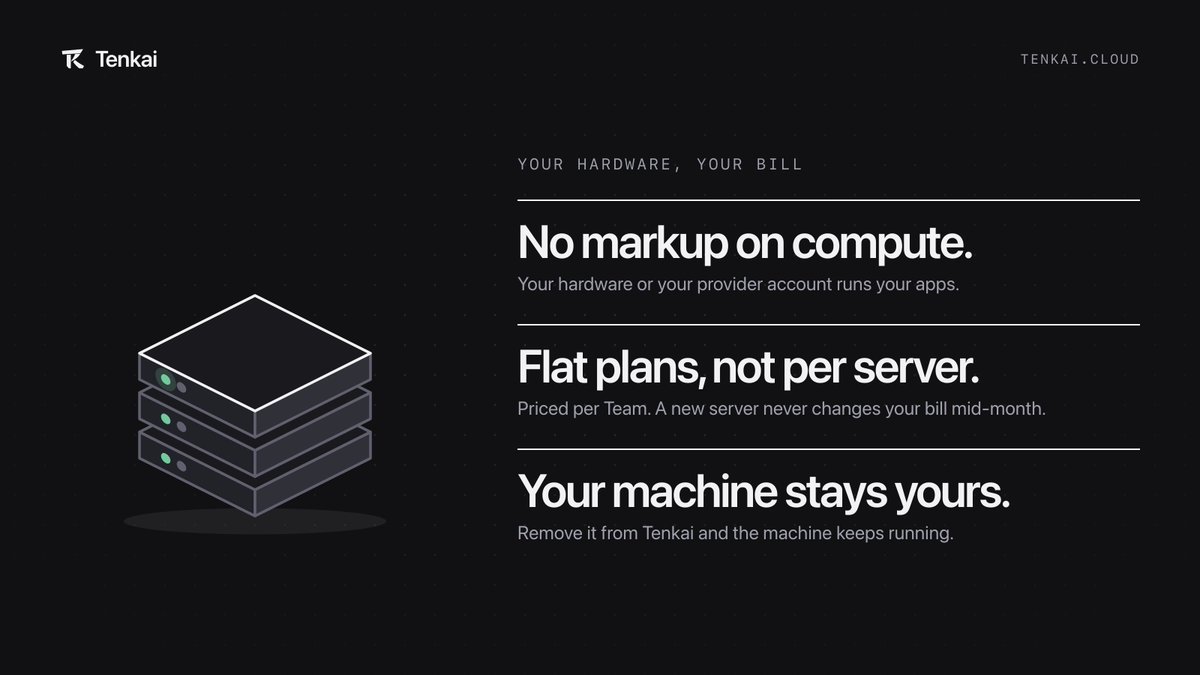
Your hardware, your bill.
Tenkai never resells compute: no markup on CPU, memory, or bandwidth.
Plans are flat and priced per Team, not per server.
And if you remove a server from Tenkai, the machine keeps running.