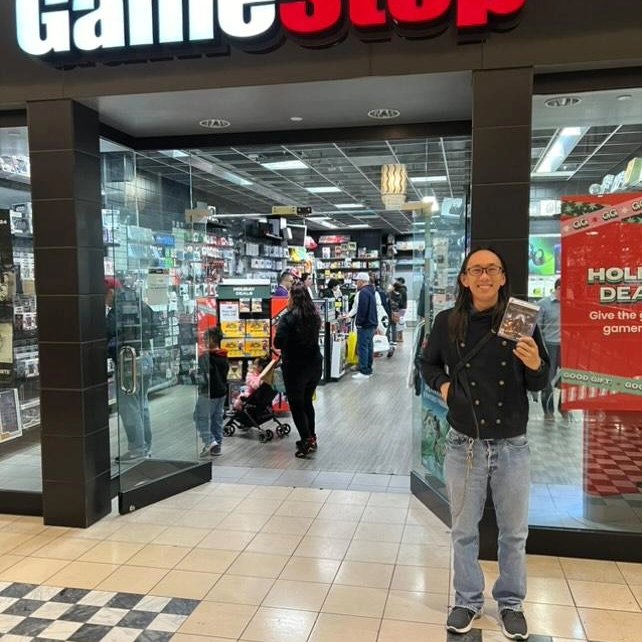
Here I am after buying the first game I worked on as a Game Designer at the Gamestop I worked at 13 years ago! What an incredible first step on a long journey Im excited to continue on!
“But Quack! Why are you acting like Sony will one day delete or revoke your license on the digitally purchased games? There’s no history of Sony doing this…. Right?”
Vita Owners, check your paid games. You’ll see Sony has in fact revoked or limited your access to your games
In his latest video, Jason Schreier said this about the XBOX layoffs:
"The reason why XBOX games struggle is because developers live in constant uncertainty and fear of layoffs."
That reminded me about this Iwata quote from 2013.
Vanillaware founder George Kamitani - wants to put their other games on PC (Unicorn Overlord, 13 Sentinels, Dragon's Crown, etc.) but says it's up to the publisher to finance the ports
@SwiiLive Exactly that! Just like you've been saying, we need to know what actually needs to be updated to its final model, but we won't know if that work is done if it's hidden by a "good-enough" placeholder. It acts as a great way for Directors to know where art is at with assets.
@Superninfreak@sarasarahT@SaGa_NeilB There is that, but you can also completely drop the subject in Japanese, so you can have full conversations with out ever explicitly staring who or what you are talking about its all just assumed.
Yes. Most of gamedev costs are the salaries, which must match the local cost of living. Oppressive rent prices make it difficult to make games in many cities, but if that game isn't a fucking hit, it's often enough to destroy that studio outright now. No misses allowed anymore.
Uncharted 1 didn't sell amazingly. Nor did Demon Souls. Red Ded Revolver and the first Yakuza also suffered from lukewarm sales. Imagine if those studios never had a chance to come back stronger because the sheer financial stress of cost-of-living-matching-salaries wiped them out.
It's depressing how so many gamers just dismiss very intentional design decisions in any older game, whether it be mechanically or visually, as nothing more than "hardware limitations" and treat it like something that's outdated and needs to be fixed
“unalived” “graped” “self delete”
the self censorship of words is so dystopian & straight out of 1984 that it makes me nauseous. stop censoring urself for an algorithm that may or may not flag u. dont undercut our language & devalue what u say & mean I cannot stress this enough.
Video games will never be taken seriously as an art form because neither the industry nor the audience treats them as art, and the audience is the larger part of the problem. Games are treated as products to be made fast, sold loud, consumed, discarded, and replaced. That is why Call of Duty and FIFA sell in the billions, not because they endure, but because they are disposable and familiar.
This has nothing to do with graphical fidelity, art style, music, voice acting, or budget, even though players insist otherwise. For most people, “artistic merit” means how flashy, pretty, and expensive a game looks. Spectacle is mistaken for depth, and production value is confused with meaning.
Games are not built to be evergreen because the audience does not want evergreen. The people who revisit old titles, engage deeply with systems, or approach games patiently are a minority. Most want the new release, the hype cycle, and the spectacle, then move on as soon as something shinier appears. This is the same reason Avatar makes a billion dollars per film yet leaves almost no cultural footprint. Audiences want stimulation for a few hours, then the exit.
Art requires patience and trust, and games demand both. They ask players to learn systems, accept friction, and think. The audience rejects this. Anything slow, strange, or uncomfortable is dismissed as boring or pretentious, so risk is punished not just by publishers, but by players themselves.
Because of this, metrics replace meaning. Engagement time, retention, and monetisation become the measure of success, because that is what the audience rewards. Art asks what something is saying. Products ask how long you stayed logged in. Games suffer most here because their greatest strength, player agency, is treated as an inconvenience rather than an opportunity.
Legacy is impossible without permission to fail, and the audience does not allow failure. A bad novel does not kill literature. A bad film does not kill cinema. A bad game can kill a studio, because players demand perfection, constant novelty, and infinite support while rejecting experimentation.
So the ceiling stays low by choice. Not because games cannot be art, but because an audience trained on disposability, spectacle, and instant gratification will not tolerate sincerity, patience, or risk. What survives is not what lasts, but what sells loudly and disappears quietly.
It's giveaway time!
Win a Warhammer 40,000: Dark Heresy alpha key — like and repost this post to enter, simple as that.
The winners will be announced after December 16th, so hurry up. Please ensure your DMs are open so we can contact you.
#owlcatadvent
@weebschemander@NINtendo_maya Interestingly basically this. Sometimes you end up with a huge budget+have on staff people with nothing to do so they just work in something. Its why art ends up over bloated too.