Hi everyone, I’m Mara Johnson, Founder & CEO of Tensor X.
Today, I want to share a little about my journey and what led me to start building Tensor X.
✅ Anyone can say:
"I have a profitable strategy."
Tensor X wants more than that.
A strategy goes through:
Strategy → Backtest → Paper/Live → Verification → Marketplace
Track record gets pulled.
The strategy gets encoded.
It gets tested under Tensor X guardrails.
Only after passing the required gates can it become a Verified Agent. ✅
Because your money shouldn't follow a screenshot.
It should follow verifiable performance.
Here's a simple way to understand QRAW:
📈 Trend detected
→ Momentum gets more attention
↔️ Sideways market
→ Mean reversion
⚡ Volatility spikes
→ Risk gets reduced
📉 Crash conditions
→ Defensive + hedge
😴 Low volatility
→ Carry + rotation
The point isn't to predict everything.
It's to recognize the environment and adapt.
That's the thinking behind QRAW.
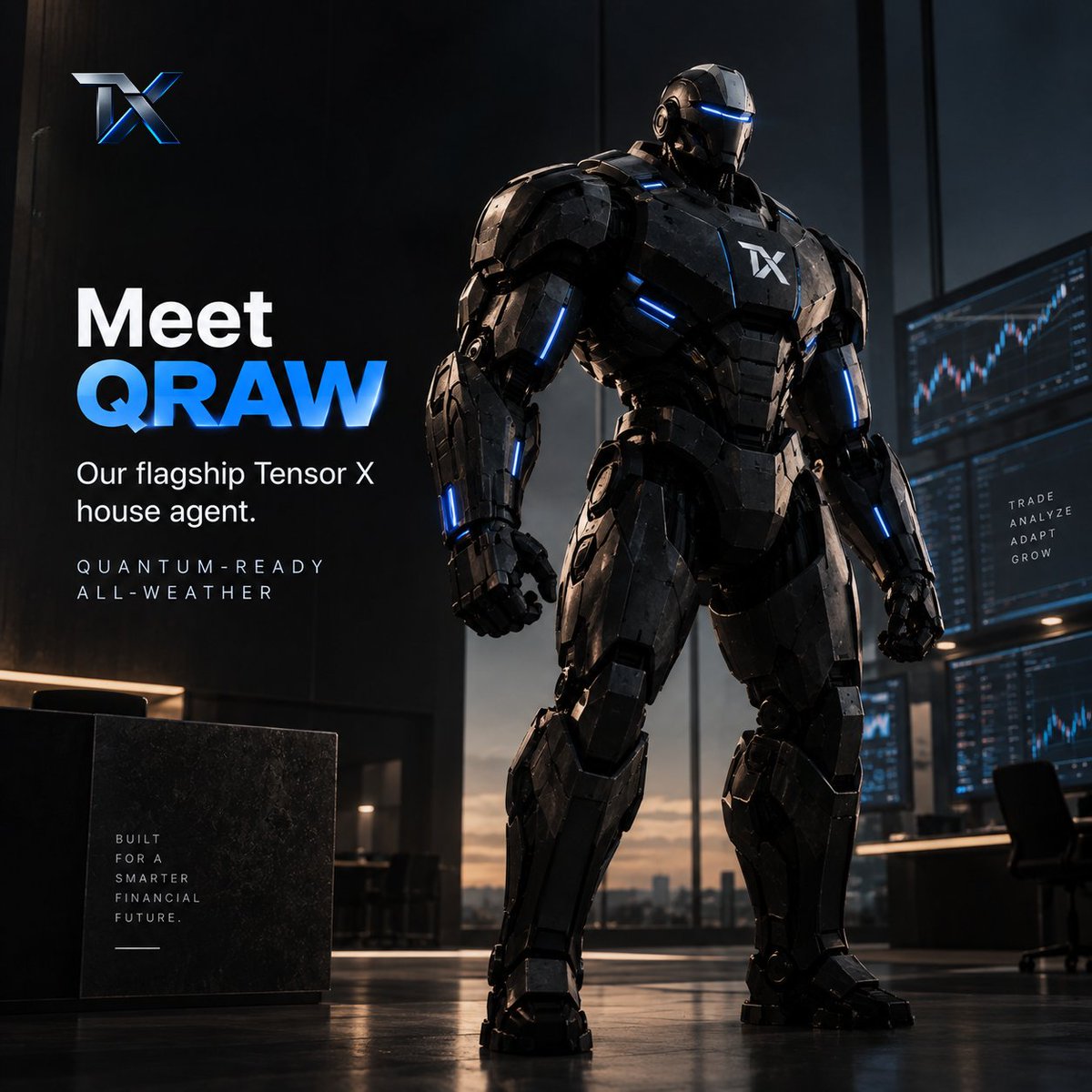
🤝 Meet QRAW 🤝
Our flagship Tensor X house agent.
Quantum-Ready All-Weather
QRAW evaluates hundreds of thousands of feature combinations, detects the market regime, and shifts capital between 5 strategy sleeves.
The goal isn't:
"Make money every single day."
The goal is:
Protect capital first. Adapt to the market. Compound over time.
No strategy wins in every market.
QRAW is designed to adapt instead of assuming.
A strategy that works in a strong trend can struggle when the market goes sideways.
A strategy built for low volatility can behave very differently during a crash.
So why should an AI agent trade every market the same way?
Tensor X is building agents that can identify different market regimes and adjust their strategy accordingly.
TREND → CHOP → HIGH VOL → CRASH → LOW VOL
Different market.
Different conditions.
Different strategy response.
👽 Most people hear AI trading and think 👽
"Ask ChatGPT what to buy."
That's not Tensor X.
A Tensor X agent continuously works with market data, analyzes signals, makes trading decisions, applies risk checks, and executes within the rules you set.
DATA → ANALYZE → DECIDE → RISK CHECK → EXECUTE
The AI isn't here to give you trading advice.
It's here to trade.
🚀 Tensor X Testnet is LIVE.
We’re now opening it up to the community so you can get early access, test the product, explore the experience, and help us improve it before mainnet.
Meanwhile, our tech team is already working on the Robinhood Chain mainnet launch.
The bigger difference?
The trading features we’re building around tokenized stocks + crypto are no longer limited to the US.
Tensor X is being built for the global market. 🌍
👉 Test it early
👉 Give us feedback
👉 Be part of what we’re building
Mainnet is coming soon. 🔥
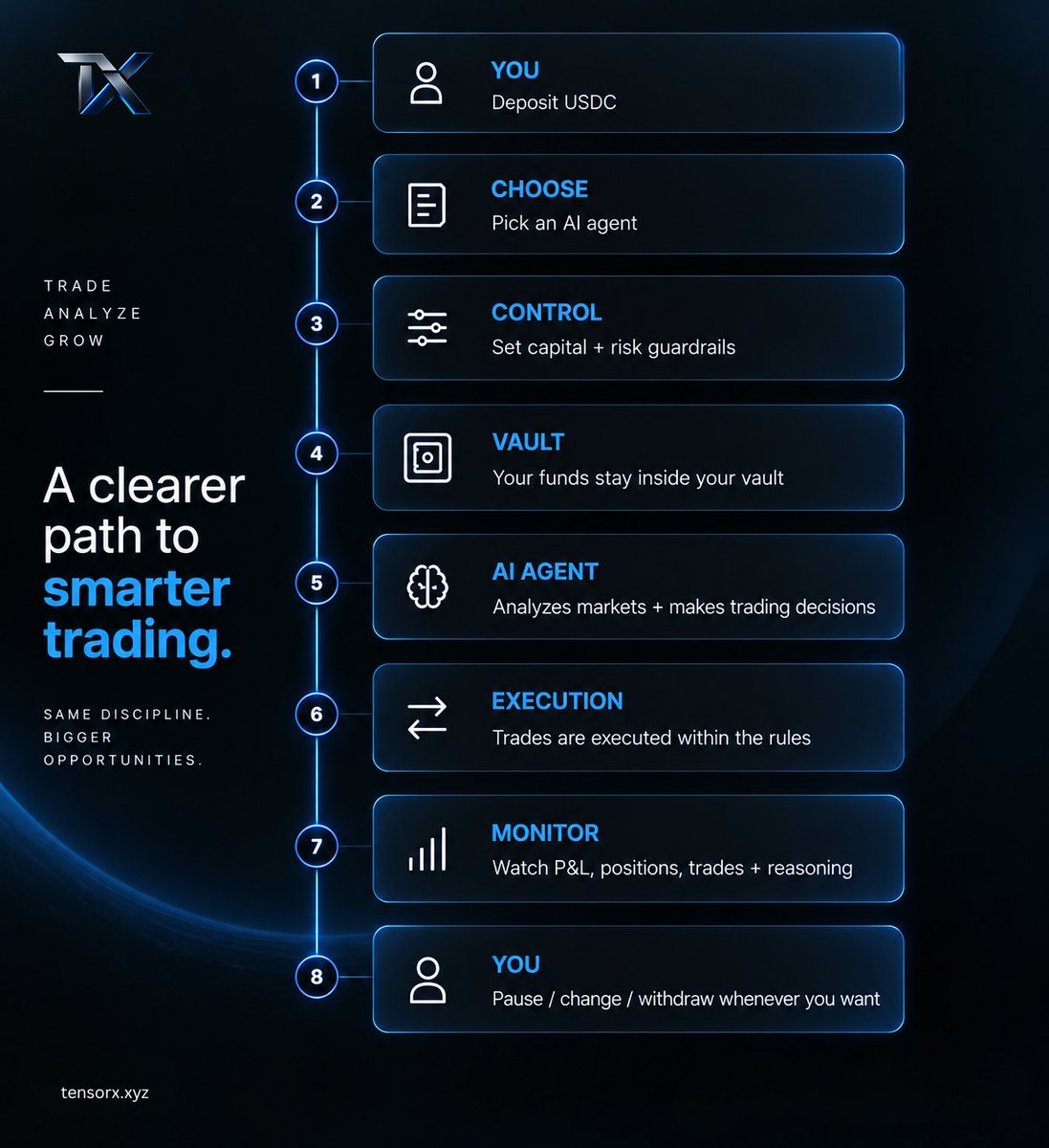
Here's the Tensor X loop:
YOU
↓
Deposit USDC
↓
CHOOSE
Pick an AI agent
↓
CONTROL
Set capital + risk guardrails
↓
VAULT
Your funds stay inside your vault
↓
AI AGENT
Analyzes markets + makes trading decisions
↓
EXECUTION
Trades are executed within the rules
↓
MONITOR
Watch P&L, positions, trades + reasoning
↓
YOU
Pause / change / withdraw whenever you want
That's the product we're building.
You don't give up control to the AI.
You give the AI a job to do.
AI trading shouldn't feel like a black box.
Tensor X is designed to show the reasoning behind each trade in plain English.
Example:
Bought 2.1 NVDA at $184.20
Earnings beat + momentum turned positive.
Stop: $176.
You can then tap into the trade and see the signals and risk checks behind the decision.
So instead of:
"AI bought something."
You get:
What it bought + why it bought + what risk checks were applied.
The most important part of Tensor X isn't the AI.
It's the vault.
Your funds sit inside your own vault.
The AI gets a restricted session key that can trade within your rules.
It can:
trade()
It cannot:
withdraw()
So think of it like this:
You → own the vault
AI → gets trading permission
Guardrails → control what it can do
The vault is the trust boundary between your capital and the agent.
Let's say you deposit $1,000 into Tensor X.
You choose an agent and set:
1. Max capital: $500
2. Allowed assets: NVDA + BTC
3. Max daily loss: $20
4. Max position: $200
5. Leverage: OFF
Now the agent can analyze the market and propose/execute trades.
But it can't simply do whatever it wants.
If a trade violates your rules:
The vault rejects it.
That's the difference between giving an AI access to your money and giving an AI controlled trading permissions.
The product plan specifies capital caps, loss limits, asset allowlists, position limits and a kill switch as enforceable guardrails.
How does Tensor X actually work?
Pretty simple:
1. Deposit USDC
2. Pick an AI agent
3. Set your rules
4. Deploy your vault
5. Let the agent trade
You don't need to manually watch the market 24/7.
The agent handles execution.
You decide the boundaries.
Tensor X = AI execution + user-controlled rules.
One of Tensor X's house agents is QRAW: Quantum-Ready All-Weather.
The idea is simple:
Markets don't behave the same way all the time.
Bull market ≠ crash ≠ sideways market ≠ high-volatility event.
QRAW is designed to detect the current market regime and shift between different strategy sleeves.
Example:
Trending market
→ momentum
Crash / downtrend
→ defensive + hedge
Sideways market
→ mean reversion
High volatility event
→ de-risk
Low volatility
→ carry + rotation
The system evaluates roughly 288,000 signal instances every 5 minutes across assets, timeframes and feature sets.
It's not designed around "profit every day."
It's designed around adapting to different market conditions while keeping risk controls in place.
This is absolutely insane.
If you invested $1,000 in Nike in 2013, you'd have $1,390 today.
If you invested the same $1,000 in $BTC that same year, you'd have $6 MILLION today.
Tensor X doesn't want screenshots.
We want verifiable track records.
A strategy can go through:
Trader → Strategy encoding → Backtest → Live/paper track record → Verification → Marketplace
Agents can show:
• On-chain trade history
• Return
• Max drawdown
• Sharpe
• Number of trades
• Capital managed
• Strategy description
So instead of:
"Trust me bro, my strategy is profitable."
You get:
"Here's the strategy. Here's what it traded. Here's the track record. Verify it yourself."
An AI agent with unlimited access to your money is not the product we want.
Tensor X uses a guardrail vault.
You can define things like:
• Maximum capital per agent
• Maximum daily/weekly loss
• Maximum position size
• Allowed assets
• Maximum trades per day
• Leverage limits
• Instant kill switch
And these rules are enforced by the vault.
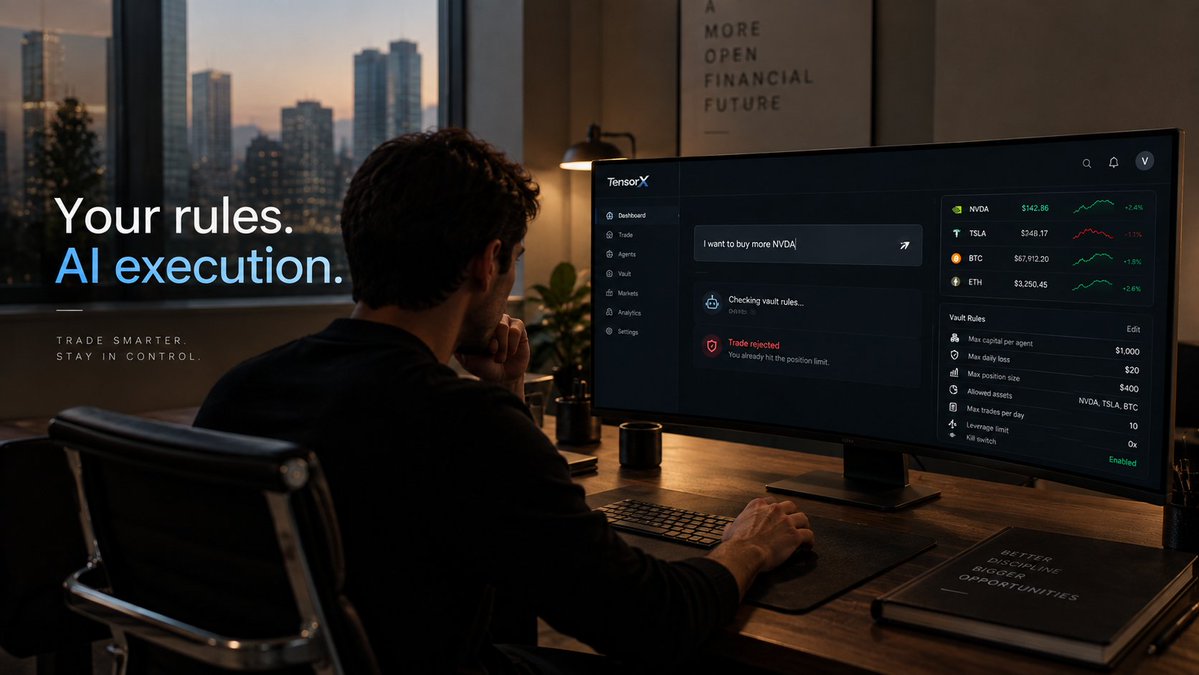
👉 Example:
Agent: "I want to buy more NVDA."
Vault: "You already hit the position limit."
Trade rejected.
The AI can make the decision.
The vault decides whether that decision is allowed.
Let's say you have $1,000.
Instead of manually watching NVDA, BTC, ETH and other assets all day, you could tell your Tensor X agent:
Trade NVDA, TSLA and BTC.
Max $400 per position.
Max $20 daily loss.
No leverage.
Now the agent operates within those rules.
If the market moves, it can make decisions and execute trades.
If the limits are reached, the vault can automatically stop further trading.
The point isn't "AI knows everything."
The point is AI execution inside rules you control.
Most people think AI trading = give an AI access to your account and hope it trades well.
That's not what we're building.
Tensor X is an AI trading terminal where:
→ You deposit USDC
→ Pick or build an AI agent
→ Set the rules
→ The agent trades 24/7
→ Your funds stay inside your own vault
You decide what the agent can and can't do.
AI trades. You set the rules.
Meet TensorX
An AI-powered trading app built for the next generation of on-chain markets.
Hire an AI agent, set your rules, fund it, and let it trade tokenized stocks + crypto 24/7.
Built on Robinhood Chain.
This is AI trading, reimagined.