Introducing O(1)
A zero-knowledge protocol artwork. Its title is its thesis: that the entire history of its ownership — however complex or deep — can collapse to a constant, committed to a single slot of Ethereum storage.
[ 72h Open Edition | .01 ETH | June 10 - 13 ]
1/
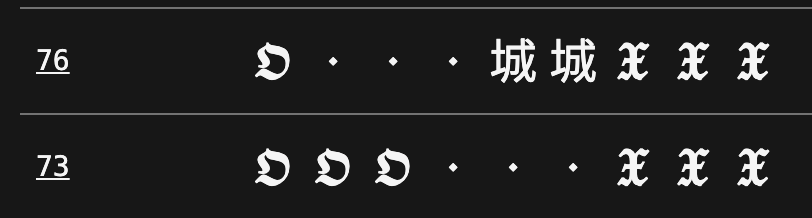
Tic tac toe character biomes exist, obfuscated under Gothic font.
Chess biomes: 85, 39, 26, 27, and 38
Tic tac toe biomes: 73 and 76
Tic tac toe is within human comprehension. We can play "optimal" games. Its solved.
Chess exceeds us. Combinatorially too complex.
"If its something that could be called art today, its not art... or its all then macaroni pictures. Its elderly scam calls on institutions that have nothing to say to the century, functionally speaking."
- @0x113d
#8412
Relisted at floor. [BOSS] is one of the less common colour palettes, doesn't come up that often.
This parcel would be a good addition for a new collector wanting something a bit different from the floor zones usually on offer.
Expanding on this cause sometimes I’m shit at communicating why certain things matter
Creating on eth as a world computer is an incredible opportunity
Imo mostly because of the collaborative and immutable possibilities
It’s like sharing a hard drive/server with the whole world
Most of the time though the art is offchain or it’s static (or even dynamic) in some siloed way
I generally can’t read the synth settings or note values or use the samples or the brushes or the images in someone else’s piece directly into my piece
It’s like slapping a sticker on a hard drive casing
And that’s kinda fine
That’s how it’s been historically too
But if we’re on the same (world) computer now we can
I can theoretically call the colors of your sky into my ocean, use your samples in my remix etc.
Recontextualize and bring the meaning along directly and explicitly (w hard coded attribution)
When the data is onchain, you can just port it right in
But nobody really does
-
Ok yes a few of us do
Adding functions and settings and samples and piano notes to an immutable public pool of art supplies anyone can use
And I think as we get more siloed in some ways, things like this bring us back to collaboration
Art on a shared ledger w shared tools and shared context
# Bidding automation & UI
ArtGod's desktop bundle ships with a built-in bidding bot, based on OpenSea orderbook scanning and reactions to relevant bidding events. Already battle-tested, highly competitive, and without any limits.
The bidding automation is controlled from the same frontend. Users only need to "install" the collection into their local ArtGod instance (more on this UI/UX later).
On the screenshot: the bid book view for trait bidding, with another extension-enabled Terraforms extra - visual Zone/Biome hints on the right side of the grouped trait buckets.
A fully functional desktop build that can be shipped to user machines has finally been achieved internally, so stay tuned for the public release announcement very soon.
The links:
- Blockspace Explorer: https://t.co/7HtcQwZKAN
- The Hypercastle: https://t.co/voKiVCmiD6
- Offers/trait bidding: https://t.co/QJsCtgLx6x
[3/3]
-- THIS IS THE LAST MESSAGE IN THE THREAD --
Last week, we got a new beefy server and released a few interesting features both for ArtGod's core and specifically for the frontend for Terraforms by @mathcastles.
# Blockspace Explorer - "How do you visualize multi-decade spacetime as a map?"
A multi-level drill-down grid interface that users can navigate to see the indexer's sync progress in real-time. The pink "❀" marks the exact deployment block of Terraforms, along with a path to access it through the drill-down.
In this UI, a user can queue up long historical backfills or fill gaps in sync coverage.
Of course, the whole feature is a core part of ArtGod and works out of the box for any EVM-based collection, as well as for all collections installed in that particular ArtGod instance at the same time.
The Blockspace Explorer is already live on the public, read-only ArtGod instance that syncs Terraforms (link below).
[1/3]
The "Droste effect" is the effect of a picture recursively appearing within itself, in a place where a similar picture would realistically be expected to appear. In art history, the technique is known as "mise en abyme"
- Wikipedia
#3660 (Spine parcel)



![TerraformsOTC's tweet photo. Relisted at floor. [BOSS] is one of the less common colour palettes, doesn't come up that often.
This parcel would be a good addition for a new collector wanting something a bit different from the floor zones usually on offer. https://t.co/Oasp6chC2Y](https://pbs.twimg.com/media/HJuvlFcW8AEVKFx.jpg)
![artgod_eth's tweet photo. # Bidding automation & UI
ArtGod's desktop bundle ships with a built-in bidding bot, based on OpenSea orderbook scanning and reactions to relevant bidding events. Already battle-tested, highly competitive, and without any limits.
The bidding automation is controlled from the same frontend. Users only need to "install" the collection into their local ArtGod instance (more on this UI/UX later).
On the screenshot: the bid book view for trait bidding, with another extension-enabled Terraforms extra - visual Zone/Biome hints on the right side of the grouped trait buckets.
A fully functional desktop build that can be shipped to user machines has finally been achieved internally, so stay tuned for the public release announcement very soon.
The links:
- Blockspace Explorer: https://t.co/7HtcQwZKAN
- The Hypercastle: https://t.co/voKiVCmiD6
- Offers/trait bidding: https://t.co/QJsCtgLx6x
[3/3]
-- THIS IS THE LAST MESSAGE IN THE THREAD --](https://pbs.twimg.com/media/HJq4ZG8XoAMfryy.jpg)
![artgod_eth's tweet photo. Last week, we got a new beefy server and released a few interesting features both for ArtGod's core and specifically for the frontend for Terraforms by @mathcastles.
# Blockspace Explorer - "How do you visualize multi-decade spacetime as a map?"
A multi-level drill-down grid interface that users can navigate to see the indexer's sync progress in real-time. The pink "❀" marks the exact deployment block of Terraforms, along with a path to access it through the drill-down.
In this UI, a user can queue up long historical backfills or fill gaps in sync coverage.
Of course, the whole feature is a core part of ArtGod and works out of the box for any EVM-based collection, as well as for all collections installed in that particular ArtGod instance at the same time.
The Blockspace Explorer is already live on the public, read-only ArtGod instance that syncs Terraforms (link below).
[1/3]](https://pbs.twimg.com/media/HJqvXjdXEAIEY_e.jpg)


