@Julianpetroulas With his addresses someone can easily pay some people to check him, if i was him i would live scared as fuck knowing that I’m scamming multi millionaires, germany is not that serious…
Bond market sending the same signal it sent in April 2025 — and policymakers responded then.
The real question is whether the same playbook works twice.
When geopolitical risk and fiscal concerns hit simultaneously, the Fed’s room to maneuver shrinks fast.
Yields at 4.45% with oil at $90+ is not a comfortable combination.
@JonErlichman The real lesson isn’t humility about origins.
It’s that the next $21 trillion company probably looks just as unimpressive today.
The question is which current garage-stage idea is genuinely inevitable — not just exciting.
Most won’t make it. One or two will change everything.
6 out of 6 is a compelling pattern.
But the mechanism matters more than the correlation.
Past oil shocks hit economies that were grid-dependent and had no alternatives.
The question this time: does distributed energy infrastructure change the transmission mechanism?
Different setup doesn’t mean different outcome. But it’s worth asking.
Brent futures pricing $90+ through December tells you one thing clearly:
The market doesn’t believe this war ends soon.
When energy stays elevated this long, the second-order trade isn’t oil stocks.
It’s everything that makes energy independence possible on-site.
The grid can’t solve this. Distributed generation can.
$400B in cash is not indecision. It’s discipline.
The real question isn’t what Greg Abel does with it.
It’s whether the market gives him a price worth paying.
Buffett waited years for the right pitch. Abel was trained the same way.
The $400B moves when the opportunity is asymmetric. Not before.
Warsh is right on the regressive nature of inflation.
But the real issue is that most people have no hedge against it.
Wages don’t keep up. Cash loses value. Bonds underperform.
Owning quality equity in businesses with pricing power is the only structural hedge that actually works over time.
65% equity allocation among HNWIs — just below the 2021 meme stock peak.
Cash at 10-year lows. Bonds at multi-decade lows.
When everyone is all-in, there’s nobody left to buy.
The smart money isn’t watching allocation levels. It’s watching what they’re allocated to.
Concentration in quality with dated catalysts beats broad exposure every time.
PEG is useful but misses one thing: it assumes growth is self-funding.
The real question is whether FCF supports the growth rate — or whether it’s being borrowed from the future.
$TSLA at 4.9x PEG with negative automotive FCF is very different from $KTOS at sub-1x PEG with a $13.7B pipeline and signed DOD contracts.
Same ratio. Completely different risk profile.
The AI arms race isn’t won by who has the most GPUs.
It’s won by who can power them.
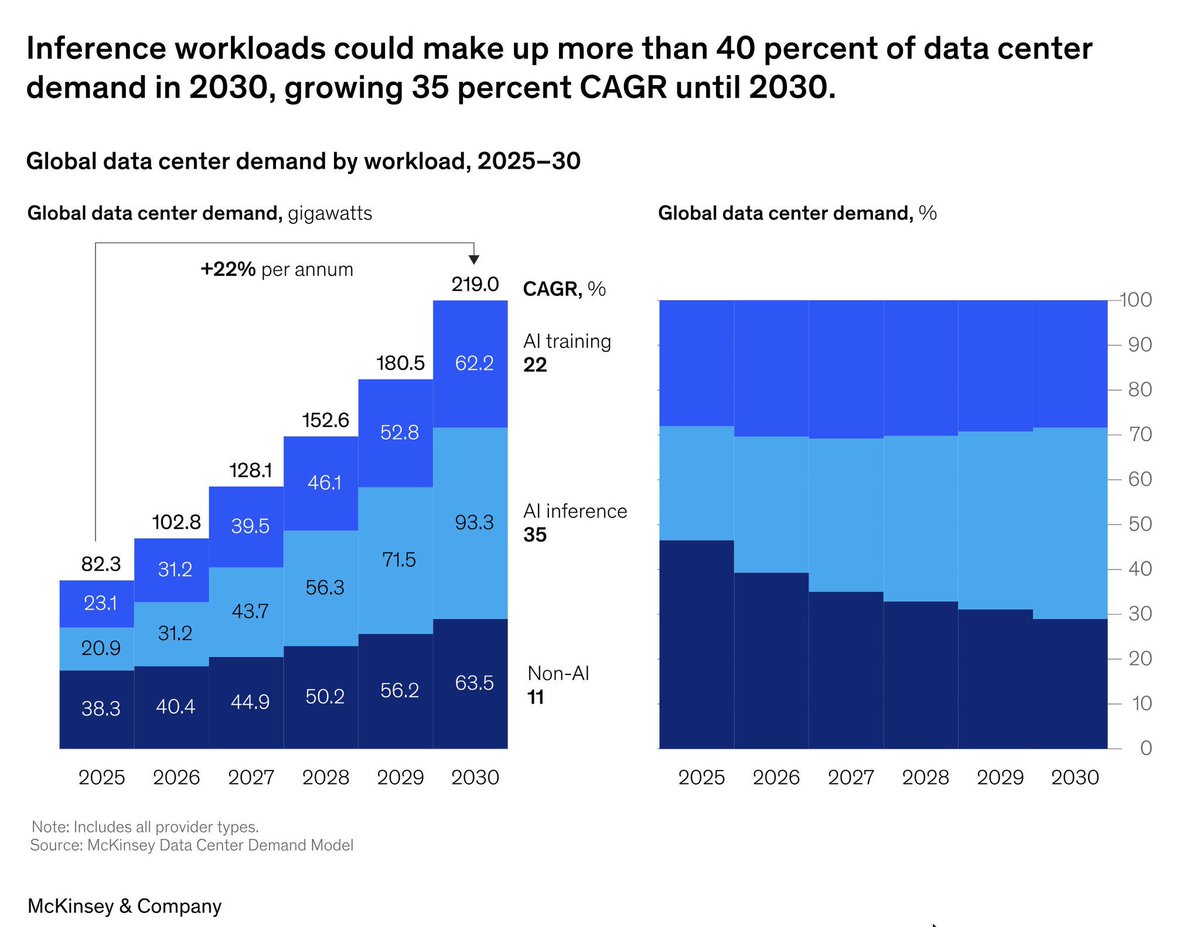
Global data center demand: +22% per year until 2030.
The grid can’t keep up. On-site power wins.
This is where I’m positioned. 🧵
Interesting table. But forward PE on semis misses the real question.
The constraint isn’t compute valuation — it’s power delivery.
Micron at 5.4x forward PE looks cheap until you realize every GB of HBM needs reliable baseload power to run.
The underpriced layer in this entire stack isn’t on this table
Inference surpassing training by 2030 means 24/7 always-on power demand — not burst compute.
That’s a completely different infrastructure requirement.
Training can tolerate grid instability. Inference cannot.
On-site, reliable baseload power becomes non-negotiable.
$BE is building exactly that.
@DavidSacks $805B in hyperscaler capex this year alone.
Everyone is modeling the GDP impact of the output.
Nobody is asking who physically delivers the power, cooling, and security infrastructure that makes $805B actually deployable.
That’s where the real asymmetric trade is hiding.
@sporadica Buffett has always said cash is a call option with no expiration date.
$270B sitting idle isn’t a failure. It’s discipline.
The question isn’t why he’s holding cash. It’s what happens to markets when he finally deploys it.
That’s the trade nobody is positioning for.
$7.6T in AI capex by 2031.
Everyone is chasing compute and data centers.
Look at the pink bar — Power is the most underpriced piece of this chart.
$BE is selling fuel cells directly to hyperscalers. $TLN has a 17-year PPA with AWS.
The picks-and-shovels aren’t the GPUs. They’re the watts.
@elonmusk While we wait for petawatts from the Moon, Earth still needs power today.
AI data centers are consuming gigawatts now with no solution in sight.
The bridge isn’t fusion or mass drivers — it’s on-site fuel cell and nuclear.
$BE $TLN are building that bridge right now.
This is exactly why owning equity matters more than earning wages.
The market doesn’t care about your hourly rate. It compounds regardless.
The gap in this chart isn’t a bug — it’s the price of not investing.
Every hour you work and don’t deploy into quality assets, you fall further behind.
The 1973 analogy breaks down fast.
In 1973 the US had no energy independence. Today it’s the world’s largest oil producer.
The real crash risk isn’t oil — it’s $7T in AI capex deployed by companies whose FCF is already declining.
Different crisis. Different cause. Different playbook.
The market is pricing out Buffett’s brain, not Berkshire’s assets.
$270B cash on the balance sheet. Greg Abel hasn’t deployed a dollar yet.
When he does — and he will — this chart reverses fast.
The real question isn’t why BRK is underperforming. It’s what happens when $270B finally moves.