Keir Starmer and The Blob are following the same script as after Southport.
Don’t fix the borders.
Blame Nigel Farage.
Don’t deport those who hate us.
Blame Nigel Farage.
Don’t crush the grooming gangs.
Blame Nigel Farage.
Don’t fix two-tier policing.
Blame Nigel Farage.
29 May 1917.
Pte Earnest F Gostling.
1 Bn Essex Regt.
Parkeston.
Buried at Niederzwehren Cemetery, Kassel (POW).
As Gosling F, on the Lych Gate Parkeston.
If the Manchester Airport thugs were two white lads, they would've both been immediately remanded in custody, found guilty, sentenced to a minimum of 5 years each, and be in jail 3 weeks after it happened.
We all know it.
Two-tier justice.
This day May 29th (1943) Thurrock’s ‘Wings for Victory’ week began. Its aim was to promote a variety of fund raising events & sponsorship from local shops & businesses to raise £300,000 to buy 15 Mosquito fighter planes. A week later £386,000 had been raised. Job done!
@VoicesofWW2 One of the most amazing stories of ww2. Truly hard to believe the conditions. The role of the Naga people also fascinating. The book “The Road of Bones” is one of the best ww2 history reads I’ve ever come across. Astounding bravery and suffering in all the participants.
On this day in 1944, the Japanese Imperial Army's greatest defeat in history was reaching its peak in a forgotten corner of India.
By nightfall on May 26, 1944, the battle that ended Japan's last offensive of the Second World War was effectively won.
Almost nobody outside the Burma campaign knows the story.
The Japanese 15th Army, 85,000 men under Lieutenant General Renya Mutaguchi, had launched Operation U-Go in March. The plan was ambitious to the point of fantasy. Three Japanese divisions would cross the Chindwin river out of Burma, climb 7,000 feet through monsoon-soaked jungle into India, capture the British supply bases at Imphal and Kohima, and trigger the collapse of British rule in South Asia.
Mutaguchi told his officers they would feast on captured British rations within weeks. He ordered them to bring only three weeks of food. After that, they would live off the enemy.
The British, under Lieutenant General William Slim, fell back into prepared positions on the Imphal plain and at a hill station 80 miles to the north called Kohima. They dug in. They waited.
What followed was 81 days of fighting in conditions that veterans on every other front of the war refused to compare to their own.
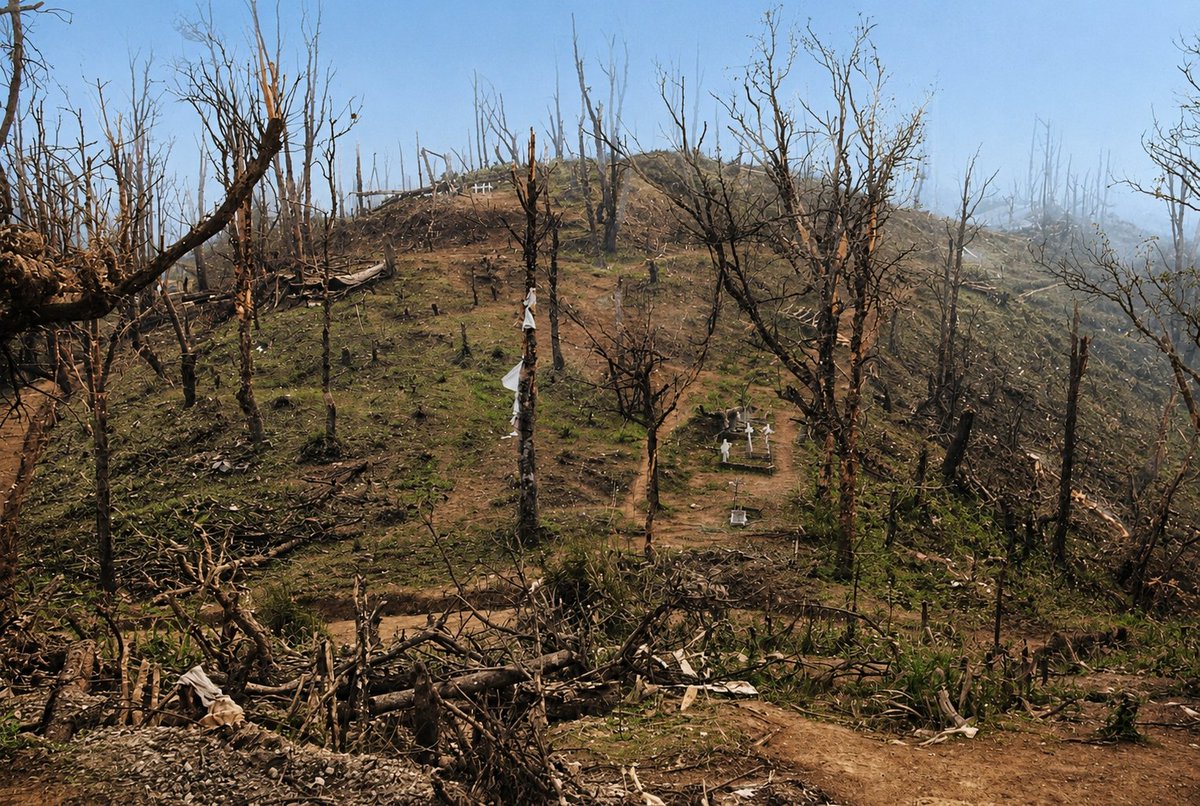
At Kohima, the centre of gravity of the entire battle compressed onto a single tennis court behind the District Commissioner's bungalow. British and Indian troops, mostly the 4th Battalion Royal West Kents and the 1st Assam Regiment, held one side of the tennis court. Japanese soldiers held the other. They fought across it for 16 days with rifles, grenades, and bayonets, at distances of less than 30 yards. Officers threw grenades back and forth like cricket balls. The clay court was churned into a graveyard.
The monsoon arrived in mid-May. Trenches flooded waist-deep. Wounded men drowned in their own foxholes. The dead were left where they fell because no one could reach them under Japanese fire. Bodies bloated in the heat. Disease killed almost as many men as bullets did. Typhus. Dysentery. Cerebral malaria.
By mid-May, the 2nd British Division had broken through to Kohima and begun counter-attacking south down the road toward Imphal.
By May 26, 1944, the Japanese 31st Division, which had attacked Kohima, was disintegrating. Out of food. Out of ammunition. Out of medical supplies. The men were eating roots, bamboo shoots, leaves, and in some documented cases, their own dead. Soldiers too weak to walk were left behind in the jungle with a single grenade and instructions to use it on themselves before the British arrived.
By that date, virtually every Japanese position in and around Kohima had been overrun. The road south to Imphal was open.
Mutaguchi refused to authorize a retreat. To withdraw was to admit failure, and Japanese military culture treated admitting failure as worse than annihilation. His subordinate divisional commanders, watching their men starve to death, began retreating anyway, in direct defiance of explicit written orders. Major General Kotuku Sato of the 31st Division simply marched his survivors back toward Burma without authorization and dared Mutaguchi to court-martial him. Mutaguchi did not.
When the Japanese 15th Army finally fell back across the Chindwin in July, of the 85,000 men who had started Operation U-Go in March, 53,000 were dead, missing, or so broken by starvation and disease that they were no longer combatants.
Most of those casualties were not from combat. They were from hunger, dysentery, malaria, exhaustion, and despair. The trail back to Burma was lined with skeletons in tattered uniforms. Indian villagers along the route remembered finding them for years afterward.
Mutaguchi was relieved of command, recalled to Tokyo, and forced into retirement. No Japanese ground offensive of comparable size was ever launched again in the Second World War. The defeat at Kohima and Imphal broke the offensive capacity of the Imperial Japanese Army in mainland Asia.
The British and Indian troops who held the tennis court are commemorated today by a small stone memorial at Kohima War Cemetery. The inscription on it has become one of the most famous epitaphs of the Second World War:
"When you go home, tell them of us and say,
For your tomorrow, we gave our today."
In 2013, British veterans and military historians voted Imphal-Kohima the greatest battle in British military history. Greater than Agincourt. Greater than Waterloo. Greater than D-Day.
Most people in Britain have never heard of it.
The Netherlands is the size of Wales. It is also the second-largest agricultural exporter on the planet by value, shifting roughly €100 billion of food a year out of a country you can drive across in an afternoon. The system that built this has been running, refining itself, since the 1950s, and feeding most of northern Europe in the process.
It is also the diet that built the Dutch themselves. In 1850, the average Dutchman was 5 foot 5, among the shortest in Europe. Today he stands 6 foot, the tallest in the world. The variable, by every cross-country analysis ever run on the question, was dairy. Cheese, butter, milk, repeated every day, for six generations, on a national scale. The Netherlands grew its population upward by feeding them what the soil and the cow could produce together.
In 2019, a Dutch court ruled that the country's nitrogen emissions, principally ammonia from livestock manure, exceeded EU limits. In 2022, the government published a target: halve nitrogen emissions by 2030. According to its own modelling, this required closing roughly 11,200 farms and significantly reducing livestock numbers on a further 17,600.
€25 billion was allocated to buy farmers out. Voluntary first. Then forced, if the voluntary route did not deliver. Nitrogen minister Christianne van der Wal informed the country, in public, that there was no better offer coming.
The farmers responded by driving tractors onto motorways, blocking distribution centres, and inverting the Dutch flag. Forty thousand of them gathered in central Netherlands in a single day. The police were briefly issued with shovels because the tear gas was running low and the farmers had brought slurry.
The protest did not stop the policy. The BBB party, formed by farmers in response, briefly became the largest force in the Dutch Senate, the coalition government softened some elements, and the rest continued. The Dutch dairy farmer who built his herd in 1985 is, in 2026, either gone, going, or being offered 120% of his land's value to leave. He is being offered this because the cow that built the tallest population on Earth is, by spreadsheet, now the problem.
Meanwhile, in the same country, Schiphol airport, KLM, and the Dutch chemical industry collectively emit nitrogen oxides the dairy sector cannot match, and have been treated with significantly more diplomatic care.
The farmer is the easiest fight because the farmer is one man, on one piece of ground, with one tractor.
The chemical plant is owned by a board.
Boards do not get bought out at 120%. They get consulted.
When is the government going to remove the blocks to get some new reservoirs built? If we have more hot days and more people living here we will need plenty of extra water. The government and Regulator have the powers to fix this. Would also add to growth and jobs.
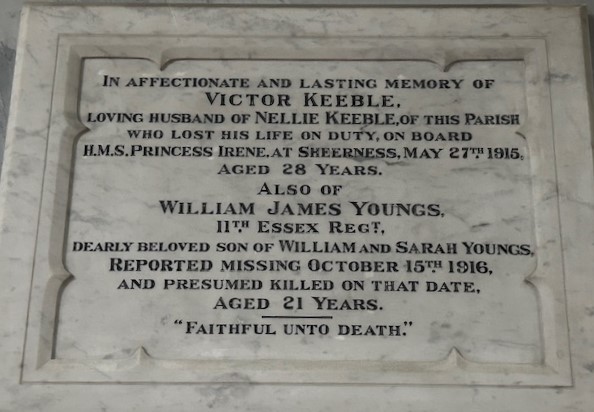
27 May 15.
Shipwright Keeble Victor Jubilee.
HMS Princess Irene.
Aged 28.
43 Waddesdon Road. Harwich.
Victor was the husband of EJS (Nellie) Keeble, and is now remembered on the Chatham Naval and
St Nicholas Church Memorials./1
27 May 1918.
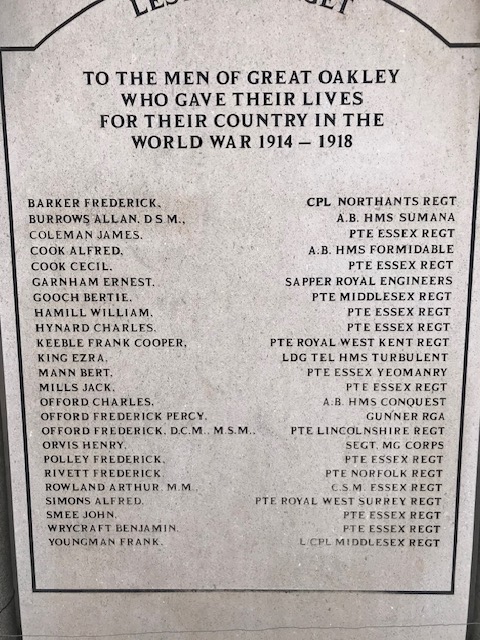
Pte Offord Frederick.
1 Bn Lincolnshire Regt.
Aged 18.
Great Oakley.
Remembered on the Soissons and Great Oakley Memorials.
The Great Oakley Memorial has Frederick listed, incorrectly as having been awarded the DSM and MSM.
On this day at 0600 HMS Hood was torn apart in the Denmark Strait.
In moments, 1,415 sailors were lost to the sea.
Yet even now 85 years later their courage and sacrifice still echo through the Royal Navy they served.
We remember HMS Hood.
We remember her ship’s company.
24 May 1915.
Pte Muckell Henry
RMLI, Chatham Bn, RN Div
Aged 34.
3Fernlea Terrace, Harwich.
Husband to Lillian Vera.
Remembered on the Helles Memorial, and St Nicholas Church Harwich.