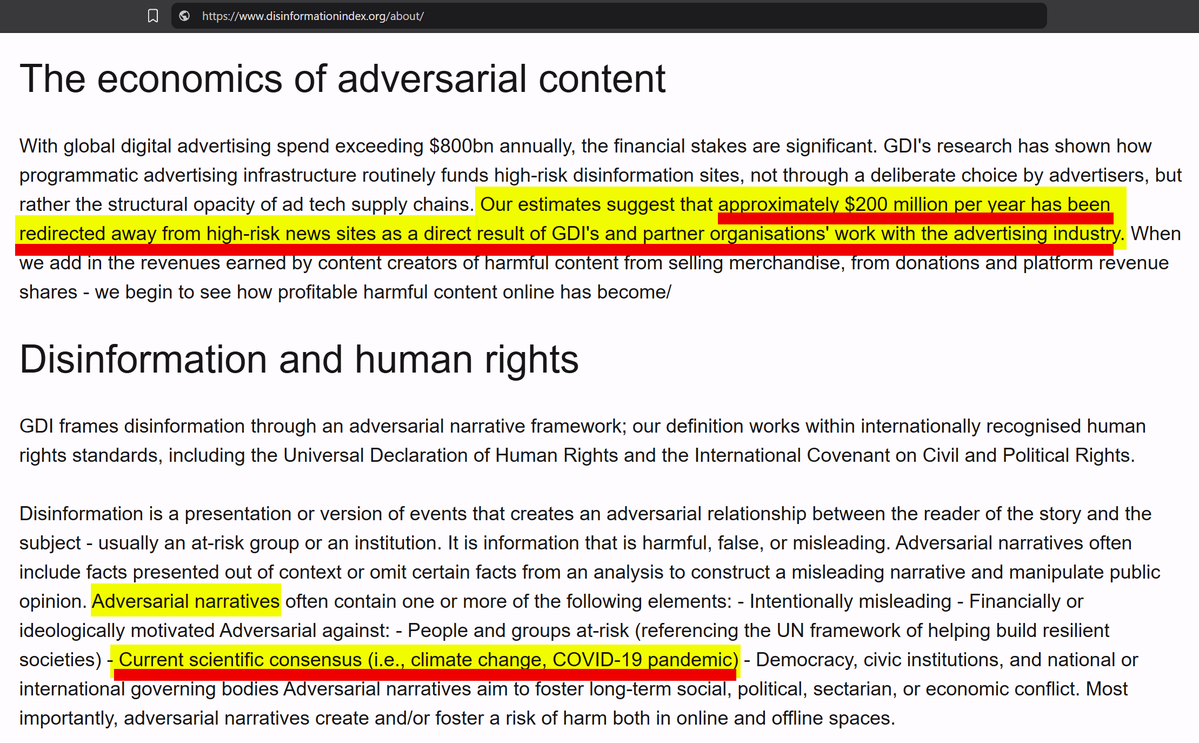
GDI put nearly every major conservative news outlet in America on an ad blacklist to financially assassinate their businesses. GDI killed $200 million in ad revenue to media outlets reporting the wrong "narratives." GDI was recommended to USAID by the US intelligence community.
@zerohedge This combined with banks talking about bringing about ESG which implies bringing back debanking once Trump is out of office. They're going to get a run on banks.
This IPO allowing non founder insiders to sell up to 10% of their holdings in day 1 is so outside the norm I have no words. Usually there is a 180 day lock up. This was beyond ridiculous.
@RueDayton@CassandraRules Yes, I heard they didn't do it because it was considered too dangerous. Going by reports if it's so unstable adding material to it might be enough to cause an explosion, and private companies don't like death liability. The whole issue is mostly legal fallout.
BTW in case you didn't know "shoot them in the leg" is lethal force in terms of effect and law. It was a meme started by people that like sowing chaos to see how many people would repeat it.
Now it's in a video game morality system is chef's kiss.
@ModernityNews The plan was always to rebuild Ukraine without its people. That's why the little green man wants two more years of war to finish the job.
One of the worst takes I've seen on this platform is that "because conservatives didn't revolt or resort to violence during the COVID lockdowns, they never will."
The threshold of violence is well-studied and says the opposite.
In modern stable societies, especially Western ones, the government has a monopoly on violence. Under the "social contract," citizens subordinate violence to the state, which decides when and where to apply that violence. The state enforces its monopoly by criminalizing extrajudicial violence. Some governments believe in their monopoly so much that they criminalize violence even in self-defense.
The result is that citizens are conditioned to believe in that monopoly because the risk of violating it is so high.
Which is to say that there's a certain amount of inertia that needs to be overcome before sporadic political violence becomes organized and coordinated (such as during an armed conflict).
The logic of "because of x case, y will never happen" is faulty. Their argument is that because COVID didn't break this inertia, it will never be broken. This is simply not true.
This post is not advocating violence. I am merely explaining why I still believe a domestic armed conflict is likely.
It's kind of like watching a cake bake: not having a timer, I don't know when the cake will be fully cooked, but you can see the dough rising as it's getting closer.
So what's required to break this inertia? What conditions accelerate violence?
According to the studies, it's tolerance for violence.
When a growing share of citizens signal their tolerance for political violence as an alternative to a broken political process, that violence becomes far more likely.
Citizens don't even need to actively support that violence, just acquiesce to it because the system (political, social, or economic) is so broken that they will tolerate violence against it. They are out of F's to give.
And it's not just that the system is broken -- i.e., it no longer works for me -- it's that the system has become illegitimate.
And the next logical conclusion is that an illegitimate system that doesn't work for me needs to be replaced with a legitimate one that does. That's the basis of virtually every revolution in human history.
Another bad argument is that because violent actors can't pick out specific targets, that political violence is not going to happen.
Again, studies are very clear: that doesn't matter. In civil war/domestic conflict, violent actors resort to generalized, collective punishment (i.e., any Democrat or Republican) if they don't have a specific target.
But let me tell you the greatest reason why I believe a domestic conflict is inevitable. (I dislike the term "civil war" because it's vague and conjures up a lot of different pictures, which is why I typically just use low intensity conflict, which covers a wider range of things like revolution, insurgency, terrorism and violence social movements, each of which can lead to revolutionary political change.)
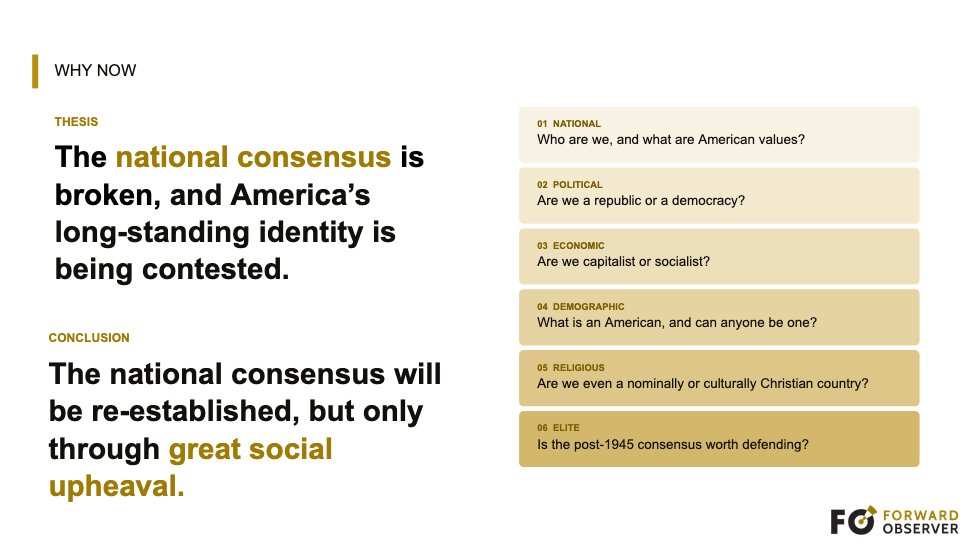
The national consensus is broken.
Nearly every part of our society is fractured. We can no longer agree on basic tenets like republicanism versus democracy, capitalism versus socialism, what is an American and what are American values, are we even a culturally Christian country, etc.
Regardless of differences in D or R political flavor, 20 years ago most Americans shared a consensus across all these factors. That's no longer the case and this shift was pretty rapid.
And when the national consensus is this broken, governments lose legitimacy and a society's tolerance for violence increases. (We haven't even gotten into the bad economic times yet. Industrial revolutions ALWAYS generate conflict.)
The national consensus will be restored -- either as a whole or separate countries -- but only after great social upheaval, usually armed conflict.
This is because citizens' tolerance for political violence increases as the ability to achieve change through the political process decreases. This is especially the case when politics become existential for one or both sides.
This is no my entire case because this is an X post, but this is my off-the-cuff thinking on the topic.