Today, the Tesla navigation wouldn’t show me the usually route… apparently it was due to major traffic due to construction. We need to be notified of this so we know not to override. @elonmusk@aelluswamy@Tesla_AI
This blatantly irresponsible reporting does more harm to people than they realize.
Using Tesla self-driving is far safer than manual driving, and this was measured over 10B miles.
Planting such FUD in the minds of general public, who might not know the all the facts, might prevent them from using this technology that makes them safer.
@elonmusk@kylaschwaberow Yup. In this case, the driver manually overrode self-driving by pressing the accelerator all the way to 100% of the accel pedal in this residential area. They reached a speed of 73 mph during the crash, and had the accelerator pressed even after the crash.
@elonmusk@t_blom This is on a busy street too! Also, it needs to know that if navigation shows red where I'm going, get in the lane earlier since I won't be able to get into the lane later due to traffic.
@elonmusk@t_blom Tesla's navigation leaves a lot to be desired! It should really try to follow UPS routes where making a right is better than making a left. Everyday, when I go to work, it wants to cross a 2 way street TWICE, when what I would do is take a right then a left at the light.
@heydave7 This fails to mention one thing: I need the range so I don’t constantly have to charge. My wife and I have a Tesla and we take turns charging. People don’t drive 300 miles everyday but 50 miles would mean about 5 days without charging which is a good amt
Wow, Elon wasn’t kidding. 14.3.3 is absolutely a banger.
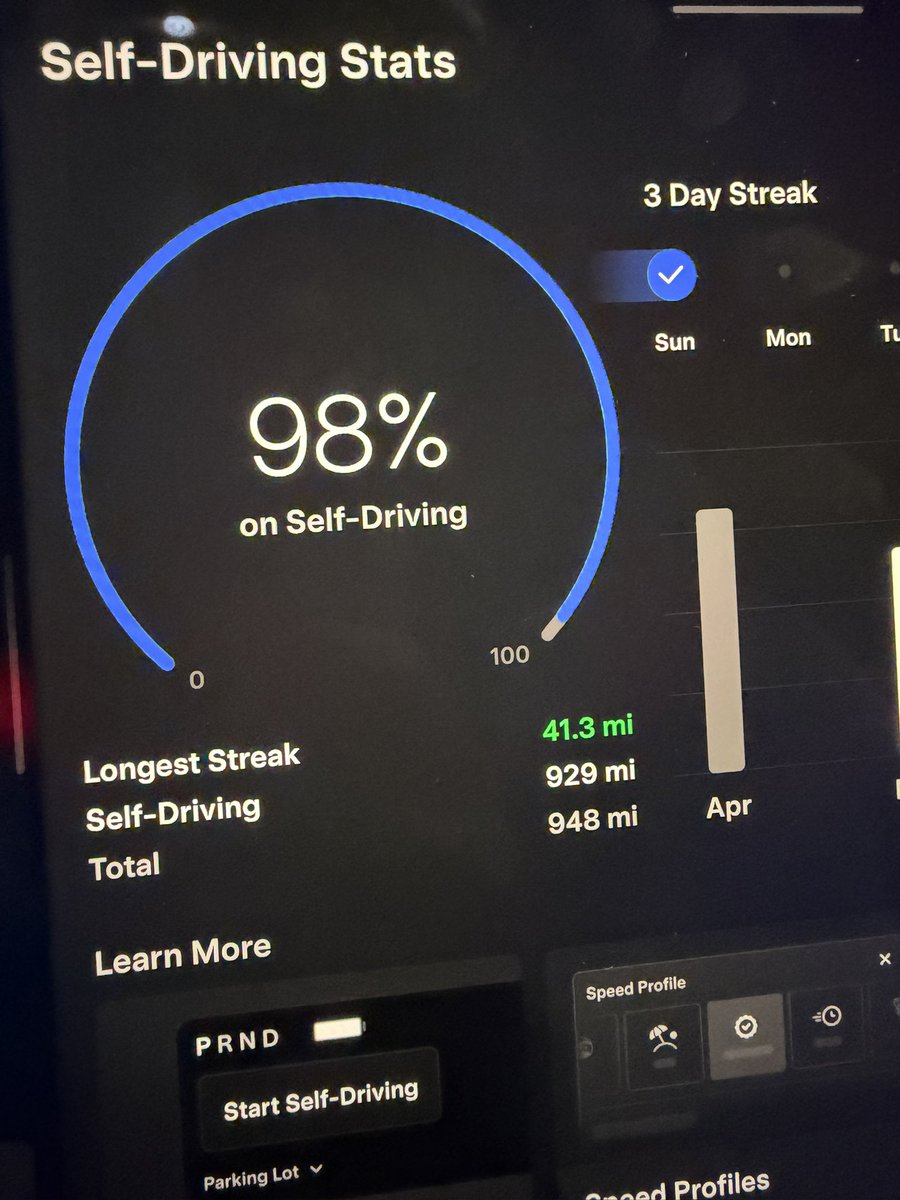
As you can see here i’ve used self-driving every day for the last 3 days, and have gone 41.3 miles without intervention on 14.3.3
This is first truly refined build of FSD 14.3.3. It is the first build that surpasses 14.2.2.5 in polish. In my opinion, this is the first version that should have gone wide. 14.3.2, while great, was often a little jumpy or jerky due to its increased reaction time. When the reaction time increases the model often gets a little jumpy until it is retuned. That seems to have happened now.
With each little point release I feel the model coming to life. The way it slows down ever so slightly (~1 mph) when it can’t see over the hill, the way it eases in when it sees a bumpy section of the road. It’s so refined. The way it responds instantly when it sees the car next to it veering into its lane. Like wow, even I can’t drive that smoothly and react that quickly.
Tesla is by far the gold standard in self-driving comfort. With each build it feels more and more like a personal robotaxi. It can now even operate driverlessly at up to 8 miles per hour.
Kudos to the Tesla AI team. You mother fuckers are absolutely COOKING!
Send it wide… replace 14.3.2 with this right away.
Also love the new self-driving streaks feature. Gamifying self-driving usage is a very smart way to make sure people only intervene when absolutely required, increasing the signal to noise ratio of interventions in the dataset.
Please make this available via fleet telemetry so people can compare to see who has the longest streak easily
@farzyness Elon is a technologist… he wants to own the ride hailing and possibly public transportation service. He’ll let the auto makers deal with selling cars…
My 2 cents into this Tesla Merger... SpaceX IPO will dictate the premium for Tesla's stock price to get both companies to a 50/50 merger when it happens. For example, if SpaceX at IPO is valued at a 2T company than Tesla's share price will go up to ~$510. It's in SpaceX's best interest to do it sooner rather than later since Robotaxi and Optimus isn't factored yet.
@DoctorJack16 I realized yesterday it would do the same thing. Park at a place it finds right away instead of skipping spots.. hopefully it's not a fluke.
Following future rollout of FSD V14 Lite for HW3 vehicles in the US, we plan on expanding V14 Lite to additional international markets.
This update ensures that HW3 vehicle owners will continue to benefit from ongoing software updates.
Since international rollout is subject to several factors (completion of technical verification, regional adaptation & relevant regulatory approvals), we can't provide definitive dates at the moment, but will provide updates on a rolling basis
Nine billion miles of driving data just became a chip.
Tesla AI5 is finalized for production. The design files are at Samsung in Texas and TSMC in Arizona. The transistors are locked. There is no going back. Tape-out is the hardest gate in semiconductor engineering because everything before it is reversible and everything after it is silicon.
How this particular chip was designed is the most interesting part.
Nvidia builds general-purpose GPUs. They pack transistors into a full-reticle die, ship it with CUDA, and let customers figure out which operations matter. Blackwell B200 delivers 4.5 petaFLOPS at up to 1,000 watts. It runs any model for any customer. That generality is the moat and the tax. Every workload pays for circuits it never uses.
Tesla designed AI5 backward. They started with 9 billion miles of FSD inference data and asked one question: where does the neural network waste cycles? The answer was softmax computation and quantization precision loss. Two specific mathematical operations that consume disproportionate silicon area and power in every general-purpose GPU on Earth. Operations that Nvidia cannot optimize away because other customers need those transistors for different workloads.
Tesla hardened them. Burned custom quantization and softmax accelerator blocks directly into the die. Five times more efficient on those operations than any general-purpose equivalent. Then they added 10 times the raw compute and 9 times the memory capacity relative to AI4. The result: a single AI5 system-on-chip delivers roughly 5 times the useful compute of the current dual-chip AI4 configuration at an estimated 250 watts. Musk has framed a single AI5 as Nvidia Hopper class and dual AI5 as Blackwell class for Tesla workloads, at 3 to 5 times better power efficiency and roughly 10 times better performance per dollar.
This is not a chip designed to compete with Nvidia. This is a chip designed to run one thing: the learned differentiable physics engine that emerged from 9 billion miles of camera observation. Every transistor serves that engine. No wasted silicon. No generality tax. The neural network wrote its own hardware.
The chip goes to two foundries. Samsung in Taylor, Texas. TSMC in Arizona. Both American. Musk thanked both this morning and added: “It will be one of most produced AI chips ever.”
Samples arrive late 2026. Volume targets H2 2027. In the same post, Musk confirmed AI6, Dojo3, and “other exciting chips” are in active development. The 9-month cadence is real. AI6 targets tape-out by December. Dojo3 restarts on the unified architecture after Musk shut down Dojo2 last August as an “evolutionary dead end.” Intel joined Terafab eight days ago for advanced packaging. The $16.5 billion Samsung deal runs through 2033.
The chip that taped out this morning is not a product. It is the physical crystallization of 9 billion miles of learned physics into transistors optimized for the exact mathematical operations that physics requires. The software trained on the road. The silicon was designed from what the software learned. And the factory that will mass-produce it is being built in the same city where the cars that generated the training data roll off the line.
The loop is closed.
NEWS: Dutch regulators (RDW), which just approved @Tesla FSD (Supervised) in the Netherlands, have just issued an official statement:
"Due to the continuous strict monitoring of the driver in the vehicle, the system is safer than other driver assistance systems. We have thoroughly researched and checked this system, more than a year and a half.
The RDW has issued a type approval for Tesla's driver's assistance system, FSD Supervised. This driver's assistance system has been extensively researched and tested on our test track and on public roads for more than a half years. Safety is paramount for the RDW. The proper use of this driver's system makes a positive contribution to road safety."
This approval from the RDW clears the path for approval in other European countries. Tesla owners in the Netherlands will be receiving FSD (Supervised) on their cars shortly. Amazing day!