My bat signal 🦇🔊 will return when ETH is ultra sound again, soon enough™.
ETH supply currently grows 0.5%/year. That's 1%/year of issuance minus 0.5%/year of burn. To become ultra sound again, either issuance has to decrease or the burn has to increase. I believe both will happen, let me explain :)
ETH vs BTC
Before diving into Ethereum's issuance and burn, quick interlude on ETH vs BTC.
Internet-native money is an enormous opportunity, think tens of trillions of dollars. Monetary premium rarely accrues at scale. You need a truly attractive asset with outstanding properties for society to coordinate around.
At first approximation moneyness is a zero-sum game. Gold is primed for demonetisation in the internet age. There are only two candidates to supplant it and win internet money—BTC and ETH. Nothing else comes close. IMO the determining Schelling points are credible neutrality, security, and scarcity.
Since the merge, ETH is definitely scarcer than BTC. It's remarkable BTC supply grew 666K BTC, worth $66B, all while ETH supply stayed flat. Today BTC supply grows 0.83%/year, 66% faster than ETH. And for those looking ahead, as I explain below, ETH supply is poised to decrease again.
Scarcity is important, but ultimately the fight for internet money will likely be settled by security. Ironically, the famous 21M BTC cap is to blame. BTC issuance is going to zero—that's Bitcoin's strongest social contract. In a few halvings, issuance will be so small as to be irrelevant.
Here's a shocking stat: in the last 7 days only 1% of miner revenue came from Bitcoin fees. Yes, 99% came from issuance. And that's despite 4 halvings that reduced issuance by 16x, and despite 15 years of search for transactional utility on Bitcoin.
IMO the Bitcoin blockchain is cooked. It takes roughly $10B and access to 10GW to permanently 51% attack Bitcoin. The cost is peanuts for nation states. As for the power, Texas—a single state of a single country—can produce 80GW. The BTC security ratio is 200-to-1, it's a $2T asset secured by $10B of economic security.
Any shortable instrument correlated to BTC mining incentivises an 51% attack attack. There's $20B of Bitcoin mining stocks—those would insta-nuke. There's $40B of open interest on BTC perps—direct short exposure. Not to mention potential short exposure through the $100B in ETFs and the $100B in MSTR.
Will BitVM solve the fee problem? Any BitVM bridge is an incentive to 51% attack Bitcoin. Indeed, a 51% attacker can censor fraud proofs over the challenge period and drain BitVM bridges. Ironically, BitVM is arguably a direct attack on Bitcoin. And no, Bitcoin doesn't have social slashing to recover from 51% attacks.
What if the BTC price grows by 10x, flipping gold, is Bitcoin safe then? Let's say this happens in the next 11 years. BTC would be a $20T asset but issuance would shrink 8x because of the three halvings. The security ratio would grow beyond 1000-to-1. IMO this is untenable especially as BTC institutionalises, becomes more liquid, and ultimately become easier to short in size. Imagine $1T of perp open interest but just $10B of economic security.
Can Bitcoin somehow fix itself before it's too late? Bitcoin is the epitome of blockchain ossification. Can it have 1%/year tail issuance? Ha, good luck fighting the 21M cap! Maybe Bitcoin can switch to PoS and rely on minimal fees? PoS is sacrilege. Maybe Bitcoin can change to another PoW algorithm? Nope, that nuclear option won't help. Maybe Bitcoin can have big blocks and sell data availability at scale? Ser, a holy war was fought over small blocks.
If you made it this far and understood the above, congrats. Even today few appreciate how screwed Bitcoin PoW is long term and what the ramifications are for BTC the asset. This is a frontrunable opportunity but it requires patience. The time frame is not 1 month or even 1 year—it's 10 years.
Talking about long time frames, the Lummis proposal to lock BTC for 20 years is kinda insane—Bitcoin will be smoked by then. Worse, if the US were to hold trillions in BTC it would directly incentivise US enemies to muster a 51% attack. Contrary to popular belief, Bitcoin is not remotely resistant to nation states—China and Russia can pull off a 51% attack with ease.
ETH issuance
Ok, back to ETH :) The current issuance curve is a trap. Unfortunately, like Bitcoin's issuance, Ethereum's issuance was misdesigned. It guarantees 2% tail APR, even if 100% ETH is staked. Every rational ETH holder is incentivised to stake as staking costs are significantly lower than 2%.
We all lose when most ETH stakes:
→ ETH displacement: Liquid staking tokens like stETH and cbETH displace pristine ETH as unit of collateral. This injects systemic risks—custodial risks, slashing risks, governance risks, smart contract risks—into the core of defi. This displacement also erodes ETH as a unit of account, with further knock-on effects to monetary premium.
→ real yields and taxes: Real yield, i.e. the yield adjusted for supply growth, decrease as more ETH stakes. When 100% of ETH stakes all ETH holders get equally diluted. Worse, income taxes are drawn on nominal yield. It would be a tragedy of the commons for no staker to enjoy positive real yield and for all ETH holders to suffer billions of dollars per year of tax sell pressure.
IMO the issuance curve should drive discovery of a fair issuance rate through staker competition—no arbitrary 2% floor. This means the issuance curve must eventually decline and return to zero with increased ETH stake. My suggestion is "croissant issuance".
Croissant issuance is a simple half-oval with two parameters:
→ soft cap: The staking fraction where issuance returns to zero. To me a 50% staking soft cap feels credibly neutral and pragmatic. In particular it's large enough to address discouragements attacks.
→ peak issuance: The theoretically-maximal issuance borne by ETH holders. An arbitrary round number like 1%/year will do as ultimately the equilibrium rate would be market-set.
EF researchers have studied issuance for years—IMO there's rough consensus the current curve is broken and needs to change. Navigating the social layer to change issuance won't be easy. This is an opportunity for a champion to rise to the occasion and coordinate change to mainnet over the next couple years.
ETH burn
IMO the sustainable way to burn vast amounts of ETH is to scale data availability. It's much more lucrative to have 10M TPS with each transaction paying $0.001 in DA than it is to have 100 TPS at $100/tx.
Yes, the data availability supply shock from EIP-4844 that introduced blobs temporary lowered total burn. This is the nature of supply and demand. When demand for DA catches up expect the blobs to burn hard. The Pectra hard fork, in a couple months, will double blob count. The short-term goal is growth and I expect lots of it.
For the next couple years it will be a cat-and-mouse game between supply and demand as full danksharding is deployed. I wouldn't be surprised if this year we see hundreds of ETH per day of blob burn, and then that burn suddenly collapsing again with peer DAS in the Fusaka fork.
Zooming out, we're here to build infrastructure for the next decades and centuries. Fundamentals will play out over years. Whether it's Bitcoin security, ETH issuance, or the ETH burn, stay patient and have conviction :)
The amount of short term thinking on ETH is crazy.
Let me explain how ETH value accrual works.
Over the next 5 years and longer Ethereum will oscillate like a pendulum back and forth between two states: burn and expand.
Burn cycles
During burn cycles demand for blockspace will exceed threshold supply - more ETH will be burnt than is issued and ETH will flip deflationary for a time.
The last burn cycle started Spring of 2023 and lasted until Ethereum shipped a blockspace supply expansion in March 2024.
The end of a burn cycle will generally be triggered by an Ethereum blockspace expansion upgrade or a bearish crypto market.
Expand cycles
An expand cycle starts when Ethereum increases blockspace supply. During expand cycles ETH flips back to inflationary and blockspace demand is cheap and plentiful.
We started the most recent expand cycle in March 2024 with EIP4844 which shipped fastlane blockspace for rollup transactions called blobspace.
It's looking like we're in the early phases of exiting the expand cycle and close to moving back to the burn cycle as blobspace demand is showing signs of exceeding threshold supply.
ETH is burnt aggressively when blockspace thresholds are exceeded.
Why the pendulum?
Because Ethereum is designing within the constraint of staying decentralized - keeping it practically impossible for any third-party to steal or censor - it has to expand blockspace primarily through well tested cryptoeconomic breakthroughs.
The Ethereum computer upgrades gradually - the way chip builders increase compute performance in each new CPU model according to moores law.
In March, the blobspace deployment gave Ethereum rollups a maximum of 607 TPS. The next peerDAS will may increase it upwards of 1,300 TPS.
After that, we'll be on a gradual upgrade path to 58,000 TPS. All the while the pendulum will oscillate back and forth from burn to expand.
Value accrual to ETH?
ETH the asset benefits both during times of burn and times of expand.
During burn cycles ETH supply becomes deflationary - which increases the scarcity of ETH the asset as a monetary unit - a digital gold with superior economics vs all other SoV assets including gold, T-bills, and bitcoin. This is good for ETH.
During expand cycles, L2 blockspace becomes cheap and creates induced demand for ETH the asset inside native Ethereum L2 economies. This is good for ETH.
How do L2 economies benefit ETH?
While other monies will exist inside L2 economies, ETH is the enshrined unit of account for blockspace just as petrodollars are the global unit of account for oil.
Additionally, the properties of ETH make it the credibly neutral schelling point for a reserve currency status across the entire Ethereum economy. ETH is the primary SoV in the Ethereum economy the way property, stocks, and T-bills are primary SoV's in U.S. economy.
In short, during burn cycles ETH becomes more scarce, during expand cycles Ethereum GDP increases - both become sources of demand for ETH as money.
Why is ETH down?
Here's what i think.
Crypto sentiment is a weathervane not a forecast. During burn cycles they panic that "ETH fees are too high" and during expand cycles they say "ETH value accrual is too low". They haven't taken time to understand the pendulum because they're trading the swings.
It's not just that.
The world hasn't seen an asset like ETH before. The Ethereum L2 roadmap and the economics I outlined are probably understood by less than 5000 people. The burn/expand cycles are new - they just started 2 years ago and we haven't seen multiple cycles play out yet.
The world will catch up.
I'd also add there are many people with financial incentives to prop up their assets at the expense of Ethereum.
That's fine. Fundamentals eventually win.
How could this be wrong?
There are three ways i could be wrong.
1. Low demand for Ethereum - the burn/expand cycles assumes demand for Ethereum blockspace always catches up to the new supply. Maybe this is wrong because competitors or demand for truly decentralized blockspace is weak.
2. Low demand for ETH - it could be that the Ethereum economy produces massive L2 GDP but ETH the asset never picks up the SoV meme. Maybe more centralized money is imported in L2s, like tokenized gold, stablecoins, or bitcoin and all these squeeze ETH out.
3. Ethereum fails to ship - the Ethereum roadmap may fail to ship or the L2 economy may prove a dead end.
On 1, blobspace is already close to meeting threshold supply - that's bullish.
On 2, L2s are already importing billions in ETH as money - that's bullish. (We have work to do on the memetics)
On 3, Ethereum now has shown a proven record of shipping, Vitalik has a clear path, and L2 traction is already incredible - this is bullish.
Maybe things reverse but so far the burn/expand pendulum seems to be right on track.
Long-term view
When I put all this together ETH seems underrated relative to its peers because people don't understand it and aren't taking the long-term view.
There's a Buffet type opportunity in ETH.
Introducing Tactics: Your Ultimate Social Betting Opportunity! 🧩
We are excited to unveil Tactics – a strategy-based social betting game, similar to DraftKings, offering up to 20,000% liquid gains in a day.
In addition, we're welcoming 11 New Heroes.
––––
Register Now for the First Tactic! 🎟️
Tactics do not require players to own any cards.
3,432 Slots are opened with a prize pool of:
💵 $60,085
🟡 30,040 BLAST GOLD
✨ FAN pts.
Join us for the most meritocratic Social Fi Betting gameplay ever created! 🧵
––––
🎁 GIVEAWAY 🎁
To celebrate, we will select 10 winners from participants who retweet this tweet, follow @fantasy_top_, and tag a friend in the replies.
Each winner – and their friend – will receive:
🧩 1 Free Tactic
🟡 100 GOLD
✨ 5K FAN points
Using the Fantasy PFP might boost your chances! Winners will be announced in 24 hours.
6 Reasons Why You Aren't BULLISH enough on @frenpetonbase
I have 3 minutes to change your mind
You have 3 minutes to change your life
The game has started 👇🧵
It’s the final week of the #rhinorun and we’ve got a good one!
Week 6 of the Rhino Run is - Blast 🚀
🔎Explore @Blast_L2
✅Complete tasks
🤑Win a share of $50,000
Join now 👉https://t.co/R79iq2onSB
We’ve got some amazing partners lined up for this week to help you explore this new chain:
🔥 @ambient_finance
🔥 @tradeonblitz
Aave cost 30$ to use on L1 and 0.01$ on Arbitrum
It's the exact same codebase.
If the 870M$ of liquidity we have on Arb is not enough for you and you do need the L1 11B$ Liquidity.
Then you can afford 30$ txs fees.
Stop whining and start using the L2s anon.
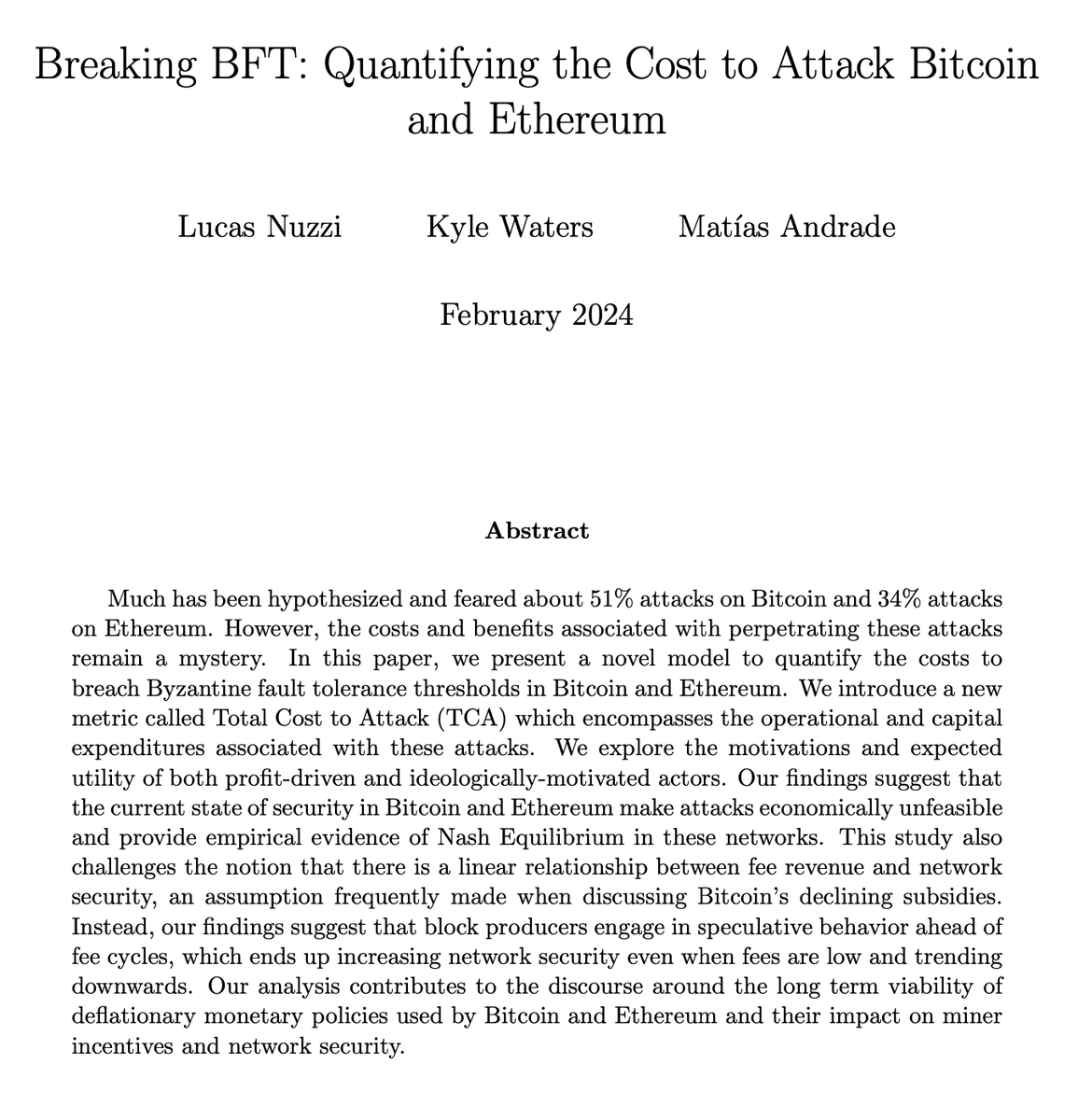
How much does it cost to 51% attack Bitcoin and Ethereum?
To find out, we simulated what an attack would look like.
Our paper, Breaking BFT, was published today with some interesting results ⬇️
https://t.co/weNnmyeuBl
[THREAD + CONCOURS] Présentation de JPG 🟥🟨🟦
JPG est un écosystème crypto POUR les degens 🇫🇷 créé PAR des degens 🇫🇷
Si la culture web3 vous intéresse, alors ce thread est fait pour vous 🫵
Mais tout d'abord, on vous offre un ENORME GIVEAWAY pour fêter ce lancement ⬇️
The truth they don’t want you to hear:
Transaction fees are always fairly priced exactly where organic demand meets fixed blockspace supply.
If you find tx fees too pricey for you, you’re free to explore L2s or alt L1 more fitting for you anon.
Cher @AxeldeTarle,
J’ai regardé avec attention votre chronique d’hier sur les cryptomonnaies dans Télématin.
Je vous suis dans @Cdanslair depuis des années et c’est souvent une porte d’entrée de qualité sur des sujets que je connais mal. Mais quelle mouche vous a piqué lorsque vous avez évoqué les cryptomonnaies ?
Je peux tout à fait entendre que l’on n’y soit pas favorable, mais comment justifier vos arguments ? Avez-vous seulement pris le temps de savoir ce qu'était un mécanisme de consensus ? Lu sur la théorie des jeux ?
Mais ce qui m’attriste le plus, c’est la façon dont vous avez conçu cette chronique (“Hier soir j’ai tapé “cryptomonnaies” dans Google”).
Sans compter la qualité des sources que vous avez choisies de retenir....
Le choix de cette source et de son sujet (un top des cryptos dans lesquelles investir) sert un biais visant à ridiculiser le sujet à tout prix. Un peu comme si vous utilisiez Closer pour couvrir la réforme des retraites.
Je fais l’impasse sur le ton que vous prenez en citant certains projets qui seraient discrédités en raison de leur nom que vous trouvez amusant.
Et aussi sur le fait que vous choisissez de montrer le dynamisme d’une cryptomonnaie en montrant son cours sur 24h… Feriez-vous ça pour illustrer la santé de LVMH ?
À la réponse “est-ce que toutes les cryptomonnaies sont à jeter ?”, vous répondez d’un lapidaire “oui”. “Le Bitcoin c’est du vent, ça ne repose sur rien”, ajoutez-vous.
Visiblement votre recherche sur Google dimanche soir vous a permis de balayer d’un revers de main le travail de certains des cryptographes les plus brillants des 30 dernières années.
J’ai bien conscience qu’il faut être prudent lorsqu’on parle d’un tel sujet à une heure de grande écoute, surtout lorsque le public n’est peut-être pas celui qui va s’y intéresser.
Mais pourquoi offrir un traitement digne du café du commerce alors qu’il aurait été possible d’apporter un peu de contexte et d’équilibre dans les propos ?
C’est ce à quoi m’avait habitué "C dans l’air" que vous co-présentez brillamment depuis des années.
Il y a tellement de choses à dire sur le Bitcoin et sur les raisons qui poussent les gens à l’acquérir et à l'utiliser à travers le monde. On n’est pas obligé d’être pour, mais il est important de présenter les choses de manière équilibrée.
Je vous suggère d'ailleurs de regarder ce qui se passe en Argentine ou au Nigeria.
Notre profession de journaliste fait l’objet d’une grande défiance, notamment de la part des plus jeunes qui préfèrent s’informer via des sources qui ne sont pas des organes de presse. Vous devriez suivre Wallerand Moullé-Berteaux (@lecrayonmedia), qui a le don pour sentir les tendances de ce public biberonné aux nouveaux médias.
Malheureusement, j'ai peur que cette chronique y contribue.
Je vous en prie, prenons du recul tous ensemble et privilégions l'expertise.
C’est parfois difficile lorsque le sujet est complexe, mais tout le monde y gagnera.
[#THREAD] - Si vous doutez encore de l'intérêt de Bitcoin, souvenez-vous du 15 juin 2011 🗓️
Le jour où #Bitcoin a montré son importance au monde entier, à travers WikiLeaks.
Un thread 🧵
One crypto sector is estimated to reach $16 Trillion by 2030:
Real World Assets.
This will be the CATALYST for mainstream Crypto adoption.
Here's your 2023 guide to RWAs (and the top protocols):
🇫🇷 🚫 Twitter, j'ai besoin de votre portée pour pousser cette lettre, écrite au cab du ministre des finances
Lien: https://t.co/rKetJNzIhm
Dans cet article, je précise en quoi la proposition de loi peut réduire au silence l’industrie #crypto en France et freiner son adoption


![_Cryptique's tweet photo. [#THREAD] - Si vous doutez encore de l'intérêt de Bitcoin, souvenez-vous du 15 juin 2011 🗓️
Le jour où #Bitcoin a montré son importance au monde entier, à travers WikiLeaks.
Un thread 🧵 https://t.co/EUgPJmn2E2](https://pbs.twimg.com/media/F62ZqcxaQAA0pwm.jpg)




![jpgxfm's tweet photo. [THREAD + CONCOURS] Présentation de JPG 🟥🟨🟦
JPG est un écosystème crypto POUR les degens 🇫🇷 créé PAR des degens 🇫🇷
Si la culture web3 vous intéresse, alors ce thread est fait pour vous 🫵
Mais tout d'abord, on vous offre un ENORME GIVEAWAY pour fêter ce lancement ⬇️](https://pbs.twimg.com/media/GEc0LfubsAAQcxr.jpg)