Protect your idea before someone else files it. Texas IP Law Group is a Texas-based patent firm that helps inventors and startups protect inventions worldwide.
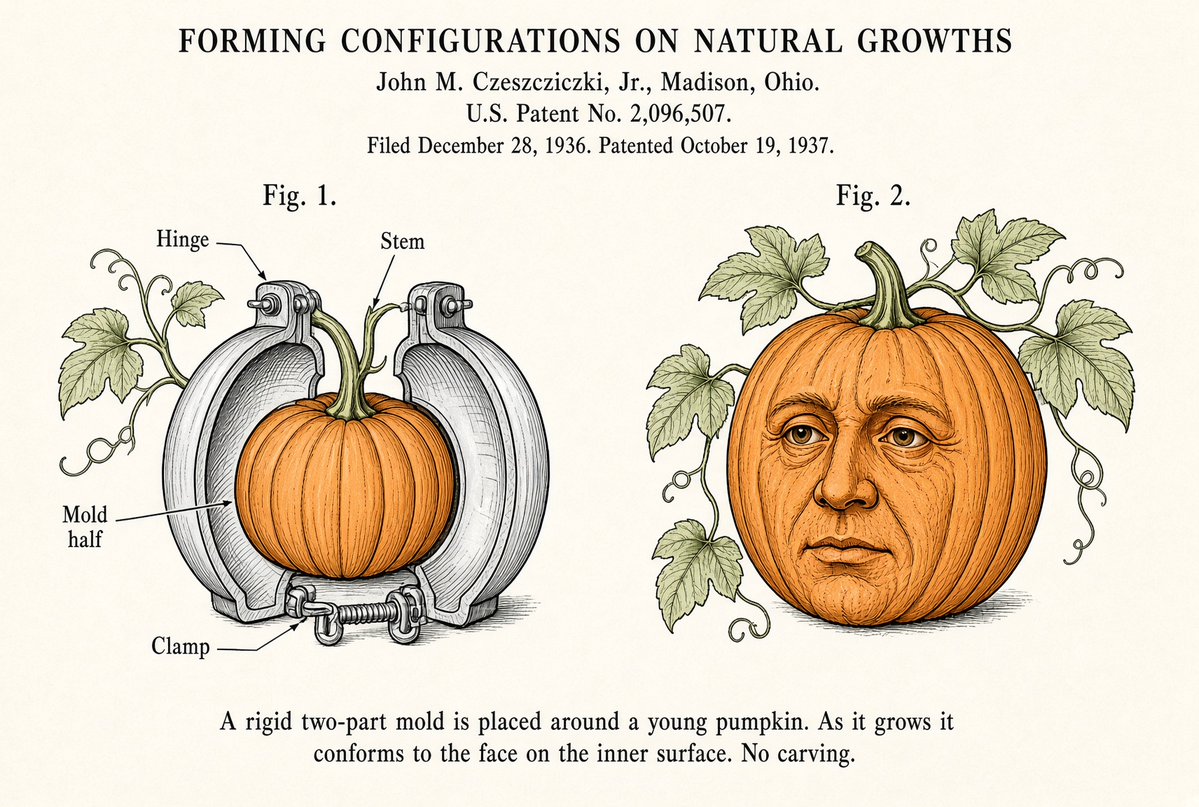
In the spirit of October, a patent with a Halloween twist.
John M. Czeszcziczki Jr., U.S. Patent 2,096,507 (October 19, 1937), “Forming Configurations on Natural Growths.”
A two-part metal mold clamped around a small pumpkin. The pumpkin grows into the face on the inside of the mold, then the mold comes off.
Full text: https://t.co/G4zAz1ukyx.
Would you confuse a bear with a puma?
Japan’s IP High Court still struck down KUMA.“Kuma” means bear. It does not sound like PUMA.
The problem was the leaping pose, the layout, and a site that said PUMA “transforms into” KUMA.
Free-riding, not a joke.Same famous cat, different result: the SHI-SA lion-dog kept its registration. Pose was similar. Intent and overall impression were not.
Parody is not the test.
If the mark only works because you already know PUMA, it is too close.
My takeaways for brand owners:
A different meaning won't save you if the get-up copies a famous mark.
Parody is neither a defense nor an offense in itself. What matters is how far you have moved from the original.
The more of your own identity you add, the safer you are.
Where do you draw the line?
In the heart of Texas innovation, Texas IP Law Group turns groundbreaking ideas into ironclad patents, giving startups and tech pioneers the protection to compete with giants.
Veterans — Thank You
To every Veteran who fought for this great country: we honor your service.
As a small token of our appreciation, we’re offering 10% off our fee to file your patent application.
This discount applies to our professional filing services only — it does not include USPTO government fees.
If you’ve created something worth protecting, we’d be proud to help you do it.
Reach out and mention this Veteran offer when you contact us.
https://t.co/IoOLKpyoAF for a free consult.
Most inventors lose the patent fight before it starts.
They build the thing.
They talk about it.
They file late, or file the wrong claim.
Colt didn’t beat Wesson & Leavitt by making a nicer revolver. He owned the claim that mattered.
If you have an idea worth protecting, get counsel on it before a competitor does.
Free consult: [email protected]
https://t.co/gv3vC8DxHy
I bought this gun because of the story.Not because it won, but because it lost.
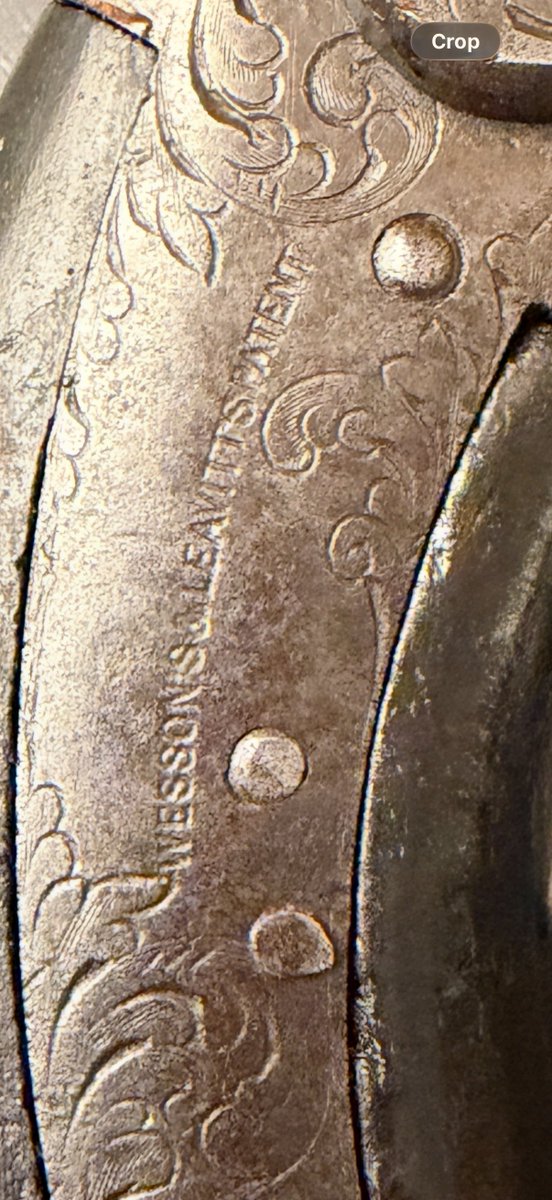
The lockplate says WESSON’S & LEAVITT’S PATENT.
In 1850 that marked one of the first revolvers good enough to scare Samuel Colt.
Daniel Leavitt had an 1837 patent. Edwin Wesson added the mechanism that turned the cylinder when you cocked the hammer.
Massachusetts Arms built a cleaner, better-finished gun than a lot of people expected from a Colt rival. Colt didn’t out-manufacture them. Instead, they sued.
Colt's 1836 patent covered automatic cylinder rotation. In 1851, Colt v. Massachusetts Arms Company ended production after only about 800 Dragoon and 1,000 Belt revolvers.
A dollar in damages, but an injunction is what mattered. Massachusetts Arms strong product was killed by Colts one claim that controlled the market.
That is why this piece is on the table. Invention is not protection. The winner is often the person who filed the right claim and enforced it.
Texas IP Law Group helps inventors and companies protect what they actually built, before a competitor turns it into an exhibit. Contact us today for a free consult.
https://t.co/gv3vC8DxHy
[email protected]
Thomas Edison did not invent the incandescent lamp out of thin air. He won the credit because he built a system, fought for the patents, and then made a deal when the fight got too expensive.
Joseph Swan, a British chemist, had been working on carbon filaments in vacuum bulbs for decades. By late 1878 he was demonstrating lamps that actually glowed for hours. In 1880 he received a British patent and started lighting real rooms and public buildings, including London’s Savoy Theatre.
Edison was racing the same problem from Menlo Park. His breakthrough was not “a bulb that lights,” but a practical one: a high-resistance carbon filament, a better vacuum, and a whole electric system around it: generators, wiring, sockets, meters. He filed U.S. Patent No. 223,898, granted January 27, 1880, for an “improvement in electric lamps.”
Two inventors. Two countries. Two patent systems.That last part is the whole story.
A U.S. patent does not control Britain, and a British patent does not control the United States. When Edison’s company tried to lock down the U.K. market, Swan’s rights were strong enough that litigation looked like a losing bet. In 1883 the companies merged into the Edison & Swan United Electric Light Company, “Ediswan.”
British bulbs used Swan’s design with Edison’s commercial muscle. Edison kept the American narrative. Swan later even helped defend Edison’s U.S. claims.
Meanwhile Edison was fighting other rivals at home, including Sawyer and Man. Patents were filed, challenged, invalidated, and revived.
The “winner” was not always the first person to make a filament glow. It was the person who could prove a valid claim, survive prior art, and commercialize the result.
That’s the lesson hiding in the poster: invention is only half the war. Filing in the right country, claiming the right improvement, and having counsel who can prosecute or settle is the other half.
Need a U.S. patent strategy that survives the fight?
Texas IP Law Group helps inventors and companies, including foreign-domiciled applicants who now must use a registered U.S. patent practitioner under the USPTO’s July 20, 2026 rule, turn an idea into claims that can stand up at the Office and in the market.
Contact us today for a free consult.
https://t.co/gv3vC8DxHy
[email protected]
New USPTO rule: if you’re a foreign-domiciled inventor or patent owner, you now need a registered U.S. patent practitioner.
Effective July 20, 2026, the USPTO requires patent applicants and patent owners whose domicile is outside the U.S. or its territories to be represented by a registered patent attorney or patent agent. That applies to papers filed on or after July 20, even in applications that were already pending.
A few details that trip people up:
Domicile is your permanent residence (or a company’s principal place of business), not just citizenship or a U.S. mailing address.
If even one applicant or owner is foreign-domiciled, representation is required.
A general U.S. lawyer is not enough. It has to be a USPTO-registered patent practitioner.
Replies, amendments, and many other filings must be signed by that practitioner.
Texas IP Law Group works with inventors and companies worldwide. If you need U.S. counsel under the new rule, contact us today for a free consult.
[email protected]
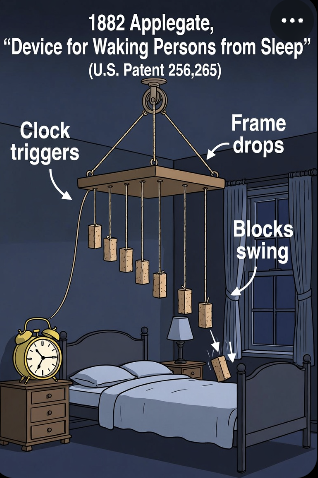
Rise and shine, inventors. ☀️
This 1882 “wake-up machine” is proof that even the wildest ideas can get a patent.
Got one of your own? Don’t sleep on it.
Texas IP Law Group — free consult today.