Et si je vous disais que je n'avais pratiquement pas écrit une ligne de code à la main depuis six mois ?
Déléguer le clavier, pas la réflexion 📰
https://t.co/HxnBYJEeFn
Been financing Jarvis for almost 2 years now.
Following the hacks of Midas and 0vix, the project never really recover, both tvl and revenues have been divided by a factor of 10, and despite all the effort and money purred into it, we shrunk.
That’s the way forward!
A new proposal has landed on the forum!
JIP-17: launching different risk-adjusted managed-vaults, and a new USD stablecoin backed by a vault and secured by a Junior tranche.
This new protocol will live near by the existing one and both will eventually converge over time.
Je débunk le post d’Eric Larchevêque —
précisions techniques et réglementaires 👇
Dans 4 semaines, DAC8 sera live. C’est en effet un véritable système de surveillance automatisé de toutes les transactions de crypto sur les plateformes centralisées. Ça fonctionnera comme pour le système bancaire.
Par contre, non, la self-custody n’est pas la réponse. C’est une solution à beaucoup de choses, mais pas à ça. Et c’est clairement plus compliqué que ce qui est souvent présenté : ça limite l’empreinte numérique, mais uniquement pour un temps.
Déjà, DAC8 n’est que le reflet du CARF, qui est déployé au niveau de l’OCDE. Ce n’est donc pas une mesure de l’administration française ou européenne, mais bien une mouvance mondiale qui touche 38 pays dans le monde qui représentent 48 % du PIB mondial.
En matière de surveillance des transactions financières en crypto par rapport à de nombreux pays, la France est bien en retard. Non pas par volonté politique mais juste par manque d’équipement / moyen. Elle est complètement dépassé par rapport à l’Espagne ou l’Autriche, dont les données sont télé-transmises automatiquement entre les exchanges et l’administration depuis des années.
Croire que le self-custody est exclu du périmètre est, selon moi, un leurre. C’est en partie et uniquement temporaire. La self-custody reste essentielle pour la souveraineté, mais elle ne rend pas invisible fiscalement.
Avec la travel rule, les transactions entre les exchanges et les wallets en self-custody sont déjà identifiées par les plateformes. Lors des contrôles fiscaux on constate que les transactions, tous les flux et mouvements entre comptes sont étudiés par l’administration fiscale, pas uniquement les cash-in et cash-out et encore moins une limite aux mouvements sur les plateformes centralisées.
Avant-hier, la Cour des comptes proposait d’inclure dans les formulaires des déclarations de compte à l’étranger les self-hosted wallets. Dans de nombreux pays, les valeur du patrimoine crypto -comptes self custody inclus- sont à déclarer comme l'Italie, la Suisse...
Un outil de surveillance mondiale des transactions financières en crypto est en train de se mettre en place, indépendamment de toute volonté politique nationale. Et, ignorer ces mécanismes expose surtout les particuliers, pas les institutions.
Personnellement, je me concentre sur pousser des mesures qui encouragent l’investissement, le développement du patrimoine personnel et l’éducation financière.
Exemple: la possibilité de déduire les pertes crypto à d’autres gains et aussi à l’ensemble des revenus, y compris ceux du travail, comme c’est le cas en Nouvelle-Zélande, ou encore les exonérations d’imposition en fonction de la durée de détention pour les holders moyen et long terme de Bitcoin / crypto, comme en Allemagne.
C’est là, à mon sens, que le vrai combat politique et économique se joue.
🧵 Thread : Pourquoi je crois encore dans Jarvis Network + comment je farme du $JARVIS
1/7
En 2020, j’ai découvert Jarvis Network.
À l’époque, ils travaillaient d’abord sur un protocole de perpétuels, avant de pivoter vers les stablecoins et la DeFi.
👉 Après un pump historique de x60 depuis le TGE, le token s’est effondré, faute d’utilité et de mécanismes de partage de revenus.
Yes, @ProtonPrivacy just launched a new YouTube channel (200k views already). Find out how to disappear online, get in and out of hostile territory without being hacked, and more. Like and subscribe to see the coolest content in the privacy/security world: https://t.co/KMR9SmsDgz
Running Bitcoin ZK Knots, baby!
We've successfully run a POC verifying a STARK proof of Bitcoin's mainnet block header #1 inside a modified Bitcoin Knots client.
The proof validates critical consensus rules:
- Timestamp
- Chain difficulty
- Block difficulty
- Proof of Work
👇
Wow, just saw this and this is horrifying: https://t.co/TmVv5FqVyz I guess now we know what Infomaniak stands for - maniacs who can't wait to give all your info to the feds!
Introducing Eleven v3 (alpha) - the most expressive Text to Speech model ever.
Supporting 70+ languages, multi-speaker dialogue, and audio tags such as [excited], [sighs], [laughing], and [whispers].
Now in public alpha and 80% off in June.
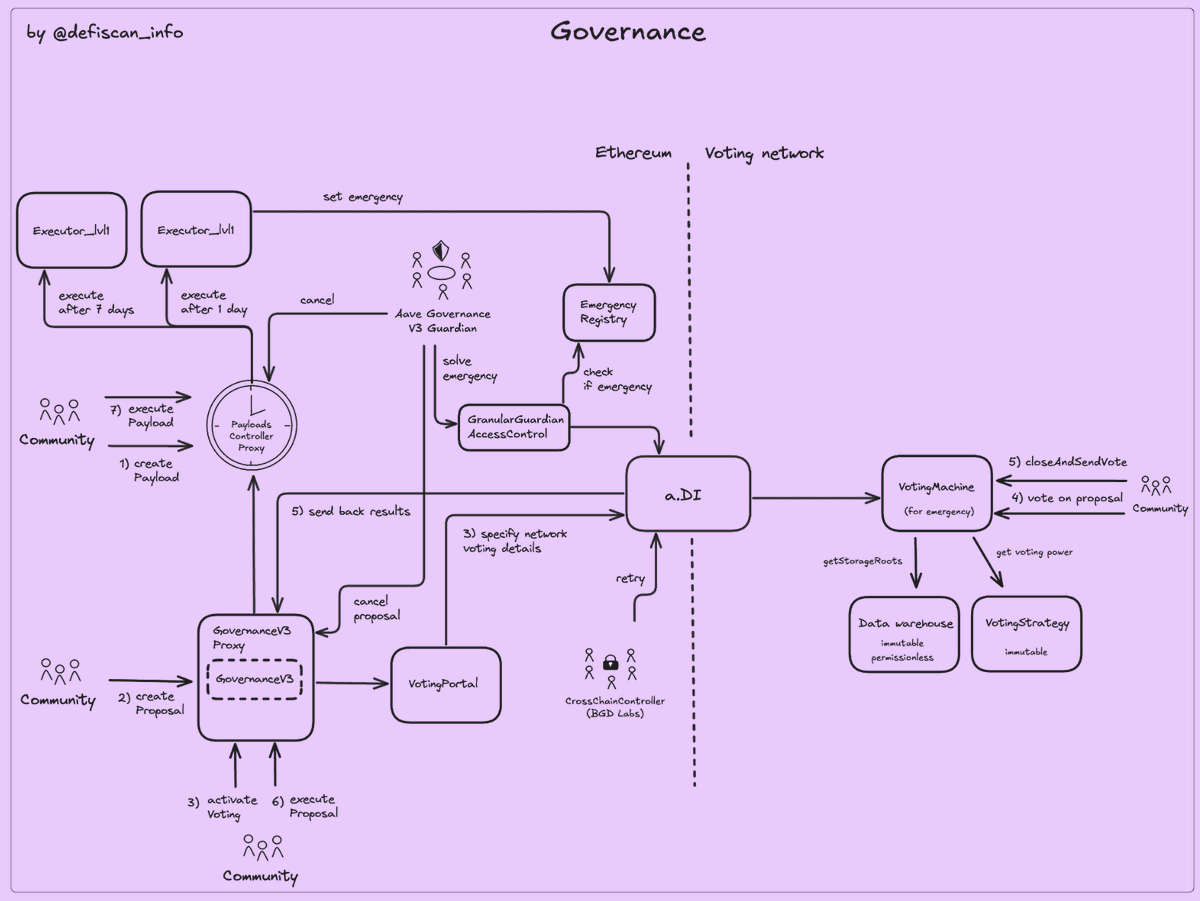
The decentralization review of @aave by @defiscan_info went live last week and was discussed in @DeFi_FR@marczeller chipped in 4 times, never tackling the report, but instead attacked its publishers: a classic deflection attempt
Why? Let me dive into what he wants to bury
Aave's review is simply the biggest one ever produced for @DeFiscan_info. Because of Aave's codebase's size and relative complexity, we are talking about months of effort. Every finding was verified several times, and experts on the codebase, like @The3D_, were consulted before publication.
The decentralization analysis concluded that Aave is a Stage 0 protocol, just like Compound, and for similar reasons.
The main lack here lies in three dimensions of the analysis: autonomy, exit window, and upgradability.
The autonomy dimension assesses the protocol's critical dependencies, which could seriously affect its users if they were to fail. For a lending product like Aave, the star culprit is the oracle(s) used—ChainLink.
"The protocol does currently have limited validation on asset prices provided by Chainlink. These checks include upper caps for stablecoins and LSTs and a sanity check that the price is above 0 for all assets. If the reported price by the price feed was below 0, a fallback oracle would be queried.
Aave has currently no fallback oracle price feeds instantiated. As a consequence if the price was equal to or below 0, user actions on the Pool contract that require a price would revert."
==> Aave uses ChainLink data with barely any validation and no fallback mechanism ===> It inherits all Chainlink-related risk (an upgradeable system without decentralized ownership over those permissions.)
For the two other dimensions, I'll keep it simple and let you read the report, because today, I'd like to highlight @marczeller's manipulation tactics as well.
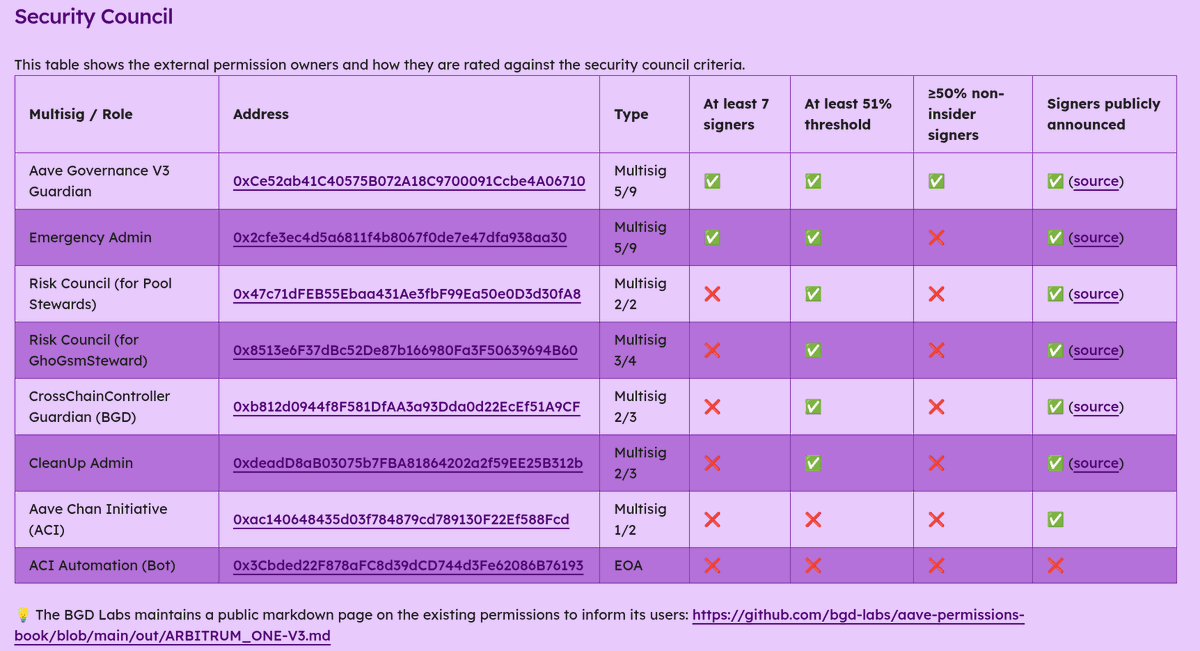
Aave gets a High Risk on the Upgradability and Exit Window dimensions because some emergency features are without a timelock (such as pausing markets), enabling potential manipulations, and several multisigs do not adhere to the security council criteria:
The report, of course, does not fail to highlight what is worthy of praise in Aave's current model, such as their redundant and fault-tolerant implementation of cross-chain governance with a.DI.
A precise list of what needs to be done to reach the next stage is also provided for each item at fault.
---
Now, let's take a minute to analyse @marczeller reactions to this report:
In order:
1. Marc: "The two people at the end of the room who still care about this kind of stuff are shocked"
↪ Plenty of actors care about contextualized information, including savvy degens, institutionals, etc.
A classical fallacy: you are not popular, and thus you are wrong.
2. Marc: "@bluechip_org gave A rating to LUSD and D to GHO, and still look at their market cap."
↪ @bluechip_org evaluates the economic model of stablecoins, not their potential for growth. This is a classic case of pretended confusion (Marc knows this) to discredit the report altogether without even discussing it.
Another classic: don't like something? Discredit it by misinterpreting its goals on purpose.
3. Marc: "BOLD was supposed to kill GHO? It was so superior as a concept"
↪ It is. GHO is a caveman stablecoin with no redemption, a manually managed interest rate, and uber-centralized peg maintenance. No matter how many millions Aave splurges on GHO, BOLD will eventually prevail. However, growth/market cap is not the topic here; we discussed decentralization.
Seeing Marc dance on the grave of BOLD's first iteration as the relaunch was announced was surprising, to say the least. I assumed he was pro builders and DeFi. The reality is that he is pro-Aave, and if he has to damage the DeFi ecosystem to grow Aave further, I am now convinced that he would do it without hesitation.
4. I mentioned that "Emilio from BGD double-checked the review", Marc attacked again on the fact that it is now Avara and not BGD.
↪ You're starting to see the pattern? Argue, discuss, and attack everything around so that the core (the review) is ignored, discredited, and most importantly, never addressed.
Marc has commented 4 times about the @defiscan_info review in @DeFi_FR, but still hasn't said anything about the content itself, apart from calling it a "brain fart". It's a usual tactic of Marc that when faced with a topic he dislikes, he will tackle everything around it and resort to personal attacks on the poster and attacks on the reputation of his projects.
It was exactly the same when @bluechip_org published the $GHO review, again with the exact same twisted argument that the Bluechip rating (which assesses economic safety) is not correlated with the stablecoin market cap.
https://t.co/4kn6jdbi67
I'm simply at a loss that such behavior can be tolerated and even supported in our industry, and I wanted to share it with you. Those are classic bully tactics seen in many profiles in our space, and the only way to eventually improve is to call them out.
I have the luxury of not caring a second about my "employability", allowing me to stand my ground and my values even if that could be deemed risky for my career. Indeed,
I realize this is an exception rather than the norm, and that's one reason I wrote this post and led the charge today. Indeed, Marc is an investor in many projects, which could explain why many are shy to denounce his abusive behaviour.
Marc and I obviously have a history, as I am one of the few people in the space willing to tell him when he's out of place, which happens often. Since I started doing this, he's relentlessly attacking my character on random occasions, as if he were spreading poison as an insurance policy to protect his past, present, and future abuses.
I remain baffled by his behavior, which often exhibits adolescent characteristics. During one of our last altercations, he literally flexed that "he has a girlfriend, and thus is not available to answer, unlike me, the ugly, lonely nerd" (and as often with Marc, he assessed this without any knowledge of my situation).
This behavior is net damage for the whole DeFi space, as Marc is not a random person but someone with influence that many still look up to. It's up to us to hold our champions to the highest standards, so here I am, doing exactly that.
@0xStarny@pscltllrd A balloon is quicker to deflate than to inflate. Ethereans are heavily exposed because their ethers are often used as collateral to support defi strategies. When liquidations hit hard, we find ourselves like idiots with nothing to fall back on.
I was the lead market maker at Jump.
I'm no longer under NDA so I can say this,
Typically when you see down moves during the weekends like this, it is pure market manipulation.
It was one of the tactics I invented during the low volume moments.
We would load up and pay attention to Crypto Twitter as a source of sentiment, with specific accounts organized in specific categories.
One thing I used to like doing was purposely "nuking" a new 4H candle on BTC and/or ETH, which was an easy trap.
"Smart" traders know we'll eventually revisit those wickless candles, so it was good bait for me to set with eager buyers stepping in and the candle continuing lower.
They end up capitulating before we reverse.
Bottom shorters get comfortable here too.
Anyway, I can't give away too much but just know,
Most of thos "bad" price action you're seeing is a group of "whales" sitting in a chatroom together and merely oil painting on charts.
My alias in Jump was "Vincent van Gogh."
And that isn't because I lost my mind [well - that too],
But because I painted some of the best looking bear traps.
I know an influenced painter copying my work when I see one.
Stay safe.
Retar Dio.
What we have been saying for years in our Twitter echo chamber is becoming reality with @MorphoLabs and @coinbase: DeFi as a backend.
Coinbase is already doing a great job with USDC being used for international payments.
Now they use themselves DeFi to power their lending services, ofc built on the top of Morpho. DeFi has scaled enough, and has became resilient enough, to be a liquidity backend for a centralized consumer facing app.
Soon in a bank near by you. Neobanks are few months away to provide their first crypto-backed loans powered by DeFi, and I bet it will use Morpho. Why?
Because Morpho is built for this : 600 lines of code, formally verified, that you can trust. Bring your oracle, forget all the governance slowing down processes. And create your market.
What is next for Morpho? I am no one to know but this is where I think Morpho will be in a few years for a very specific use case, business loans (please @PaulFrambot make this a reality) :
1. A reputable funds becomes a Curator and launches a US Business Loan Vault. It raises funds though its network and deposit these funds into the vault. Its strategy? Lend USD to solid US companies, so they don't need to rely on banks or other venues. The vault can only accepts KYC-ed deposits. Yes, new vaults have new features, inspired by Uniswap (hooks) to create new features.
2. Tokenize companies assets using @centrifuge or something else. Invoices, stocks, etc. = RWA
3. Launch USDC-RWA markets on Morpho.
This can become the backbone of a consumer app. People could deposit USD in a centralized app, lend money to companies who receive USD, but in reality its Morpho behind.
Aujourd'hui est un jour clé pour Waltio.
Waltio accompagne actuellement plus de 45 000 investisseurs en Europe pour gérer leur déclaration fiscale de cryptomonnaies. Cela représente un patrimoine total de 2,5 milliards d'euros.
Au fil des années, une frustration se développait... voir sur les portefeuilles de nos clients trop d’erreurs évitables, de frais inutiles et des comptes sous-exploités. Une chose est devenue évidente : le patrimoine crypto de nos clients a bien plus de potentiel à leur offrir.
Je me suis dit qu'il était temps d’aller plus loin.
Voici les nouvelles fonctionnalités qui sortent aujourd'hui 👇
Notre mission reste la même : aider chaque investisseur à développer son patrimoine crypto et atteindre ses objectifs financiers.
Nous entamons une nouvelle ère avec une ambition forte et ce n'est que le début
Chainlink CCIP v1.5 is officially live across all supported blockchain mainnets 👀
Anyone, anywhere can now deploy or upgrade their existing tokens to become a Cross-Chain Token (CCT) in minutes 🔥
Onboarding a token to CCIP is now completely self-serve via a simple, no-code web interface 🧠
CCTs do not impose any vendor lock-in on token issuers, allowing any existing ERC20 to be onboarded by its issuer
Over $1.3B have already been securely transferred over CCIP since launch and is continuing to rapidly accelerate
LFG