Never lose your temper in Thailand.
Even if you're 100% justified; even if the person you're yelling at 100% deserves it. You will still be seen as the bigger problem.
In Thailand, everyone engages in daily acts of self-sacrifice to maintain public order and social cohesion.
For Westerners, self-control is primarily seen as an internal struggle over the self. In Thailand, self-control is public infrastructure; it's a sacrifice you make so society stays in balance.
So when you lose you're temper, it's not just a personal failure; you're actively destroying social cohesion. And that's why Thais will blame you, not the person who wronged you.
If you ever feel like getting angry or yelling will solve your problems in Thailand, remember: you're wrong. Your problems will only multiply.
Why Thais say “yes” when they mean “no”.
A common complaint of foreigners is when Thais say “yes” when they clearly mean “no”.
It doesn’t happen every time, but is common enough to cause confusion. Are Thais being dishonest? Not really.
When you ask a question, you may want a purely informational answer, but Thai people generally keep the context of the conversation in mind. There’s interpersonal context, between you and them. There’s social context, between the both of you and the people around you. And usually, “yes” is the answer that maintains harmony, and “no” is the answer that causes discomfort and confrontation, regardless of what the underlying answer to the question actually is.
Think of the famous question: “Does this dress make me look fat?” This question acknowledges that there’s often a difference between the truth, and the answer you should give to maintain harmony.
Sure, telling a white lie to save your marriage may seem appropriate, but what about your taxi driver or AC repairman? Is that relationship important enough to justify their “lying” to you? Well, maybe not to you. But you probably aren’t as sensitive to “saving face” as Thai people are, especially because most of your interactions, as a hotel guest or shop customer, place you in the "superior" position in that relationship, increasing their desire to keep you happy in the moment.
So what should you do?
It’s best to avoid yes or no questions altogether. Ask open ended questions that allow them to elaborate. Not, “can you get this done by noon today?” But rather, “when can you get this done?” Pay attention to their answer, their body language when they give the answer, and their follow through on whether they’re treating that answer as serious or binding.
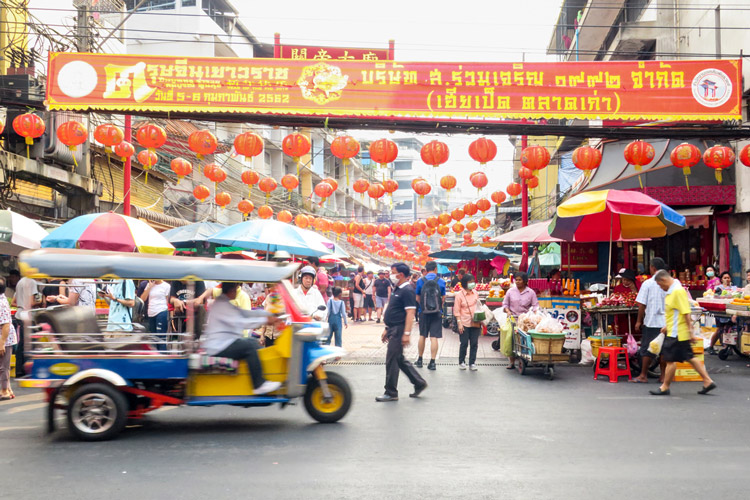
Modern celebrations of Chinese New Year in Thailand are largely recent, not a continuation of ancient Thai-Chinese traditions. Rather, much like celebrating Christmas, Halloween, or Valentine’s Day, Thais will never pass up a good opportunity for a fun, beautiful, and delicious reason to have a party.
Chinese New Year is fast approaching! And Thailand loves to celebrate it.
While wide-scale Chinese New Year celebrations in Thailand mostly started in the early 2000’s, Thailand has a long history with China and Chinese people.
Here are some fun tidbits about the Thai-Chinese:
Thailand has the largest overseas Chinese community in the world: 9-10 million people, 11-14% of Thailand’s population.
The majority of these are descendants of Teochew people from Guangdong Province, who moved to Thailand between 1850-1900 during the Southern China crises (like the Taiping Rebellion and resultant famine). By the 1910 census, 40-50% of Bangkok’s population was Chinese.
Continued below...
Many famous Thai dishes are either directly from the Chinese diaspora, or are heavily influenced by their cuisine.
Thailand’s most popular soup noodle dish, Kuay Tiew (ก๋วยเตี๋ยว), is the Teochew dish 粿条. Kuay jap (ก๋วยจั๊บ), ba mee (บะหมี่), and rad na (ราดหน้า) are likewise Teochew in origin.
Most stir-fry dishes are Chinese in origin, including pad see ew (ผัดซีอิ๊ว).
Whereas Thai dishes tended to favor seafood, Chinese people brought their love of pork. Moo daeng (หมูแดง), moo grob (หมูกรอบ), khao kha moo (ข้าวขาหมู) are Chinese in origin.
@FPetet When you believe your life is in the hands of Fate, you don’t really need to worry about things like traffic laws or speed limits. If it’s your time, it’s your time. If it’s not, you’ve got nothing to worry about.
Stop wai-ing everyone.
A common mistake new foreigners make in Thailand is wai-ing everyone they meet.
They think they’re being polite and respectful, but in actuality, it tends to cause a lot of awkwardness and discomfort for Thais.
The wai isn’t a generic Thai “hello.” It’s also not the same as a handshake.
It’s an acknowledgment of social hierarchy.
This can feel uncomfortable for Westerners, because we’re trained to equate respect with equality. Thailand doesn’t work that way. Here, respect is directional.
If you wai indiscriminately, to hotel staff or cashiers (people clearly junior to you), you’re not being respectful. You’re creating awkwardness.
If you winced at reading “people who are junior to you”, that’s your Western upbringing showing through.
But if you’re choosing to wai people, you’re engaging with Thai culture, and it’s worth getting it right, without imposing your own view of the world onto local people.
Thai culture prioritizes:
• relative status
• age
• role
• context
And as a guest at the hotel, you “out rank” the hotel staff. As a customer at a restaurant, you “out rank” the servers. This does not mean you’re better than them; so acknowledging this difference in social rank does not mean you’re asserting personal superiority over them. And Thai people know this.
In almost all casual social interactions, you should respond to a wai with a gentle head nod. That is 100% sufficient. Doing more than that can feel uncomfortable to the Thai recipient.
For the social interactions that genuinely do call for wai-ing, I’ll follow up with a breakdown of all the types of wai-ing, and when to use each one.