Hemi Tunnels vs Traditional Bridging Architecture
Not all cross-chain infrastructure is built the same.
Traditional bridges typically lock assets on one chain and mint representations on another, relying on validators, relayers, multisigs, or oracles to verify remote state. This introduces additional trust assumptions and expands the attack surface.
Hemi Tunnels take a fundamentally different approach.
Powered by the Hemi Virtual Machine (hVM), they enable trust-minimized interoperability by giving smart contracts direct access to Bitcoin state. Rather than depending on centralized intermediaries to relay information, Hemi is designed to make Bitcoin-aware applications possible at the protocol level.
Traditional Bridges
❌ Depend on external relayers or trusted validators
❌ Often rely on wrapped assets and intermediary assumptions
❌ Security is tied to the bridge's operational model
Hemi Tunnels
✅ Built for trust-minimized interoperability
✅ Leverage hVM's native Bitcoin awareness
✅ Enable secure asset portability between Bitcoin and Ethereum
✅ Allow future tunnel designs to evolve with innovations like BitVM and new Bitcoin primitives
The biggest difference?
Traditional bridges move assets. @hemi_xyz Tunnels are designed to move assets with security, decentralization, and Bitcoin's ethos at their core. 🟠⚡
But... wait... aren't these new features for HAIRgames? 👀
We have a feeling @mintora_app isn't entirely innocent in all this! 🤔
Be smart, don't waste any time ! 🙄
An official announcement for Season 5 is coming soon.
Stay ready, Hemigos. 🔥
#HAIRgames@hemi_xyz#NFT #GamingDaily
How is Hemi audited? 🛡️
@hemi_xyz 's security strategy isn't based on a single audit or a single smart contract.
Instead, different components of the ecosystem have undergone independent security reviews by Quantstamp and Resonance, covering everything from the HEMI token and VeHemi governance to protocol contracts and Bitcoin infrastructure like the BTC Tunnel.
Here's what that process looks like:
🔹 1. Component-level reviews
Rather than auditing the protocol as one giant codebase, Hemi audits individual systems including token logic, governance contracts, vault infrastructure, and Bitcoin interoperability.
🔹 2. Deep technical analysis
Auditors review business logic, access control, minting and inflation mechanisms, signature verification, upgrade paths, governance flows, cross-chain interactions, and edge cases that could impact protocol security.
🔹 3. Findings are documented not hidden
The published reports classify issues by severity and explain recommended remediations. Some findings are fixed, some mitigated, and some are explicitly acknowledged when they reflect intentional design trade-offs rather than vulnerabilities.
For example:
• Quantstamp's BTC Tunnel re-audit identified multiple issues across severity levels, with high-severity findings remediated before publication and the remaining items either mitigated or acknowledged.
• Quantstamp's HEMI Token audit reported no high-severity findings, with lower-severity issues fixed or documented as intentional design choices.
• Resonance also conducted dedicated reviews of the protocol contracts, HEMI token contracts, and VeHemi governance system, providing an additional layer of independent scrutiny.
The takeaway?
An audit isn't proof that code is flawless. It's a rigorous engineering process that surfaces weaknesses, validates assumptions, and improves protocol resilience before deployment.
That's the standard Hemi appears to be pursuing: multiple audits, transparent findings, and continuous security improvements.
Hemi audit github repository- https://t.co/JEvnGj7I5m
As Hemi continues to grow, new platforms are emerging to support the broader ecosystem. NFTs play an important role in preserving the onchain culture and expression developing across the network.
To provide a marketplace for both existing and future Hemi NFT collections, community member @0xalpha_7 launched @mintora_app.
Everyone is talking about “holding BTC.”
Smart money is starting to focus on something bigger:
making BTC productive.
That’s where the narrative is quietly shifting right now.
For years, Bitcoin was treated mostly as a store of value.
Buy. Hold. Wait.
But the next phase of the market is about unlocking utility without losing exposure to BTC itself.
That’s why BTCFi infrastructure is getting so much attention.
Projects like @hemi_xyz are pushing this idea forward by building infrastructure that connects Bitcoin and Ethereum in a more composable way.
The interesting part isn’t just “bridging.”
It’s the possibility of turning dormant BTC into capital that can actually participate in DeFi, applications, and yield opportunities.
Institutions are watching this closely.
Builders are moving early.
Because the market is slowly realizing something important:
The future may not be just about owning BTC.
It may be about what BTC can do.
#BTCFI
Yesterday's post described the problem. @vetro_org is what we built in response.
A treasury layer for dollar-denominated digital assets.
Three instruments that handle redemption, yield, and composability separately. No treasury team to hire on the holder side. No counterparty to underwrite.
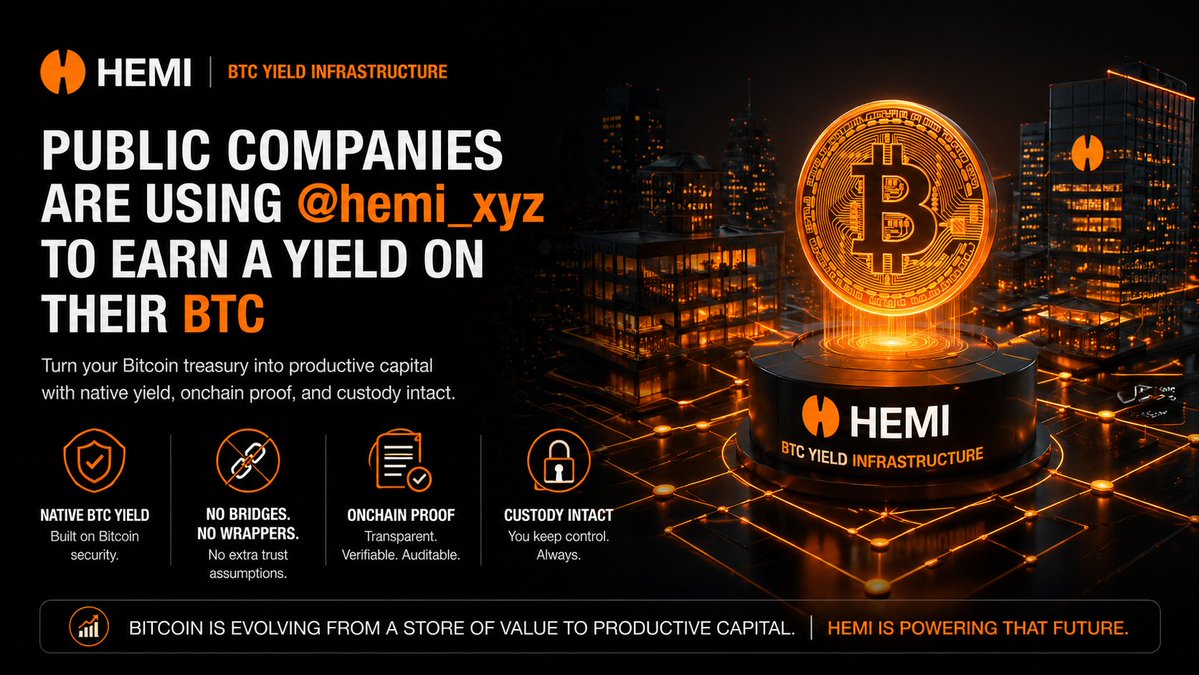
Public companies aren’t just holding BTC anymore, they’re putting it to work with @hemi_xyz .
Treasuries that once sat idle are now generating native yield, without giving up custody or relying on risky intermediaries.
No wrappers. No opaque lending desks. Just verifiable, on-chain yield, built for institutions.
Bitcoin is evolving from a balance sheet asset into productive capital.
And @hemi_xyz is where that shift is happening.⚡
"Google paper uses a zero-knowledge (ZK) proof to demonstrate the algorithm's existence without leaking actual optimisations. From now on, assume state-of-the-art algorithms will be censored. There may be self-censorship for moral or commercial reasons, or because of government pressure. A blackout in academic publications would be a tell-tale sign."
From ZK infrastructure to ecosystem expansion.
Here’s what the Hemi team has been building this week.
Midweek with Max recap here.
https://t.co/py3rXrdNJz