Aka That Japanese Man Yuta. I make YouTube videos about the subtleties of Japanese culture and the language
Learn Japanese with me by clicking on the link ⬇️
Want to learn Japanese with me? Sign up for my FREE Japanese lessons and learn "real-life" Japanese that textbooks don't teach you
https://t.co/I19SqUvuzw
This is the funniest anime radio I've ever listened to lol
Some people are even like, "Oh, I dropped the anime, but I listen to this radio every week," so they keep reminding us, "Hey, don't forget to watch the actual anime."
https://t.co/UvrVNRu4eV
When I talk about weird-sounding Japanese sentences, I often get responses like:
"Oh, it's okay as long as it's grammatically correct."
But in communication, it's better to try to convey the right nuances than to be grammatically correct.
And I came up with this example using the words "talk" and "speak."
For example, if I'm talking about somebody who talks too much and I'm annoyed, and I try to say:
"He talks a lot."
But I make a grammatical mistake and end up saying:
"He talk a lot."
This sentence is grammatically incorrect, but my intention and the sentiment behind it are still pretty clear.
Now, what if I use the word "speak" and say:
"He speaks a lot."
While this sentence is grammatically correct, it blurs my intention and the context that I'm annoyed.
Of course, ideally, if you get both the nuance and the grammar right, that's better.
But if you really have to pick, it's better to attempt to convey the right nuances and be grammatically wrong than to say something that is technically grammatically correct but doesn't convey the same meaning and nuances.
What do you think of this example?
The idea that language acquisition is about consciously learning rules and applying those rules has been debunked a long time ago.
Despite that, a lot of people today still approach language learning this way.
There's a massive amount of evidence showing that we do not acquire languages, whether it's our first language or a second language, this way.
And we already knew this in the '60s and '70s.
So a lot of people today learn a language as though they are still stuck in the '50s or something.
This doesn't mean you cannot learn a language using outdated methods.
People in the past did learn languages.
It just means that if you use massively outdated methods (there are several popular methods from the past), it will be pretty inefficient, because those methods are based on a false idea of language acquisition.
Again, you can always learn something from something, even if it's not super efficient.
But once you update your knowledge, skills, and approach a language in a more informed way, you can see how much faster you can learn a language to a conversational level (not to perfection, though).
This doesn't mean there's one specific "correct method".
If your general direction is solid, there are many different things you can do and many different resources you can use based on your personal preferences.
Communicating this can be a little hard for beginner language learners, because they often have a preconceived idea of how one should learn a language.
But once you experience how quickly you can acquire a language to a decently conversational level, you can see that a lot of people are taking an unnecessarily long route to reach their goal.
At the same time, I do acknowledge that outdated methods can have "psychological" benefits for certain learners because they give you conscious knowledge of the language, which some people find reassuring.
Language learning is largely an unconscious, intuitive process, which makes measuring progress not very straightforward.
So consciously learning rules, even though it's not the direct way of acquiring a language, can have psychological benefits for certain learners with certain personality dispositions.
When we acquire Japanese, our brain is learning statistically the probability that certain words and expressions occur in a given context.
Textbooks and apps often sound unnatural because they break the statistical probability of words and expressions used in a given context.
They artificially manipulate the examples and insert lots of statistically unlikely words and expressions.
This is why, if your initial input is skewed toward textbook input, you're likely to acquire a skewed distribution of words.
Which means you'll often end up (unconsciously) thinking that this skewed, misrepresented distribution is how the language works.
Unlearning this is particularly challenging because this is something you do implicitly, meaning this process happens unconsciously.
And something you learned unconsciously is hard to unlearn consciously.
This is why using naturalistic input from day one is massively beneficial if your ultimate goal is to communicate with Japanese people and understand native media.
Naturalistic input naturally follows the natural distribution of words and expressions (duh).
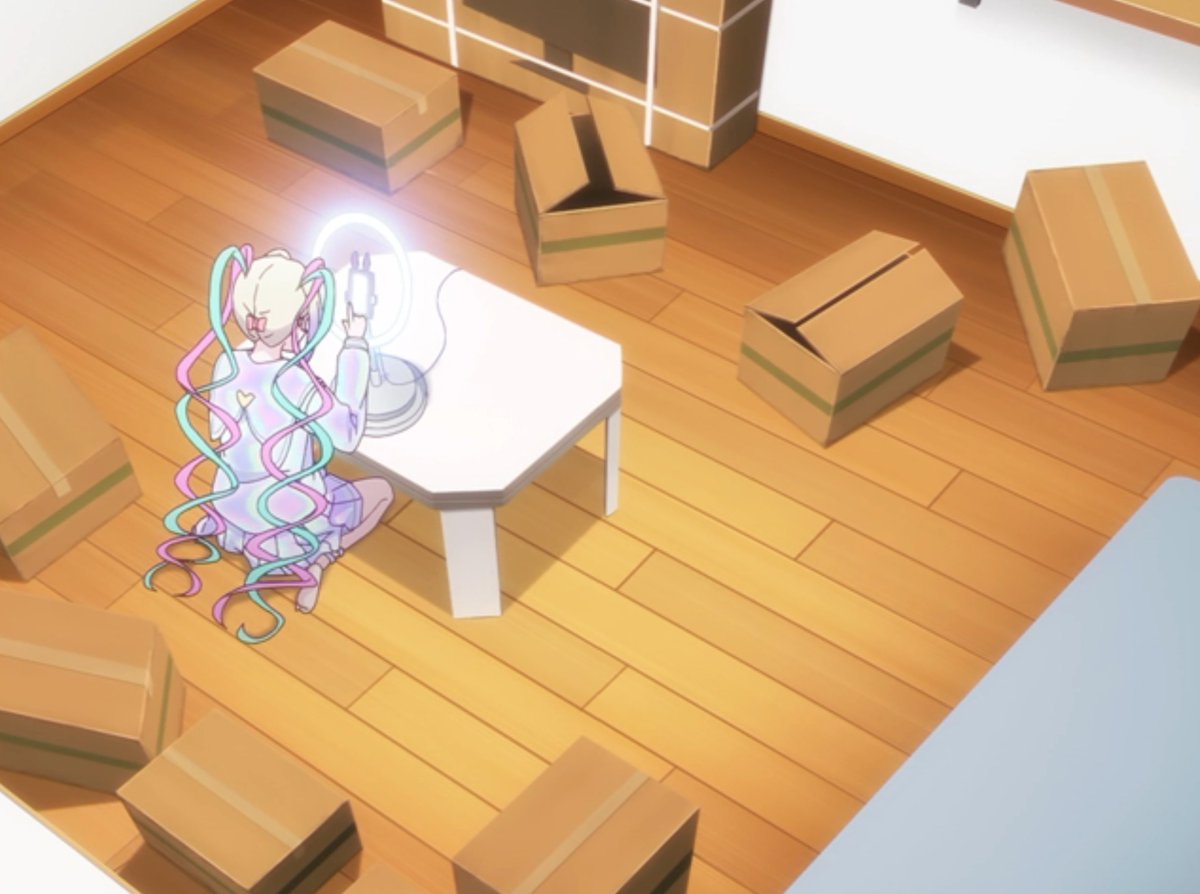
Needy Streamer Overload
I can't say this is objectively a good anime.
I can't recommend this to average people because of the sensitive content.
But this is my favourite anime this season so far. I've also played the game.
This is what happens when creators say, "We don't care about pleasing everybody. We will do whatever we want."
Kind of reminds me of Evangelion (and there are a lot of references to it too.)
@ThatYuta He is better off giving up now than having any false sense of being able to talk to a native or play games in the language. It’s a false hope, you have to hit the flashcards, talk on language platforms, read the books etc.
This guy made me say, “Yeah, using Duolingo to learn Japanese makes sense in your case.”
He told me that he has severe ADHD, and Duolingo is the only learning resource he can use.
He just can’t stick with anything else.
And in that kind of situation, doing something is better than doing nothing.
Duolingo at least teaches you SOME Japanese compared to doing absolutely nothing at all.
But that’s an extreme situation.
For most people, there are plenty of better, fun, engaging things you can do to learn Japanese.
When learning Japanese, efficiency might not matter if you simply want to enjoy the process of learning without having any specific goals and you don't care about actual gains.
But for people who are serious about learning Japanese and willing to spend thousands of hours on it, efficiency absolutely does matter.
It's really a sad thing when you spend a lot of time and money on it, only to realise it didn't quite serve your goal, which happens a lot in language learning.
Differences in approaches and tools will show up as real-life differences in results after spending a large amount of time learning.
We also have decades of second language acquisition research showing how people learn second languages.
And those insights genuinely inform us about the general direction we should take if our goal is to acquire Japanese for practical purposes.
If something has a lot of evidence behind it, it’s no longer "overrated". It’s "correctly rated".
"I'm playing sports just for fun. Winning doesn't matter" is a valid approach. "I want to be good at this so I want to learn how to practice for maximum gain" is also a valid approach.
@ThatYuta My hot take is that, wrt language learning, people overrate the importance/efficacy of any one particular tool/method over another. It seems to be noobs, or gurus that shill to noobs, that most obsess over which tools/methods are the most effective etc
Talking about unnecessarily inefficient or outdated Japanese learning resources often feels like this:
Me: “This knife is dull. You’d be better off using a sharper knife.”
Some people: “Oh, but a dull knife is better than no knife. You can technically make it work. In fact, you can use both sharp and dull knives.”
Me: "Why wouldn’t you want your knife to be sharper? You can, of course, use different types of sharp knives, but intentionally adding a dull knife doesn't make sense."
One possible reason is that they haven't used a sharp knife, so they don't know how dull their knife is?
Also, in reality, people do keep using dull knives (like, literally, when cooking) because even the small psychological barrier of switching knives is enough for people to avoid doing it.
People often choose to avoid short-term discomfort at the expense of long-term gains.
And this applies to all kinds of things in life.
@ThatYuta Maybe but I feel the efficiency of a tool depends on how skillful the user is. I don’t think any particular app can really do that 1 job. It’s your duty as a learner not to stick to just 1 app or source. You have to learn with multiples sources and completely immerse yourself
To be fair, I've also been guilty of doing things like this. "Yeah, I know learning this tool will make me more productive, but I don't feel like spending time on this now, so I will just do the less efficient stuff."
Talking about unnecessarily inefficient or outdated Japanese learning resources often feels like this:
Me: “This knife is dull. You’d be better off using a sharper knife.”
Some people: “Oh, but a dull knife is better than no knife. You can technically make it work. In fact, you can use both sharp and dull knives.”
Me: "Why wouldn’t you want your knife to be sharper? You can, of course, use different types of sharp knives, but intentionally adding a dull knife doesn't make sense."
One possible reason is that they haven't used a sharp knife, so they don't know how dull their knife is?
Also, in reality, people do keep using dull knives (like, literally, when cooking) because even the small psychological barrier of switching knives is enough for people to avoid doing it.
People often choose to avoid short-term discomfort at the expense of long-term gains.
And this applies to all kinds of things in life.