Over the summer, @sh_reya and I hosted 13 sessions on AI Engineering topics like retrieval, post-training, inference, and evals.
I've summarized all the sessions, organized by theme, with links to the source materials.
Warning: I've tried to pull the most important ideas from each talk, so some notes are short (9.5 hours of sessions comes out to about 20 minutes of reading).
Enjoy! https://t.co/wBgoOY9HFr
RIP toy projects.
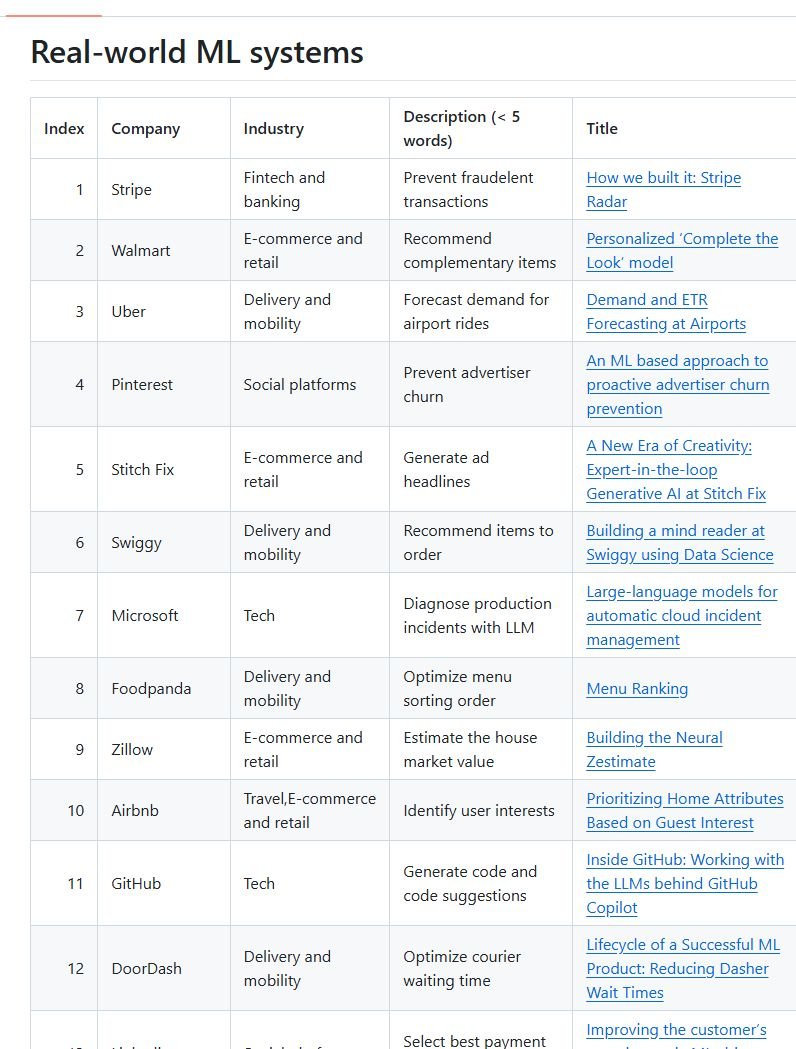
If your portfolio doesn’t touch real business problems, you’ll get filtered out.
Here are 300+ real ML system case studies from top companies (free).
DoorDash just published how their AI agents automated 130,000 engineering tasks in a single month, and it reads like a spec for a job that did not exist two years ago
The work itself is unglamorous. Reviewing pull requests, triaging broken builds, clearing on-call tickets, and the routine maintenance. 25,000 code reviews a week on its own.
An agent on your laptop shares the CPU with everything else, stops when you close the lid, and holds every credential you hold.
So they moved it off the laptop, into four pieces.
A sandbox: a Firecracker microVM per task, loaded with the repos, tools and secrets that task needs. Cold VM to ready in under five seconds at p95.
A gateway: one door to CI, tickets and monitoring. The task declares what it needs, gets exactly that, and every call is logged.
A playbook: one YAML file holding the task, its tools, its permissions and its expected output.
Surfaces: that same playbook fires from Slack, GitHub, cron or the CLI.
Teams wrote the 300 playbooks themselves.
Nobody is short of agents. The scarce thing is somebody who can build the place to put one.
Un doctor japonés profesional aconseja:
Y dice: si tienes dolores molestos en la parte baja de la columna vertebral, haz estos ejercicios y verás cómo desaparecen en segundos 🔥🔥👍
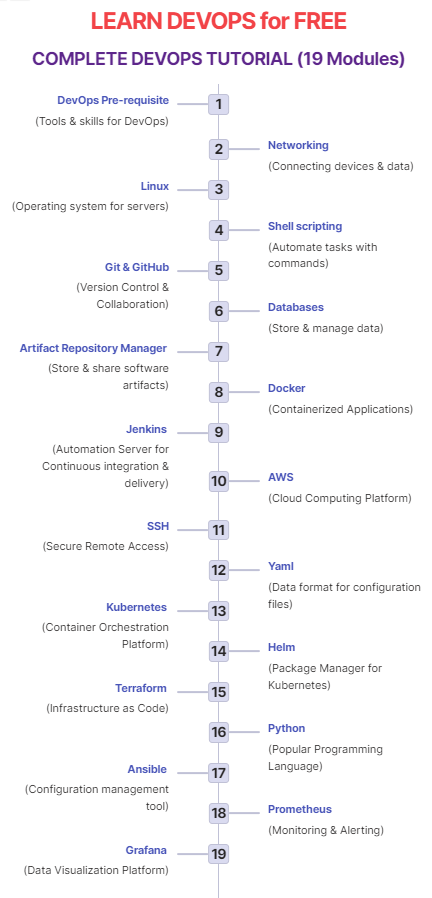
LEARN DEVOPS for FREE - COMPLETE DEVOPS TUTORIAL (19 Modules)
(Roadmap + Step by Step FREE Resources)
In this post, I am sharing 19 Resources (Available absolutely free) and are enough to master DevOps.
Just need to go through step by step & become DevOps Expert:
1. DevOps Pre-requisite
2. Networking
3. Linux
4. Shell scripting
5. Git & GitHub
6. Databases
7. Artifact Repository Manager
8. Docker
9. Jenkins
10. AWS
11. SSH
- Mobaxterm
- Putty
12. Yaml
13. Kubernetes
14. Helm
15. Terraform
16. Python
17. Ansible
18. Prometheus
19. Grafana
Like, if you find this post helpful
Retweet, if you want to help others
Follow, for more quick content (to grow faster)
Keep Learning, that matters the most
DevOps Journey – From Easy to Extreme (Make your 2026 count)
• Linux Basics → Easy
• Git & GitHub → Easy
• Package Managers → Easy
• Basic Scripting (Bash) → Easy
• CI/CD Pipelines → Easy–Medium
• Docker → Easy–Medium
• Cloud Basics → Easy–Medium
• Basic Security Practices → Easy–Medium
• Networking Concepts → Medium
• Monitoring (Logs/Metrics) → Medium
• Load Balancing → Medium
• Infrastructure as Code (Terraform) → Medium
• Kubernetes → Hard
• IAM & Access Control → Hard
• High Availability Systems → Hard
• System Design → Very Hard
• Debugging Distributed Systems → Very Hard
• Production Outage Handling → Extreme
Most people learn tools.
Top 1% understand systems.
The ka~NkAlI mound in the mathurA was the site of numerous ancient temples of the three religions of the age that were razed to the ground by Mahmud of Ghazna. One of those was a gupta temple to viSNu, a fragment of whose main image has been recovered.
Don’t overthink DevOps.
• Learn Git → version control
• Learn Docker → containerization
• Learn Kubernetes → container orchestration
• Learn CI/CD → automated delivery
• Learn Terraform → infrastructure as code
• Learn Linux → system fundamentals
• Learn Monitoring → reliability & observability
• Learn Networking → how systems communicate
You don’t need every DevOps tool.
Just master the ones that actually run production systems. ⚙️
working at HFT and complex Fintech systems for 8 years, I’ve noticed something:
Most engineers think databases become slow because of complex queries while problems lies somewhere else.
Interviewers now ask things like:
“How would your database survive 10M writes/minute without melting the disk?”
And candidates immediately jump to:
- sharding
- caching
- replicas
But the real bottleneck often starts much deeper: Database internals.
These 10 concepts are what actually allow modern databases to handle insane write throughput in production.
Bookmark this thread. Read till the end.
@sabeer Why will they abandon their religious duty ..jihad ie waging war against kuffar non muslims is sure shot way to heaven why would they do that to please some kufrr bhatia..moron read their quran..then come to senses