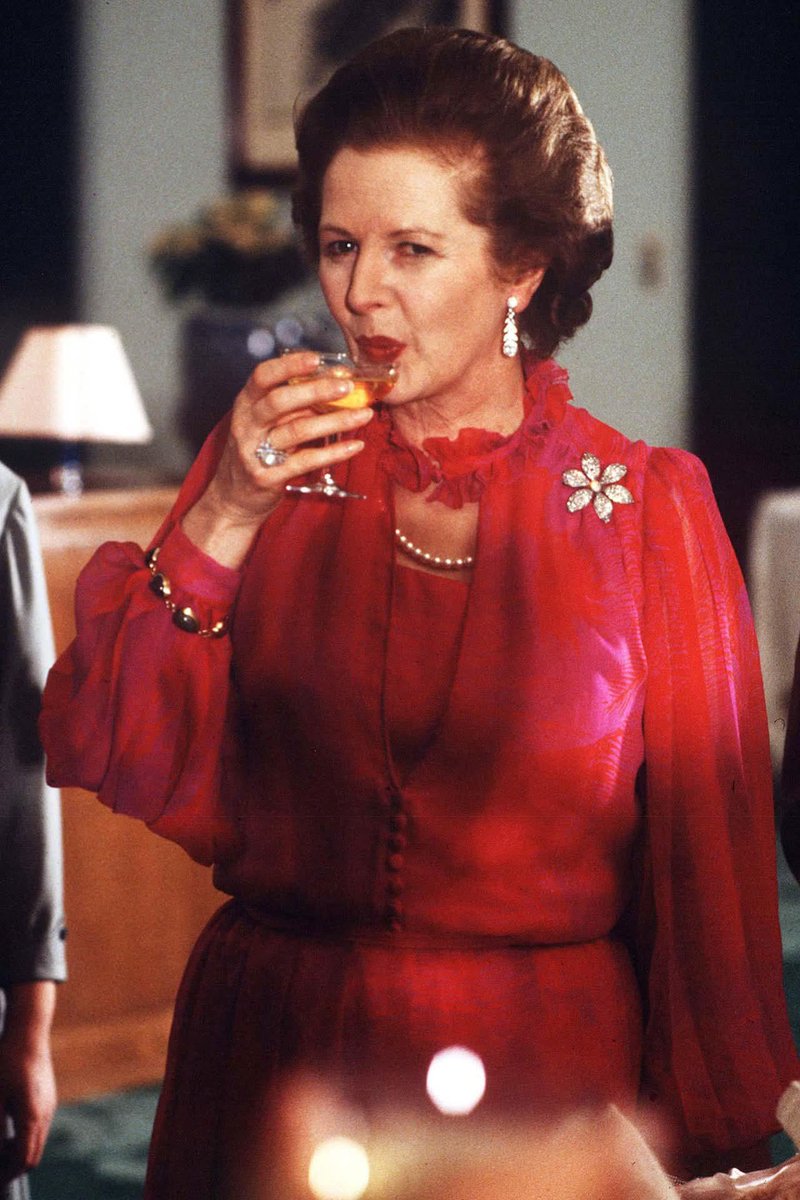
"I'm a tough boss, yes: I drive people, but it's my job to do that. We do have tough discussions in Cabinet, that's the way I run it—I don't want yes men—but it's utterly ridiculous to call me a dictator.
It may be that a woman with natural authority stands out more than a man—but I didn't develop it on purpose. I'm not a woman second and a politician first.
I'm a personality blended into one—I don't think you can separate qualities, tease them out."
— Interview for Living magazine. (1984)
Message on the 25th anniversary of the liberation of the Falklands (“Fortune does, in the end, favour the brave”):
The Falklands War was a great national struggle.
The whole country knew it and felt it. It was also mercifully short. But many of our boys – and girls as well, of course – are today stationed in war zones where the issues are more complex, where the outcome is more problematic, and where life is no less dangerous.
In these circumstances, they often need a different sort of courage, though the same commitment.
So, as we recall – and give thanks for – the liberation of our Islands, let us also recall the many battle fronts where British forces are engaged today.
There are, in a sense, no final victories, for the struggle against evil in the world is never-ending.
Tyranny and violence wear many masks. Yet from victory in the Falklands, we can all today draw hope and strength.
Fortune does, in the end, favour the brave. And it is Britain’s good fortune that none are braver than our armed forces. Thank you all.
― Margaret Thatcher, 13 June 2007.
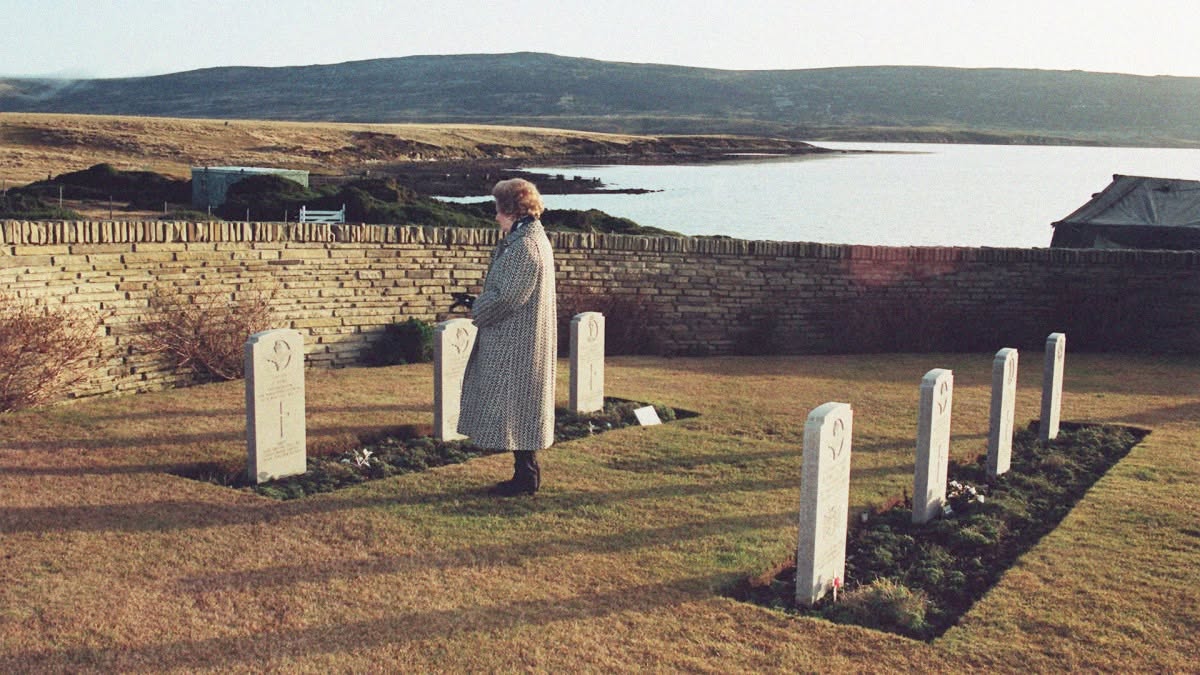
Margaret Thatcher at the Blue Beach Military Cemetery at San Carlos in 1992, remembering the servicemen who lost their lives on the grounds where the Falklands invasion started.
"If you value independence and self-reliance, then you will practice thrift to achieve them. You will seek an ordered society in which an individual's chosen pattern of life is protected by the law from criminal violence.
We do not need statistics to tell us that vast numbers of people in this country first want to own a home in which they can take pride, in which they can live their personal lives in the environment of their choice.
In short, terrible as this may sound to our socialist opponents, they want to own a piece of personal property.
In order to obtain it, they are prepared to save their money.
They are prepared to forego some immediate pleasure or luxury for what they judge to be the greater satisfaction of ownership.
It is worth asking ourselves two further questions.
Why do they find such satisfaction in ownership?
Why are they ready to make sacrifices for it?
The answer is because it gives them a sense of independence, of self-reliance, of individuality. They feel some of the pride of ownership.
Independence, self-reliance, individuality.
These are the values which count most with so many people.
Here is a firm foundation on which to build a policy, more reliable than the discredited theories of Karl Marx.
— Speech to Conservative Women's Conference (1975)
"We have external enemies, but the greatest enemies we face are in ourselves.
They are called Apathy, Indifference, Wishful-Thinking and Fear.
They can, and must, be vanquished. Freedom, that most priceless of all benefits bestowed upon mankind, will triumph if each of us is actively and personally involved in the cause of Western Democracy."
— Speech at Wellington Parliamentary lunch (1976)
"History tells us of Man's striving to be free.
You may use brute force to crush a nation: but you cannot destroy its identity and pride.
You can forbid individuals to employ their talents to better their families: but in the end some will be more equal than others.
You can fight a war against truth by every means at your disposal: but ultimately truth will win the battle of ideas."
— Speech to Leningrad State University.
"The people of Northern Ireland have long been famous for their courage in adversity. You are second to none in the belief that we should stand on our own feet. Indeed, there is no other way forward for any of us."
— Speech in #belfast (1981)
"There is little point in creating prosperity if, having done it, we fear we might be attacked in the streets or we or our property assaulted at home. And I believe, Madam Chairman, that above all else the people of this country wish to be protected against violence, theft and intimidation. And they want children to be brought up to believe in the best of our traditional values and to know the difference between right and wrong.
Now our opponents claim to be compassionate, and I'm sure they are.
Yet the fact that hundreds of thousands of elderly people no longer feel safe from assault and robbery and that they fear to leave their homes for social or family visits, for worship, for entertainment, even for shopping, that seems to have no place in socialist compassion.
They promise welfare but ignore well-being."
— Speech to Conservative Women’s Conference (1978)
“They tell us we must be prepared to contemplate, in fact to welcome, the alteration and alienation of our towns and cities. They tell us there is no such thing as our own people and our country…”
Enoch Powell
In 1969, as governor of California, you [Ronald Reagan] spoke at Eisenhower College. It was a terrible time of student rebellion, of violence against property, violence against fellow students, and violence against others on the campus.
“How and when did all this begin?” you asked.
“It began,” you said, “the first time someone old enough to know better declared it was no crime to break the law in the name of social protest. It began with those, who in the name of change or progress, decided they could scrap all the time-tested wisdom man has accumulated in his climb from the swamp to the stars.”
And I particularly like the next bit.
“Saint Thomas Aquinas warned teachers that they must never dig a ditch in front of a student that they failed to fill in. To clearly raise doubts and to ever seek and never find is to be in opposition to education and progress.”
You were right and said so fearlessly, while some academics just compromised.
— Speech on President Reagan’s 83rd birthday (1994)
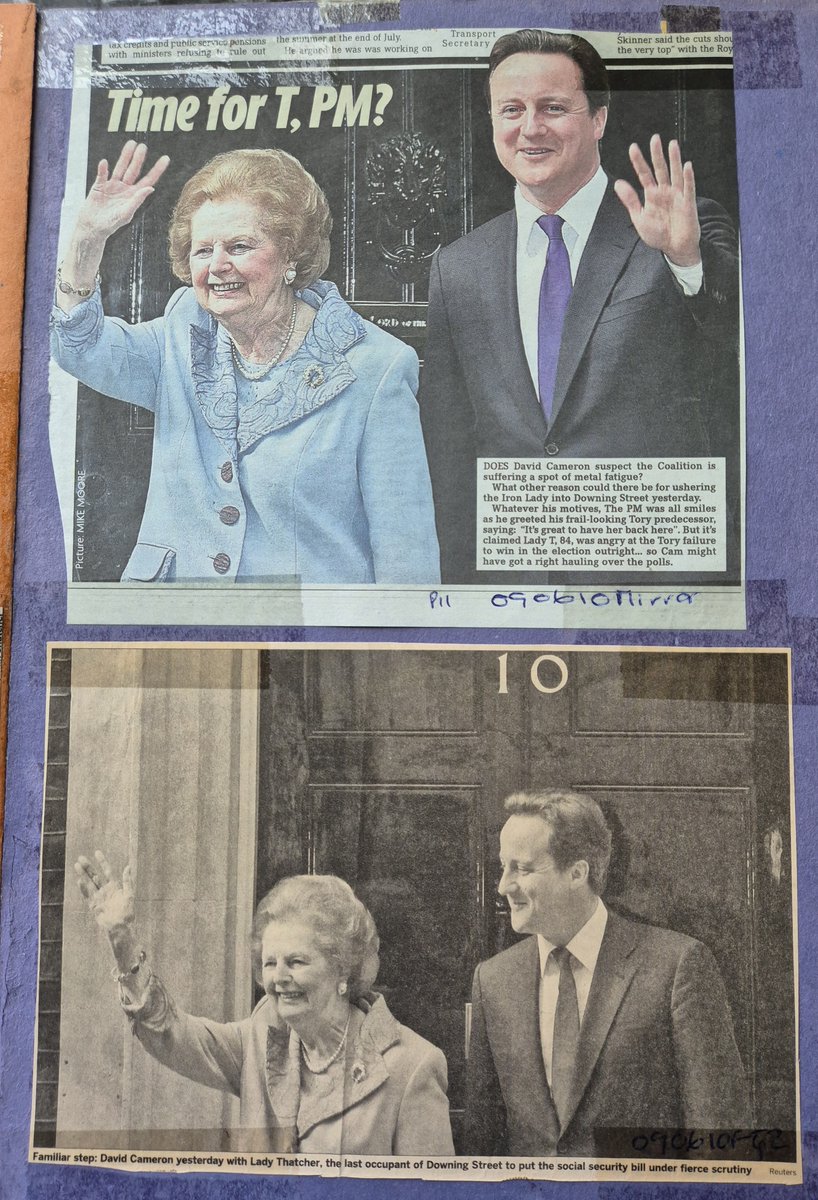
📰 'Maggie's den again'.
🗓️ Just one of the headlines that appeared on this day, 9 June, in 2010 reporting on Margaret Thatcher visiting David Cameron in Downing Street the previous day.
🔍 With a cameo appearance by Gordon Brown.
#OnThisDay in 1983 Margaret Thatcher won a landslide election victory over Michael Foot, returning to parliament with a majority of 144 seats. 🇬🇧 🇬🇧 🇬🇧
This marked the most decisive election victory since Labour's win in 1945.
#History#TodayInHistory#Thatcher#uk #conservatives
#OnThisDay in 1983 Margaret Thatcher won a landslide election victory over Michael Foot, returning to parliament with a majority of 144 seats. 🇬🇧 🇬🇧 🇬🇧
This marked the most decisive election victory since Labour's win in 1945.
#History#TodayInHistory#Thatcher#uk #conservatives
I could never have signed this treaty. I hope that that is clear to all who have heard me. The Bill will pass considerable further powers irrevocably from Westminster to Brussels, and, by extending majority voting, will undermine our age-old parliamentary and legal institutions, both far older than those in the Community.
We have so much more to lose by this Maastricht Treaty than any other state in the European Community.
It will diminish democracy and increase bureaucracy.
Mr Delors knew well the importance of his words when he spoke to the European Parliament in 1988. He said:
“Ten years hence, 80% of our economic legislation, and perhaps even our fiscal and social legislation as well, will be of Community origin”.
Then he went on:
“What I am afraid of is that some of these national parliaments are going to wake up with a shock one day, and that their outraged reaction will place yet more obstacles in the way of progress towards European Union.”
The national parliaments are entitled to have an outraged reaction. They will soon be little more than an agency for the Commission and for the European Council.
– Speech in the House of Lords (1993)
"Experience has shown that #Socialism corrodes the #moral values which form part of a free society. Traditional values are also threatened by increasing State regulation.
The more the State seeks to impose its authority, the less respect that authority receives.
The more living standards are squeezed by taxation, the greater is the temptation to evade that taxation.
The more pay and prices are controlled, the more those controls are evaded.
In short, where the State is too powerful, efficiency suffers and morality is threatened."
— Speech to Zurich Economic Society ("The New Renaissance") 1977










![Thatcheritage's tweet photo. In 1969, as governor of California, you [Ronald Reagan] spoke at Eisenhower College. It was a terrible time of student rebellion, of violence against property, violence against fellow students, and violence against others on the campus.
“How and when did all this begin?” you asked.
“It began,” you said, “the first time someone old enough to know better declared it was no crime to break the law in the name of social protest. It began with those, who in the name of change or progress, decided they could scrap all the time-tested wisdom man has accumulated in his climb from the swamp to the stars.”
And I particularly like the next bit.
“Saint Thomas Aquinas warned teachers that they must never dig a ditch in front of a student that they failed to fill in. To clearly raise doubts and to ever seek and never find is to be in opposition to education and progress.”
You were right and said so fearlessly, while some academics just compromised.
— Speech on President Reagan’s 83rd birthday (1994)](https://pbs.twimg.com/media/HKXaLAmWYAAuwvA.jpg)