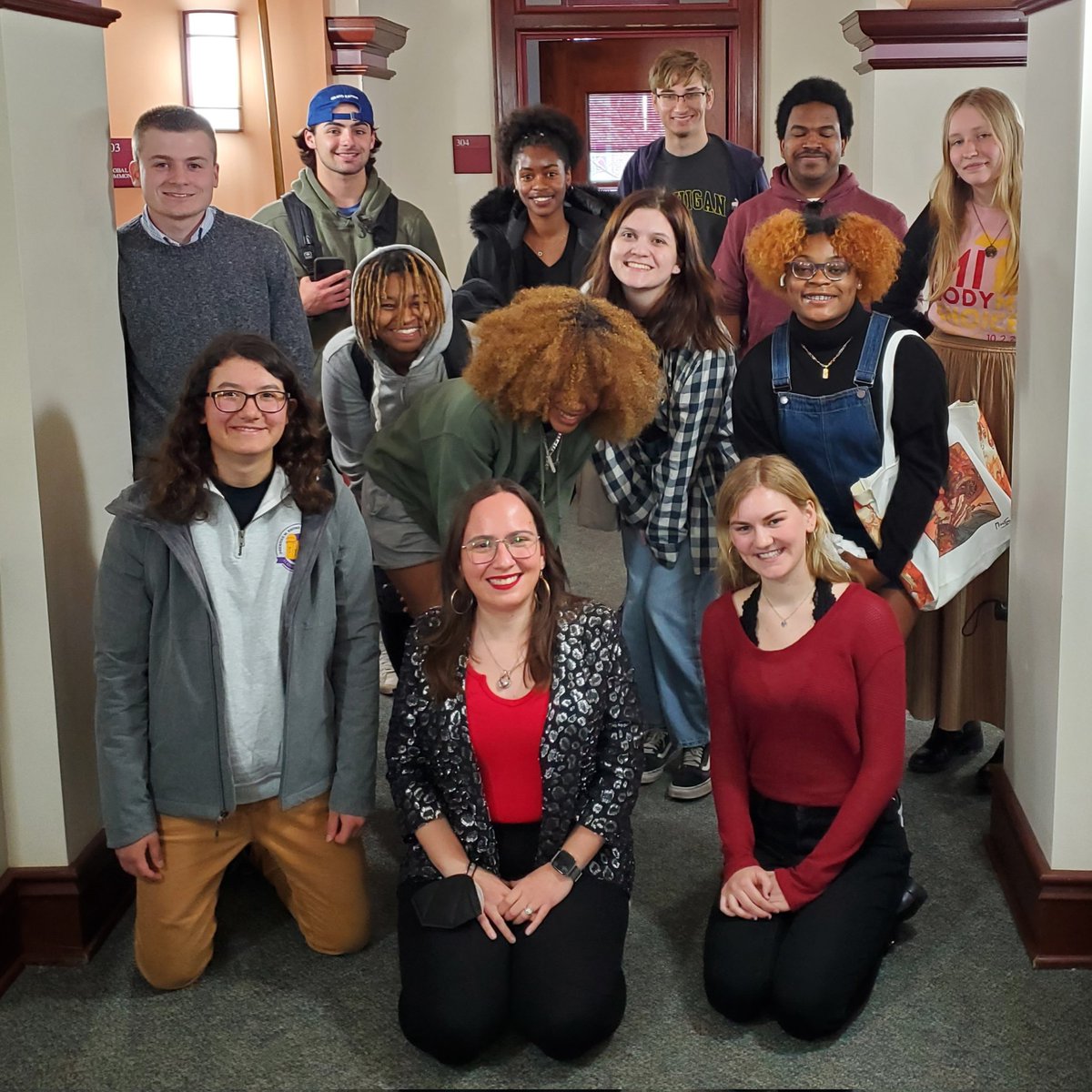
Little more than a week since we last met to discuss our oral history projects. May this account serve as an archive of our narrators' stories and the analyses of the artifacts we discussed throughout the Spring 2022 semester. #Twitterstorians#LongSixties#The1960s
Hello, my name is Jordon Maosn and I am a senior majoring in physics and political science here at Albion College. I will be sharing information with you about the Oral History Interview for the 1960s course.
20
I believe this assignment will influence the way I approach my elders. Specifically, before this assignment, I believed all of my elders were involved in the many historical movements of the 1960s. The way it will change is by talking to both bystanders and participants.
19
Some major takeaway from this assignment was that not everyone was adversely affected by the revolutionary times of the 1960s. The effects of the 1960s were not distributed uniformly. The most difficult part was just trying to schedule the interview and etc.
18
One of the reasons why my grandmother was not involved heavily is because her mother felt scared for her safety and how she would get hurt. However, she was heavily exposed to pro-Civil Rights rhetoric and steered her opinion on equality due to Church.
17
My grandmother informed my knowledge further on the 1960s by providing a very behind-the-scenes perspective. The behind-the-scenes perspective adds depth to movements discussed in class. For example, the Civil Rights movement.
16
The depth it adds is that not everyone had a direct effect exerted on them. Specifically direct effect in the 1960s case is being thrown in prison for protesting and etc. However, my grandmother did experience a lot of indirect effects such as segregation.
15
The 1960s course informed my interview heavily with overall political movements. My interview guide is based on the political movements that we discussed in class. However, my grandmother not being involved in these movements directly added depth to the course
14
My grandmother's lack of experience with the various political movements may seem useless in this project. However, it begins to bring up some interesting questions on surface-level political behaviors.
13
In terms of transcribing the interview, I didn't use any special software for writing down my grandmother's words. To mitigate "lost in translation" issues, I let my grandmother read over what I had written, and she did approve.
11
The reason why she was dissatisfied is that she felt there was still a lot of work that needed to be done. The Civil Rights movement she was loosely involved in, but not much. My grandmother is also a devout Christian.
10
Outside of Vietnam, she remembers the Civil Rights Act of 1964 and 1968 being signed. She was extremely happy with the action, however, she said she was still unsatisfied with the actions. T
9
She wasn't totally disinvolved in politics because she did remember watching NBC news on the war in Vietnam. It was pretty scary for her because her husband was in Vietnam fighting the war. A priority we both decided on was the Vietnam War.
8
The reason why she wasn't very politically involved is that she was enrolled in a nursing program for a year and dealing with a full-time job due to her husband being away in Vietnam.
7
The interview was done over the phone and the recording was done over google voice. I relied pretty heavily on the interview guide I created about a month before. Something that stood out to me is my grandmother was not very politically involved.
6
Her initial reaction to receiving the invitation was somewhat hesitant. The reason why she was hesitant is that she felt she might not be able to remember everything about the 1960s.
5
The reason why my interviewer was special was that my grandmother was just finishing high school around that time. Also, she was just entering college in Memphis and she was also of the black working class.
4
The dimensions of the exercise I shared with my grandmother were explaining to her that it was just a conversation between me and her about the 1960s. She was initially hesitant because she could not remember much about the 1960s.
3
I finally chose my grandmother on my mom's side and she was perfect for the interview because she was born in Memphis, TN and my grandfather served in the Army and fought in Vietnam. He was drafted into the Army.