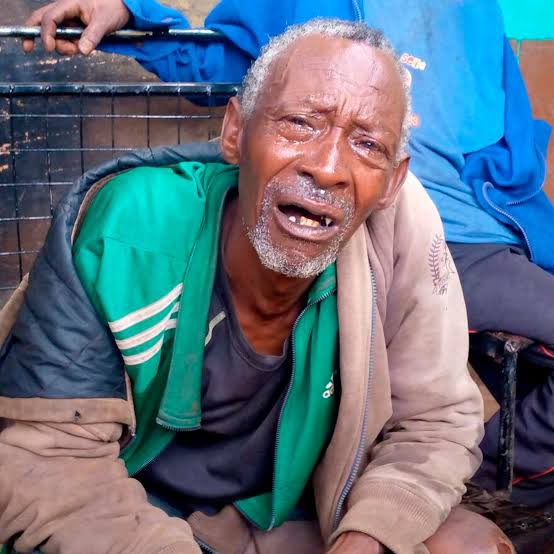
This is my friend, James Njuguna Kamau.
He started life with discipline stitched into his bones.
Kingeero Primary.
Alliance high school.
Top of his class every single time.
He graduated with first-class honors in Engineering at the University of Nairobi in 1967, then finished a PhD long before his peers even wrapped up their Masters.
He never smoked.
Never touched alcohol.
Never chased scandal of women.
Never stained his name.
He chose one woman.
Married her.
Stayed faithful to her for life.
He raised four brilliant children and sent all of them to the Ivy Leagues on merit, doors he opened with sacrifice, late nights, quiet work and money he never spent on himself.
He gave them the life he never had.
And they took it.
And they went abroad.
And they stayed there.
Now he is in his seventies.
A well respected professor.
A man who shaped generations.
But in the house he built with his wife, he is a ghost moving from room to room.
He stood in his kitchen today, staring at raw chicken, trying to remember how chicken tikka is made.
Because he’s alone.
Utterly alone.
His wife left four years ago to “help their daughter” in Melbourne after childbirth.
Routine visit, she said.
She never came back.
She now belongs to the children.
Birthdays are FaceTime calls.
Anniversaries reduced to emojis in group chats.
Her body is abroad.
Her heart left long before her flight.
And this man who lived right, loved right, did right, has been abandoned without ever doing anything wrong.
A bachelor again.
Not by sin.
Not by choice.
But by quiet, creeping neglect from the very people he built his world around.
This is the lonely end of a good man.
A man who never cheated.
Never strayed.
Never hurt anyone.
A man who believed that doing everything by the book would protect him in old age.
Yet here he stands:
Alone.
Heartbroken.
Still loyal to a woman who forgot to come home.
And the saddest part?
His story is not rare. This is the silent fate of many “good men”, men who poured themselves out until nothing was left for them.
So the hard questions linger:
If he was a polygamist… would at least one wife have stayed?
If he built stronger friendships, social circles, a life outside the family… would the silence be softer?
If he had someone, anyone, who checked in on him the way he checked in on everyone else… would he feel this invisible?
If he had lived even 20% for himself… would this ending still look this cruel?
This is not an invitation to abandon virtue.
It’s a plea to balance it.
Because loyalty is beautiful.
But loneliness is unforgiving.
And love, when it stops being mutual in old age, becomes a slow, quiet heartbreak that medicine can’t treat and time can’t fix.
To every man reading this:
How do we avoid ending up like this?
What systems, friendships and self-preserving habits must we build now so that at 75, we are not standing over a lonely kitchen counter, whispering to ourselves, “Where did everyone go?”
Because in 2025, being a good man is no longer enough.
Not by itself.
Not anymore.
In Nairobi, I think this is the realistic places people live based on their monthly income🥲. Where are you in these bandings?
1. Kes 10M+: Old Muthaiga, Gigiri, Karen (Hardy), Runda.
2. Kes 5–10M: Kitisuru, Rosslyn, Nyari, Lower Kabete.
3. Kes 2–5M: Spring Valley, Riverside, Loresho, Westlands.
4. Kes 1–2M: Lavington, Kilimani, Kileleshwa, Parklands.
5. Kes 800k–1M: Brookside, Gen Mathenge, Hurlingham, Peponi Rd.
6. Kes 600–800k: Upper Hill, Ngong Rd (Adams), Westlands (Raphta), Kilimani (edge).
7. Kes 400–600k: Lang’ata, South C, South B, Madaraka.
8. Kes 200–400k: Ruaka, Syokimau, Kikuyu, Ongata Rongai, Thindigua.
9. Kes 100–200k: Donholm, Imara Daima, Tena, Zimmerman.
10. Kes 50–80k: Kasarani, Roysambu, Ruiru, Githurai 44 &45.
11. Kes 20–50k: Umoja, Pipeline, Kayole, Mwiki.
12. 5-20k: Kariobangi (N/S), Dandora (Ph 4/5), Kayole (Soweto), Githurai/Mwiki, Ongwaro, Mukuru Kwa Ruben and Kayaba, Number 8, Mathare N and S.
Grok 4 can now create Mind Maps for books.
No more wasting hours creating visuals for studying or breaking down complex books.
Here’s how to create a mind map in just few minutes:
Nairobi has a certain air of promise. Especially if you are a jobless graduate. It is magnetic and optimistic.
There is always a deal around the corner—a tender here, a business breakthrough there. Even street language teems with hope. Kuomoka. Kuondoka/kuchomoka block. Siku moja fomu itajipa. There is a hope that somehow, all of us, by some magic alchemy, we will become rich.
In between, you may land a good deal. But the waiting period for the next deal can break your heart as a man. You can lose your wife, children, girlfriend, mpango, and everything you own as you wait for the next deal. Or for the government tender to be paid.
I look back on my more desperate days before I started hawking books. Used to be called to these meetings. High-end hotels. I would sit across top government or NGO folk discussing strategy. Or Java. Art Café. Or the swankier ones in Kilimani, Lavi, and in the many malls that dot Nairobi’s greener and leafier suburbs. I would leave the meetings thinking of what car to buy, what neighbourhood to move to, or where between Machakos or Kajiado outskirts should I build my city home. Kamulu has a certain repellent quality while Kitengela has a certain secure and sunny charm. I could even call my Kisii girlfriend and we could discuss vacation ideas. Because I was talking to guys who make decisions about how the funds of government or the NGO they worked for are moved. By the way delusion is a very bad thing.
Back home, I would hammer out a proposal with my business partner (back then, there was no ChatGPT). There would be pages upon pages of proposals and PowerPoint presentations. Proposal safi kama Kelly Rowland.
And then, the waiting would begin. The big man will stop picking up my calls. Blueticks. Painful. Grey ticks are even more disrespectful. And boy, once you start chasing these big men, you can lose your soul. You befriend their PAs and secretaries, who will update you about their moves and there whereabouts, when you can meet, etc. But licking ass of big men is nasty business. When I hear that you guys eat ass, I don't even know how y'all do it but stop it.
Do women also have friends in high places that they simp for?
Because in the corridors of big men's offices, I only bump into men. And the only women I see in the corridors are their mistresses who have express access or some odd woman who wants some CDF or something.
And then, there are jobs to apply for. You apply until the day comes when you no longer want to apply. Because job applications are just PE. And LinkedIn is honestly full of poop. Ever applied for those UN jobs that need 4 hours? Or those you apply via LinkedIn, and then you manually have to fill in your details on some digital forms and submit your CV. Sometimes you have someone in the right place to put in a good word for you. Except that your person doesn’t have enough flex, and thus the boss will fix their niece there, far younger, far less experienced, and that is the way the world works.
Another six months have gone by. No business. No job. No deal.
And then you see a tender. You know, people who can swing you the tender. Then you do paperwork. Tender paperwork is ridiculously laborious. Last time, I printed almost 300 pages, spending my last supper money on it, betting on the connection to get the tender. Then you get that appetite and do like ten tenders. You get none in return. Later you learn that the big man in the department has shell companies with his clandes, nieces and nephews that they use to cart the money away. You are humbled.
And now you are 37. It has been three years since you last had a good deal.
Or you are 29, five years since you graduated, and have no job or deal in sight. Now, dating and marriage are indefinitely suspended. If above 37, you are probably divorced or will be divorced sooner rather than later.
This period of stagnation, where you wait indefinitely for a job after graduation, is called Waithood. If you are an adult, it is called Stalled Mobility. Millennials in Kenya, especially those born between 1986 and 95, have experienced difficulties changing their socio-economic status. There hasn’t been upward mobility. Instead, there has been a lot of downward mobility. Most of my friends who, just a decade ago, used to lend each other sums up to Sh 100,000 and would dispense with it like it is pocket change, nowadays we are down to asking each other for Sh 100-500 for kabej. The economy has wiped out many marriages I knew, and all the memos we have written don’t address the elephant in the room: the economy. It is rough on women. Rougher on men. The Kenyan economy started collapsing in 2015, and the effects were being felt as early as 2018-19. Covid-19 accelerated the situation, but saved the Uhuru government because everything could be blamed on Covid-19. Ruto has no such luxury; he is badly exposed.
So, we now have two cohorts: younger adults in their mid to late 20s-early 30s with no job prospects, and now they are missing out on all markers of adulthood, marriage, and home ownership, as well as career or business progression. The other cohort in their late 30s and 40s who have gone through a good fortune, enjoyed a good corporate job, Nairobi-type deals, and business, had a good marriage, and even a family but for the last 3-5 they are stuck. Same job. Or sacked. Same neighbourhood. Or downgraded. Stalled mobility has either shattered their lives or everything good they ever had.
So, we have almost three overlapping generations, born 1986-93, 93-99, 2000-2005, who are now lost generations. Already, nothing short of a miraculous intervention can save most of them. Pushed to the end, a revolution may be inevitable. But revolutions rarely solve problems. They level the playing field, and everyone starts worse, save for a few who may gain from the ruins.
Kenya still has a chance to turn things around. A Kibaki-like figure with a greater inclination for nationhood instead of narrow ethnic interests and far less corrupt can change our fortunes and unleash the country's full potential.
Otherwise, Waithood and Stalled Mobility are with us for a long time. And if you sing “kumi bila break”, you will cry and gnash your teeth until 2040. Sadly, we don’t get any younger to experiment with our lives under lazy and inept leadership.
I really don't want to sound like a genius in 2030 when you look back and remember when I told you that Kenya Kwanza is not an option in 2027. Three generations are at stake. Don't trivialise this. If you intend to vote Kenya Kwanza kindly block me and delete me from your life.
This is a matter of life and death.
Hate me or love me.
Gentlemen, as a 20 - 25 yr old, what would you do with KES 2 million in cash?
Provide a detailed breakdown of your smart investment plan.
By 8 am Monday, the best comment wins KES 2,500.
Let’s go:
Money Market Funds vs T-bills
A question that is often asked by many:
"Since MMFs mainly invest in T-bills, why can't I invest directly in T-bills and get the *full gross return* before management fee is deducted?"
Here is how MMFs compare to T-bills👇👇