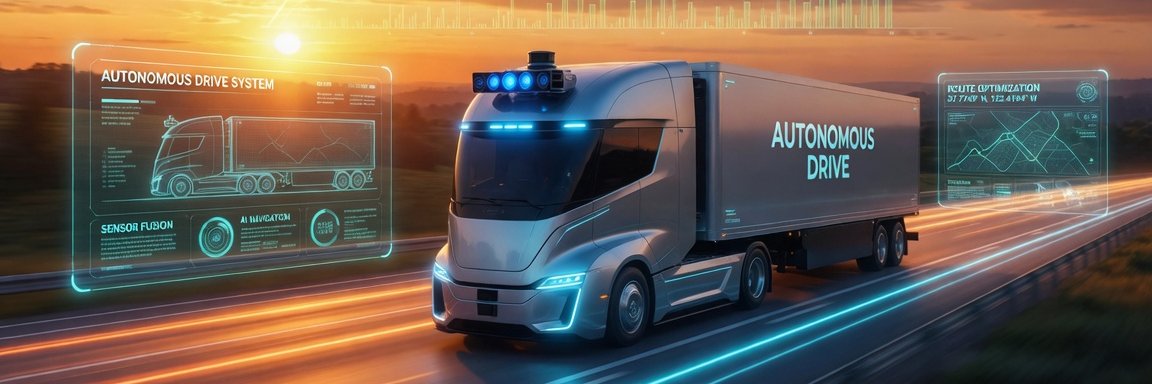
Q2 ended 11 days ago.
Aurora said it would haul with no observer in Q2.
Kodiak said it would hit mid-30s driverless trucks.
Neither has said a word.
I track every dated promise in AV trucking. 125 so far.
16 delivered. 5 missed or late.
Nobody's keeping score. So I am.
At 75 mph, 12 seconds means driving 1,320' blind. More than four football fields.
You dont need driver-facing video to know there is a problem. Hard braking. Close following. Lane departures. Erratic steering. Pitch, yaw and repeated near misses.
The telematics are the indicators, not managing those is what takes carriers to court and to the cleaners.
Hard braking is usually not the problem. Its the symptom.
Tesla's Austin robotaxi geofence covers the entire metro, roughly 4,300 square miles.
The fleet inside it, per third-party trackers: about 28 cars.
Waymo runs roughly 4,000 robotaxis across 10+ cities. Geofence is a press release. Fleet is the business. $TSLA $GOOGL
Unitree's first quadruped, the Laikago, sold for $45,000 in 2018.
The Go2 today starts at $1,600.
A 96% price drop in six years, most of it before humanoids became a mainstream trade. The cost curve in robotics is steeper than most models assume.
Walden Robotics spun out of a Toyota lab in January. By July it raised $300M at a $1.1B valuation.
Six months, lab to unicorn.
It already has a robot running 8-hour shifts at a Toyota plant, loading parts and kitting for assembly. Backers include $NVDA and $BA.
The best-funded new humanoid of the month doesn't walk.
Walden's robots are a humanoid torso on a wheeled base. The reason is regulatory: manufacturing has safety standards for rolling machines. None for walking ones.
Legs aren't a hardware problem. They're a compliance problem.
With open source models becoming as or even more capable than the U.S. Frontier Labs - And with the open-source models, costs are significantly lower than what the Frontier Labs offer. it only stands to reason that the Frontier Labs (i.e., OpenAI, Anthropic, XAI) will have to subsidize their users' spend on tokens. How's that for a business model?
Tesla launched robotaxi in Miami on July 3, its first market outside Texas. Fully unsupervised from day one, no safety driver.
Launch day fleet: two Model Ys. Three within 48 hours. Service area: 10 to 14 square miles.
The capability is real. The scale isn't there yet. $TSLA
Chinese humanoid investment hit 47.1B yuan in Q2, about $6.95B. Double Q1. Six times a year ago.
Unitree cleared IPO review in 73 days, fastest on record for the STAR Market. LimX is prepping Hong Kong at $2.2B.
China isn't funding this sector. It's listing it.
Waymo began driverless service in Las Vegas on July 8. San Diego, Tampa and Denver are queued behind it.
10+ cities now, targeting 20 and a million weekly trips by year end. About 4,000 vehicles. 20 million rides delivered.
The "if" question was settled a while ago. $GOOGL
Robotics startups have raised $55.8B in 2026. Or $18.8B. Depends who you ask.
Dealroom counts physical AI broadly. Crunchbase counts robotics narrowly. Same sector, same period, 3x gap.
Every "record robotics funding" headline is reporting a methodology choice.
Humanoid robotics has produced exactly one profitable company at scale.
Unitree. And the profit isn't from humanoids. It's from actuators, the joints that are 50-70% of every humanoid's bill of materials.
The only one making money sells picks and shovels to its own competitors.
THE BOTTOM LINE:
Cargo theft is a $15-35B/year problem built almost entirely on human vulnerability: rest stops, bribes, fake pickups, GPS gaps.
Autonomous trucks don't just reduce these vectors. They structurally eliminate most of them.
78% of major theft vectors → gone.
Insurance costs → down.
Recovery rates → up (continuous tracking).
The companies building this: $AUR $KDK $GTTK
Sources: Verisk CargoNet 2025 Annual Report, FBI IC3, NICB, DHS, FreightWaves, Munich Re Cargo Theft Report 2025
The Autonomy Thesis
Autonomous trucks may be the single biggest anti-theft technology in freight history.
Not because they're armored. Because they eliminate the human vulnerabilities that make cargo theft a $15-35B/year problem.
The vector-by-vector breakdown:
THE COUNTERARGUMENTS (because they're real):
AV trucks introduce new vectors:
⚠ Cyber attacks: hacking vehicle systems to reroute or stop a truck. Real risk. Mitigated by air-gapped controls, encrypted comms, and remote ops centers monitoring every vehicle.
⚠ Physical forced stops: blocking the road. But this is already possible with human trucks, and AV trucks can alert authorities instantly + have 360° cameras recording everything.
⚠ Warehouse theft (41% of incidents): AV doesn't fix facility-level security. That's a separate problem.
Net assessment: AV trades 7 high-frequency human-dependent vectors for 2 lower-probability, more mitigable technical vectors. The math favors autonomy.