I hate you blue light I hate you infinite scroll I hate you ai customer support I hate you onedrive I hate you no usb port I hate you two factor authentication I hate you accept all cookies I hate you autoplay I hate you subscription I hate you buy more storage I hate you
WW3 is going on rn and the only way any of us can get a job is telling a mcdonalds interviewer "my entire life is actually about burgers. I actually want to be a burger when i grow up"
Scientists put kids through 100 hours of reading, then scanned their brains. New wiring had physically grown inside the language regions. Communication between brain areas sped up by a factor of 10. Kids who didn't read showed zero change.
That was a 2009 Carnegie Mellon study. It gets wilder.
In 2013, Emory University scanned 19 students every morning for 19 straight days while they read one novel chapter each night. Mornings after reading, the brain areas responsible for understanding other people's emotions lit up with new connections. So did the region that processes physical sensation. Their brains were simulating what the characters felt, as if it were happening to them. Those changes stuck around for 5 days after they finished the book.
Now flip to scrolling. A massive review published in Psychological Bulletin last September pulled together 71 studies covering 98,299 people. Heavy short-form video use (TikTok, Reels, Shorts) showed a clear pattern: worse attention, weaker self-control, and more anxiety. Consistent across teenagers and adults, across every platform tested. Oxford didn't name "brain rot" its 2024 Word of the Year for nothing.
A 2024 brain wave study found that people hooked on short-form video had weaker activity in the front of the brain, the part that controls focus and impulse control. Separate brain scans showed the same thing: heavy scrollers had less activation in the exact regions that deep reading strengthens.
UCLA neuroscientist Maryanne Wolf has been studying this for decades. Humans were never born to read. There's no gene for it. Reading is something we invented, and it hijacked neurons that were originally meant for recognizing faces. Over time, it built entirely new brain circuits connecting language, vision, and emotion. But those circuits only survive if you use them. Stop reading, and they fade. Wolf's conclusion is simple: screens built for speed produce a speed-wired brain. Books built for depth produce a depth-wired brain.
One honest caveat: most of these studies are snapshots, not long-term tracking. People who already struggle to focus might just prefer short videos. But the same pattern showing up across nearly 100,000 people is hard to shrug off.
The tweet repeats the line seven times. The research backs it up with brain scans, EEG data, and white-matter imaging across tens of thousands of people.
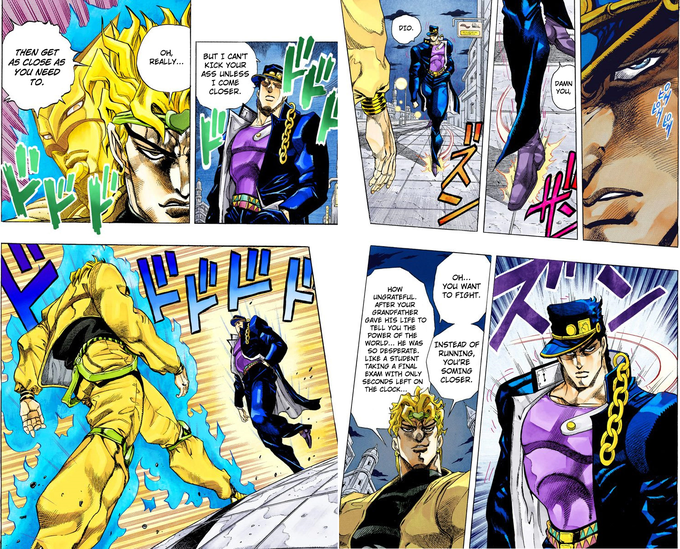
On this day 34 years ago, Chapter 143 of JoJo’s Bizarre Adventure: Stardust Crusaders gave us the iconic Jotaro vs. Dio Brando face-off.
“Oh? You’re approaching me?”
“I can’t beat the shit out of you without getting closer.”
Johnny:
I want to learn how to walk
Josuke:
I want my memories back
Jodio:
I'M NOT A BIG FAN OF THE GOVERNMENT
I'M NOT A BIG FAN OF THE GOVERNMENT
I'M NEVER PAYING MY TAXES
I'M NEVER PAYING MY TAXES
FUCK THE GOVERNMENT
FUCK THE GOVERNMENT
30 ON 30 ON 30 ON 30