2 of 2
The authors note that objects of these sizes and speeds are unprecedented in conventional astronomical catalogs of lunar phenomena (transient lunar phenomena, impacts, etc.). They reference prior work by Carlotto on large anomalous objects near the Moon and Jacques Vallée’s methodological remarks, and they quote an external comment that no known terrestrial propulsion system matches the observed performance. Their central conclusion is that the Moon serves as a base or staging area: objects capable of the reported speeds could reach Earth in roughly 20 minutes and would appear as UAP when observed from the ground or from near-Earth space. The synchronized variability, structured morphologies, and apparent control of brightness and motion are taken as evidence of intelligent, technologically advanced behavior.
Strengths of the Work
The paper’s principal value lies in the quantitative photometric treatment. High-cadence sampling, careful calibration, frame registration, and Fourier-based cleaning of the light curves go beyond simple visual claims. The consistent finding of correlated brightness changes across widely separated objects is particularly hard to dismiss as random noise or simple instrumental artifact. The low contrast and near-lunar albedo explain why such objects would routinely escape notice in ordinary lunar imaging. The dynamical numbers—kilometer-scale sizes, multi-km/s velocities, and rotational accelerations of order 1–2 g—are striking and force the discussion beyond routine transient lunar phenomena (outgassing, impacts, or optical illusions).
Taken at face value, the data set is difficult to reconcile with ordinary natural processes or with known human technology.
The combination of extreme scale, high speed, synchronized modulation, and morphological regularity leans toward something outside the current catalog of well-understood lunar or near-Earth phenomena. In that sense the authors are justified in treating the observations as evidence of an unknown technological presence rather than merely unexplained flashes.
Distance and size estimates depend on albedo and geometric assumptions that, while reasonable, are model-dependent. Single-site observations leave open the possibility of residual atmospheric or optical effects, although the authors’ phase-discrimination method and the lock-step motion with the Moon argue against simple terrestrial-atmosphere explanations.
Earlier papers by the same team on terrestrial UAP met with methodological criticism from their own institution’s scientific council; the lunar series shows clearer photometric rigor, yet external confirmation remains essential.
The leap from “anomalous, structured, synchronized objects of extreme size and speed” to “Moon base of a technologically advanced civilization” is interpretive. The observational facts themselves, however, already indicate that something highly unusual is present.
“UFO Dynamics on the Moon” is a serious attempt by professional astronomers to extract quantitative dynamical and photometric information from high-speed lunar video.
The reported objects—stationary multi-kilometer-scale sources with pulsed, correlated variability, and moving 25–40 km discs and toroids traveling at tens of kilometers per second while rotating at rates that produce artificial gravity are not easily accommodated by conventional explanations. The evidence, as presented, leans toward phenomena that current physics and known technology do not account for. Whether these are ultimately natural processes of an unrecognized class, artifacts of extreme observational subtlety, or indicators of non-human technology operating in cis-lunar space, the data demand further high-cadence, multi-site, multi-wavelength scrutiny.
The paper is valuable precisely because it forces that confrontation with the unknown.
Direct PDF link:
https://t.co/o0n1668uiL
A Detailed Review of “UFO Dynamics on the Moon” Paper.
Main Astronomical Observatory, National Academy of Sciences of Ukraine
This 2026 preprint (DOI: 10.13140/RG.2.2.13866.79042; also available via the observatory’s site) presents high-speed telescopic video observations of anomalous objects in the vicinity of and apparently associated with the Moon. The authors classify the objects into two broad categories—“atmospheric” (appearing stationary relative to the lunar disc) and “continental” (moving across or near the lunar surface)—and argue that the data point toward technologically advanced craft for which the Moon functions as a base. The work is observational, photometric, and interpretive rather than purely theoretical, and it builds on earlier related papers by the same team.
Observational Setup and Methods
Observations were obtained primarily on 7 September 2025 (with additional data from 16 August 2025) using an Intes-Alter M603 telescope equipped with an ASI 294 Pro camera at a site in Vinarivka, southern Kyiv region. Data were recorded at 0.05 s cadence (20 Hz sampling) in video mode via SharpCap, followed by standard astronomical calibration (bias/offset, dark, flat-field). Processing was performed in MATLAB. The authors emphasize low-contrast detection (often ≤10 %, sometimes ~3–5 %), the use of false-color rendering to enhance visibility, frame alignment to remove lunar motion and tracking residuals, and a “phase discrimination” Fourier technique to isolate genuine brightness variations from atmospheric transparency changes and tracking errors. The global lunar light curve is used as a reference interference signal so that common harmonics can be rejected.
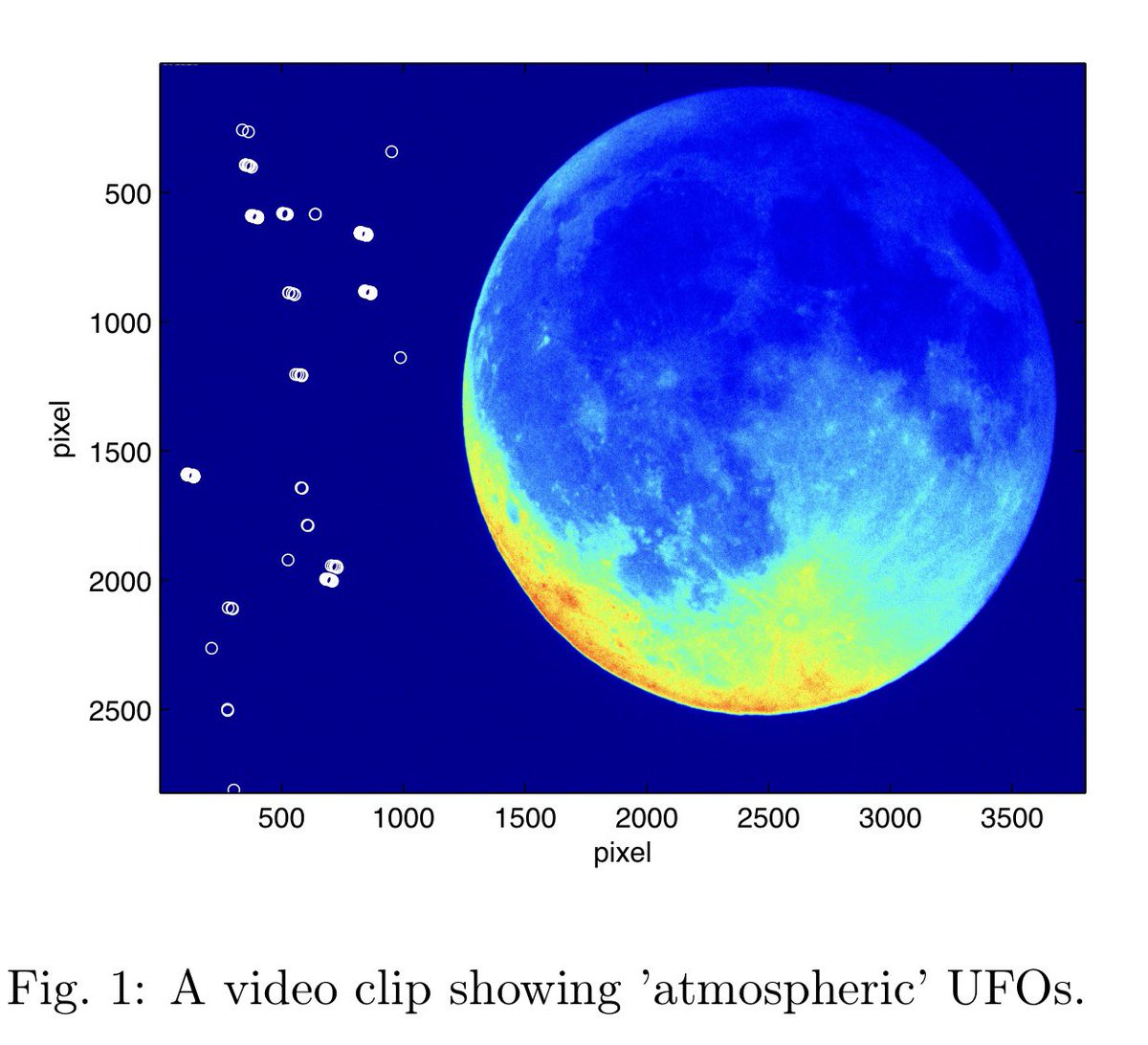
More than 20 distinct objects appear across the frames. The authors carefully distinguish objects that remain fixed relative to the Moon (moving in lockstep with it) from those that traverse the disc.
Atmospheric (Anchored) Objects
These remain positionally stable to roughly one pixel (~0.75 arcsec) over sequences of 100 frames. They exhibit short flashes lasting 100–500 ms with amplitudes of approximately one magnitude. Fourier analysis of the light curves reveals a fundamental frequency plus harmonics (overtones) in the few-hertz range; the spectra are characteristic of pulsed rather than purely sinusoidal processes. In several cases, objects separated by tens to hundreds of kilometers show statistically significant (95 % confidence) correlated brightness changes. Size estimates, derived from reflected-sunlight assumptions and comparison with lunar surface brightness, range from a few hundred meters (if albedo ≈ 1) to roughly 1.8 km (if albedo is lunar-like, ~0.064). The objects are described as low-contrast and effectively camouflaged against the lunar background.
Continental Objects: Discs and Toroids
Disc-shaped objects are reported with diameters of approximately 25–40 km. They display low-amplitude (~1 %) brightness fluctuations at frequencies of a few hertz (notably 3.0, 4.5, and 6.0 Hz). Toroidal (doughnut-shaped) objects are estimated at ~36 km across. One well-analyzed example shows translational speeds up to ~11 km/s. Rotation is inferred from the apparent motion of bright surface features: a period of ~180 s yields a centrifugal acceleration of ~2200 cm s⁻²—roughly twice terrestrial surface gravity. The authors interpret this as artificial gravity generated by rotation. Albedo estimates for the toroids are low (~0.061), close to the Moon’s, and residual intensities in RGB channels are consistent across colors, suggesting the objects absorb rather than emit strongly and are therefore difficult to detect optically. Reconstructed images after careful processing show clear disc and toroidal morphologies. Synchronous brightness modulation is again reported among spatially separated objects.
1 of 2