Being a Community Manager in Web3 has been an incredible journey, but I can honestly say that being a Community Manager for a founders' community has been one of the most rewarding learning experiences I've ever had.
Every day, I get a front-row seat to the realities of building a startup. And one thing I've learned is this: building a startup is not easy. It takes resilience, consistency, and a willingness to learn, adapt, and keep going even when things don't go as planned.
We're currently in the Fourth week of our Validation Cohort 1.0 at The Builders Room, where founders are learning how to validate their ideas before building. Although I'm the Community Manager, I've been learning alongside them from business models and customer validation to legal foundations, startup structures, and the importance of building businesses that truly solve real problems. Every session leaves me with valuable insights I can apply beyond community management.
What makes it even more exciting is seeing founders share their journeys through our Founders Spotlight, learn from one another during our Founders Hot Seat, and grow together as a community. Watching ideas evolve into businesses is inspiring.
To my fellow Community Managers, I'd love to hear from you. What's one valuable lesson your community has taught you?
And if you're a founder looking for a community that will challenge you, support your growth, connect you with other builders across Nigeria and Africa, and provide practical resources to help you build, The @TheBuildersRoom is the place to be.
Join us through the WhatsApp link below. We'd love to have you build with us.
https://t.co/3goK5dhnk6
@Vodacom Group has increased its shareholding in Safaricom PLC from approximately 35% to 55%, securing majority ownership of one of Africa's largest telecommunications, fintech and technology companies.
The deal, first announced in December 2025, involved acquiring a 15% stake from the Government of Kenya for KES 204 billion (approximately €1.36 billion) and an additional effective 5% from Vodafone for KES 68 billion (approximately €0.45 billion), bringing the total transaction value to approximately €1.81 billion across both tranches.
Safaricom is not just a telco. It is one of the most consequential digital infrastructure companies on the continent. Its M-Pesa platform alone contributes 44% of the company's Kenyan revenue and has fundamentally reshaped how financial services work across East Africa. Beyond Kenya, Safaricom already serves approximately 14 million customers in Ethiopia and is expanding its cloud, IoT and enterprise technology services across the region.
For Vodacom, this acquisition is the centrepiece of its Vision 2030 strategy, creating a contiguous African footprint stretching from South Africa through East and Central Africa all the way to Egypt. Safaricom now becomes a fully consolidated subsidiary, meaning its financials, including R29 billion in EBITDA, flow directly into Vodacom's group results.
For Kenya, the proceeds from the partial stake sale go back into the country. John Mbadi, Cabinet Secretary for National Treasury, framed it simply: "Twenty-five years ago, the Government of Kenya made a founding investment in a mobile telephone licence. That investment has grown into Safaricom." The government retains a 20% stake and Safaricom remains listed on the Nairobi Securities Exchange.
What this deal signals is straightforward. Africa's digital infrastructure is maturing, and the companies that built it are now worth serious capital at scale. A $2.1 billion transaction for a majority stake in a fintech-driven telco is not a bet on potential. It is a recognition of what has already been built.
Safaricom's best days, as Kenya's own Cabinet Secretary put it, are not behind it.
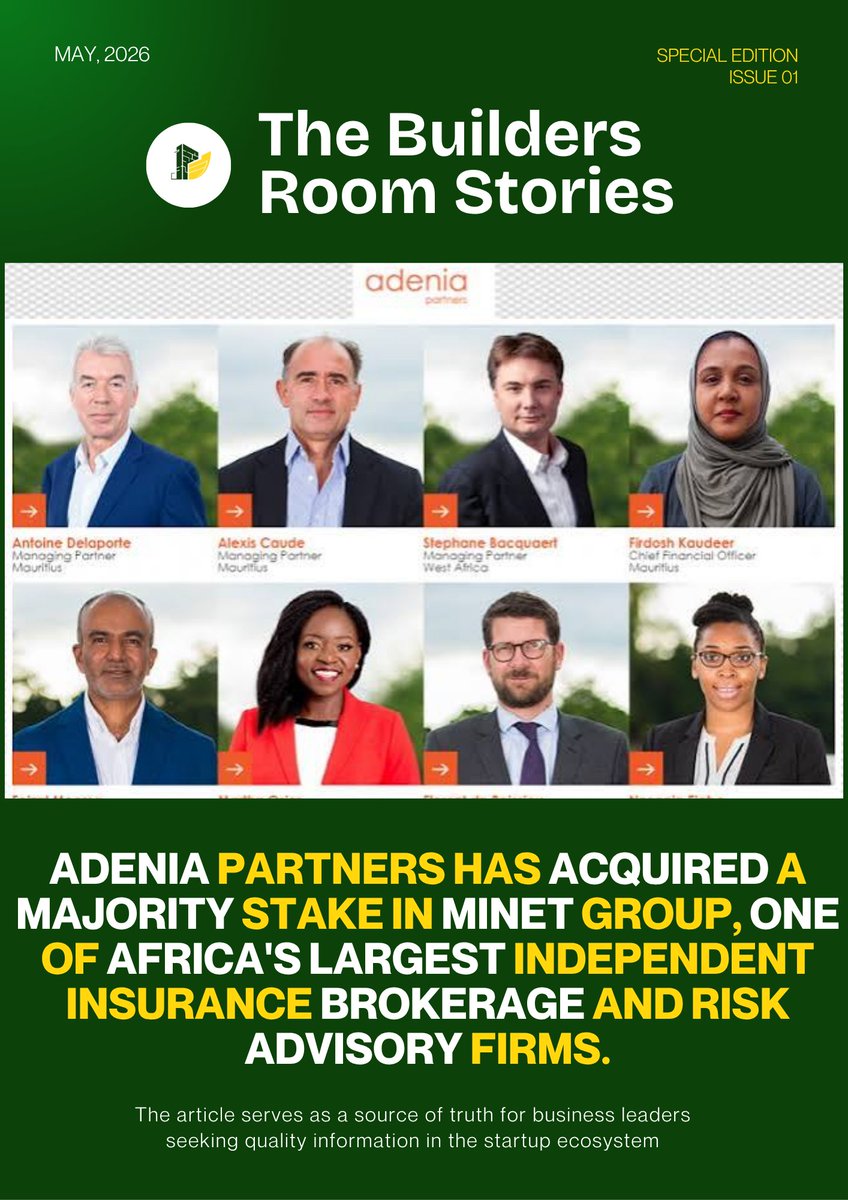
@AdeniaPartners has acquired a majority stake in Minet Group, one of Africa's largest independent insurance brokerage and risk advisory firms.
The stake was acquired from Capitalworks, which originally brought Minet into its portfolio in 2017 after the company was carved out of global insurance giant Aon. The transaction completed on June 30, 2026 following receipt of all required regulatory approvals. Financial terms were not disclosed.
@MinetGroup is not a small operation. The company provides insurance brokerage, risk advisory, and employee benefits solutions to corporates, SMEs, and institutions across nine African countries: Botswana, Kenya, Lesotho, Malawi, Mozambique, Namibia, Tanzania, Uganda, and Zambia. That footprint, built over years under Capitalworks' ownership, is exactly what made it an attractive target for Adenia's next chapter of growth.
Adenia Partners is a private equity firm focused on growth opportunities across Africa, and this acquisition fits squarely within that mandate. "There is a generational opportunity to build scalable, technology-driven insurance models that meet the needs of young and urbanising populations in many parts of Africa, which Minet is well-positioned to capitalise on," said Martha Osier, a partner at Adenia.
That framing is worth paying attention to. Insurance penetration across most of sub-Saharan Africa remains critically low. The combination of a young population, rising urbanisation, growing SME activity, and improving mobile infrastructure creates real conditions for a company like Minet to expand meaningfully if the right capital and operational support are behind it.
For Capitalworks, the exit is a validation of what active private equity partnership can do. "The transaction is a testament to how active private equity partners alongside experienced management teams can unlock significant growth potential in leading businesses," said Garth Willis, managing partner at Capitalworks.
Two private equity transitions in nine years. A continent-wide footprint. And a new owner with explicit plans to drive technology into the insurance model.
@MinetGroup's next chapter is one worth watching.
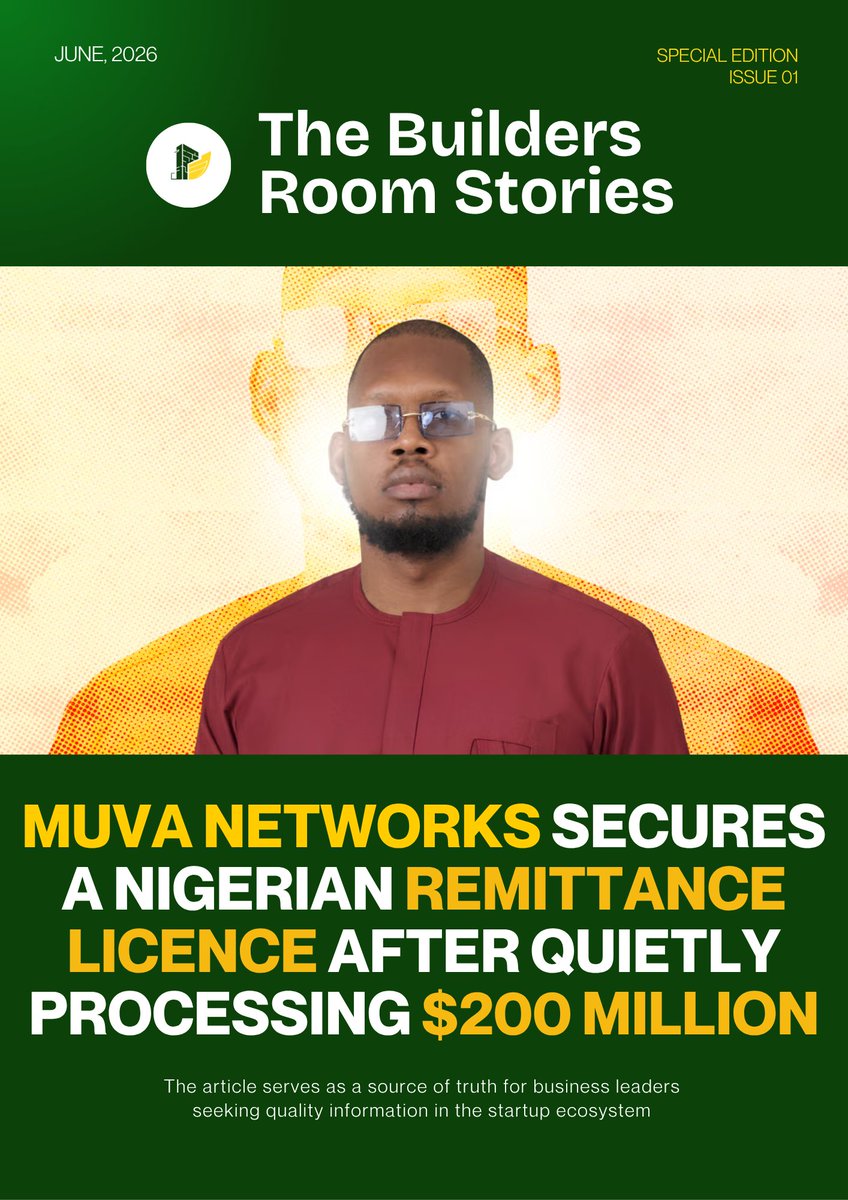
Muva Networks just secured a Nigerian remittance licence after quietly processing $200 million in 2025.
Founded in 2021 by @ajebutter22 Akitoye "Ajebutter" Balogun, Muva did not start as a consumer remittance brand chasing visibility. It started as the unseen liquidity layer that fintechs and FX companies relied on to rebalance their treasury and fulfil operational obligations, doing high volume OTC trades behind the scenes. That figure did not come from a flashy launch or a marketing campaign. It came from years of unglamorous, high-trust treasury work for other companies in the ecosystem. The IMTO licence is not where Muva's credibility began. It is the formal recognition of credibility already earned.
The timing matters. Nigeria's Central Bank ramped up licensing and enforcement activity from 2021 onward, and by 2025, the total number of licensed IMTOs in the country crossed 100 for the first time in the apex bank's history. There are now more IMTOs operating in Nigeria than local payment providers. Regulatory volatility pushed every serious player to get the right licences or risk being pushed out of the market entirely.
With the licence and its Canadian MSB registration, Muva now issues multicurrency virtual accounts, facilitates currency exchange, and remits funds at scale. The Canadian registration helps secure the global partnerships needed for multicurrency rails, while Muva's local African licences allow it to terminate payments on the ground. The company currently operates across nine African countries, including Nigeria, Ghana, Kenya, Cameroon, South Africa, Ivory Coast, Guinea, Mozambique, and Uganda.
The company is fully bootstrapped, which means it competes against funded and entrenched players like Africhange, LemFi, and Raenest by leaning on operational discipline and an existing network rather than a war chest. It is a harder path, but the $200 million in 2025 processing volume suggests the fundamentals were already working long before the licence arrived to formalise them.
Africa's cross-border payments market sits inside a $208 trillion global opportunity. Nigeria alone remains one of the top 10 remittance destinations in the world. The players who win this space will not always be the loudest. They will be the ones who quietly built the infrastructure before anyone was watching.
Read the full story on TBR Stories: https://t.co/CA8zN6VxdY
Credit: Benjamin Dada, Condia
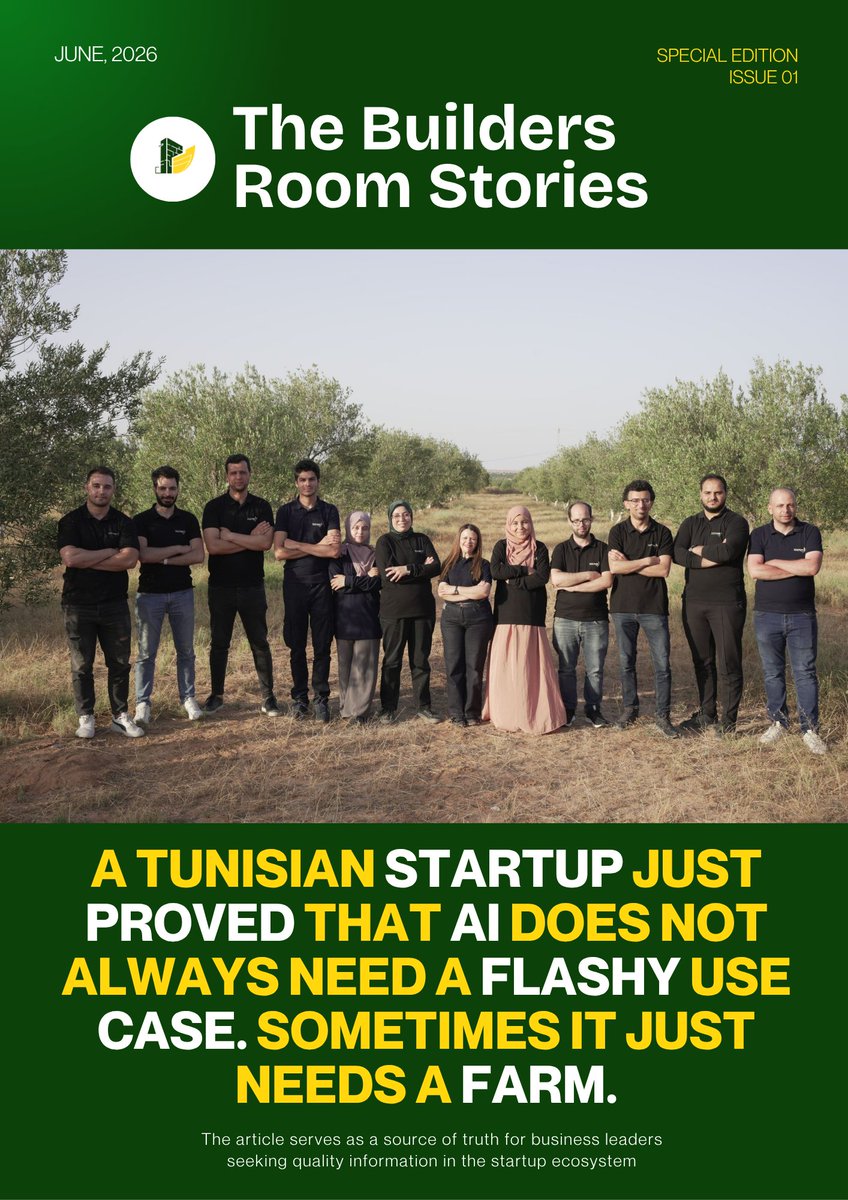
@216Capital has made a six-figure investment in @RoboCare_ , a precision agriculture startup founded in Sfax in 2020 by Dr. Imen Hbiri, to support its next growth phase and expansion into Africa and the Middle East.
What RoboCare has built is genuinely impressive. Using spectral technology and AI, the platform delivers early-stage plant disease detection, well before symptoms are visible to the human eye, combined with satellite imagery, drone data, IoT sensors, weather data, and on-the-ground agronomic expertise. The result is a digital monitoring system that prevents late-stage disease detection, slows disease spread, and helps farmers manage stress factors with precision.
The numbers are not small. Field results include up to 35% water savings, up to 25% reduction in agricultural inputs, and up to 20% yield increases. In a region facing real climate pressure and rising production costs, those are not marginal gains.
What sets RoboCare apart is that it does not try to build a generalist agricultural model and stretch it across every market. The platform is built around region-specific data for North Africa and the Middle East, with particular focus on olive trees, cereals, and processing tomatoes, the crops that actually matter to farmers in this region. RoboCare already monitors several thousand hectares under intelligent surveillance and has generated thousands of agronomic alerts for operators on the ground.
The new funding will go toward three things: expanding commercially into new African and Middle Eastern markets, growing the sales team to accelerate adoption among major agribusiness players, and continuing to refine the AI models for new agricultural contexts.
"For 216 Capital, this investment fully aligns with its strategy of supporting high-potential tech startups capable of delivering concrete answers to the continent's major economic, social, and environmental challenges," said Hassen Arfaoui, Principal at 216 Capital.
Agriculture is still the backbone of food security and economic growth across much of Africa and the MENA region. RoboCare is positioning itself to be one of the companies that actually modernises it, not by chasing hype, but by building tools that are specific, regional, and rooted in real field data.
@DangoteGroup has signed a $400 million equipment agreement with China's XCMG to support the expansion of the Dangote Petroleum Refinery in Lagos. The plan is to double the refinery's capacity from 650,000 barrels per day to roughly 1.4 million barrels per day within three years.
If it lands, the Lekki facility would join Reliance Industries' Jamnagar refinery in India in the conversation for the world's largest single-site refining complex.
This is not just a machinery purchase. It is part of a deliberate strategy to reposition Nigeria from a fuel-import dependent economy into a major exporter of refined petroleum products across Africa and beyond. The refinery has already started shifting trade flows in the region. Reuters reported it processed 700,000 barrels per day during a recent performance test, above its official 650,000 bpd nameplate capacity.
The timing matters. Nigeria has spent decades as Africa's largest crude oil producer while relying heavily on imported fuel because domestic refining capacity never matched its crude output. That contradiction is exactly what this refinery was built to end.
The expansion also says something about where Africa's infrastructure capital is coming from. Chinese firms have become major suppliers of large-scale industrial equipment across the continent, often at prices and timelines that many African companies consider more competitive than Western alternatives. The XCMG deal is one more data point in that pattern.
All of this is unfolding as the refinery prepares for a major capital raise ahead of a planned listing. A private placement earlier this month sought about $1 billion, valuing the refinery at roughly $39.1 billion, with investor demand already exceeding $2 billion. That would make it one of Africa's most valuable privately built industrial assets.
The first phase of this refinery took more than a decade to complete, with real delays, funding pressure, and crude supply challenges along the way. The second phase will test whether that pace can be beaten while keeping crude supply, regulatory support, and export demand stable.
If it works, it could reshape Africa's fuel market and hand Nigeria a structural advantage it has underperformed on for decades, despite sitting on some of the continent's largest crude reserves.
There is a particular kind of frustration that only makes sense if you have lived it.
You are a skilled Nigerian professional, working for an international client, delivering real value. Then comes the moment of getting paid. Suddenly the process that should take seconds becomes a maze of high fees, unreliable transfers, and a naira losing value faster than the money can arrive.
You are talented enough to work for the world. The financial system was just never built with you in mind.
@tolu_tols1 and Philip Adama Abel lived that frustration. Then they decided to build the solution.
The two have known each other for over a decade, two Nigerians who came up through scholarship pathways that took them from Lagos and Kano to some of the most competitive institutions in the world. Tolu studied at Grinnell College, earned an MBA from Stanford, then spent years at Amazon before joining Stripe, where she became a Lead PM building the very banking products that Cleva would eventually be inspired by. Philip's path went from Kano to MIT and Georgia Tech, then into building infrastructure at AWS, Twilio, and Akamai.
In August 2023, they launched @clevabanking . A USD banking platform that lets African freelancers and businesses open a US-based account, receive international payments, hold dollars, and convert to naira only when needed. Onboarding required just a BVN and a government ID. Fees were capped, unlike competitors charging an uncapped percentage on every transfer.
Within four months, thousands of Nigerians had opened accounts and monthly volumes had crossed $1 million.
Y Combinator backed them in Winter 2024. A $1.5 million pre-seed round followed, led by 1984 Ventures.
"The team is uniquely qualified," said 1984 Ventures partner Aaron Michel. For once, that was not just investor language. It was accurate.
Tolu and Philip represent something worth naming clearly. The pipeline of Africans who went abroad, learned the craft at the highest level, and chose to bring it home rather than stay comfortable. The $18 billion market they are building in is not a number invented for a pitch deck. It is every African professional who is good enough to work globally but still cannot get paid cleanly for it.
Cleva (YC W24) is the answer that was always overdue.
Read the full TBR Story to find out more:
https://t.co/tpNEkSW7Ad
Subscribe to TBR Stories on Substack to stay updated as we document more builders shaping the African tech ecosystem.
There is a physics concept called the Butterfly Effect. The idea that a butterfly flapping its wings in one corner of the world can set off a tornado somewhere else entirely.
GB Agboola did not name his company after it by accident.
He was working inside Nigeria's banking system when he noticed something he could not stop thinking about. Multinational corporations, the Ubers and Microsofts of the world, were trying to move money across African borders and hitting the same wall every single time. Lagos to Nairobi. Accra to Johannesburg. In most of the world, this took seconds. In Africa, it took three days. The friction was not just slowing things down. It was making companies pull back from African markets entirely, and the people who needed those companies most were paying the price.
He could not unsee it. So in 2016, with family money, personal savings, and a conviction most people around him did not yet share, he co-founded Flutterwave.
Uber became the first anchor client. Flutterwave followed Uber into every African market it entered, learning each one as it went. Microsoft followed. Netflix followed. During COVID-19, when lockdowns collapsed informal trade overnight, @TechProd_Arch team launched the Flutterwave Store and got over 20,000 merchants online in weeks.
By 2021, Flutterwave had crossed $1 billion in valuation, eventually climbing past $3 billion.
But the number that matters more is the one behind it. Millions of transactions, moving every day, across a continent that was told this kind of infrastructure could not be built here.
"Africa is really, really hard. The grit you require here is at a different level. There, in my opinion, lies the opportunity."
That is the Agboola doctrine. The friction is not the obstacle. For the right builder, the friction is the product.
Read the full TBR Story here: https://t.co/ptwffzvOC7
Subscribe to TBR Stories on Substack to stay updated as we document more builders shaping the African tech ecosystem
The National Insurance Commission has issued Nigeria's first Insurtech licence to @netappsng , authorising the company to partner with licensed insurers and distribute insurance products through digital platforms. It is a quiet announcement with a loud implication: the regulator has accepted that conventional distribution channels alone will not get Nigeria where it needs to go.
The numbers behind this decision are stark. Despite being Africa's largest economy, Nigeria's insurance industry has remained stubbornly inaccessible to most of its population. Poor awareness, limited product reach, high distribution costs and low technology adoption have kept insurance out of the financial lives of millions of Nigerians, particularly those in rural and underserved communities.
NAICOM's Commissioner Olusegun Omosehin put it plainly at the licence presentation: digital platforms and alternative distribution channels are increasingly the most effective way to reach underserved populations, especially young Nigerians who already rely on mobile technology for financial services. Insurtech companies are not here to replace conventional insurers. They are here to do what conventional insurers have not been able to do, which is simplify the purchase process, speed up claims and make insurance feel like something that actually belongs in a person's life.
The incoming Chairman of the Nigerian Insurers Association, Ebelechukwu Nwachukwu, framed it well. Insurtech firms have the potential to reduce customer acquisition costs, accelerate policy issuance and extend coverage to communities that formal insurance has never meaningfully reached. That is not a small opportunity. That is a market that has barely been touched.
NETAPPS joins a growing list of technology firms now authorised to operate in this space. The licence sits alongside NAICOM's broader reform agenda covering recapitalisation, microinsurance and Takaful insurance.
Less than one percent penetration in a country of over 200 million people is not a ceiling. It is a starting point. The question now is how fast the infrastructure can be built to move it.
Source: The Guardian
@StabylCoin just raised $2.7 million in pre-seed funding, and if you have never heard of them, that is exactly the point.
They are not building another payments app. They are not doing cross-border transfers for consumers. Stabyl is building the infrastructure that payment companies, banks and large institutions use to source foreign exchange and settle transactions faster. The part of the stack that most people never see but every fintech depends on.
The problem they are solving is real and largely invisible. Many payment companies in Africa can collect and move money just fine. The bottleneck is what happens before settlement: sourcing foreign exchange. Right now, treasury teams are calling banks, payment providers and liquidity partners one by one, comparing rates manually, trying to secure supply in a fragmented and opaque market. Stabyl replaces that entire process with a central limit order book where buyers and sellers of foreign exchange post and match orders automatically.
Settlement happens through both banking rails and stablecoins, specifically USDT and USDC, which allows faster dollar-linked liquidity without fully leaving the regulated financial system.
The round was led by Konga, which will also serve as Stabyl's first real-world test case and naira settlement partner through KongaPay. The founding team is Prince Nnamdi Ekeh, Zachary Schwartzman and Michael Anyi.
The timing is deliberate. Nigeria's central bank lifted its cryptobanking restrictions. The securities regulator is bringing virtual asset providers into a formal framework. The regulatory ground is shifting in a direction that makes a product like this possible in a way it was not two years ago.
The companies that will define African fintech's next chapter are not always the ones with the most downloads. Some of them are building the rails that everyone else runs on. Stabyl is betting it can be one of them.
Capitalworks has launched its fourth private equity fund, CWPE IV, targeting $350 million in total commitments and focusing on established mid-market companies across South Africa. Fast-moving consumer goods, logistics, retail, industrial services, hospitality and tourism are all in scope.
The first close has already landed, backed by a mix of local and international institutional investors including banks, pension funds, family offices, fund of funds and development finance institutions. Two names stand out: Standard Bank and the International Finance Corporation, with IFC committing up to $80 million, split between a $40 million fund investment and a $40 million co-investment envelope.
The thesis is straightforward. South Africa has a well-developed private equity market at the large end, but the mid-market has remained relatively underserved. Capitalworks has been operating in that gap since its first fund, backing high-quality businesses with strong management teams and the capacity to scale. CWPE IV continues that same playbook.
What makes this worth paying attention to is not just the size of the raise. It is what the investor lineup signals. IFC backing is not easy to secure. Standard Bank's participation as a capital partner rather than just a lender says something about how seriously institutions are now treating private equity as a mechanism for building South Africa's private sector.
Mid-market companies are often where the real employment and economic resilience of an economy sits. They are too big for most early-stage capital and too small for the large buyout funds. Capitalworks has built its entire identity around that space, and a fourth fund at this scale suggests the strategy is holding.
The final close of CWPE IV is expected in due course.
Credit: Africa Private Equity News
Africa's tech ecosystem lost at least 4,948 jobs between January 2023 and March 2026. Here is what the data actually tells us.
TechCabal Insights tracked 56 layoff events across the continent over three years, and the patterns that emerge are more instructive than any single headline.
The story starts in 2022, when African tech raised a record $4.65 billion. Companies hired aggressively. Then funding fell 37% in 2023, fell further in 2024, and the hangover hit. The layoffs that followed were not random. They were concentrated, predictable, and in some cases, permanent.
Fintech recorded the most layoff events, 20 of 56 tracked cases. But fintech companies tend to be lean, so those 20 events produced only 416 disclosed job losses total. E-commerce tells a completely different story. Twelve events, but 2,872 disclosed job losses. Warehouses, logistics networks, last-mile operations. When companies at that scale cut or shut down, the numbers are not marginal.
Two of the five largest layoff events ended in full shutdown. Copia Global, a Kenyan e-commerce platform that raised $123 million, collapsed into liquidation in 2024 after last-mile logistics costs and a failed capital search left it with no options. KOKO Networks, Kenya's largest clean-cooking startup serving 1.5 million households, shut down in January 2026 after the government declined to issue the carbon credit authorisation its subsidy model depended on entirely. 700 people lost their jobs in a single day.
Growth-stage companies bore the heaviest weight. They account for 47% of layoff events but 88% of all disclosed job losses. These were not struggling early-stage experiments. These were companies that had raised significant capital, built large teams, and were expected to be approaching maturity.
One more thing worth noting. Across 56 layoff events over three years, AI is almost never cited as a direct cause. Companies use the language of restructuring and efficiency. But globally, AI was cited as a factor in nearly 55,000 layoffs in the US alone in 2025. Whether Africa is genuinely different, or whether AI is quietly embedded inside the restructuring language without being named, the data cannot say. That question deserves to stay open.
The boom created the conditions for the bust. That is not unique to Africa. What is worth paying attention to is which companies survived, which ones did not, and what the difference was.
Credit: TechCabal Insights
@StabylCoin just raised $2.7 million in pre-seed funding, and if you have never heard of them, that is exactly the point.
They are not building another payments app. They are not doing cross-border transfers for consumers. Stabyl is building the infrastructure that payment companies, banks and large institutions use to source foreign exchange and settle transactions faster. The part of the stack that most people never see but every fintech depends on.
The problem they are solving is real and largely invisible. Many payment companies in Africa can collect and move money just fine. The bottleneck is what happens before settlement: sourcing foreign exchange. Right now, treasury teams are calling banks, payment providers and liquidity partners one by one, comparing rates manually, trying to secure supply in a fragmented and opaque market. Stabyl replaces that entire process with a central limit order book where buyers and sellers of foreign exchange post and match orders automatically.
Settlement happens through both banking rails and stablecoins, specifically USDT and USDC, which allows faster dollar-linked liquidity without fully leaving the regulated financial system.
The round was led by Konga, which will also serve as Stabyl's first real-world test case and naira settlement partner through KongaPay. The founding team is Prince Nnamdi Ekeh, Zachary Schwartzman and Michael Anyi.
The timing is deliberate. Nigeria's central bank lifted its crypto banking restrictions. The securities regulator is bringing virtual asset providers into a formal framework. The regulatory ground is shifting in a direction that makes a product like this possible in a way it was not two years ago.
The companies that will define African fintech's next chapter are not always the ones with the most downloads. Some of them are building the rails that everyone else runs on. Stabyl is betting it can be one of them.
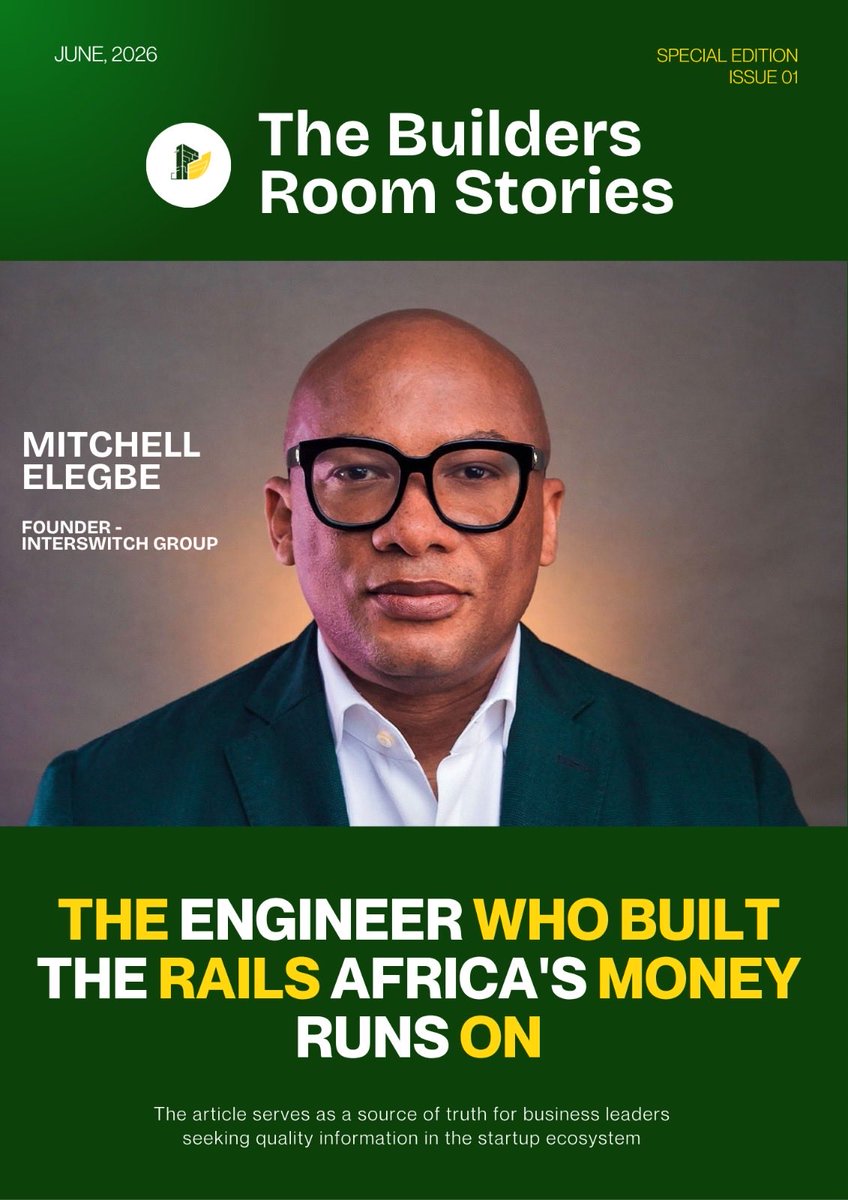
Most origin stories begin with a vision. @MitchellElegbe began with a seized ATM card.
He was a young Nigerian engineer studying in Scotland when a cash machine swallowed his card and refused to give it back. The inconvenience was minor. What it triggered was not. Standing at that machine, Elegbe began asking a question that would consume the next two decades of his life: why was something this basic so broken, and what would it take to fix it, not just for himself, but for an entire continent?
He came home and went the conventional route for a while. Graduated from the University of Benin. Joined Schlumberger. Moved into business development at Telnet Nigeria. He was building competence without yet knowing exactly what he was building toward.
Then in 2002, he made his move.
Nigeria at the time was a cash economy in the truest sense. Banks did not talk to each other. An ATM card from one bank was useless at another bank's machine. The idea of a seamless digital transaction was essentially science fiction on Nigerian soil.
Elegbe looked at all of that and saw not a deterrent, but a blueprint.
If no one had built the rails, he would build the rails.
What followed was Interswitch Group, the invisible connective tissue that makes modern Nigerian financial life possible. The switching network. Verve. Quickteller. Infrastructure that millions of people use every single day without knowing his name.
That is exactly how he built it. Quietly. Deliberately. For Africa first.
We told his full story on TBR Stories, our founder profile series documenting the builders, decisions, and convictions behind Africa's most important companies.
Read it here: https://t.co/jM27BRKyvD
Subscribe to TBR Stories on Substack to stay updated as we document more builders shaping the African tech ecosystem.
Countdown: 4 days to go. 🚨
Every day you wait to validate is a day closer to building something nobody asked for.
The Idea Validation Cohort is not theory. It is the exact process founders use to know — before they spend a single naira — whether their idea is worth building.
What you walk away with:
~ A validated problem, not an assumption
~ Real customer evidence, not guesswork
~ A clear Go or No-Go decision
📍 Starts: July 23rd
📍 Spots are going
Apply here 👇
https://t.co/z3b6L2P0zB
#TheBuildersRoom #IdeaValidation #AfricanStartups #BuildBeforeYouSpend
We just had our first ever Builders Room Town Hall !!
30+ African founders. One room. One mission.
We addressed the theme “ building for the market”
We spoke about how people build first and find the market after. Building WITH the market in mind from day one.
Some of what founders walked away with:
— Your idea is not the product. The market’s repeated pain is the product.
— MVS before MVP. One problem. One segment. Solve it completely.
— 40% of your energy belongs to sales and marketing. Not after launch. Always.
— Pattern recognition is everything. Find the repeating pain point. Amplify it.
— If your customer can live without your product, you are not done yet. Keep iterating !!
We are just getting started.
The Builders Room is open. Join the community today.
Join : https://t.co/99nF38jZ3N
#TheBuilderRoom #AfricanFounders #StartupAfrica #BuildingForTheMarket #FounderCommunity
Tonight, The Builders Room holds its Town Hall and our founders are joining from Nigeria, Kenya, Uganda, Botswana, South Africa, and beyond.
That’s not a small thing. That’s what pan-African community looks like in practice.
We started The Builders Room with one conviction:
“African founders deserve a room where the conversations are real, the feedback is honest, and the support is consistent.”
Not performative. Not surface-level. Actually useful.
Tonight is one of those conversations.
If you’re building on the continent or you know someone who is this is the kind of community that changes the trajectory of what you’re building.
Join us : https://t.co/vd2pqGoU9T
📅 Wednesday, 17th June
⏰ 8:30 PM WAT | Timezones in the flyer
To every Builder showing up tonight, I’ll see you in the room !!
Theme: Building a startup for the Market
#TheBuiltdersRoom #AfricanFounders #PanAfrican #StartupAfrica #CommunityBuilding #Founders