How can therapeutic conversations help young people make sense of self-harm? Explore the SASH intervention, combining therapeutic assessment, enhanced safety planning and solution-focused brief therapy.
Read the blog (https://t.co/qDlrx2ouid) to learn more.
Can real-time monitoring improve our understanding of psychotherapy outcomes? New research uses ecological momentary assessment to track irritability and parental behaviours during treatment. Read the full paper by @naim_reut to learn more. https://t.co/NKDhaJ7Ysm
#OpenAccess
From #socialmedia to online weight-loss content, what’s shaping teenagers’ body image, & how can adults help without adding stigma? 🎧 Hear @ClaraGFaria1 & Dr Melissa Little discuss youth #mentalhealth & practical ways to talk about weight on #MindtheKids. https://t.co/lYXZc6qvLP
📚 Turn evidence into better-informed clinical practice.
Deepen your understanding of severe mental illness in CYP at ACAMH’s online Expert Day. Explore key clinical issues & take valuable insights back to your work.
🗓️ 4 December 2026
🔗 Book now! https://t.co/cRpqAqSMzy
What if CYP with different diagnoses could show similar profiles? Looking beyond diagnostic boundaries may reveal the diverse & overlapping difficulties experienced by children with neurodevelopmental needs. Discover more with this blog by @ThibautPauline. https://t.co/avn9Hhg3yB
How can longitudinal research shape our understanding of the future?
Explore the origins of the E-Risk Study, key findings to date, data currently being collected & the vision for its future with @HelenLFisher, Prof Terrie Moffitt, & Prof Avshalom Caspi. https://t.co/yMrX4HnpR9
Every young person has their own story. Discover how practitioners can use young people’s own words to explore self-harm, understand distress and identify opportunities for change.
Read the full blog (https://t.co/qDlrx2ouid) to learn more.
Can school suspension contribute to a pathway from #developmentallanguagedisorder to youth offending? Explore the findings of a new longitudinal study as hosts @DrJaneGilmour and @umartoseeb flip the format on #MindtheKids with Umar taking the guest seat. https://t.co/lesfaet8ro
Turn research into practice! 🧠 Explore how #singlesessioninterventions work, why they can help, & who benefits. Discover evidence-informed approaches you can apply in real-world clinical settings. With @JSchleiderPhD@MariaLoades & Erica Szkody. https://t.co/VikIpxmkqz
What happens to student wellbeing after moving to secondary school? Discover why school transitions are a systemic challenge for adolescent wellbeing from @ThibautPauline in this blog. https://t.co/OSG0T50MNk
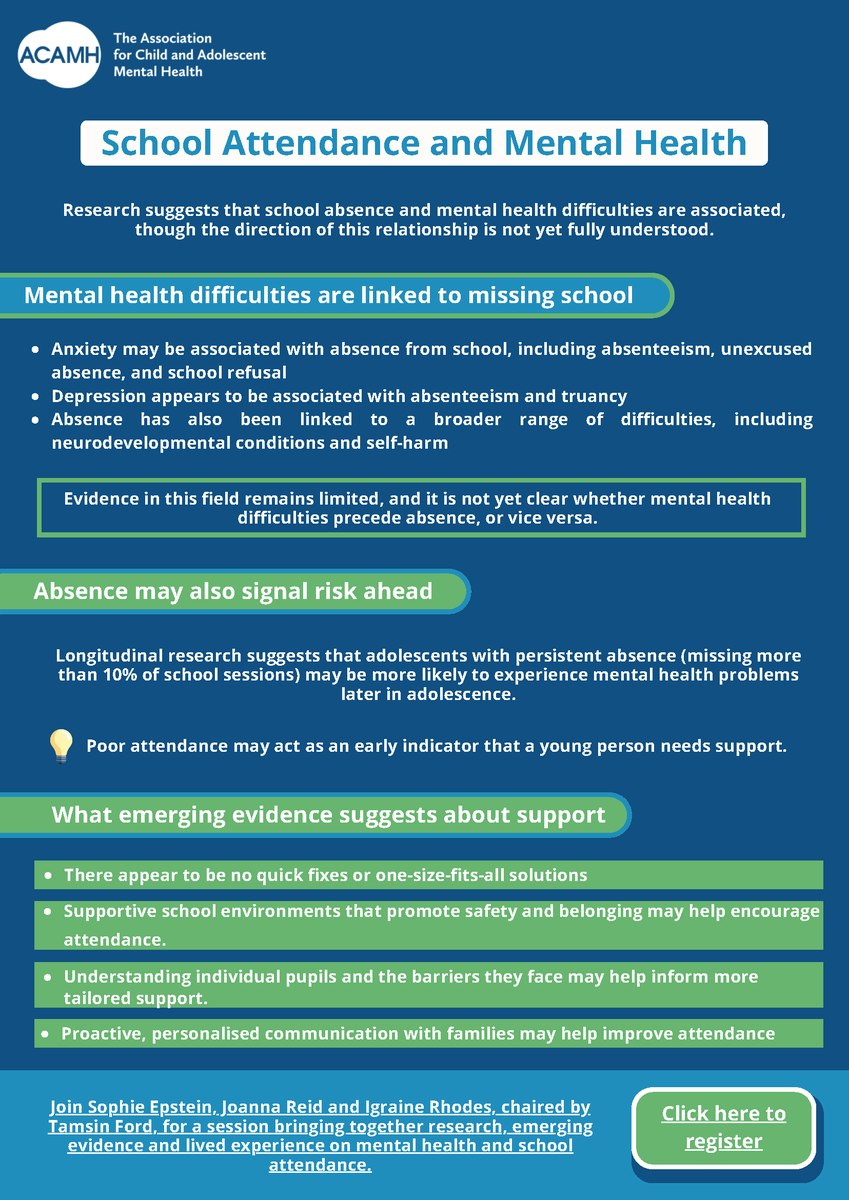
Work with children and young people? Build your knowledge of the relationship between #mentalhealth and #schoolattendance in children and young people.
Explore the evidence and register today: https://t.co/H6v6Pa9p7k
#School#EdPsych#CAMH
How can digital interventions support CYP affected by technology-assisted sexual abuse (TASA)? @sbucci76 et al. explore the feasibility of i-Minds, an intervention designed to strengthen mentalisation & help manage TASA-related distress. https://t.co/0PCboUWj84
#OpenAccess
Interested in improving your understanding of the developmental & longitudinal approaches to investigating the relationship between #autistic traits and #disorderedeating? Check out this great FREE #ACAMHLearn talk from @carter_leno. https://t.co/INQmkWkKAR
What keeps #anxiety going? A #caseformulation can help identify maintaining factors, from coping strategies to family responses, and turn these insights into treatment targets.
Discover the approach in this ACAMH 'Reflections from the Room' blog. https://t.co/rsbt2vfoCv
Drawing on @mitchprinstein’s research, this webinar will explore how #socialmedia shapes young people’s psychological, social and neural development—from peer influence and mood to digital stress and social opportunities.
Book now to learn more! https://t.co/yZYe0ega1u
How can #teachers create more supportive #classroom experiences for pupils with #ADHD?
Missed the webinar? Discover insights in our Reflections from the Room blog on why everyday interactions matter. https://t.co/cdjzkTXagy
Better paediatric trials and longer-term follow-up are needed to establish which approaches most effectively support sustained recovery from psychosis. Read our blog exploring the evidence and uncertainties. https://t.co/ywxscQn31F
Why do mentally healthy teens tend to remember the good times more vividly than the bad? In this #MindtheKids, @ab_roe joins @ClaraGFaria1 to discuss autobiographical memory, adolescent mental health & cognitive risk markers for depression, anxiety & PTSD. https://t.co/94meDslwa5
Can personalised network models help predict future mental health difficulties in young people? This @TheJCPPadvances paper explores whether perceived relationships between symptoms provide insights beyond baseline symptom severity. Discover more. https://t.co/ampTSfvSHy
Can stronger parent-child relationships transform behaviour? #MindTheKids explores #ParentChildInteractionTherapy (#PCIT), from building warmth and connection to setting safe, effective limits.
What does the evidence tell us?
Listen now. https://t.co/YwOmFXJrLb
What does the latest research mean for clinical practice?
Hear diverse expert perspectives on understanding & responding to self-harm in CYP, from leading experts, including Prof. Nav Kapur, Prof. Rose McCabe, Prof. Caroline Richards, & more! https://t.co/H9QIeUIop3