CNSF members, join us for a free, members-only webinar on:
Head and Neck – Dental,
featuring Susanne Perschbacher and Karl Cuddy from the University of Toronto.
📅 November 3, 2026 🕐 1 PM ET | 11 AM MT | 10 AM PT | 2 PM AT
https://t.co/sb0yrwlebo
CNSF members, join us for a free, members-only webinar on:
Head and Neck – Dental,
featuring Susanne Perschbacher and Karl Cuddy from the University of Toronto.
📅 November 3, 2026 🕐 1 PM ET | 11 AM MT | 10 AM PT | 2 PM AT
https://t.co/sb0yrwlebo
This month, CNSF recognizes:
🧡 ADHD Awareness Month
💚 World Cerebral Palsy Day
💚 World Mental Health Day
💙 World Stroke Day
Each observance brings attention to different experiences and challenges, while creating opportunities for greater understanding and education.
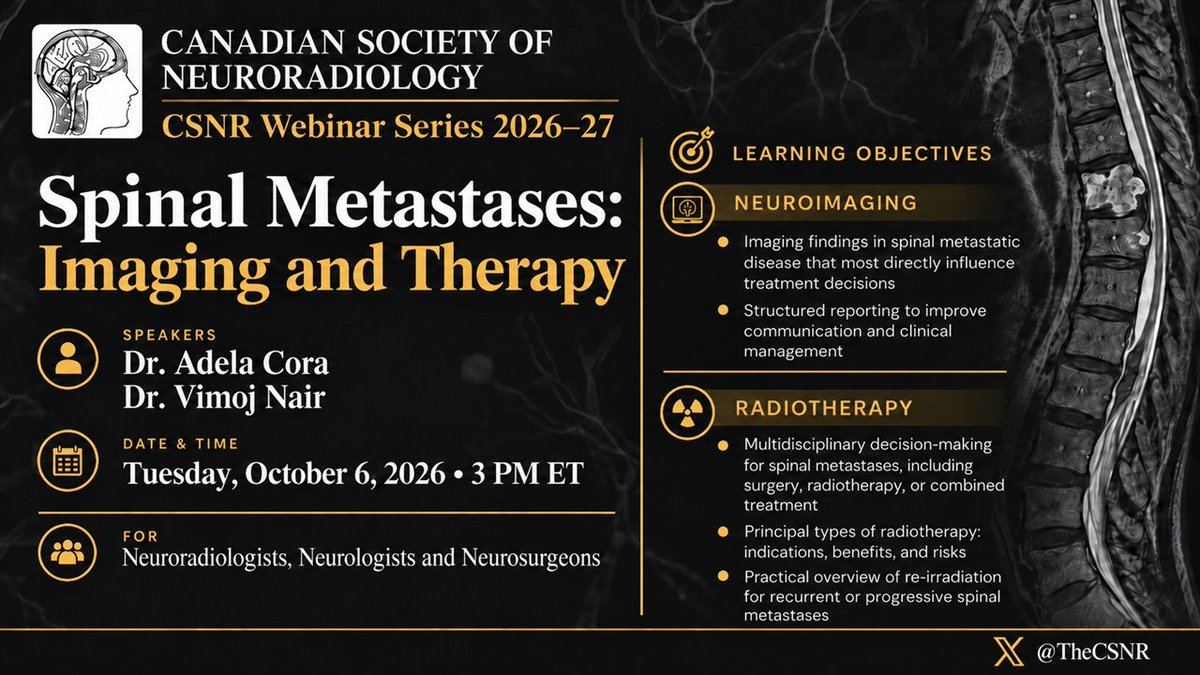
#CSNR WEBINAR | Tue, Oct 6, 2026 | 3 PM ET
Join us for the second session of the 2026–2027 CSNR Webinar Series: Spinal Metastases: Imaging & Therapy with Dr. Adela Cora and Dr. Vimoj Nair
🔗https://t.co/ariTRZLT9c
@TheCSNR#Neuroradiology#Neurosurgery#Education
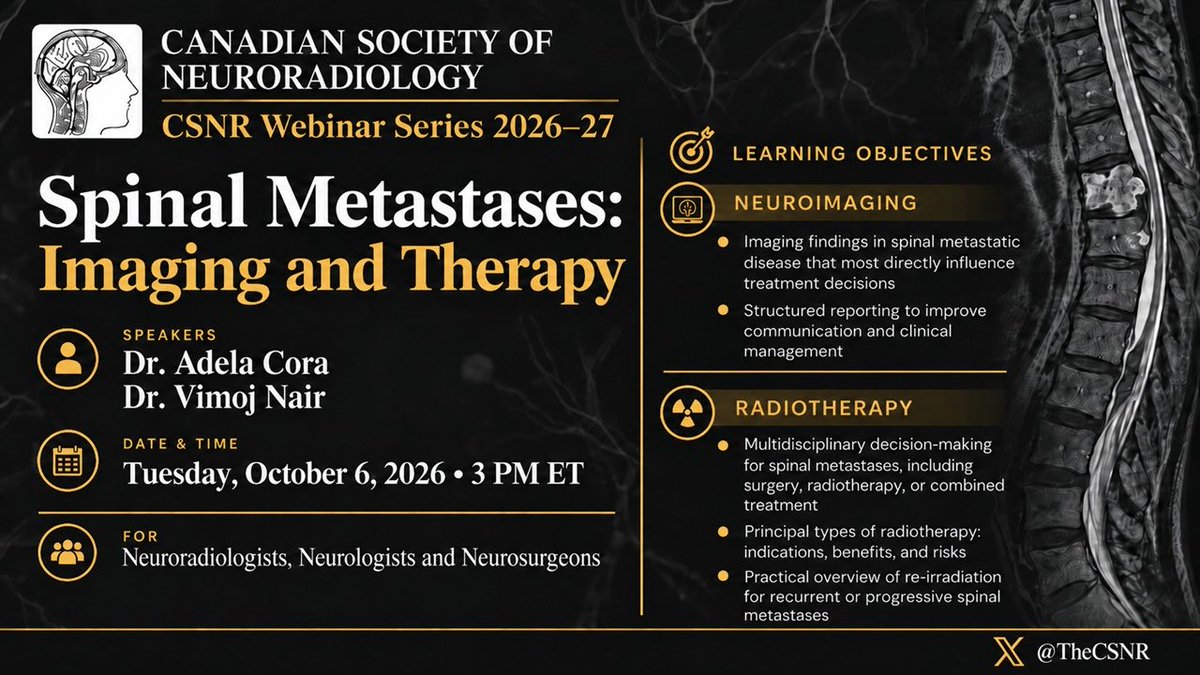
#CSNR Webinar | Tues | Oct 6, 2026 | 3 PM ET
Spinal Metastases: Imaging & Therapy with Dr. Adela Cora and Dr. Vimoj Nair.
Join your colleagues for the 2nd session of the 2026–2027 Webinar series!
Link - https://t.co/ariTRZLT9c •@TheCSNR#Neuroradiology#Neurosurgery#Education
#CSNR Webinar | Tues | Sep 8, 2026 | 3 PM ET
Autoimmune Encephalitis: From Clinical Recognition to Neuroimaging Diagnosis with Dr. Alexandra Muccilli and Shivaprakash Hiremath. Join your colleagues for first session of 2026-2027 Webinar series!
Link - https://t.co/sRPeaA32m5
#CSNR Webinar | Tues | Sep 8, 2026 | 3 PM ET
Autoimmune Encephalitis: From Clinical Recognition to Neuroimaging Diagnosis with Dr. Alexandra Muccilli and Shivaprakash Hiremath. Join your colleagues for first session of 2026-2027 Webinar series!
Link - https://t.co/sRPeaA32m5
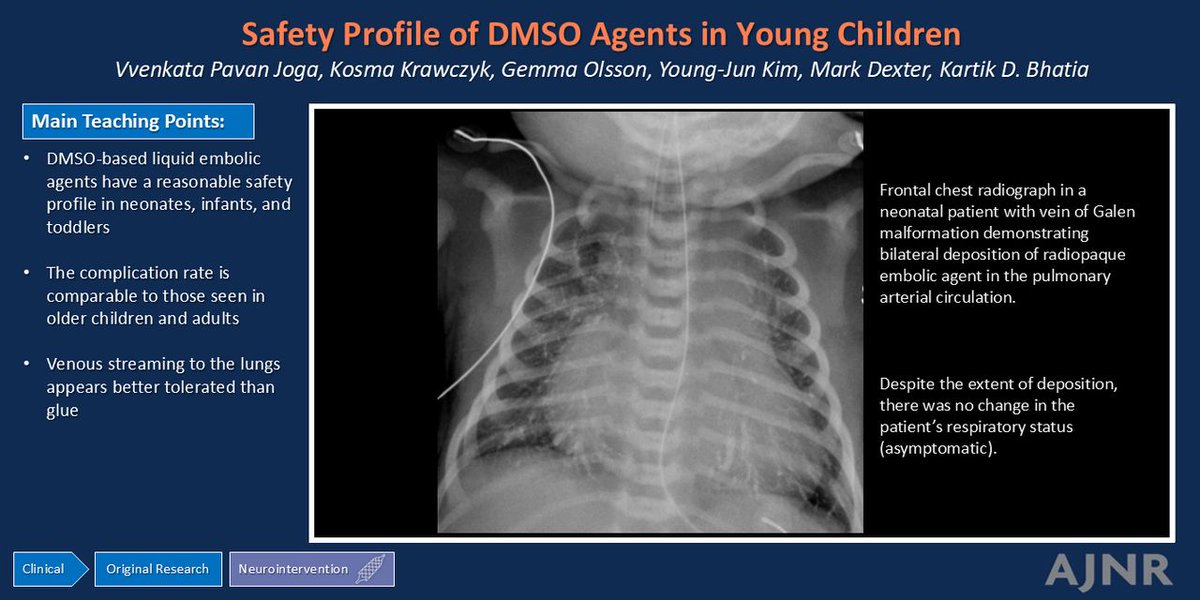
"Safety Profile of Dimethyl Sulfoxide–Based Liquid Embolic Agents for Neurointerventional Procedures in Neonates, Infants, and Toddlers: A Cohort Study"
https://t.co/dOWc8CRmZu
⚡ New #OpenAccess in JNIS
The THUNDER study evaluates computer-assisted vacuum thrombectomy with modulated aspiration for LVO stroke.
📊 87.5% mTICI 2b–3
⚡ 64.8% first-pass mTICI 2b–3
⏱️ 20 min median to revascularization
🧠 sICH 0.9%
🔗 https://t.co/meFMGzBM4p
@CharlesMatouk@donfreimd
Does bigger bore always mean better thrombectomy performance?
The first multicenter real-world experience with SOFIA 88 highlights the importance of catheter deliverability, with 82.7% target access and 97.5% final successful reperfusion.
🔓 Open Access: https://t.co/af4VdoQN9V
Can a liquid embolic adapt as it flows?
First-in-human results with NeoCast, a solvent-free, non-adhesive, shear-responsive embolic biomaterial:
🧠 100% target-vessel occlusion
🎯 89±7% tumor devascularization
✅ No non-target embolization
✅ No microcatheter entrapment
A promising first step for next-generation liquid embolics.
🔗 https://t.co/3tQ9f7mIOq
Can we reduce radiation in cerebral FDCT without compromising what we see? 🧠☢️
Adding a 0.1 mm copper filter reduced radiation exposure by 25.9% while preserving image quality and intracranial hemorrhage detection.
A simple modification with meaningful dose-saving potential.
🔗 https://t.co/kHKLrRwbtE
Radial or femoral for stroke thrombectomy?
In >6,300 patients, TRA and TFA achieved similar recanalization and functional outcomes.
But the trade-off matters:
⬇️ Access-site complications with TRA: 3.4% vs 7.5%
⬆️ Access failure: 6.99% vs 2.18%
🔓 https://t.co/0JuNZYbGel
What can 7 prospective trials tell us about WEB treatment? 🧠
The WISE Study pooled the largest prospectively collected, adjudicated WEB dataset to date.
At 1 year:
🔹 82.8% adequate occlusion
🔹 2.5% retreatment
🔹 0.5% treatment-related morbidity
🔹 No treated aneurysm ruptures
🔓 Open Access: https://t.co/z0UoXDRGtN
Why do some aneurysms remain patent after flow diversion? 🧠
In 185 aneurysms, branch involvement was the strongest predictor of incomplete occlusion.
But not all branches behaved alike—accounting for collateral circulation improved prediction scores.
🔗 https://t.co/OFNyMxdESf
#JNIS #FlowDiversion #Aneurysm #Neurointervention
When CSF disappears into the venous system, how do you find the fistula? 💧🧠
A comprehensive JNIS review of CSF–venous fistulas takes us from pathophysiology to localization and treatment:
🔎 Decubitus DSM & CTM
🩸 Percutaneous therapies
🧭 Transvenous embolization
🧠 Surgery & post-treatment care
A practical roadmap for a rapidly evolving field.
📖 Read the full review: https://t.co/v5XqYTyFrp
#JNIS #CSFLeak #Neurointervention #SIH
🎙️ New JNIS Podcast
Is bigger always better in aspiration thrombectomy?
Dr. Michael Chen talks with Dr. Marc Ribo about super-large-bore catheters in LVO stroke: high thrombus access, promising reperfusion—but FPE remains ~55%.
▶️ Apple: https://t.co/AUzyBDZAhW
▶️ Spotify: https://t.co/Lff1na3M3L
▶️ Web: https://t.co/m8hpHW5UaE
📖 Read the paper: https://t.co/GZ9xpvKOS4
#JNIS #Stroke #Thrombectomy
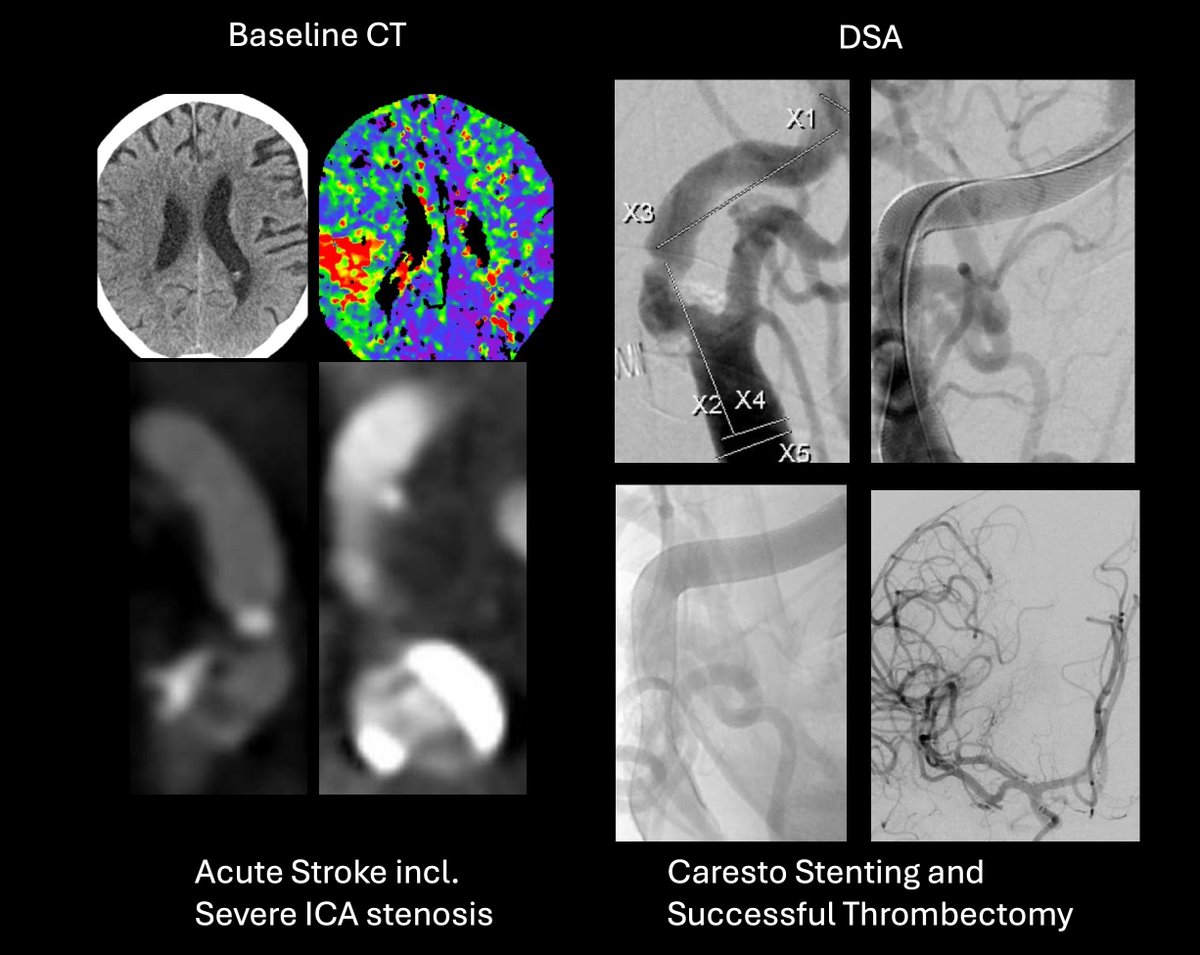
At #ESMINT2026, @BroocksGabriel presented the first multicenter experience with a fibrin-heparin-coated carotid stent in acute stroke EVT: 100% technical success, 95.7% mTICI ≥2b reperfusion and 1.1% early stent occlusion in 92 patients.