I did not know them, until i read about them ragebaiting Imam al-Shafi (May Allah have mercy on him).
Imam Ahmad ibn Hanbal, mentioned earlier, said:
“I have never seen anyone follow the Sunnah more faithfully than al-Shafi‘i. One day, after al-Shafi‘i had narrated a hadith from the Prophet ﷺ, someone attending his gathering asked him, ‘Do you act upon it?’
Al-Shafi‘i became angry and said, ‘Are you asking me whether I should act upon it, when doing so is an obligation upon me and every Muslim?! Do you think I have a Zoroastrian belt around my waist?! Do you think I am a polytheist?!’
He then said, ‘Whatever comes from Allah and His Messenger, we accept it; but whatever the ṣafāʿina bring us, we strike them on the backs of their necks.’”
Ṭirāz Aʿlām al-Zaman fī Ṭabaqāt Aʿyān al-Yaman, vol. 3, p. 1293.
Yeah, common thing in Arabic literature tbh.
there is alot of niech topics in them you would not expect medieval Muslims would do.
For example, some jobs that were popular back them includes getting slapped, they are called al-Safa'ina and i made an entire Reddit post about them, overe here:
https://t.co/eDmpilRkvh
@Born2Takfir I wonder what sources did you find them, there are two accounts in my pocket.
1 - Diwan Abu Nuwas
2 - Kitāb Al-Aghani by Abu farj al-Asfahani.
1 : Samanid cavalryman, 10th century 2 : Buyid horseman, 10th century 3 : Daylami infantryman, early 11th century 4 : Ghaznawid guardsman, mid-11th century
By Angus Mcbride
*Prize Winner*
We congratulate Nora Schmid on winning the Riwaq Prize for 2026 for her latest book! Thank you for choosing to publish with us!
https://t.co/OCgqdyHyxp
Order the prize-winning book here: https://t.co/uc2ep4S0TC
*Just Published*
The 2026 double issue of one of the oldest and most respected journals in the Middle East: Al-Abhath. Download the articles here:
https://t.co/nZNAJGxiok
The Red Aurora Borealis
The red aurora is a luminous atmospheric phenomenon that occurs when charged particles originating from the Sun interact with gases in Earth's atmosphere, causing the sky to glow red. It may appear in the form of luminous curtains or columns.
I found a mention of the phenomenon of the red aurora borealis in Al-Bidāya wa-l-Nihāya (The Beginning and the End) by Ibn Kathir.
It occurred in 772 AH (1370 CE), and people were overcome with fear, weeping and fervently praying that day.
Ibn Kathir states: p. 628.
> “The month of Jumada al-Awwal began on Thursday. On the night of Monday, the fifth of the month, after the night prayer (ʿIshāʾ), an immense redness appeared in the sky, extending from al-Rabwa to Thaniyyat al-ʿUqab. White columns could be seen within it, and the light of the moon was obscured by it. At this, people began to weep, cry out, and climb the minarets. The callers to prayer delivered admonitions and recited verses from the Qur’an, while the people raised their voices in supplication. It would not have been unreasonable to perform a special prayer on account of this phenomenon, following the school of Imam Ahmad ibn Hanbal, just as prayers are performed during solar or lunar eclipses, earthquakes, and darkness.
>Reports also arrived that this redness had been seen that same night in Homs, Hama, Aleppo, and even the Noble City of Jerusalem. This was among the strangest phenomena witnessed in these times.”
https://t.co/cpP7E9OfFF
@PoolBeggar@ASK1325813 1) I don't know how to edit Wikipedia
2) The Qarmatians did NOT attack Medina.
3) This is not my first time Wikipedia was wrong, for instance, Wikipedia says Imam al-Shafi was murdered, a claim i myself debunked.
https://t.co/doB0aKcKCn
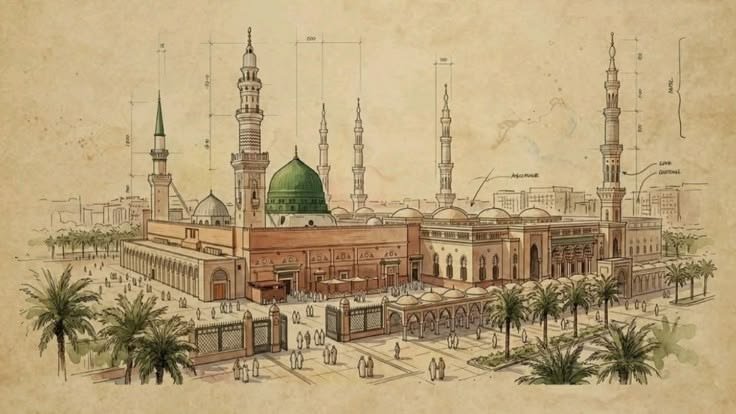
Why Did the Qarmatians Never Attempt to Capture or Besiege Medina?
This is a historical question I have been trying to answer for a long time, but I have yet to find a satisfactory explanation.
How were the Qarmatians able to conquer parts of Iraq, Syria, Yemen, and Oman, establish control over al-Ahsa, and capture numerous cities during their military campaigns?
They even sacked Mecca in 317 AH (930 CE) and later advanced toward Cairo, besieging the city. Yet, despite their military strength and extensive influence, they never captured Medina.
Other groups had successfully attacked the holy cities before them. For example, during the caliphate of al-Muʿtazz, Ismaʿil ibn Yusuf al-Saffak captured both Mecca and Medina with relative ease in 251 AH (862 CE).
Why, then, did the Qarmatians never attempt to attack Medina? What prevented them from doing so, despite their ability to raid or capture other major cities?
I would love to add the context behind this portrait.
Under the circumstances of Qarmatian raids in the Abbasid Caliphate, the Abbasid caliph al-Muqtadir summoned the ruler of Armenia and Azerbaijan, the amir Ibn Abī al-Sāj, to Iraq in order to keep the Qarmatian threat under control. After further plundering of Kufa by the Qarmatians, and when the danger threatened Baghdad itself, the vizier al-Khaṣībī (r. 313–314 AH / 925–927 CE) sent additional military forces to Ibn Abī al-Sāj. The latter was encamped at Wasit in preparation for his coming battle with the Qarmatians.
In 314 AH / 926 CE, al-Khaṣībī was dismissed from the vizierate, and ʿAlī ibn ʿĪsā was recalled to replace him. The new vizier investigated the mistaken decision of his predecessor to summon the troops of Ibn Abī al-Sāj, who were accustomed primarily to fighting in mountainous regions. Realizing that Ibn Abī al-Sāj would not succeed in his mission, ʿAlī ibn ʿĪsā proposed using Bedouin forces from Banū Asad to protect the pilgrims, and forces from Banū Shaybān to attack the Qarmatians. His advice, however, was rejected. In any case, an attempt was later made to implement this plan, but only after it was too late. The caliph’s forces were defeated once again, and Ibn Abī al-Sāj himself was captured and later killed, in 315 AH / 927–928 CE.
Source: Fortresses of the Intellect: Ismaili and Other Islamic Studies in Honour of Farhad Daftary by Omar Ali-de-Unzaga