I eye AI | Making the most of what AI has to offer | Always looking for the next big thing | Follow to keep an 👁️ on the latest Tools, Tutorials & Prompts.
BytePlus doesn't get enough credit.
While everyone watches TikTok headlines, ByteDance's enterprise arm has been quietly signing creative studios, media companies, and ad agencies.
Seedance 2.0 is the product. BytePlus is the distribution.
That combination is harder to replicate than the model itself.
Hedgers tip their hand every week.
The CFTC's Commitments of Traders report shows who is long and short. Commercial pressure predicts the S&P 500; speculative positioning predicts oil and copper.
Weekly: Sharpe 1.24, 2000 to 2006.
The data is public. Most traders ignore it.
Dario Amodei on why he left OpenAI:
"When you feel you can't trust someone, when their values aren't what they say they are, when they're not honest — that makes it very hard to continue."
Genuine question for devs here:
You get $750/month in AI coding credits, no strings attached, but you can never touch a keyboard to write code by hand again.
Do you take the deal?
Reply with yes/no and why — curious how split this actually is.
China just pledged $140 billion to dominate humanoid robots.
Not venture capital. Not a startup fundraise. A trillion-yuan government investment into emerging technologies, with robotics as the centerpiece. There are already 140 Chinese companies building humanoids, scaling so fast that government officials have publicly warned about a potential bubble.
That warning is the strategy. In China's industrial playbook, overfund everything, let hundreds compete, and the survivors emerge with scale no Western company can match. It's the exact playbook that won the EV race. Chinese EV makers went from zero to dominating global sales in under a decade because the government subsidized the entire ecosystem until the economics worked.
The same pattern is now playing out with humanoid robots. Companies like AgiBot, UBTECH, and Unitree are already shipping at volumes that dwarf Western competitors.
If this plays out like EVs, the rest of the world won't just lose a market. It'll lose control of the physical infrastructure layer that runs factories, warehouses, and eventually homes.
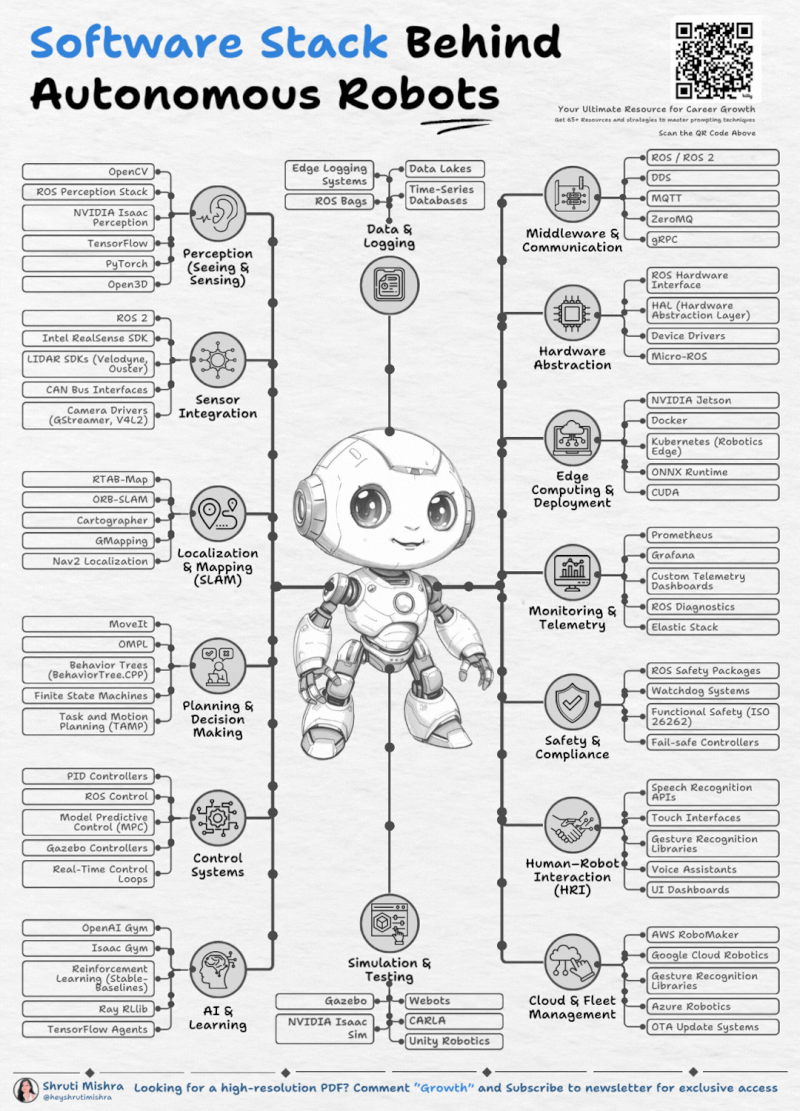
I analyzed the software stack behind autonomous robots, and here's what actually makes them work:
It's 50+ tools working together like a symphony.
Think of a robot like a human:
1. Eyes (Perception)
OpenCV, TensorFlow – Help robots "see" the world
2. Brain (AI & Learning)
OpenAI Gym, Ray RLlib – Make decisions and learn from mistakes
3. Memory (Mapping)
ORB-SLAM, Cartographer – Remember locations and build mental maps
4. Muscles (Control)
PID Controllers, ROS – Turn thoughts into physical movements
5. Nervous System (Communication)
MQTT, gRPC – Connect all parts together
6. Support Team (Cloud)
AWS RoboMaker – Manage entire fleets remotely
7. Safety Net (Compliance)
Watchdog Systems – Prevent disasters
The magic isn't in any single piece.
It's in how they ALL talk to each other.
A self-driving car uses 20+ of these simultaneously. A warehouse robot? Another 15.
The craziest part?
Most of these are open-source.
What surprises you most about this stack? 👇
Dario Amodei on why he left OpenAI:
"When you feel you can't trust someone, when their values aren't what they say they are, when they're not honest — that makes it very hard to continue."
Show Codex a workflow once. Reuse it as a skill.
Record & Replay lets you show Codex a recurring task, like filing an expense report or submitting a time-off request.
Codex turns that demo into an inspectable, editable skill.
You control when recording starts and stops.