This reality hits:
deadlines, new team members, rushed PRs, “we’ll fix it later.”
Most #dotnet projects don’t fall apart because of bad developers.
They fall apart because nobody decided how things should look when things get messy.
At the beginning:
✔ clean structure
✔ good intentions
✔ “we’ll keep it tidy”
Then reality hits:
• deadlines
• new team members
• rushed PRs
• “we’ll fix it later”
And suddenly the codebase starts fighting back.
This carousel shows the full curriculum of Pragmatic .NET Code Rules.
Not as a syllabus.
But as a system.
A system that:
- removes pointless decisions
- enforces consistency automatically
- keeps projects clean even when teams grow
I made this course for developers who:
• are tired of style debates
• want predictable projects
• care about long-term sanity, not quick wins
Already 50+ developers joined during pre-order.
And yes, you get access immediately.
And yes, you get access to the community.
You don’t wait.
You apply.
You improve your project while the course grows.
40% OFF Preorder price: $59.89
(Only 4 spots left at the price and only today)
Original price is $150.
👉 Get it now here:
https://t.co/xhEsynIezB
Curious, what’s the one rule your current codebase is missing?
Do you want to actually use AI as a #dotnet developer - not just read about it?
Over the past year, I've built a full set of resources that take you from "AI-curious" to shipping real AI features in .NET. Here's everything in one place. 🚀
𝐅𝐫𝐞𝐞 𝐠𝐮𝐢𝐝𝐞𝐬 & 𝐫𝐨𝐚𝐝𝐦𝐚𝐩𝐬:
• AI Roadmap for .NET 2026 (8 steps, 8-week plan): https://t.co/6raYyPiXBw
• AI Roadmap Course - Track A (free written course): https://t.co/BRKiDFRLoD
• AI in .NET Starter Kit (free source code + 5 Claude Code skills): https://t.co/8cOG2CgDfX
𝐇𝐚𝐧𝐝𝐬-𝐨𝐧 𝐚𝐫𝐭𝐢𝐜𝐥𝐞𝐬:
• Semantic Search in 50 Lines of Code: https://t.co/IfIkx0V4Ex
• How to implement a RAG system in .NET: https://t.co/UIKuVrHFgB
• I Built an MCP Server That Tests .NET API Performance: https://t.co/wvf8fhdDAP
• AI Agents for .NET - audit a whole codebase in one command: https://t.co/bBRICwSYGo
• How to use ChatGPT in a C# application: https://t.co/JISfT2ouoG
𝐕𝐢𝐝𝐞𝐨𝐬 (𝐘𝐨𝐮𝐓𝐮𝐛𝐞):
• I Built an MCP Server in .NET - AI Agents Can Now Test My API: https://t.co/zcC1Vsbt5z
• Make Your AI Postgres-Smart in 10 Minutes (Tiger Docs MCP Server): https://t.co/qJYSuSTfKi
• I Connected Miro to My AI Agent - and It Built My .NET Feature: https://t.co/DPkF1ovegz
• 6 Seconds → 150ms (One .NET Fix, found by an AI agent): https://t.co/lnpvPGP6Km
𝐓𝐨𝐨𝐥𝐬 & 𝐜𝐨𝐦𝐦𝐮𝐧𝐢𝐭𝐲:
• AI for .NET Developers - 50+ AI tools for your real C# code (7-day free trial): https://t.co/k7lJdEUNe3
• Free Claude Code skills for .NET (one command): /plugin marketplace add StefanTheCode/dotnet-ai-toolkit
• TheCodeMan Community on Skool (free): https://t.co/IPQwbeQ8pG
Want the full arsenal - 50+ skills, specialist agents & CLAUDE.md templates? Join AI for .NET Developers (7-day free trial): https://t.co/moR3sRWCQk
Save this post - I'll keep adding to it. ♻️
Repost to help another .NET dev get into AI.
Do you want to actually use AI as a #dotnet developer - not just read about it?
Over the past year, I've built a full set of resources that take you from "AI-curious" to shipping real AI features in .NET. Here's everything in one place. 🚀
𝐅𝐫𝐞𝐞 𝐠𝐮𝐢𝐝𝐞𝐬 & 𝐫𝐨𝐚𝐝𝐦𝐚𝐩𝐬:
• AI Roadmap for .NET 2026 (8 steps, 8-week plan): https://t.co/6raYyPiXBw
• AI Roadmap Course - Track A (free written course): https://t.co/BRKiDFRLoD
• AI in .NET Starter Kit (free source code + 5 Claude Code skills): https://t.co/8cOG2CgDfX
𝐇𝐚𝐧𝐝𝐬-𝐨𝐧 𝐚𝐫𝐭𝐢𝐜𝐥𝐞𝐬:
• Semantic Search in 50 Lines of Code: https://t.co/IfIkx0V4Ex
• How to implement a RAG system in .NET: https://t.co/UIKuVrHFgB
• I Built an MCP Server That Tests .NET API Performance: https://t.co/wvf8fhdDAP
• AI Agents for .NET - audit a whole codebase in one command: https://t.co/bBRICwSYGo
• How to use ChatGPT in a C# application: https://t.co/JISfT2ouoG
𝐕𝐢𝐝𝐞𝐨𝐬 (𝐘𝐨𝐮𝐓𝐮𝐛𝐞):
• I Built an MCP Server in .NET - AI Agents Can Now Test My API: https://t.co/zcC1Vsbt5z
• Make Your AI Postgres-Smart in 10 Minutes (Tiger Docs MCP Server): https://t.co/qJYSuSTfKi
• I Connected Miro to My AI Agent - and It Built My .NET Feature: https://t.co/DPkF1ovegz
• 6 Seconds → 150ms (One .NET Fix, found by an AI agent): https://t.co/lnpvPGP6Km
𝐓𝐨𝐨𝐥𝐬 & 𝐜𝐨𝐦𝐦𝐮𝐧𝐢𝐭𝐲:
• AI for .NET Developers - 50+ AI tools for your real C# code (7-day free trial): https://t.co/k7lJdEUNe3
• Free Claude Code skills for .NET (one command): /plugin marketplace add StefanTheCode/dotnet-ai-toolkit
• TheCodeMan Community on Skool (free): https://t.co/IPQwbeQ8pG
Want the full arsenal - 50+ skills, specialist agents & CLAUDE.md templates? Join AI for .NET Developers (7-day free trial): https://t.co/moR3sRWCQk
Save this post - I'll keep adding to it. ♻️
Repost to help another .NET dev get into AI.
The biggest open-weight AI model in the world just landed in JetBrains, available right in the ACP registry.
I gave Kimi K3 one prompt - "build a live dashboard of my GitHub stats" - and it wrote the whole #dotnet app: API, frontend, animated Chart.js, across multiple files. First run. Zero edits.
2.8T params, running in Rider. Grab it here: https://t.co/hwrV3CtyP4 👇
The legendary @csharpfritz has left the building.
Jeff is one of the people that inspired me to start YouTube and streaming during the dark days of 2020-2021.
A genuine loss for MS.
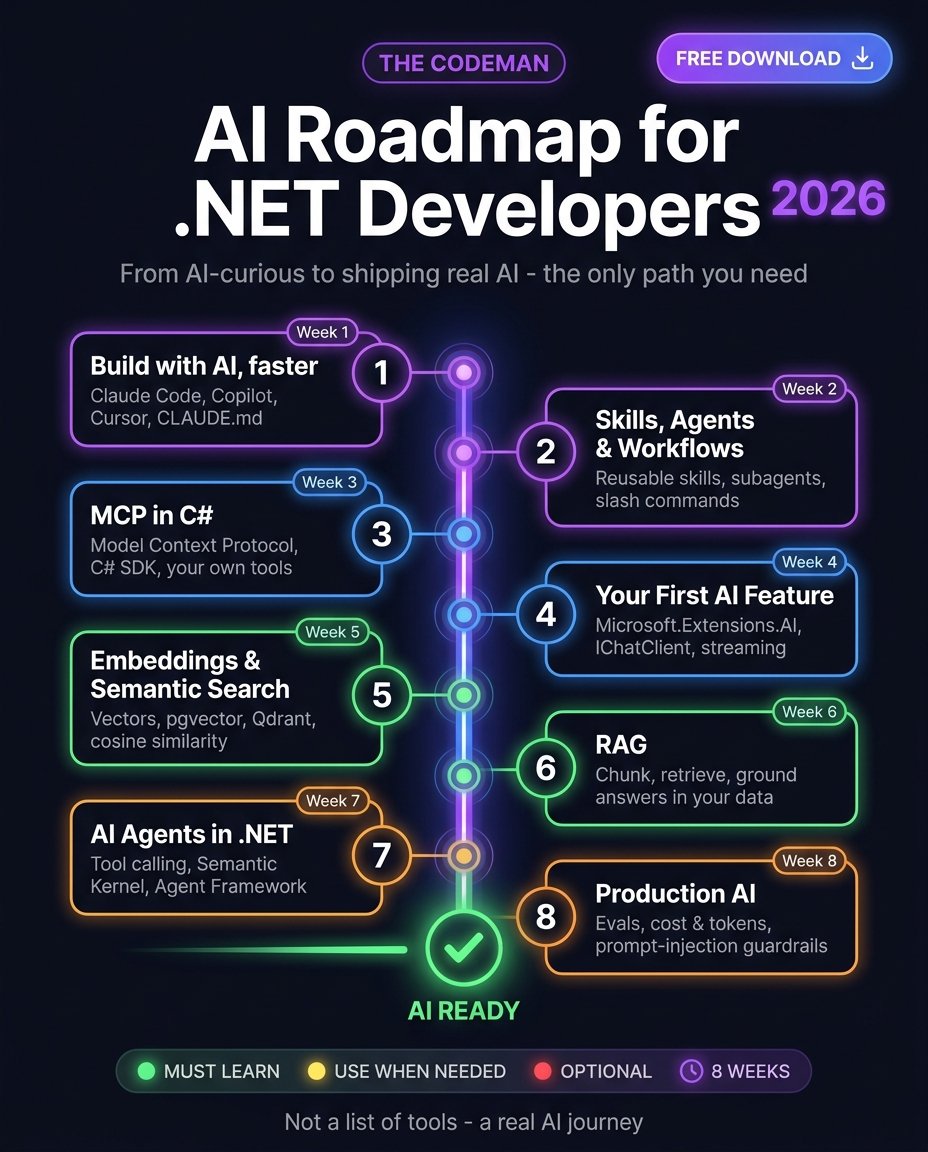
I built a free AI Roadmap for #dotnet Developers (2026)👇
8 steps, two tracks:
→ Use AI: Claude Code, skills, MCP in C#
→ Build AI: LLMs, embeddings, RAG, agents, production
No hype. MUST vs OPTIONAL for every step, an 8-week plan, and 3 runnable .NET projects.
Free 👉 https://t.co/3d9wipKh3y
I built a free AI Roadmap for #dotnet Developers (2026)👇
8 steps, two tracks:
→ Use AI: Claude Code, skills, MCP in C#
→ Build AI: LLMs, embeddings, RAG, agents, production
No hype. MUST vs OPTIONAL for every step, an 8-week plan, and 3 runnable .NET projects.
Free 👉 https://t.co/3d9wipKh3y
@AntonMartyniuk The biggest productivity gain is knowing when to reset context without losing the useful decisions already made. A fresh session works best when the architecture, constraints, and progress are captured in files instead of relying on conversation history.
I'm giving away my .NET AI Prompt Playbook for free - to everyone who joins my community.
36 prompts I use every day to make Claude write production-grade .NET: EF Core, APIs, tests, security, and real AI features (RAG, MCP, agents). The exact phrasings, not "write me code" one-liners.
But the Playbook is just the door. Here's what's actually waiting inside 👇
• 𝐓𝐡𝐞 .𝐍𝐄𝐓 𝐀𝐈 𝐓𝐨𝐨𝐥𝐊𝐢𝐭 - 44+ Claude skills and 7 agents that run on your real .NET code (EF Core, performance, architecture, testing, security, observability). Now installable in Claude Code with 𝐨𝐧𝐞 𝐜𝐨𝐦𝐦𝐚𝐧𝐝.
• 𝐀 𝐠𝐫𝐨𝐰𝐢𝐧𝐠 𝐜𝐮𝐫𝐫𝐢𝐜𝐮𝐥𝐮𝐦 - step-by-step lessons on actually using AI in real .NET work. Starting with the fundamentals, building up to agents, MCP, and shipping AI features into your own apps.
• 𝐓𝐡𝐞 𝐏𝐫𝐨𝐦𝐩𝐭 𝐏𝐥𝐚𝐲𝐛𝐨𝐨𝐤 - yours the moment you join.
• 𝐍𝐞𝐰 𝐜𝐨𝐧𝐭𝐞𝐧𝐭, 𝐰𝐞𝐞𝐤𝐥𝐲 - I've started recording walkthroughs, built around what members actually ask for.
• 𝐃𝐢𝐫𝐞𝐜𝐭 𝐚𝐜𝐜𝐞𝐬𝐬 𝐭𝐨 𝐦𝐞 - ask questions, share what you're building, get answers. Full courses are on the way, and members get them all.
This isn't a pile of files. It's where you actually get good at using AI in .NET - with me in the room.
It's open on a 𝟕-𝐝𝐚𝐲 𝐟𝐫𝐞𝐞 𝐭𝐫𝐢𝐚𝐥.
Want in? Comment "𝐏𝐋𝐀𝐘𝐁𝐎𝐎𝐊," and I'll send you the link, or join here:
👉 https://t.co/moR3sRWCQk
I thought this .NET endpoint was fine.
No exceptions. No failed requests. Every response was a clean 200 OK.
And loading 40 rows took almost 7 seconds.
No error to grep for, nothing useful in the logs - just a request that "felt slow." If you've ever chased one of these, you know how much time it can eat.
So this time I didn't guess. I opened Sentry - and it had already flagged the problem on its own.
One click later, its AI debugger (Seer) walked me straight to the root cause: a hidden N+1. Twice, actually. EF Core loads each order's items in a separate query and then makes a separate HTTP call to a second service for every single item.
Hundreds of calls are hiding inside one request.
The fix was small - one. Include one batched call.
The result:
~6,800ms → ~142ms. Same data, ~40x faster.
The hard part of a performance bug was never writing the fix. It's finding it.
Having the trace and the root cause handed to you changes the whole workflow.
Full walkthrough on YouTube: https://t.co/ShOTkheFiq
What's the worst "it's just slow" bug you've had to track down?
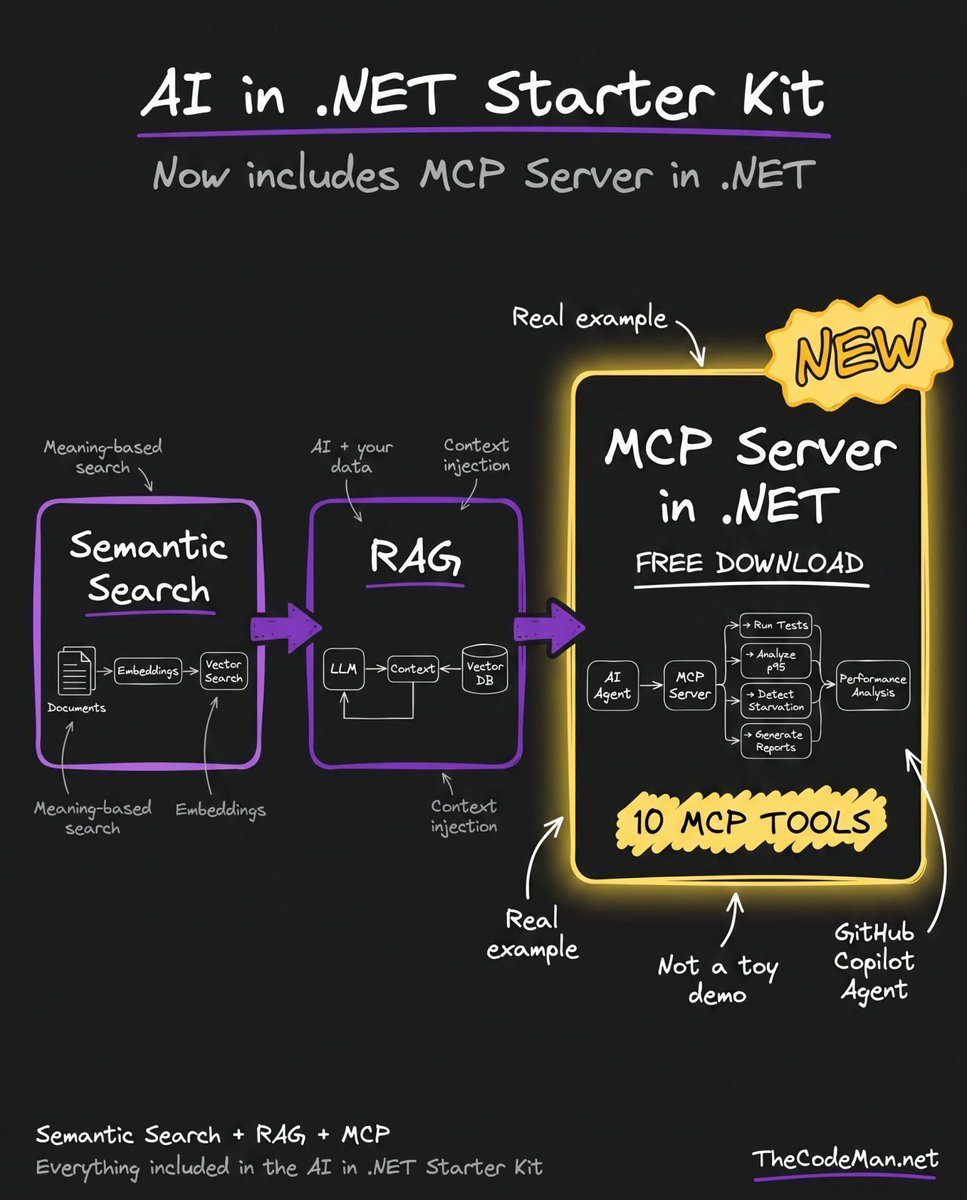
Everyone is talking about MCP servers right now.
So I decided to create a realistic example in #dotnet and add it completely FREE to the:
My AI in .NET Starter Kit: https://t.co/8cOG2CgDfX
I built an MCP Server in .NET for API performance analysis.
Not a “hello world” demo.
A real example where GitHub Copilot Agent mode can actually call tools and analyze API performance for you.
You type something like: “Compare slow-thread-sleep with slow-task-delay using 20 users for 15 seconds.”
And the MCP server:
→ Runs load tests
→ Compares endpoints
→ Measures p50/p95/p99 latency
→ Detects thread pool starvation
→ Suggests optimizations
→ Generates reports
The whole point was to show HOW MCP actually works in practice.
So instead of building another toy calculator example, I created a scenario around performance testing because it naturally fits the MCP model really well.
The project includes:
→ MCP Server in .NET
→ 10 MCP tools
→ Custom load testing engine in pure .NET
→ ASP. NET Core API with intentional performance issues
→ Blazor dashboard for visualizing results
→ Unit tests
→ Full source code
And yes, this is more educational than production-ready.
The goal is to help you understand:
→ How MCP servers expose tools
→ How AI agents call them
→ How tool orchestration works
→ How to structure an MCP server in .NET
→ How AI can interact with real developer workflows
I genuinely think MCP is going to become a very important skill for developers.
Especially for people building AI-powered tooling and developer platforms.
__
📌 I'm running a closed group AI for .NET developers: https://t.co/moR3sRWCQk
I thought this .NET endpoint was fine.
No exceptions. No failed requests. Every response was a clean 200 OK.
And loading 40 rows took almost 7 seconds.
No error to grep for, nothing useful in the logs - just a request that "felt slow." If you've ever chased one of these, you know how much time it can eat.
So this time I didn't guess. I opened Sentry - and it had already flagged the problem on its own.
One click later, its AI debugger (Seer) walked me straight to the root cause: a hidden N+1. Twice, actually. EF Core loads each order's items in a separate query and then makes a separate HTTP call to a second service for every single item.
Hundreds of calls are hiding inside one request.
The fix was small - one. Include one batched call.
The result:
~6,800ms → ~142ms. Same data, ~40x faster.
The hard part of a performance bug was never writing the fix. It's finding it.
Having the trace and the root cause handed to you changes the whole workflow.
Full walkthrough on YouTube: https://t.co/ShOTkheFiq
What's the worst "it's just slow" bug you've had to track down?
I'm giving away my .NET AI Prompt Playbook for free - to everyone who joins my community.
36 prompts I use every day to make Claude write production-grade .NET: EF Core, APIs, tests, security, and real AI features (RAG, MCP, agents). The exact phrasings, not "write me code" one-liners.
But the Playbook is just the door. Here's what's actually waiting inside 👇
• 𝐓𝐡𝐞 .𝐍𝐄𝐓 𝐀𝐈 𝐓𝐨𝐨𝐥𝐊𝐢𝐭 - 44+ Claude skills and 7 agents that run on your real .NET code (EF Core, performance, architecture, testing, security, observability). Now installable in Claude Code with 𝐨𝐧𝐞 𝐜𝐨𝐦𝐦𝐚𝐧𝐝.
• 𝐀 𝐠𝐫𝐨𝐰𝐢𝐧𝐠 𝐜𝐮𝐫𝐫𝐢𝐜𝐮𝐥𝐮𝐦 - step-by-step lessons on actually using AI in real .NET work. Starting with the fundamentals, building up to agents, MCP, and shipping AI features into your own apps.
• 𝐓𝐡𝐞 𝐏𝐫𝐨𝐦𝐩𝐭 𝐏𝐥𝐚𝐲𝐛𝐨𝐨𝐤 - yours the moment you join.
• 𝐍𝐞𝐰 𝐜𝐨𝐧𝐭𝐞𝐧𝐭, 𝐰𝐞𝐞𝐤𝐥𝐲 - I've started recording walkthroughs, built around what members actually ask for.
• 𝐃𝐢𝐫𝐞𝐜𝐭 𝐚𝐜𝐜𝐞𝐬𝐬 𝐭𝐨 𝐦𝐞 - ask questions, share what you're building, get answers. Full courses are on the way, and members get them all.
This isn't a pile of files. It's where you actually get good at using AI in .NET - with me in the room.
It's open on a 𝟕-𝐝𝐚𝐲 𝐟𝐫𝐞𝐞 𝐭𝐫𝐢𝐚𝐥.
Want in? Comment "𝐏𝐋𝐀𝐘𝐁𝐎𝐎𝐊," and I'll send you the link, or join here:
👉 https://t.co/moR3sRWCQk
Everyone is talking about MCP servers right now.
So I decided to create a realistic example in .NET and add it completely FREE to the:
My AI in .NET Starter Kit: https://t.co/8cOG2CgDfX
I built an MCP Server in .NET for API performance analysis.
Not a “hello world” demo.
A real example where GitHub Copilot Agent mode can actually call tools and analyze API performance for you.
You type something like: “Compare slow-thread-sleep with slow-task-delay using 20 users for 15 seconds.”
And the MCP server:
→ Runs load tests
→ Compares endpoints
→ Measures p50/p95/p99 latency
→ Detects thread pool starvation
→ Suggests optimizations
→ Generates reports
The whole point was to show HOW MCP actually works in practice.
So instead of building another toy calculator example, I created a scenario around performance testing because it naturally fits the MCP model really well.
The project includes:
→ MCP Server in .NET
→ 10 MCP tools
→ Custom load testing engine in pure .NET
→ ASP. NET Core API with intentional performance issues
→ Blazor dashboard for visualizing results
→ Unit tests
→ Full source code
And yes, this is more educational than production-ready.
The goal is to help you understand:
→ How MCP servers expose tools
→ How AI agents call them
→ How tool orchestration works
→ How to structure an MCP server in .NET
→ How AI can interact with real developer workflows
I genuinely think MCP is going to become a very important skill for developers.
Especially for people building AI-powered tooling and developer platforms.
__
📌 I'm running a closed group AI for .NET developers: https://t.co/moR3sRWCQk