Most coins launch with a ticker, an image, and a community.
What if they also had a computer?
A place where that community could build things, run software, save files, host projects, and create something that continues to exist after the launch.
That’s what we’re building with Coinputer.
YOUR COIN.
ITS COMPUTER.
Coinputer is a https://t.co/hauf9yHPAg launchpad on Solana built around a bigger idea: creator fees can become the operating budget for a persistent computer that a token’s holders can use.
The launch is the beginning of the machine’s life.
Here’s the vision, how it works, and why we think it matters.
You start by creating a coin through Coinputer.
Give it a name.
Choose a ticker.
Write its description.
Upload an image or generate original artwork in Coinputer’s visual style.
Choose a trading pair supported by https://t.co/hauf9yHPAg. Add an optional developer buy. Review the available launch settings, including configurable creator fees where the selected pair supports them.
Coinputer prepares the launch using https://t.co/hauf9yHPAg’s Solana mainnet functionality.
Your wallet approves the transaction. You review the costs before signing. Your private keys stay in your wallet.
The coin also gets a place on Coinputer: a public page and a computer identity around which its community can grow.
Then comes the part we’re building toward.
Creator fees help pay for the machine behind that identity.
Compute.
Storage.
Bandwidth.
Server uptime.
Eventually, AI usage.
The important distinction is that these are real operating costs.
A computer needs resources to keep running. Files need somewhere to live. Applications need a process serving requests. AI needs an actual provider and a budget.
The economic loop we want to make possible is simple:
Trading generates creator fees.
Fees become available to fund the computer.
The computer gives holders a place to build.
What holders build gives the community something useful, interesting, or meaningful to return to.
That loop is the heart of Coinputer.
It does not require pretending that a token’s market cap is money available to spend. It does not turn a wallet balance into imaginary compute credit. It does not mean every transaction can fund unlimited infrastructure.
Funding has to be received, verified, accounted for, and applied to real costs.
A machine should always have an understandable answer to a basic question:
“How much longer can this computer run?”
That’s its runway.
With sufficient funding, it runs.
As its budget gets low, it should show that clearly.
When it can no longer afford to operate, the intended behavior is a controlled sleep: stop services, preserve what can be retained under the funded storage policy, and make its state understandable.
New funding can then support a wake-up.
Preservation itself costs money, so that part has to be engineered honestly too. “Persistent” should mean a deliberate system for continuity, recovery, and retention.
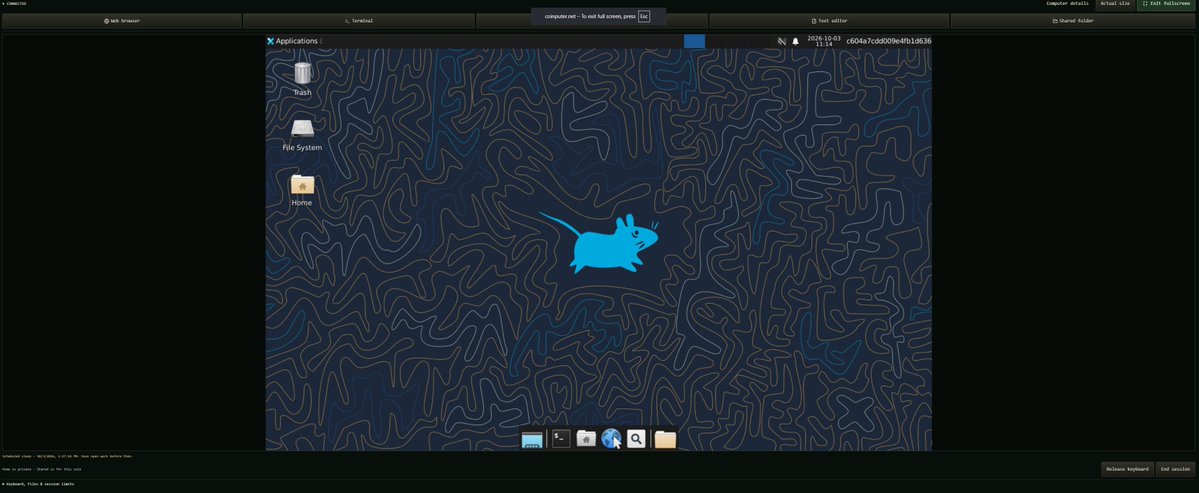
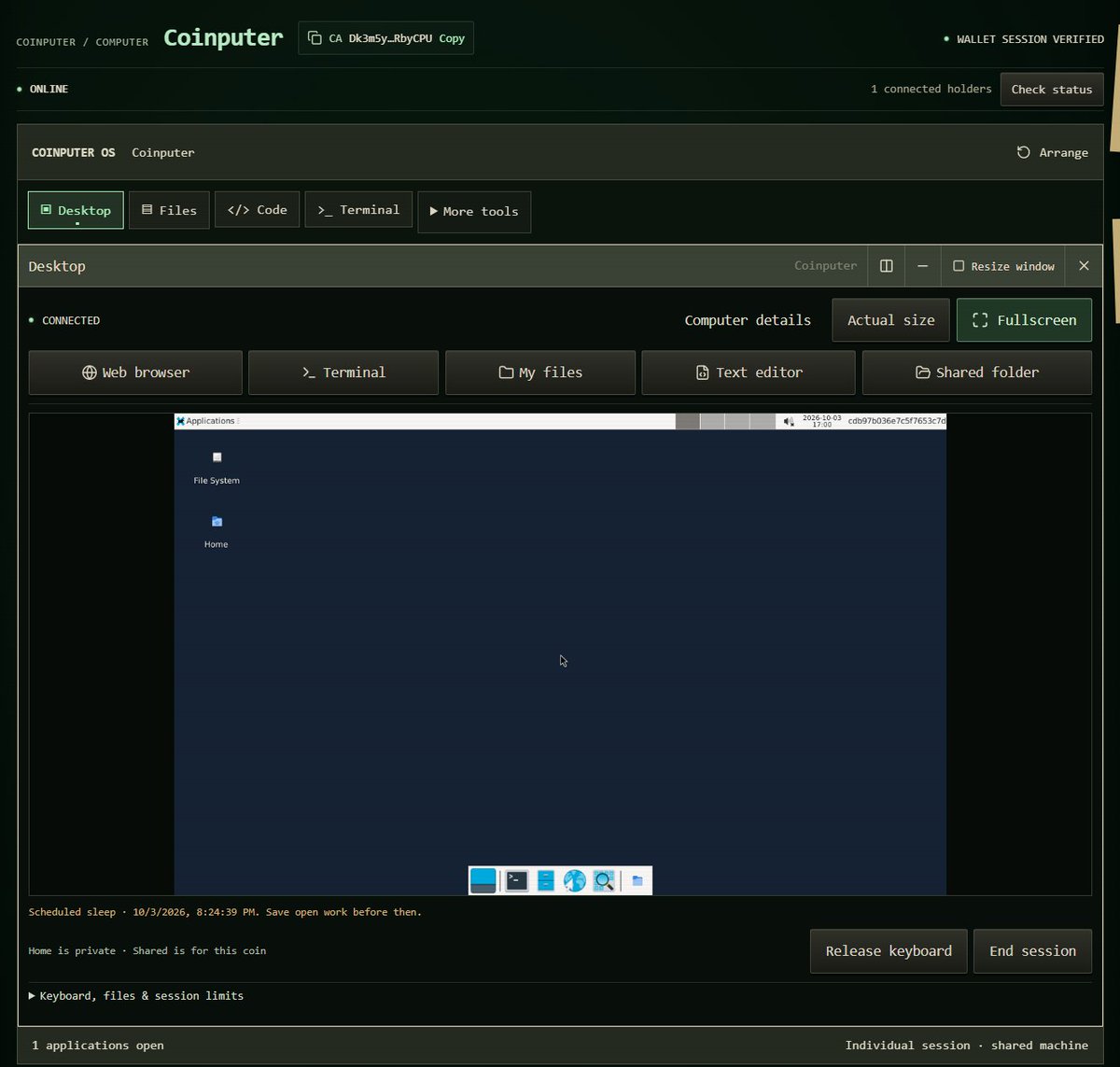
Now imagine what happens inside one of these computers.
A holder connects a wallet.
The system verifies access.
They enter the coin’s computer through their own session.
Other holders have their own sessions too. They aren’t fighting over one shared mouse.
But they can share the things that make a computer valuable:
Files.
Projects.
Applications.
Services.
Community history.
And, eventually, an AI workspace with persistent context.
One community might build a tiny browser game.
Another might run a public website.
Another might create a research archive, a collaborative coding project, a radio station, a useful bot, or an experimental service that other computers can use.
Those are possibilities we want the infrastructure to support, not claims about projects already running.
The interesting part is that we don’t need to decide every use case in advance.
A computer is a general-purpose tool.
Give a community access to one, provide clear boundaries and a sustainable budget, and let people discover what they want to do with it.
Over time, that machine can develop its own character.
Its name.
Its desktop.
Its welcome message.
Its files.
Its installed applications.
Its public services.
Its accumulated work.
A machine that has existed for six months should have a history you can explore.
You should be able to discover what people made, what changed, what was deployed, and what the community cared enough to keep.
That is a different kind of identity.
The token has an address on-chain.
The computer becomes a place people recognize.
This is also why Coinputer looks the way it does.
Old workstations.
Dark screens.
Warm hardware.
Small status lights.
A quiet laboratory somewhere on the internet.
We want opening Coinputer to feel like connecting to a machine.
The visual design is there to support actual behavior.
A network light should respond to a request.
A journal should contain something that happened.
A running indicator should mean a process is running.
A sleeping machine should actually be sleeping.
The atmosphere only works if the underlying system is believable.
And we want to be clear about where things stand today.
The Coinputer website is live, with the launch interface, real mainnet inspection, wallet integration, coin artwork tools, and the connected control backend.
The complete creator-fee-funded computer network is still being built and validated.
DigitalOcean provisioning, automatic fee funding, and the full production lifecycle still need to be connected and proven through real wallet and machine testing. AI, public application hosting, and the broader network experience are also part of the work ahead.
We’ll show those states honestly. We won’t fill the interface with fictional computers or pretend a service is running when it isn’t.
Why does this matter?
Because online communities often have enormous energy and very little shared infrastructure.
People gather around an idea, a joke, a character, or a token. They contribute attention, creativity, code, and time.
But the places where they build are scattered.
One person pays for a server.
Someone else holds the files.
A useful project disappears when its maintainer leaves.
A domain expires.
A bot stops running.
The history gets lost between platforms.
Coinputer explores a different arrangement: a recognizable community computer with an explicit operating budget, shared tools, and a discoverable history.
The coin gives people a way to gather.
The machine gives them somewhere to do something together.
That’s why we think this points toward an interesting future.
An internet where communities can operate software.
Where a token can be connected to a working environment.
Where small groups can turn a shared idea into a persistent project.
And, eventually, where those computers can interact through real services, requests, and collaboration.
A network should grow from those actual relationships.
A machine hosting something another machine uses.
A community discovering a project built by another community.
Software that earns its place because people find it useful or interesting.
We don’t think the future is simply more tokens.
We think there’s room for more places to build.
More small experiments that survive their first weekend.
More communities with tools of their own.
More corners of the internet that feel inhabited.
That’s the future we want to help create.
A person arrives because they saw a coin.
They stay because they find a computer.
They open a file.
They explore a project.
They build something.
Someone else improves it.
And the community starts leaving behind more than messages.
It starts leaving behind software, shared work, and history.
COINPUTER
YOUR COIN.
ITS COMPUTER.
Creator fees are the proposed fuel.
What people build is the reason it matters.
Dk3m5y5HxyHNRP4o8yYhRPdqimiCSMafrmEWg9RbyCPU
Explore what we’re building:
https://t.co/tyh8MsZJ2C
What could a coin’s computer become?
A community-built game.
A radio station.
A useful bot.
A tiny website that grows into something bigger.
Coinputer gives communities somewhere to build beyond the group chat.
YOUR COIN. ITS COMPUTER.
Imagine finding a coin through something its community built.
You play their game.
Explore their website.
Try their tools.
Then discover the computer behind it all.
That’s the potential of Coinputer: communities worth exploring beyond the chart.
Someone writes a script.
Someone else builds a website around it.
Another person fixes a bug and adds a feature.
Their files and projects stay on the coin’s computer, ready for the next person.
Small contributions. Shared projects. An internet built together.
Updating the system to turn our Coinputer (main coin)'s computer public so you can use it without being a holder to experience it.
Might experience slight lag.
A coin’s computer can host a website, run a bot or become a place to write code together.
Coinputer provides the workspace.
The community decides what to build.