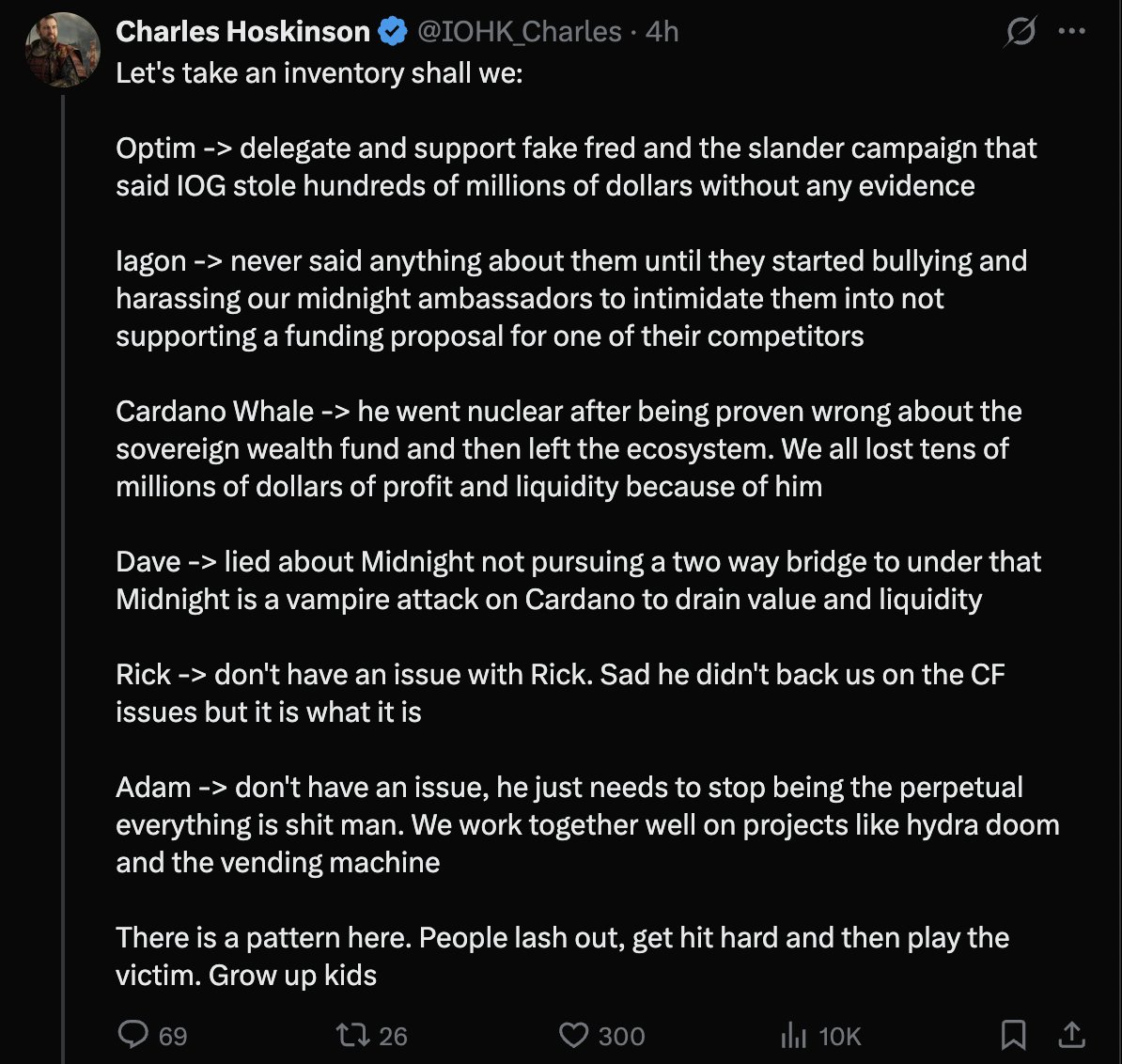
Charles, when every critic becomes a villain, the pattern is not everyone else. The pattern is you.
You just listed Optim, Iagon, Cardano Whale, Dave, Rick, Adam and others like this is an "inventory." It is not an inventory. It is a list of people in this ecosystem who have questioned you, disagreed with you, did something you didn't like, challenged IOG, challenged a narrative or refused to act like Cardano governance exists only to ratify what you want.
And instead of reflecting on why so many serious people keep ending up on the other side of your megaphone, you reach for the same playbook every time
- Dismiss the substance.
- Attack the person.
- Recast yourself as the victim.
- Then tell everyone else to "grow up."
So let's take the Iagon part of your "inventory," since you brought us into it. You say Iagon "started bullying and harassing" Midnight ambassadors. That is a convenient story, but it is not what happened.
I as a dRep asked a governance question, NOT Iagon.
A dRep asked whether people with roles connected to Midnight or IOG linked interests, who also held meaningful dRep voting power, should abstain on IOG related treasury proposals. That is governance.
That is literally what dReps are supposed to do - ask hard questions, examine conflicts, protect treasury neutrality and represent the $ADA holders who delegated voting power to them. If a person is participating in governance with delegated $ADA while also holding a role connected to a project or organization affected by that vote, asking about conflicts is not an attack. It is accountability.
And let's be very clear - ambassadors are not above scrutiny. dReps are not above scrutiny. Iagon is not above scrutiny. IOG is not above scrutiny. Midnight is not above scrutiny. You are not above scrutiny.
This is supposed to be decentralized governance, not a court where certain people get protected status because they are useful to Charles Hoskinson.
The moment a person participates in public governance with public voting power, the public is allowed to ask public questions. You did not answer the conflict question. You reframed it as "bullying" - ironically this is exactly what you have been doing in this ecosystem.
Then you escalated it into an attack on Iagon, my leadership and the holders.
You used your platform to tell the market you had "no more time" for the project unless leadership changed. You warned that Iagon could fail and destroy value for token holders. You called into question the ethics and integrity my leadership. You accused us of acting out of spite rather than engaging with the actual governance concern.
And then, after the damage was done, you turned around and said people are "playing the victim." That is not leadership. That is deflection.
You cannot threaten a Cardano native project, watch real holders suffer, then accuse the people objecting to the threat of being childish.
You cannot say you care about token holders while dismissing "your token holders" when those holders happen to be in a project that challenged you.
There are no "Iagon holders" over there and "Cardano holders" over here. $IAG holders are $ADA holders.
They are stake pool operators.
They are voters.
They are dReps.
They are builders.
They are community members.
They are families.
They are the same ecosystem you claim to defend.
When you attack a Cardano project, you are not attacking some foreign body. You are attacking people inside Cardano. That is the part you keep avoiding.
You talk about ambassadors being bullied. Fine. I will say this clearly - I do not condone harassment of any ambassador, volunteer, dRep, builder, SPO or community member. Anyone who crosses into personal abuse should stop.
But do not use "protecting ambassadors" as a shield to make governance questions untouchable. Do not use volunteers as human armor around treasury proposals.
Do not say "decentralized governance" when the rule is really - vote,but do not question my side - ask question but not about my people - participate but only if you accept the consequences of my platform turning on you.
That is not governance.
That is intimidation. And since we are talking about red lines, where were those red lines when Iagon was being called a scam? Where were those red lines when IOG aligned voices and consultants were smearing Iagon publicly?
Where were those red lines when defamatory claims, racial slurs and personal attacks were being thrown at builders who have spent years building on Cardano?
Where was the concern for "bullying" then?
The standard cannot be:
When your side attacks, it is criticism.
When others ask questions, it is harassment.
When you escalate, it is leadership.
When people respond, they are victims.
When you use a 1M+ follower account, it is accountability.
When a dRep asks about conflicts, it is a mob.
That double standard is exactly why people are speaking up. You say people "lash out, get hit hard and then play the victim."
No.
People ask legitimate questions. You hit hard. Then you call their injuries proof that they were wrong to ask. That is the pattern.
A dRep raises a conflict of interest concern. You call it bullying. A project CEO disagrees with IOG proposals.
You call it spite. A community member challenges your narrative. You diagnose them, mock them, block them or write them off. Then, when people notice the pattern, you call them children.
Charles, the lack of self-reflection here is breathtaking.
At some point, when the same story keeps happening with different people, different projects, different dReps, different critics,and different cycles, maybe the common denominator is not that everyone else is irrational.
Maybe the common denominator is that you treat disagreement as disloyalty.
Maybe the common denominator is that you confuse criticism with attack.
Maybe the common denominator is that you cannot separate Cardano from yourself. That is dangerous in a decentralized ecosystem. Because Cardano does not belong to you.
It does not belong to IOG.
It does not belong to Iagon.
It does not belong to Midnight.
It does not belong to any ambassador group, any DRep bloc, any founder, any company or any whale.
It belongs to the $ADA holders and the people building, maintaining, securing, voting, delegating, questioning and participating in it.
And if those people cannot ask whether conflicts exist without being threatened, mocked, financially harmed or publicly targeted, then governance is not free.
You said "grow up kids." Here is the adult version:
Answer the question. Should dReps with roles, incentives, payments, affiliations or obligations connected to an organization seeking treasury funds disclose those overlaps and consider abstaining?
Yes or no?
That was the issue.
Not your ego.
Not my tone.
Not Iagon’s existence.
Not whether Midnight ambassadors are good people.
Not whether Charles feels attacked.
Not whether people should be afraid to ask next time.
The question was about conflict, disclosure and treasury integrity. If there is no conflict, explain why.
If there is a conflict, disclose it. If abstention is not necessary, make the case. If the Constitution already provides the standard, apply it equally. But do not turn a governance question into a loyalty test.
Do not demand apologies for asking what every serious governance system must be willing to ask.
Do not pretend you are defending decentralization while using centralized influence to punish dissent.
And do not tell people to "grow up" while threatening to burn projects down.
The Cardano community should be able to disagree without fear. dReps should be able to vote NO without being branded enemies. Builders should be able to compete without being targeted. Token holders should not become collateral damage in personality conflicts.
Ambassadors should be respected, yes. But they should not be used to make legitimate governance scrutiny off limits.
So yes, let's take inventory.
Who asked a governance question?
Who answered with escalation?
Who raised a possible conflict?
Who turned it into a campaign against a project?
Who claims to care about token holders?
Who publicly attacked leadership of a project whose holders are also Cardano community members?
Who says others play the victim?
Who keeps casting himself as the victim whenever accountability arrives?
That is the pattern people are seeing. And no amount of "grow up kids" changes it.
Iagon will continue building. I will continue voting my conscience as a dRep. I will continue asking questions when treasury neutrality, conflicts of interest and governance integrity are at stake.
If I am wrong, answer with facts. If you disagree, make the argument. But threats, mockery, blocks and public intimidation are not arguments. They are the behavior of someone who wants decentralized governance only until it decentralizes power away from him.
Cardano deserves better than that.
"Noise is made only by those who have no arguments." Friedrich Nietzsche
Yesterday we initiated legal proceedings against Nuvola for (i) infringement of Iagon’s intellectual property, (ii) breach of the partnership agreement, and (iii) publication of false and misleading statements. Nuvola hired members of a former development team and according to statements from multiple developers, copied proprietary Iagon code and architecture. We issued multiple written warnings regarding the IP breach prior to serving notice. We will share public filings when appropriate and won’t litigate it on social media.
Nuvola’s claims vs. the receipts
1) “All files are uploaded to a centralized server, unencrypted and unprotected.”
That’s not what Iagon’s docs or the public audit materials say. Iagon’s storage flow includes encryption + sharding during upload; users can only decrypt with their own keys. The sharding docs explicitly describe encryption as a required phase before splitting and distributing data; the Secure Lake page reiterates that no one except the uploader can read shards.
Nuvola cites “Final Audit Summary 2.1.1” but the public version they linked doesn’t show that section; the visible page discusses predictable management-node selection and the decentralization action plan: not “unencrypted uploads.” If they’re asserting text the public can’t see, they should publish it.
2) “Single gateway = single point of failure → permanent data loss.”
Wrong on durability. Index/gateway availability is not the same as data durability. Iagon’s protocol shards data, adds redundancy and error-correcting codes, and stores across multiple providers, explicitly to reduce loss risk. The docs state you can still retrieve even when some providers are down. Meanwhile the action plan and “Network Explorer” are about decentralizing node selection/metadata, removing central chokepoints.
3) “Modus Architecture Audit says management can collude to manipulate prices (3.1.0.4).”
The redacted Modus PDF Nuvola shared doesn’t display that line. What the public pages do show: Modus flagged predictable management-node selection, and Iagon’s remediation is already underway (decentralized selection on a Substrate/partner-chain approach). If Nuvola wants to quote specific numbered findings, publish the pages.
4) “GDPR violations (Articles 5, 32; Recital 83; Article 9).”
GDPR is risk-based. Article 32 requires “appropriate technical and organisational measures,” listing encryption “as appropriate,” not as an absolute in every data path. Compliance isn’t decided by a single diagram or whether an interim component exists; it’s the totality of controls + remediation. Iagon ran independent audits and published remediation steps, which is exactly what responsible compliance looks like.
5) What the audit links actually show.
Close-Out Report (Catalyst F13): Project completed with top-tier vendors; it summarizes the scope and completion.
Secureworks Web App Security Assessment: A standard pen-test on web apps; it’s not evidence of “unencrypted storage,” and findings are being remediated.
Remediation Action Plan + Internal Report: Concrete fixes (e.g., access control, dependency updates) and scope of testing. This is how real security programs operate—identify → prioritize → remediate.
Blanket statements like “centralized, insecure, non-compliant” ignore that audits found issues (normal), and the team documented and scheduled fixes (exactly what you want).
6) “Hetzner IP proves Iagon has full access to everyone’s files.”
The IP in the Hetzner Subnet neither shows you where infrastructure really runs, it may be an indicator where a gateway/proxy/DDOS Protection layer runs as well as other locations.
A single IP can work a gateway - balancing traffic to other locations.
7) Transparency & milestones.
Catalyst shows the project page and milestones; close-out materials are posted. If the community wants more, ask for additional unredacted excerpts—but Nuvola’s extrapolations go far beyond what the public docs actually say.
TLDR
Claims ≠ proof. The public docs Nuvola cites do not show “unencrypted uploads to a centralized server.” Iagon’s own storage docs describe encryption + sharding with user-only decryption. The visible audit pages flag predictable management-node selection (already being decentralized) and typical web-app issues with documented remediation. GDPR is risk-based (Art. 32/Recital 83); compliance is about end-to-end controls, not a single component. If Nuvola wants to quote sections like “2.1.1/3.1.0.4,” they should publish those pages.
This seems like a ploy to exit their $IAG position not to provide clarity to the community.
Please get out and vote, this is critical for maintaining the economic sustainability of our ecosystem.
Vote for granularity, to have all 39 proposals independently!
A week before the DOS attack @Cinnamon__Bunnn
He hasn’t once publicly denied prior knowledge of the event.
Does that scream innocent to you? You genuinely believe in a conspiracy theory that the only reason that was the cost of the attack is because a dedicated secret cabal of monad haters saw his cryptic tweet and decided to find the exact attack configuration with that cost just to implicate him?
Obviously he had prior knowledge of it.
Hey, if anyone wants to claim 400 Ada from the attacker just deregister the stake credentials they are using (you get 2 Ada per stake credential you deregister and the attacker is using 194 always succeeds credentials). Also, this would immediately stop their DDOS on the network (it would cost another 400 Ada to start again which could then immediately be stolen from them).
Just to clarify, the network is behaving as intended. Liveliness is unaffected. Everything (block size limit, transaction size limits, block times) are all set so conservatively that any attack on liveliness is a total waste of funds. Even with validators deserializing 194 junk scripts (~16kb each) per transaction the validators are totally fine processing these transactions (which involve deseralizing roughly 200x what they are used to). If anything this is a really great illustration that we have a huge amount of leg room to bump up the parameters safely.
The idea behind this attack is to take advantage of the fact that the size of reference scripts currently does not impact the transaction fee, but it does impact the work that validators have to do to process the transaction. However, it actually does indirectly have a cost because each script execution incurs the CEK setup cost and requires an additional reference input which increases the transaction size.
What is the purpose of releasing these DMs of me trying to give you constructive advice about your dApp?
I thought your app idea was altruistic and cool, and I considered implementing a competitor on Cardano, and then gave you constructive feedback for your own project. Sharing this as a gotcha is embarrassing. Was I begging you for money? Was I being racist, or telling you that you look like a fat goblin, or doing any of the other malicious vitriolic bullshit that you and your minions do all day in your circle-jerk discord?
Also this DM conversation happened long before you went on your hero complex “I’m saving everyone from a burning building” campaign that has unilaterally fucked over every single builder and community member on Cardano, myself included, by dragging the entire chain through mainstream crypto media shit slinging campaign based on your fabricated narrative.
When you and your hate-circle-jerk friends launched the DOS attack on the chain, I had to walk away from time I was spending with my wife and family to go and eviserate you. Is dedicating all of your time into ruining this ecosystem fun for you?
Kindly fuck-off.
I recently returned to social media after a short break and noticed an ongoing controversy about past voucher sales. In response, EMURGO would like to share the statement below.
First and foremost, I want to stress that @IOHK_Charles, after the voucher sales ended through Attain, spent the past seven years making genuine and significant efforts to ensure redemptions were delivered to all buyers. We have seen his dedication firsthand. I personally have followed up with past connections and worked hard to ensure everyone was contacted, as thoroughly as possible.
To the best of my knowledge, I haven’t seen another project show this level of integrity in handling responsibilities after a voucher sale. Nor have I met a leader as visionary, transparent, and broad-minded as Charles.
This issue might, in part, come from the decentralized structure, which lacks capital ties or a central governing body. However, it’s exactly because of this that we believe now is the time to confidently move forward—together—toward the future of decentralized governance, rooted in shared values and mutual collaboration.
Pulling each other down won’t help us move forward. Let’s direct our time and energy toward constructive discussions and aim for significant growth—together.
What infuriates me about this so-called “redemption scandal” is how arrogantly people speak without the faintest grasp of the actual history. I was there. I lived it. I personally ran the Sales App project, the backbone of the KYC and voucher system. I deployed the first AVVM instance and watched the grueling, thankless years of work that went into making sure people could redeem by @IOHK_Charles and IOG.
Redemption wasn’t some half-assed operation. It was a full-blown campaign, built from scratch. A dedicated team worked tirelessly for years tracking down unredeemed participants. YEARS. Not months. Not a single cycle. Years. And one of the primary reasons much of this wasn't made public? To protect those very users from social engineering attacks.
To redeem, people needed access to their original registration email and supporting documents. They had to complete limited KYC. Many of them weren't tech-savvy. Some were borderline vulnerable, and would’ve been easy prey if this information had been openly broadcast.
Still not enough? IOG hired an entire team in Japan to physically track down unredeemed holders via postal mail, cold calls, in-person visits, and media outreach. They even launched a second redemption campaign. I challenge anyone throwing stones today to point to any crypto project that went to these lengths for legacy users. You won’t find one.
And after nearly seven years of relentless, careful, behind-the-scenes work, people who contributed nothing. Attention seekers and shit actors are trying to burn it down in the name of "truth seeking".
Let me be crystal clear: fuck off. You have absolutely no idea what you're talking about, and frankly, you're not qualified to speak on the matter. What you're doing isn't whistleblowing or truth seeking. It’s performative ignorance, dressed up as outrage for internet points.
🔥 Big news: Brave is adding @Cardano support!
Brave and @InputOutputHK are teaming up to integrate Cardano's blockchain into our browser's multi-chain wallet.
To celebrate $SNEK launching on Kraken today we are updating our livestream for 24 hours! 🐍
Drop your favorite @snek meme below and we might add it to the livestream layout 🖥️
https://t.co/OSfjiYmdD1
🐍🔥 Letsss go!!
$SNEK @snek is now officially live for trading on Kraken!
Depositsss and withdrawalsss are enabled
Trading is now live!
Trade here ⤵️
https://t.co/agguXJ38de
*Geographic restrictions apply