A deep dive on $BE.
Bloom Energy just posted a record quarter.
Revenue up 138%. Guidance raised for the 3rd time this year.
The AI power trade, by the numbers:
@KobeissiLetter Breadth is the tell: rallies that broaden last longer than ones carried by 10 names. 61% above the 50-day is healthy — the question is whether it holds through the next CPI print.
@BrianFeroldi Fair valuation for a 2.7/5 business is the trap — at $28 you're paying for the brand, not a moat. The buy case needs energy growth to re-accelerate. That's the whole bet.
@StockMKTNewz A $750M cash deal for boxed mac and cheese. Incumbents aren't innovating anymore — they're buying growth off the shelf. And the employees got rich doing it.
@BrianFeroldi Buffett's whole filter in one image: gross margin >40%, net margin >20%, cash > debt. Most stocks fail at line one — which of these does your portfolio actually pass?
@BrianFeroldi EBITDA pretends capex is free. EBT charges for interest and taxes first. That's the whole difference — and why Buffett trusts one and not the other.
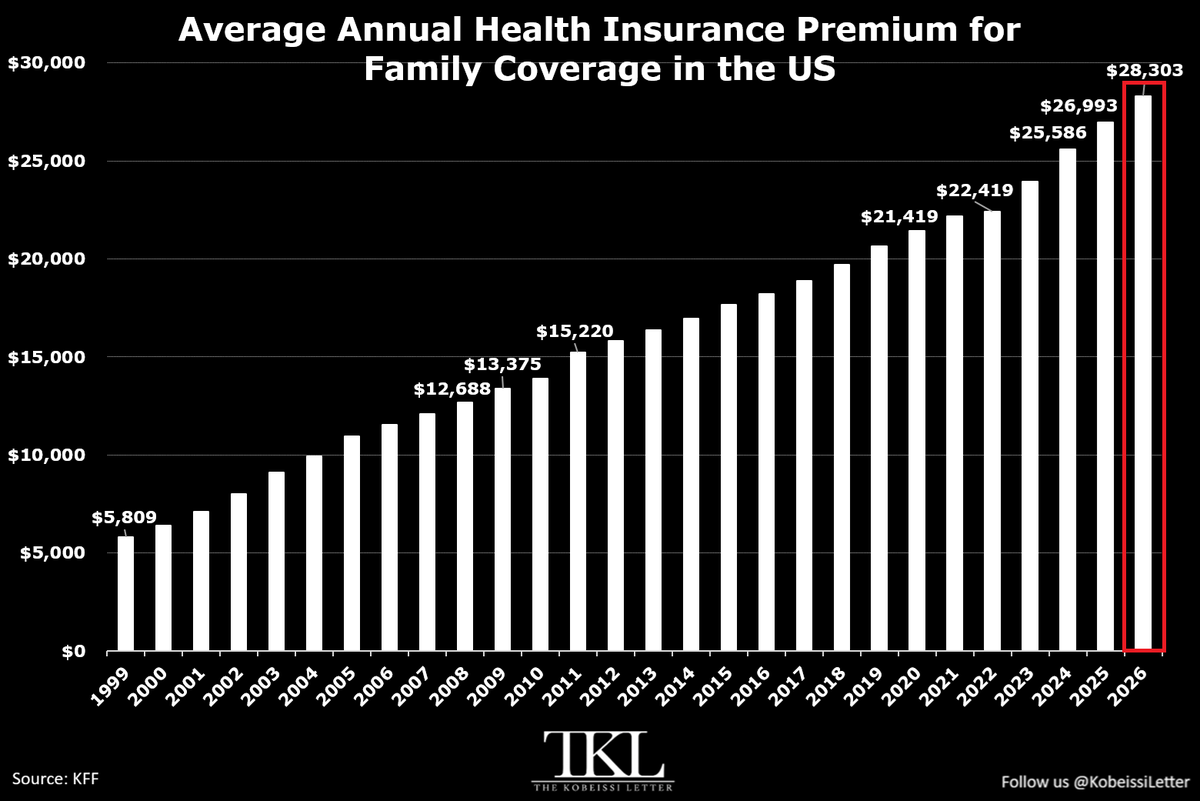
BREAKING: The average cost of a family’s annual health insurance premium in the US is up +$1,303 YoY, or +5%, to a record $28,303.
This marks the 4th consecutive annual increase of at least +$1,300.
Over this period, the average annual premium for family coverage has surged +$5,884, or +26%.
To put this into perspective, CPI inflation has risen +13% over the same period, or half as much.
Since 1999, the average health insurance premium for a family has soared +$22,494, or +387%.
This represents an average annual growth rate of +6.1%, well above CPI inflation at +2.6% over the same period.
Health insurance has never been more expensive.
@StockMKTNewz Leveraged ETFs aren't investments, they're daily bets that decay. $10K to $0.04 is the math working exactly as designed — never hold them.
@KobeissiLetter 27 years of chip deflation, reversed in one AI cycle. PPI +26% YoY isn’t a blip — it’s the cost of the buildout landing on every buyer downstream.
@stevenfiorillo Comparing $SOFI's growth to $HOOD only works if you adjust for the model — lending revenue and trading revenue behave nothing alike in a drawdown. Same growth rate, different risk.